Latest News
Allwyn Begins Next Phase of Retail Investment with New National Lottery PPOS Rollout Trial

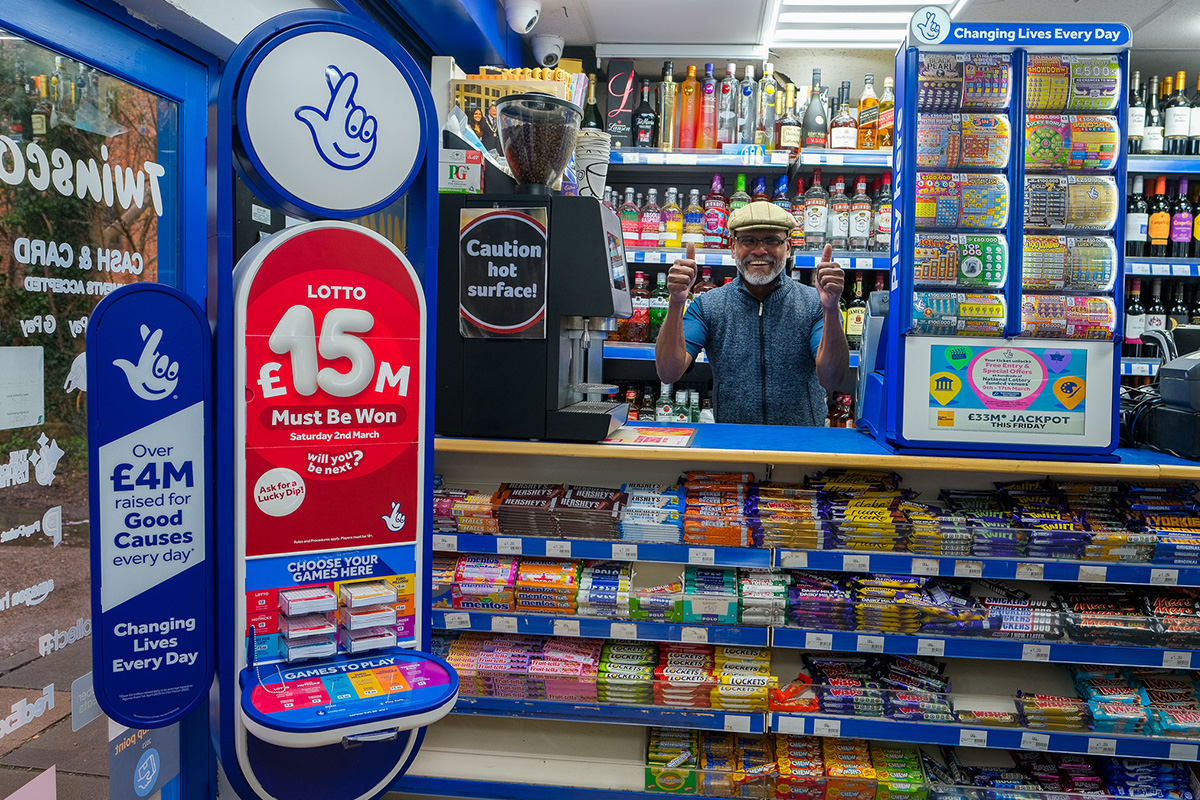
Brand new National Lottery permanent point of sale (PPOS) has started hitting the walls, floors and counter tops of a small number of National Lottery retailers over the last few weeks, as Allwyn begins testing the rollout of the specially designed kit at trial stores in preparation for wider distribution.
Designed in collaboration with accessibility and sustainability experts, the family of PPOS will help deliver more modern retail environments and capture the attention of customers with eye-catching branding and “call to action” messages, as well as giving National Lottery retailers for the first time the ability to display information about National Lottery-funded projects that are local to their store.
The suite of kit includes an attention-grabbing illuminated Scratchcard dispenser with integrated lighting and 15.6-inch HD screen, and a new Playstation with double-sided graphics and a wing to display key information – such as stories about local National Lottery-funded projects. Completing the collection are a new external wall sign and a double-sided pavement sign featuring a “call to action” to play in store, as well as a refreshed window poster frame. In most cases, these items will be swapped out on a like-for-like basis with a store’s existing kit – but larger or additional assets may be offered in certain circumstances.
Allwyn called on the expertise of its accessibility partner, Purple, and its sustainability partner, Planet Mark, in designing the new PPOS to help with its commitment to delivering a more sustainable and accessible National Lottery. For example, the height of the new Playstation tables has been standardised at a level recommended by Purple (750mm) which is considerate of wheelchair users – as has the Scratchcard dispenser media screen – while the playslips are set at a height within reach of wheelchair users. Graphics and signage, as well as the surfaces they sit behind, have also been designed to meet accessibility requirements.
In terms of sustainability, lightweight designs ensure that the kit and its transportation are carbon-efficient, while recycled and recyclable materials have been prioritised in the manufacture and deployment of the new PPOS – with some components made with 60-100% recycled materials.
The first independent retailer to have the kit installed as part of the “test and learn” trial, Raj Kularajah, owner of Twinsco store in St Albans, said: “I was delighted to be selected as the first independent store to have the new PPOS installed, and to be able to provide feedback on the equipment to help with the wider rollout. After it was first installed, two of my regular customers who had never played the lottery before saw the new kit and decided to play EuroMillions, which is absolutely excellent.
“I’m really impressed with the kit overall, particularly the new Playstation wing which can be fitted to either side of the stand depending on how the store is laid out and what space is available. But my favourite piece is the new Scratchcard dispenser which really brings to life and illuminates the individual games. Its bigger windows also make it easier to load with cards.”
Allwyn’s Director of Channel Operations Alex Green said: “We’re hugely excited that National Lottery retailers are starting to get their hands on this brilliant new kit as part of our ‘test and learn’ trial deployment. As well as looking fantastic, the new PPOS has been designed to high standards of accessibility and sustainability – demonstrating The National Lottery’s commitment to delivering wider societal benefits. We know retailers will be keen to get the kit as soon as possible, but it’s important we trial it first and use our findings to inform a more substantial phased rollout across our 40,000-strong estate. This will help us get the deployment absolutely right for our retail partners.
“The project to equip retailers with the very best National Lottery PPOS also represents the next stage of our investment in retail and signals our commitment to the channel as a whole, with retail being central to our vision to grow The National Lottery responsibly over the next 10 years. But equipping stores with the latest innovative kit is just one element of a much bigger overall project to build a more modern in-store environment. As part of this, we’ll also be delivering an enhanced Vodafone network solution for our retail partners from this spring, and installing new software from the summer onwards ahead of us starting to roll out new state-of-the-art terminals towards the end of the year.”
The next phase of the PPOS rollout will see the new kit deployed in around 40 stores by the end of May, with another 10,000 outlets scheduled to receive the new PPOS later in the year. The kit will then be rolled out to the remainder of the estate throughout the autumn and into 2025.
The post Allwyn Begins Next Phase of Retail Investment with New National Lottery PPOS Rollout Trial appeared first on European Gaming Industry News.












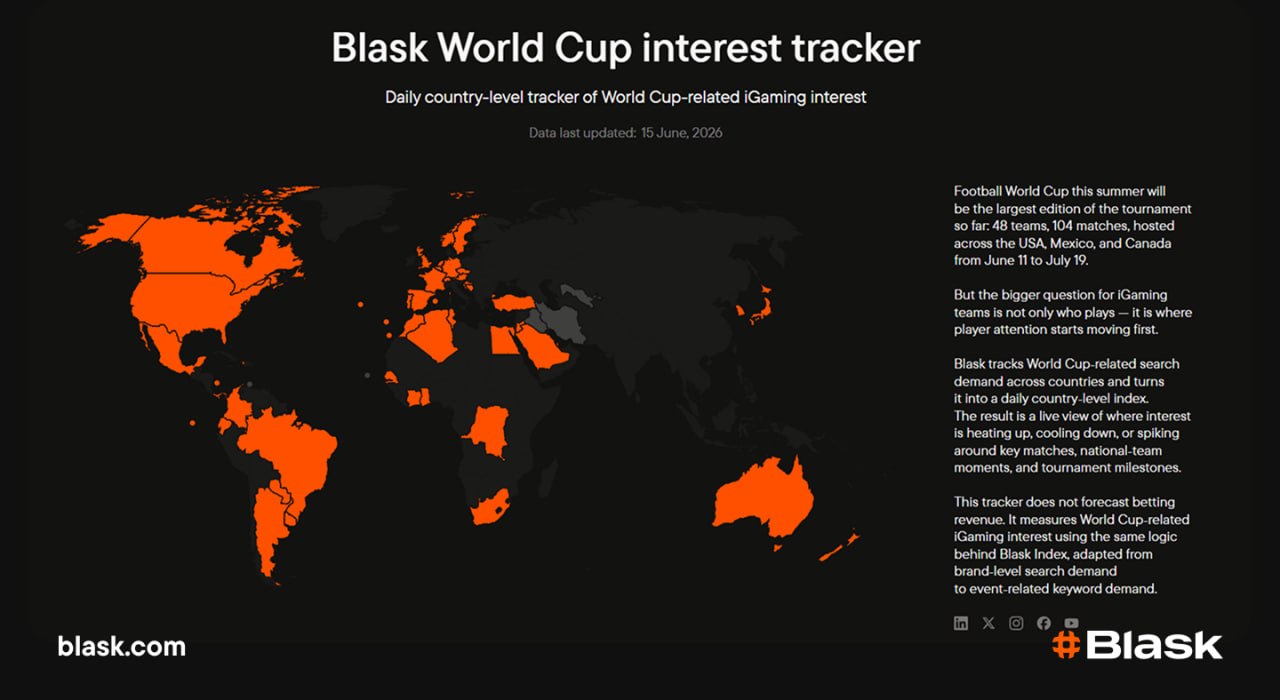
Blask has launched the Blask World Cup Index, a free interactive map showing daily interest across the majority of the 48 nations competing in the 2026 tournament. It runs for the duration of the competition.
Blask updates the map every 24 hours. Countries where interest towards the major football tournament grows over the previous day turn green. Countries where it fell turn red. Unchanged markets stay grey. Hover over any country for a quick snapshot, click through for a multi-day view, or follow the leaderboard of the fastest-rising and falling markets.
What the Blask World Cup Index measures
Blask World Cup Index draws from the Blask Index, Blask’s measure of iGaming search volume within a given market. On the landing page it tracks football related categories: how actively people in each country are searching for odds, match markets and other football-related content tied to the 2026 tournament.
Country cards show day-by-day trends; a daily leaderboard surfaces the daily World Cup Index and its change with the previous day. Visitors can track how interest in their country builds in the days before their team’s next match and how fast it collapses after an exit. The leaderboard shows which nation leads the index and how that position shifts with results. For operators and affiliates, the most actionable view is a market where interest is growing faster than the team’s performance would predict — the signal that precedes a volume spike.
After a 4-1 victory over Paraguay, the United States leads our World Cup Interest Index with 14.4 million demand points — more than three times ahead of second-placed Brazil (4.28 million), despite the Seleção’s global popularity. Germany sits third with 3.15 million following a 7-1 win over Curaçao, while England (2.53 million) and Egypt (2.22 million) round out the top five ahead of their opening group-stage matches.
To put the 2026 data in context, Blask has published two research reports drawing on iGaming activity across the 2018 and 2022 World Cups — one covering six European markets (UK, Germany, France, Spain, the Netherlands, Italy), one covering six LATAM markets.
The data shows the effect is not automatic: Germany posted positive acquisition signals at both tournaments despite group-stage exits; Peru surged +41% in 2022 without qualifying; Colombia fell 14% the same year.
Both reports include country-level APS data, cross-market patterns, and 2026 projections.
The post New Blask heatmap tracks real-time interest across World Cup 2026 nations appeared first on EE Gaming | Global iGaming & Tech Intelligence Hub.
Ani Isakhanyan Head of Rights and Content at FeedConstruct
FeedConstruct adds Ecuador’s Liga Básquet Pro to global basketball rights


Supplier takes exclusive worldwide streaming and data rights for all matches in Ecuador’s top men’s league.
FeedConstruct has acquired the exclusive worldwide streaming and data rights for all matches of the Liga Básquet Pro, Ecuador’s premier men’s basketball competition.
The deal adds another Latin American basketball property to FeedConstruct’s rights portfolio, as the supplier positions its content for sportsbook customers seeking additional live betting inventory.
“This partnership with FeedConstruct marks a decisive step in the international projection of Ecuadorian basketball,” said Enrique Zeballos Márquez, President of Liga Básquet Pro. “Working with a global leader in sports media and data rights allows us to maximise the value of our competition, safeguard the integrity of its data, and bring it to new audiences worldwide.”
Ani Isakhanyan, Head of Rights and Content at FeedConstruct, said: “We are excited to expand our regional basketball portfolio with the addition of Liga Básquet Pro. With its passionate fan base and strong competitive profile, the league brings valuable content opportunities to our network of more than 100 operators worldwide.”
FeedConstruct said the acquisition supports its continued expansion across emerging betting markets and strengthens its basketball rights offering.
The post FeedConstruct adds Ecuador’s Liga Básquet Pro to global basketball rights appeared first on EE Gaming | Global iGaming & Tech Intelligence Hub.
Ani Isakhanyan Head of Rights and Content at FeedConstruct
FeedConstruct Adds Ecuador’s Liga Básquet Pro to Its Global Basketball Rights Portfolio


FeedConstruct has acquired the exclusive worldwide streaming and data rights for all matches of the Liga Básquet Pro, Ecuador’s premier men’s basketball competition.
Latin America continues to emerge as a fast-growing market for the sports betting industry, with basketball playing an increasingly important role in regional engagement. The Liga Básquet Pro has helped elevate the sport’s visibility in Ecuador while building a passionate local fan base. With its growing commercial appeal and competitive matchups, the league continues to strengthen its position within the Latin American basketball ecosystem.
The addition of the competition enables sportsbooks to deliver consistent and engaging basketball content to bettors while benefiting from favorable regional time zones that support increased betting activity and stronger player engagement.
“This partnership with FeedConstruct marks a decisive step in the international projection of Ecuadorian basketball,” said Enrique Zeballos Márquez, President of Liga Básquet Pro. “Working with a global leader in sports media and data rights allows us to maximise the value of our competition, safeguard the integrity of its data, and bring it to new audiences worldwide.”
Ani Isakhanyan, Head of Rights and Content at FeedConstruct, commented: “We are excited to expand our regional basketball portfolio with the addition of Liga Básquet Pro. With its passionate fan base and strong competitive profile, the league brings valuable content opportunities to our network of more than 100 operators worldwide.”
The acquisition further strengthens FeedConstruct’s basketball rights portfolio and supports the company’s continued expansion across emerging betting markets worldwide.
The post FeedConstruct Adds Ecuador’s Liga Básquet Pro to Its Global Basketball Rights Portfolio appeared first on Americas iGaming & Sports Betting News.

-

 Latest News7 days ago
N1 Partners x RAZE Case: ROI+ in Canada within 3 Days
-
Canada7 days ago
N1 Partners x RAZE Case: ROI+ in Canada within 3 Days
-
Balkans6 days ago
EGT Digital signs sponsorship deal with CSKA Sofia
-
Genius Sports4 days ago
LIGA MX and Polymarket Announce Sponsorship Agreement for the US Territory with Official Data and Integrity Collaboration from Genius Sports
-
Booming Games5 days ago
Booming Games launches Ronaldinho’s Streetball Bonanza slot
-
BMM Testlabs7 days ago
BMM Innovation Group confirms Perú Gaming Show presence in Lima
-
AI5 days ago
BetConstruct AI sets Peru Gaming Show 2026 showcase around live World Cup betting
-
Africa6 days ago
Playson launches online casino games in Nigeria via BetKing deal