Latest News
Women in Esports launches women-only tournaments with FACEIT and separate community Discord

The British Esports Association, the not-for-profit organisation set up to promote and support grassroots esports, has partnered with FACEIT, the world’s leading platform for competitive online gaming, as part of its ongoing Women in Esports initiative.
Women in Esports will have its own organiser page on FACEIT and will create women-only tournaments and hubs. The Women in Esports initiative aims to create a welcoming community which encourages more women (including trans and cis women) and femme identifying/femme presenting non-binary players to take part in esports tournaments at any level.
Women-only tournaments are viewed by Women in Esports as a stepping stone to give women more confidence and experience to then aim for further involvement in other tournaments (mixed or otherwise) in the future.

The organiser page will initially focus on Counter Strike:Global Offensive (CS:GO) as the first title for tournaments and hubs, primarily due to the fantastic female community prevalent on FACEIT for this title. The variety of tournaments and hubs will later expand with future pilots for other titles.
The first 5v5 CS:GO tournament, The Lioness League, will open for registrations on Friday November 27th and occur on Saturday December 12th. There will be a max of 32 teams in a single elimination bracket. Participants will be able to join as a premade team or join as a solo player and form a team. The prize will be 3000 FACEIT points: 2000 points for the winning team, and 1000 points for second place. This will be the start of regular monthly tournaments.
Our CS:GO hub will enable players to create teams and scrim against each other. The hubs will be private by application, open to women (including trans and cis women) and femme identifying/femme presenting non-binary players to join.
Women in Esports has also created its own separate community Discord server to further its aim of providing an inclusive community space. The server will be public and open to everyone, with many social channels, announcements, an industry section, along with specific tournament chat. It will be vetted, moderated and constantly updated as per feedback and changes in line with the initiative.
“We’re delighted to partner with Women in Esports, a team that shares our passions and values. FACEIT is committed to developing grassroots opportunities and supporting the community. We want everyone to feel comfortable and confident when taking their first steps into esports and we’re hoping this hub will offer a safe space for women to come together and compete,” said Sue Lavasani, Account Manager at FACEIT.
Alice Leaman, Schools and Colleges Liaison Officer at British Esports, said: “Through Women in Esports we aim to build a community and encourage more women to get involved in the industry. By partnering with FACEIT we can start to develop more regular tournaments and opportunities for all skill levels and the creation of a community Discord will provide a dedicated space for diversity in esports to be celebrated.”
Powered by WPeMatico


NetBet, a leading online gaming platform, has announced an exciting new partnership with world-renowned boxing & MMA podcast the Fight Disciples, co-hosted by award-winning broadcasters Adam Catterall and Nick Peet.
The partnership will span some of the UFC’s biggest events, including Max Holloway vs. Dustin Poirier at UFC 318, as well as major upcoming boxing bouts.
This partnership builds on NetBet’s recent announcement as the official betting partner of the UFC in the UK and other parts of Europe. It will play a key role in boosting visibility for NetBet’s popular UFC Predictor Game. As part of the collaboration, NetBet branding will feature across all Fight Disciples UFC content, including behind-the-scenes access and exclusive fighter interviews.
Part of this deal will also see the Fight Disciples and NetBet team up to provide all-encompassing coverage for three huge upcoming boxing fights; Oleksandr Usyk vs Daniel Dubois, Katie Taylor vs Amanda Serrano and Saul ‘Canelo’ Alvarez vs Terrance Crawford.
Adam Catterall, co-host of the Fight Disciples Podcast, said: “We’ve always prided ourselves on being the voice of the fight fan, so teaming up with NetBet – the official sportsbook and betting partner of the UFC – is a massive moment for us. This partnership gives us the opportunity to get even closer to the action and, more importantly, bring our audience along with us. Whether it’s behind-the-scenes insight, exclusive content, or on-the-ground access at the biggest events, it’s all about delivering that front-row feeling to our listeners.”
Tristan Wootton, Head of UK at NetBet added: “With NetBet making huge waves in the world of fight sports, this partnership with the Fight Disciples represents another exciting opportunity with regard to brand development. We feel confident that our players will enjoy the engaging content produced from this partnership, with so many brilliant UFC and boxing shows just on the horizon!”
The post NetBet Partners with Fight Disciples appeared first on European Gaming Industry News.
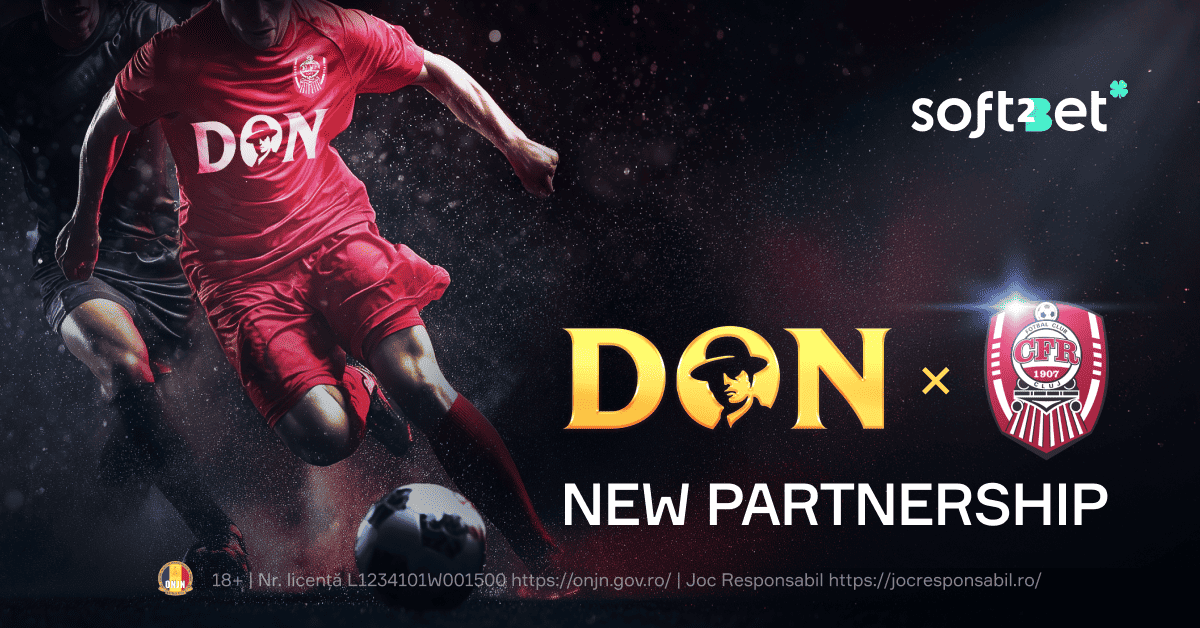
Soft2Bet continues its strategic expansion in Romania through its rapidly growing online entertainment brand, Don.ro, which has entered a multi-year agreement as the main sponsor of CFR 1907 Cluj, one of Romania’s leading football clubs.
Beginning with the 2025-26 Liga 1 season, leading Romanian brand Don.ro’s logo will feature prominently on CFR Cluj’s home and away kits, training gear, and throughout the “Dr. Constantin Rădulescu” stadium. The partnership with CFR Cluj also includes a slate of live and digital activations powered by Soft2Bet’s innovative platform, designed to deepen fan engagement.
“We are excited to announce our partnership with Don.ro, a Romanian brand that shares our values of performance, professionalism, and the desire to build something lasting. The fact that Don.ro is becoming the main partner of our club is both a validation of the work we do every day and an important step in strengthening CFR Cluj’s image both nationally and internationally.
We are pleased to have a dynamic partner by our side, one with a modern vision who believes in the power of sport to inspire and bring people together. Moreover, Don.ro has chosen to offer each season ticket holder this season an official jersey — a gesture of appreciation for the passion and loyalty with which they support us.” — Cristian Balaj, CFR Cluj President.
The partnership between Soft2Bet and CFR Cluj brings together Don.ro’s award-winning online gaming brand and a club with a rich history of success, including eight league titles, four Romanian Cups, and four Super Cups. Both sides are driven by a commitment to high performance, bold ambition, and fresh ideas, which makes this collaboration especially well-aligned.
“We are honored to join the CFR Cluj family, a symbol of excellence in Romanian football. This partnership reflects the shared values that bring us together — performance, responsibility, and respect for the community.
At Don.ro, we are committed to promoting a safe and balanced entertainment environment, and through our collaboration with CFR Cluj, we aim to deliver a strong message about the importance of responsible play, both on and off the field.” — Marius Mirasovici, Official representative of Don.ro brand
The partnership is designed to deliver real value to Don.ro’s players and the wider local community. With Soft2Bet’s backing, Don.ro will launch a range of activations tailored to Romanian audiences, such as exclusive match-day experiences, localised campaigns, community events, and responsible gaming initiatives, bringing fans closer to the action and rewarding their loyalty in meaningful ways.
Oksana Tsyhankova, Chief Marketing Officer at Soft2Bet, highlighted: “At Soft2Bet, we excel in building powerful and award-winning brands that forge deep connections with players through localised experiences. Don.ro’s partnership with CFR Cluj embodies this vision,combining a top-performing club with our drive for tailored gamified experiences, product excellence, and a passion for performance.”
Launched in 2024 and recognised as “Best Launch of the Year” at the 12th Meeting of Gambling Professionals, Don.ro delivers over 3,484 casino games, a full live-dealer lineup, and a complete sportsbook. The platform runs on Soft2Bet’s proprietary MEGA (Motivational Engineering Gaming Application) technology, which enhances player engagement through mission-based features and in-game challenges.
The post Soft2Bet’s brand Don.ro Becomes Main Sponsor of CFR Cluj in Multi-Year Agreement appeared first on European Gaming Industry News.

Here are this weeks latest slots releases compiled by European Gaming
PG Soft has served up a classic slot with its Diner Frenzy Spins. This is a 5-reel, 4-rows video slot featuring connecting ways and sticky symbol respins. Diner Frenzy Spins is set within a vibrant, retro-futuristic diner with a buzzy atmosphere thanks to a playful soundtrack. During any spin, the Mystery Respin may be randomly triggered while the reels are spinning.

ELA Games calls back to a classic yet luxurious gaming experience with its new title, Juicy Crystal. The game offers a unique and modern twist on the beloved and familiar fruit machine format, featuring timeless symbols and rich visuals. The studio’s trademark attention to detail and quality delivers a game that’s exciting, memorable and elegant.

Amusnet presents its newest Online Casino portfolio expansion – a royal-themed slot filled with exciting bonus features. The release adds to the fun of the player-favourite Extra Crown game series, this time with six reels and 100 paylines, top-notch graphics and a vibrant soundtrack. A total of 11 symbols are scattered across the now six reels and 40 fixed paylines, along with some special features that make the gameplay more engaging and fun.

Play’n GO illuminate their classic Moon Princess universe once more with Moon Princess Stargazing, a grid slot set among icy stars and rising multipliers. Set beyond Neptune in the icy reaches of the Kuiper Belt, Moon Princess Stargazing marks a radiant new chapter in one of Play’n GO’s most celebrated series. Players reunite with Star, Nova and Astra – the celestial trio whose powers help forge constellation connections and unlock sky-high wins.

Step into the golden sands of Ancient Egypt with Ra’s Relics Bonanza, a thrilling 6×5 cascading slot adventure from Booming Games! Land 8 or more matching symbols anywhere on the reels to secure a win, as winning symbols vanish and new ones tumble down, unlocking endless chances for treasure. Keep an eye on the Divine Scarab, collecting scatter symbols throughout the base game and triggering Free Spins at any moment.

The post Week 27/2025 slot games releases appeared first on European Gaming Industry News.

-
 AGCO7 days ago
AGCO Fines Great Canadian Casino Resort Toronto $350,000 for Serious Regulatory Violations Linked to Impromptu After-Party on Gaming Floor
-

 Africa7 days ago
ALA Hosted Seminar on Artificial Intelligence and Cybersecurity
-
Canada7 days ago
IGT and Atlantic Lottery Sign Eight-Year Video Lottery Central System Technology Agreement
-
Africa6 days ago
DRC Signs MoU for Public-Private Partnership with Burundi’s East African General Trade Company
-
First7 days ago
FIRST and Genius Sports Extend Landmark Data Partnership, Powering Continued Growth
-
Blokotech7 days ago
Blokotech unveils Cristian Tonanti as new Casino Partnership Manager
-
Brazil7 days ago
Esportes da Sorte holds forum on “Integrity in Sports” with Ceará and Náutico
-
Latest News7 days ago
Unlock Top-Tier Deals and Careers: Parimatch joins iGB L!VE 2025