Connect with us

Kalshi

Blask: US prediction market demand rises 5x since August 2025

Published

on

blask:-us-prediction-market-demand-rises-5x-since-august-2025

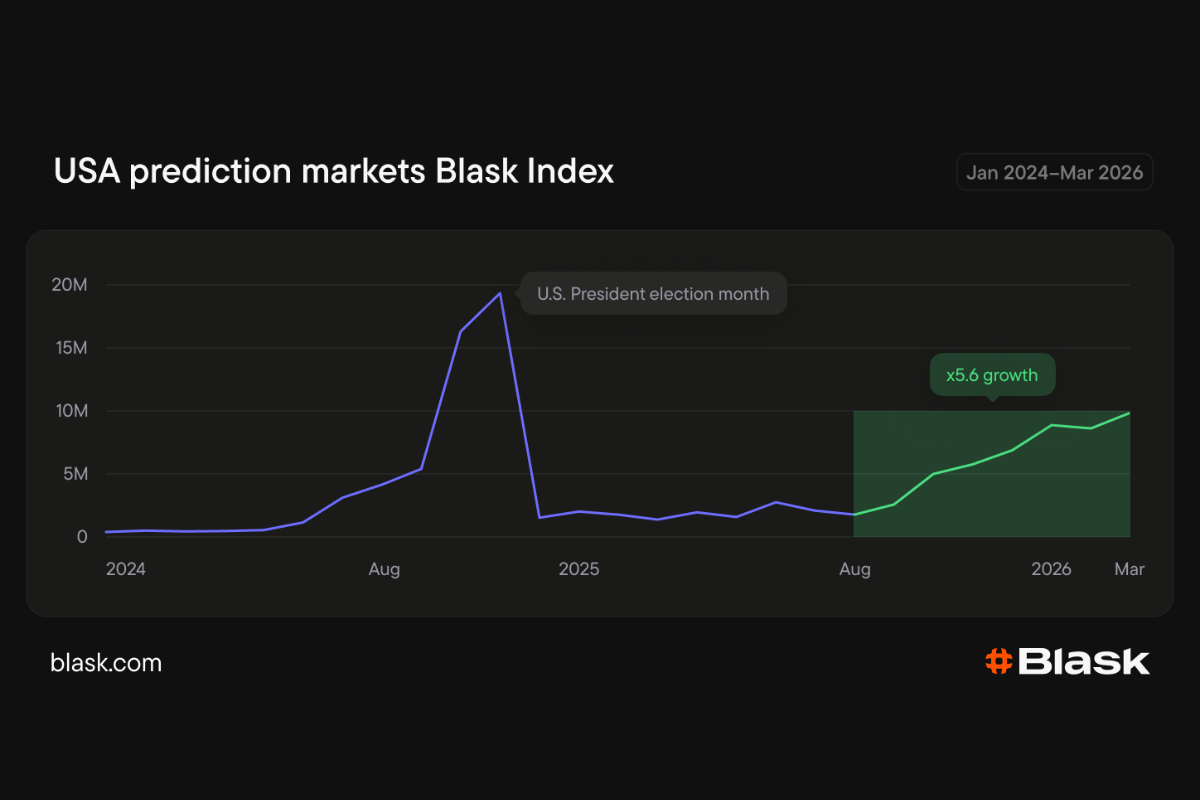
Branded demand for prediction markets in the United States has increased more than fivefold since August 2025, according to new data from Blask. The company said the rise has been sustained over eight consecutive months and comes without a single major macro event driving the category.

Blask said current demand remains about 49% below the all-time high recorded during the November 2024 US election cycle, which it described as a spike “largely driven by a single, high-impact event.” The current pattern, by contrast, suggests steadier engagement rather than an event-led surge.

The competitive landscape is increasingly concentrated. As of March 2026, Polymarket and Kalshi jointly account for around 94% of all branded demand in US prediction markets, Blask said, with both platforms gaining share during the expansion.

At the state level, Blask reported wide swings in the balance between the two leaders. Kansas is the most lopsided, with Polymarket at 95.5% of branded demand versus Kalshi’s 3.5%. Louisiana is closest, with Polymarket at 59% and Kalshi at 35.3%. Blask said California leads overall demand with 15.9% of total US branded demand, followed by New York at 10.8%.

Outside the top two, the rest of the market accounts for about 6% of branded demand, Blask said. Myriad holds under 1%, while Robinhood is the fastest-growing name tracked, with a year-over-year increase of +983.4% but a 0.24% share.

Alongside the data, Blask said it has launched a dedicated prediction market analytics feature to let operators track demand, competitive positioning and regional distribution in real time.

The post Blask: US prediction market demand rises 5x since August 2025 appeared first on Eastern European Gaming | Global iGaming & Tech Intelligence Hub.


Coinbase

Wisconsin DOJ Sues to Stop Alleged Illegal Sports Betting Operations in Wisconsin

Published

on

wisconsin-doj-sues-to-stop-alleged-illegal-sports-betting-operations-in-wisconsin


The Wisconsin Department of Justice (DOJ) has announced that it is suing Kalshi, Robinhood, Coinbase, Polymarket, Crypto.com, and their affiliates, to halt their alleged facilitation of illegal sports betting, a form of unlawful commercial gambling, in Wisconsin.

“Thinly disguising unlawful conduct doesn’t make it lawful. These companies’ alleged facilitation of sports betting in Wisconsin should be shut down,” said AG Kaul.

Except in limited circumstances, sports betting and other forms of commercial gambling have long been illegal in Wisconsin. Yet, as alleged in these lawsuits, the defendant companies have chosen to flout Wisconsin law through disguising the sports betting they facilitate on their online platforms as “event contracts,” which pay out just like ordinary bets based on the odds of sports-related outcomes.

The complaints further allege that the companies collect a fee for every bet made, meaning they generate revenue from Wisconsinites by violating the state’s gambling laws. Kalshi, as one example, reportedly generates more than $1 billion in annual revenue from its sports contracts, representing around 90% of its total estimated annualized revenue.

As the complaints allege, by making money from the sports bets they facilitate, these companies are engaging in unlawful gambling activity.

Wisconsin DOJ’s lawsuits, filed on last Thursday in Dane County, request a declaration that, by making sports-related event contracts available for trading by customers located in Wisconsin, the defendant companies are violating Wis. Stat.§945.03(1m) and thereby creating a public nuisance. The lawsuits additionally request preliminary and permanent injunctions enjoining and restraining the defendant companies from making sports-related event contracts available for trading by customers located in Wisconsin.

The post Wisconsin DOJ Sues to Stop Alleged Illegal Sports Betting Operations in Wisconsin appeared first on Americas iGaming & Sports Betting News.

Continue Reading

Betnacional

Brazil: Betting pressures household budgets and reshapes the competition for consumer spending

Published

on

brazil:-betting-pressures-household-budgets-and-reshapes-the-competition-for-consumer-spending

As the industry prepares for BiS SiGMA South America 2026, the largest and most influential iGaming event in Latin America, real market data begins to reveal a profound transformation in the behavior of the Brazilian consumer.

It is no longer just about “betting volume”, but about a reconfiguration of the Share of Wallet (participation in household spending).

The unprecedented study “Bets na Mesa, Consumo em Jogo”, carried out by NielsenIQ Brazil, sheds light on a reality that will be the center of technical debates at the Transamerica Expo Center: in 2025, 26.3% of Brazilian households participated in some form of betting.

This figure is not just a number; it is the reflection of a “new parallel shopper journey” that is capturing the attention and income of the population.

Radiography of Consumption: Who and what is being bet?

The Brazilian market in 2026 shows a clear fragmentation.

Despite the explosion of digital platforms, traditional modalities maintain notable resilience, creating a hybrid ecosystem between analog and digital.

Dominant Modalities

According to the NielsenIQ study, preferences are distributed as follows:
• Mega-Sena: 15.8% of households.
• Video Slots (such as the “Jogo do Tigrinho”): 7.7%.
• Jogo do Bicho: 3.9%.
• Sports Betting (Bets): 3.6%.

Socioeconomic and generational profiles in Brazil

The study reveals that bettors are not a homogeneous group. There is a marked division by Socioeconomic Level (SEL) and age:

• The Slots phenomenon: The “Jogo do Tigrinho” concentrates bettors from middle SEL (63.3%) and a notably young audience, with 42.4% of bettors up to 35 years old.

• The maturity of Mega-Sena: It predominates in high SEL (45.5%) and in a more mature profile, where 49.1% are over 51 years old.

As Gabriel Fagundes, Insights Leader for the Industry at NielsenIQ, points out: “We had already identified that betting became a popular and common practice in the routine of the Brazilian consumer.”

“Now, the numbers also point to the dimension that this practice is taking within household expenses and in the income of bettors.”

The Economic Motivation: Extra Income or Entertainment?

One of the most critical points for operators that will meet at BiS SiGMA is to understand the “why” behind betting.

The data from 2026 shows a diffuse frontier between gambling as leisure and gambling as economic hope.

For 49% of bettors, the main motivation is to obtain extra income, while 43.5% expect a “radical change of life”.

This second profile is more common in casual Mega-Sena players.

Classification by Intensity

The market is divided into three levels of commitment:

  1. Casual (73%): They play at least once a month.
  2. “Pro” (28%): They bet once a week. From this group, 65.8% seek extra income.
  3. “Elite” (9.3%): They bet weekly and spend more than R$ 100 per month.

This “gaming intensity” is, according to the study, the real driver of the economic impact on households, especially in the Northeast regions (29% penetration) and South (28.3%).

The Impact on Retail and the Consumption Basket

For the iGaming industry, understanding which expenses are being substituted is vital for sustainability and social responsibility.

The study reveals that only 10% of households admit substituting expenses directly for betting, but the affected categories are alarming.

Affected Categories

Among those who substitute expenses:
• Food: 47% of the cases.
• Fixed bills (water, electricity, internet): 45.3%.
• Beer: It is the category with the greatest retraction, registering a drop of 1.7 percentage points in the participation of spending.
• Cookies, perfumes and soft drinks: They also present negative impacts.

The main strategy of the consumer to accommodate spending on betting has been to reduce the quantity of items purchased; in fact, 60% of the consumption categories registered a decrease in the volume acquired in 2025.

Strategic Challenges for the Legal Market in 2026

The NielsenIQ data presents a direct challenge for brands and operators that seek to consolidate themselves in “Legal Brazil”.

The pressure on the domestic budget forces manufacturers of fast-moving consumer goods (FMCG) and betting operators to compete for the same currency.

Betting is a new competitor in the consumer’s Share of Wallet.

This pressures manufacturers to act with more precision in communication, price and activation to recover relevance in front of this new competitor: the habit of betting itself.”

Towards BiS SiGMA 2026

As we approach the largest event in the region, this study serves as a warning and an opportunity. The Brazilian market of 2026 is mature, but it is under intense social scrutiny due to the impact on low-income families.

Operators that wish to have long-term success must:

  1. Differentiate the profiles: It is not possible to treat the young middle SEL slot player the same as the high SEL Mega-Sena bettor.
  2. Promote Responsible Gaming: The substitution of food and fixed bills for betting is a regulatory “red flag” that could tighten laws in the near future.
  3. Regional Innovation: The Northeast and the South are the markets with the highest intensity, requiring more aggressive localization strategies.

BiS SiGMA South America will be the perfect stage to discuss how the industry can grow without compromising the economic stability of Brazilian households, ensuring that iGaming is seen as entertainment and not as an unsustainable financial burden.

Superscore consolidates in Brazil and launches weekly analysis for the press.

The platform offers statistical analysis of the Brazilian Championship and of the main national and international championships, such as the Copa Libertadores, the World Cup and the Champions League, among others, with metrics that go beyond goals and assists for fans and sports experts.

Superscore Insights is the new newsletter for the press, with a weekly publication and another analysis of the latest news.

Superscore, a sports intelligence application associated with Superbet, advances and consolidates itself in Brazil as a strategic platform to transform data into reliable information for football fans in real time and without advertising.

With its own methodology, the solution establishes itself as a reference among sports fans, bringing together advanced statistics, rankings and in-depth analysis of the main tournaments, players and coaches in the country.

Now, the platform takes a new step with the launch of Superscore Insights, expanding its collaboration with the press by offering even more solid analysis, contextualized data and specialized support for sports coverage.

On Mondays, journalists will receive an exclusive bulletin with deep and original analysis of the weekend matches, a specialized analysis of the most important events of the day, as well as predictions and statistics of upcoming events.

With global coverage, Superscore already gathers more than 1,900 competitions, 63,000 teams and more than 480,000 monitored players, offering a solid base for historical and real-time analysis.

The data from Superscore comes from leading partners worldwide in the collection and distribution of sports data, the same ones used by Superbet and the main companies in the sector.

These providers offer high precision, low latency and comprehensive coverage of competitions worldwide.

Superscore was born as a free sports intelligence application, without advertising, that goes beyond the basics by offering a wide database and statistics for those who want to understand the game in depth.

 In just one year, it has already achieved thousands of users and grows approximately 30% monthly, climbing positions in the Google Play ranking.”

The platform offers a solid experience for both fans and professionals, in addition to facilitating more informed decisions in sports betting, thus reinforcing the commitment to responsible gaming,” states Patrícia Prates, Marketing Director of Superbet and of the alliance with Superscore.

Superscore: Exclusive data and decades of history

In a context where sports coverage increasingly requires qualified data and contextualization, Superscore distinguishes itself by going beyond traditional indicators, incorporating metrics such as accurate shots, passes in the offensive third, tackles, recoveries, participation in decisive plays and time on the field, among other indicators.

These data are translated into the Superscore Score, a proprietary index that allows building Top 5 or Top 10 rankings of the best players of each round, with graphical visualizations and quick analysis.

Another differentiating factor is the expanded historical database, which gathers information from the Brazilian Championship since 1937, the Copa Libertadores since 1960 and the Champions League since 1992, which allows comparative analysis and identifying patterns over decades.

We are talking about a platform built on a solid technological base, which combines a large volume of unique data, history and a team prepared to transform this information into relevant content for football fans.

Superscore organizes and translates these data so that they can also be used in sports coverage,” states Guilherme Simantob, director of Superscore in Brazil.

Superscore offers free and integrable widgets for the press and content creators, facilitating the incorporation of statistics, graphics and comparisons directly into articles, enriching journalistic narrative with reliable and visually accessible data.

The app is available in the App Store and Google Play.

Reevo arrives in Brazil with Betsson

Reevo has expanded its presence in Latin America after launching its aggregation platform and its own games catalog in Brazil in collaboration with Betsson.

The integration, carried out through a single connection, allows the operator to expand its content offering with Reevo’s own titles and third-party titles.

The movement reinforces the alliance between both companies and is part of a growth strategy in regulated markets, especially Brazil, considered one of the most promising in the region after regulatory advances.

From Betsson, Andrea Rossi highlighted the impact of the agreement by stating that the incorporation of Reevo’s content “expands the entertainment offer available for our players in one of the fastest-growing markets in the region.”

Additionally, both companies anticipated new joint expansions in other markets, after a recent launch also in Mexico.

Reevo continues to bet on its aggregation model as a way to facilitate access to multiple studios through a single integration, while expanding its global distribution network.

BTG launches prediction platform and increases the dispute between banks, stock exchange and betting

The launch of BTG Trends by BTG Pactual marks a new chapter in the growth of prediction markets in Brazil, intensifying competition between banks, the stock exchange and the betting sector.

This new platform allows investors to operate binary contracts (“yes” or “no”) based on probabilities about financial events, such as the dollar, the Ibovespa or interest rate decisions, using already regulated derivative instruments.

The movement is not isolated. The Brazilian stock exchange (B3) also advances in this direction, with the development of financial event contracts and digital derivatives, although restricted to professional investors.

At the same time, the platform XP established a partnership with Kalshi, facilitating access for Brazilian investors to international predictive markets, while new startups such as VoxFi explore broader applications, including geopolitics and culture.

At a global level, these markets have gained relevance and volume, driven by platforms such as Polymarket and Kalshi.

However, their regulation continues to be a subject under debate. In the United States, the CFTC considers these contracts as financial derivatives, although discussions still exist about limits and risks, especially in sensitive events.

In Brazil, authorities, including the CVM and the Secretariat of Prizes and Betting, are already analyzing how to frame these activities from a regulatory point of view, especially when they overlap with sports events.

The advance of these products has also generated reaction from the betting sector.

The Brazilian Institute of Responsible Gaming (IBJR) maintains that, when there is money involved in uncertain events, it is essentially betting, regardless of the format, and warns about risks such as unfair competition and lower consumer protection if they operate outside the regulated framework.

The main difference between betting and prediction markets lies in their structure: in betting, the user plays against the house, while in prediction markets prices are formed among participants and reflect collective probabilities.

Even so, the boundary between both models remains diffuse.

With banks, stock exchange and new platforms advancing simultaneously, prediction markets stop being an emerging trend and become a new field of dispute within the financial system.

The regulatory framework is still under construction, and the evolution of the sector will depend on how the limits between investment and betting are defined as these products scale.

The post Brazil: Betting pressures household budgets and reshapes the competition for consumer spending appeared first on Americas iGaming & Sports Betting News.

Continue Reading

ANJL

Apuestas en Brasil: la regulación enfría el boom de patrocinios en el fútbol

Published

on

apuestas-en-brasil:-la-regulacion-enfria-el-boom-de-patrocinios-en-el-futbol

Tras un año bajo su nuevo marco regulatorio, el mercado de apuestas de Brasil comienza a dejar atrás su fase inicial de expansión.

Los operadores están recalibrando sus estrategias de marketing, los reguladores intensifican la supervisión y surgen nuevas cuestiones regulatorias.

La industria regulada de apuestas en Brasil continúa evolucionando rápidamente mientras el país atraviesa el primer año completo de su nuevo marco legal para las apuestas de cuota fija.

Los acontecimientos recientes en torno a los patrocinios en el fútbol, los debates sobre publicidad y el fortalecimiento de la supervisión regulatoria muestran cómo el mercado está pasando de su fase inicial de crecimiento acelerado hacia un ecosistema más maduro y consolidado.

Aunque el sector sigue siendo uno de los más prometedores del panorama global del iGaming, los operadores ahora enfrentan mayores costos regulatorios, una competencia creciente y un escrutinio cada vez más intenso por parte de los responsables políticos.

En conjunto, estas dinámicas están comenzando a redefinir la forma en que las empresas de apuestas operan —y cómo invierten— en el mayor mercado de América Latina.

El auge de los patrocinios en el fútbol comienza a enfriarse

Quizás la señal más visible de la transformación de la industria pueda observarse en el fútbol brasileño.

En 2025, las empresas de apuestas dominaron los acuerdos de patrocinio en el Campeonato Brasileño de la Serie A.

Dieciocho de los veinte clubes que competían en la primera división del país tenían operadores de apuestas como patrocinadores principales en sus camisetas, reflejando las agresivas estrategias de marketing que siguieron a la apertura del mercado regulado de apuestas en Brasil.

Sin embargo, el panorama para la temporada 2026 es notablemente diferente.

Seis clubes —Santos, Vasco da Gama, Bahia, Internacional, Grêmio y Coritiba— han rescindido o no han renovado recientemente sus acuerdos de patrocinio con operadores de apuestas.

Los cambios ocurrieron entre finales de 2025 y el inicio de la nueva temporada.

Cada caso tiene su propia explicación.

Internacional y Grêmio rescindieron sus contratos con Alfa Bet tras reiterados retrasos en los pagos.

Santos y Bahia acordaron de forma amistosa finalizar sus asociaciones con 7K Bet y Viva Sorte Bet, respectivamente.

Mientras tanto, Vasco y Coritiba simplemente dejaron expirar sus acuerdos con Betfair y Reals Bet.

Entre estos clubes, solo el Santos logró cerrar un nuevo acuerdo con otra casa de apuestas.

Sin embargo, el nuevo contrato representa, según se informa, una reducción de aproximadamente un 30% en los pagos anuales en comparación con el acuerdo anterior.

Los analistas señalan que estos movimientos reflejan las nuevas realidades económicas del entorno regulado de apuestas en Brasil.

La regulación aumenta los costos operativos

El modelo regulatorio brasileño para las apuestas de cuota fija entró plenamente en vigor el 1 de enero de 2025, tras la implementación de la Ley Nº 14.790/2023.

Bajo el nuevo marco, los operadores deben constituir una entidad legal en Brasil y obtener autorización federal para operar.

La licencia tiene un costo aproximado de 30 millones de reales y es válida por cinco años.

Además, las empresas están sujetas a un impuesto del 12% sobre el Gross Gaming Revenue (GGR), junto con otros tributos como PIS, Cofins y el impuesto municipal sobre servicios.

Los jugadores también están sujetos a tributación.

Las ganancias netas que superen el límite de exención están gravadas con un impuesto del 15%.

Según el especialista en regulación del juego Gustavo Biglia, socio del bufete Ambiel Bonilha Advogados, el cambio regulatorio ha alterado significativamente el panorama económico del sector.

Antes de la implementación del nuevo marco, los operadores enfrentaban menos obligaciones regulatorias, lo que les permitía destinar presupuestos considerables al marketing y a los patrocinios deportivos.

Anteriormente no existía un requisito de autorización nacional ni un régimen tributario integral que cubriera la actividad realizada en el país”, explicó Biglia.

Ese entorno permitía a las empresas invertir agresivamente en marketing y patrocinios deportivos”.

Ahora, los operadores deben operar con márgenes más ajustados.

Los operadores buscan ahora mayor eficiencia

Los expertos del sector consideran que el mercado brasileño de apuestas está superando su fase inicial de construcció6n de marca.

Eduardo Corch, profesor de marketing en Insper y director general de EMW Global para América Latina, señala que los operadores están centrando cada vez más su atención en la eficiencia más que en la visibilidad.

El objetivo ya no es simplemente aparecer en las camisetas de los clubes”, afirmó Corch.

“Las empresas están priorizando acciones de marketing donde el retorno de la inversión pueda medirse con mayor claridad”.

Otro factor importante es la competencia.

El costo de adquisición de clientes en Brasil ha aumentado significativamente a medida que más operadores ingresan al mercado.

Esta intensa competencia está obligando a las empresas a reconsiderar cómo distribuyen sus presupuestos de marketing.

En muchos casos, los recursos se están redirigiendo desde patrocinios de alta visibilidad hacia campañas digitales y estrategias de adquisición basadas en datos.

Pietro Cardia Lorenzoni, director jurídico de la Asociación Nacional de Juegos y Loterías (ANJL), espera que esta tendencia conduzca a una estructura de mercado más concentrada.

La etapa inicial del mercado vio grandes inversiones por parte de muchas empresas”, explicó Lorenzoni.

Pero la industria ahora está demostrando su viabilidad y atravesando un proceso de maduración. Una reducción del gasto es una consecuencia natural”.

Los grandes acuerdos de patrocinio aún existen

A pesar de la reducción de acuerdos con algunos clubes, las empresas de apuestas continúan invirtiendo fuertemente en asociaciones estratégicas.

Un ejemplo destacado es el reciente acuerdo renovado entre el Corinthians y la marca de apuestas Esportes da Sorte.

El contrato, extendido hasta 2029, elevó los pagos anuales de alrededor de 100 millones de reales a 150 millones, con la posibilidad de alcanzar los 200 millones dependiendo del rendimiento deportivo del club.

Para los operadores, las asociaciones con grandes clubes de fútbol siguen siendo herramientas poderosas de construcción de marca.

Darwin Filho, CEO de Esportes Gaming Brasil —empresa propietaria de la marca Esportes da Sorte— describió el acuerdo como un movimiento estratégico clave.

Fortalece nuestra conexión con los aficionados y amplía las oportunidades de construir la marca a través de experiencias, innovación y activaciones más completas”, afirmó.

Sin embargo, algunos analistas creen que la primera ola de patrocinios generó expectativas infladas dentro de los clubes.

José Sarkis Arakelian, consultor y profesor de la FAAP, sostiene que algunos acuerdos fueron impulsados por una burbuja inicial del mercado.

Existía una burbuja —y para algunos clubes todavía existe— en relación con cuánto estaban pagando las casas de apuestas”, afirmó.

Debate sobre restricciones publicitarias

Más allá de los patrocinios, la política publicitaria se ha convertido en otro tema central en el debate sobre el sector.

Un proyecto de ley actualmente en discusión en el Senado propone prohibir la publicidad y el patrocinio de las empresas de apuestas.

La propuesta, conocida como PL 3563/2024, ha generado fuertes reacciones en la industria.

El regulador brasileño de apuestas ha expresado preocupación por una medida tan amplia.

Daniele Correa Cardoso, secretaria adjunta de la Secretaría de Premios y Apuestas (SPA) del Ministerio de Hacienda, advirtió que prohibir la publicidad podría tener consecuencias no deseadas.

“¿Cómo sabrá el usuario distinguir entre plataformas legales e ilegales?”, preguntó en una entrevista reciente.

Según la funcionaria, el mercado legal aún se encuentra en una etapa temprana y la publicidad desempeña un papel importante para ayudar a los consumidores a identificar a los operadores autorizados.

“El mercado no está prohibido”, señaló. “Lo que está prohibido es operar sin autorización”.

Las autoridades temen que eliminar la visibilidad publicitaria pueda empujar a los jugadores hacia plataformas no reguladas.

La lucha contra los operadores ilegales continúa

Desde el lanzamiento del mercado regulado en enero de 2025, las autoridades brasileñas han intensificado las acciones contra los sitios de apuestas ilegales.

En cooperación con el regulador de telecomunicaciones Anatel, ya se han bloqueado más de 25.000 sitios de apuestas no autorizados.

Sin embargo, los reguladores reconocen que el bloqueo de sitios web por sí solo no es suficiente.

Las autoridades ahora están centrando sus esfuerzos en los canales financieros utilizados por operadores ilegales, trabajando con instituciones de pago para identificar y bloquear transacciones vinculadas a plataformas no autorizadas.

El juego responsable gana protagonismo

Otro foco clave para el gobierno es el fortalecimiento de las políticas de juego responsable.

Durante un reciente evento en Salvador con alrededor de mil profesionales de protección al consumidor, funcionarios de la Secretaría de Premios y Apuestas presentaron nuevas iniciativas para reforzar los mecanismos de protección al jugador.

La legislación brasileña define las apuestas de cuota fija como un servicio público que puede ser operado por empresas privadas bajo autorización del gobierno.

Como resultado, los operadores están obligados a implementar salvaguardas destinadas a abordar tanto los riesgos financieros como los riesgos para la salud mental asociados con el juego.

Uno de los desarrollos más importantes ha sido el lanzamiento de un sistema centralizado de autoexclusión, que permite a los jugadores bloquear voluntariamente su acceso a todas las plataformas autorizadas mediante un único registro.

Los mercados de predicción plantean nuevos desafíos regulatorios

Al mismo tiempo, los reguladores están monitoreando nuevos tipos de productos relacionados con las apuestas que comienzan a entrar en el mercado brasileño.

El reciente anuncio de que el operador estadounidense de mercados de predicción Kalshi planea entrar en Brasil a través de una asociación con la firma de corretaje XP International ha llamado la atención de las autoridades.

Los mercados de predicción permiten a los usuarios negociar contratos basados en el resultado de eventos futuros, que pueden ir desde acontecimientos políticos hasta resultados deportivos.

Debido a que estos productos comparten características tanto con derivados financieros como con apuestas, su clasificación regulatoria sigue siendo incierta en Brasil.

La SPA ha aclarado que actualmente ninguna empresa está autorizada a operar mercados de predicción en el país.

Andre Santa Ritta, socio del bufete Pinheiro Neto, cree que el tema podría convertirse en otro desafío regulatorio complejo.

En Brasil todavía tenemos una zona gris en relación con los mercados de predicción”, afirmó.

Un mercado en proceso de maduración

En conjunto, los acontecimientos recientes sugieren que la industria de apuestas en Brasil está entrando en una nueva etapa.

Los primeros años de rápida expansión —caracterizados por grandes inversiones en marketing y agresivas estrategias de patrocinio— están dando paso gradualmente a un entorno más estructurado y regulado.

Los operadores deben ahora equilibrar los requisitos de cumplimiento normativo, el aumento de los costos de adquisición de clientes y un escrutinio político cada vez mayor.

Al mismo tiempo, los reguladores continúan ajustando el marco normativo con el objetivo de proteger a los consumidores y mantener un mercado legal competitivo y sostenible.

Para operadores e inversores internacionales, Brasil sigue siendo una de las oportunidades más atractivas del iGaming global.

Pero, a medida que el mercado madura, el éxito dependerá menos de la expansión rápida y más de una posición estratégica dentro de un entorno cada vez más regulado.

The post Apuestas en Brasil: la regulación enfría el boom de patrocinios en el fútbol appeared first on Americas iGaming & Sports Betting News.

Continue Reading

Trending

Get it on Google Play

Fresh slot games releases by the top brands of the industry. We provide you with the latest news straight from the entertainment industries.

The platform also hosts industry-relevant webinars, and provides detailed reports, making it a one-stop resource for anyone seeking information about operators, suppliers, regulators, and professional services in the European gaming market. The portal's primary goal is to keep its extensive reader base updated on the latest happenings, trends, and developments within the gaming and gambling sector, with an emphasis on the European market while also covering pertinent global news. It's an indispensable resource for gaming professionals, operators, and enthusiasts alike.

Contact us: [email protected]

Editorial / PR Submissions: [email protected]

Copyright © 2015 - 2024 - Recent Slot Releases is part of HIPTHER Agency. Registered in Romania under Proshirt SRL, Company number: 2134306, EU VAT ID: RO21343605. Office address: Blvd. 1 Decembrie 1918 nr.5, Targu Mures, Romania