AI
Confronting the age of AI-driven fraud


Gerardo Prieto, Chief Information Security Officer at The Mill Adventure, explores how the rise of generative AI is forcing a total paradigm shift in iGaming security and player verification.
Online gambling’s traditional identity stand-off has reached a breaking point. For years, operators walked a tightrope, balancing rigid AML/KYC regulations against the player’s desire for frictionless onboarding. But as we move through 2026, the ground has shifted substantially. The modern fraudster is no longer a manual actor relying on basic tools like Photoshop, but a 24/7 automated threat, utilising adaptive AI to evolve faster than most development sprint cycles.
For operators, the cost of losing this arms race is staggering. Identity fraud and money laundering have converged as the predominant risks, with 64.8% of businesses citing them as their primary threats. However, the real wake-up call is the point of entry. Recent market analysis reveals that the financial threshold is now the most vulnerable vector, with 41.9% of fraud attempts occurring specifically during the deposit stage. This is now the absolute frontline of defence.
The death of seeing-is-believing
We have moved well beyond the era of scripted attacks. The new frontline is defined by AI-driven abuse, where generative models create synthetic identities and high-fidelity deepfakes. Using real-time FaceSwap and lip-sync algorithms, bad actors can now bypass standard KYC protocols with ease. The traditional liveness check – asking a user to blink or turn their head – is increasingly obsolete against sophisticated generative adversarial networks (GANs).
The nightmare scenario for the modern CISO is the rise of camera injection. In these attacks, fraudsters bypass the device’s physical camera sensor entirely, feeding AI-generated content directly into the verification stream. Because the software believes it is receiving a direct feed from hardware, it misses the red flags of a digital overlay. In this landscape, the human eye has become a vulnerability, and pixels alone can no longer be trusted to verify a soul.
Biology vs. Algorithms: The new verification
To defend the perimeter, operators need to shift to a verification model rooted in physics and biology, not just image recognition. This requires advanced countermeasures like Remote Photoplethysmography (rPPG). This technology analyses minute light absorption patterns to track blood flow changes invisible to the naked eye. An AI deepfake might have perfect skin texture and flawless movement, but it does not have a pulse. By detecting the heartbeat in a video stream, we can distinguish between a living human and a digital mask.
We must also utilise 3D geometry and lighting physics to validate that a user’s environment is a physical reality. While a deepfake can simulate a face, it often fails to replicate the complex interaction between environmental light and the 3D topography of human skin. If the light source doesn’t wrap around the subject correctly, or if the depth map detects a planar surface, the system exposes the image for what it is: a flat counterfeit. We are essentially moving toward a proof-of-presence model that demands physical consistency.
The lifecycle defence
Resilience in 2026 requires a ‘shift left’ strategy. This means intercepting fraud at the absolute earliest stage. However, security cannot simply end at the front door and needs to evolve into a lifecycle defence system.
At onboarding, the priority is stopping synthetic identities. At the deposit stage, operators must employ multi-signal matching to validate KYC names against cardholders, dismantling muling rings before they can load funds. During gameplay, behavioural AI is essential to analyse betting patterns for bot signatures. Finally, at withdrawal, we must replace simple passwords with biometric step-up checks to prevent Account Takeover (ATO) fraud.
The operational standard is now risk-based authentication. Instead of rigid ‘allow or block’ rules, operators must move toward dynamic risk profiles for every session. By ingesting over 100 different signals, including biometric, IP, and device data, a system can apply friction only where it is explicitly needed. Low-risk users on trusted devices enjoy a seamless experience, while medium-risk anomalies trigger a passive biometric scan. Only overt threats are blocked immediately.
In this new reality, survival is about agility and not budget. Annual audits and static policies are relics of the past. If your security strategy is static, you are effectively opening the door to attackers. It is time to cultivate an adaptive immune system that evolves faster than the threat.
The post Confronting the age of AI-driven fraud appeared first on Eastern European Gaming | Global iGaming & Tech Intelligence Hub.














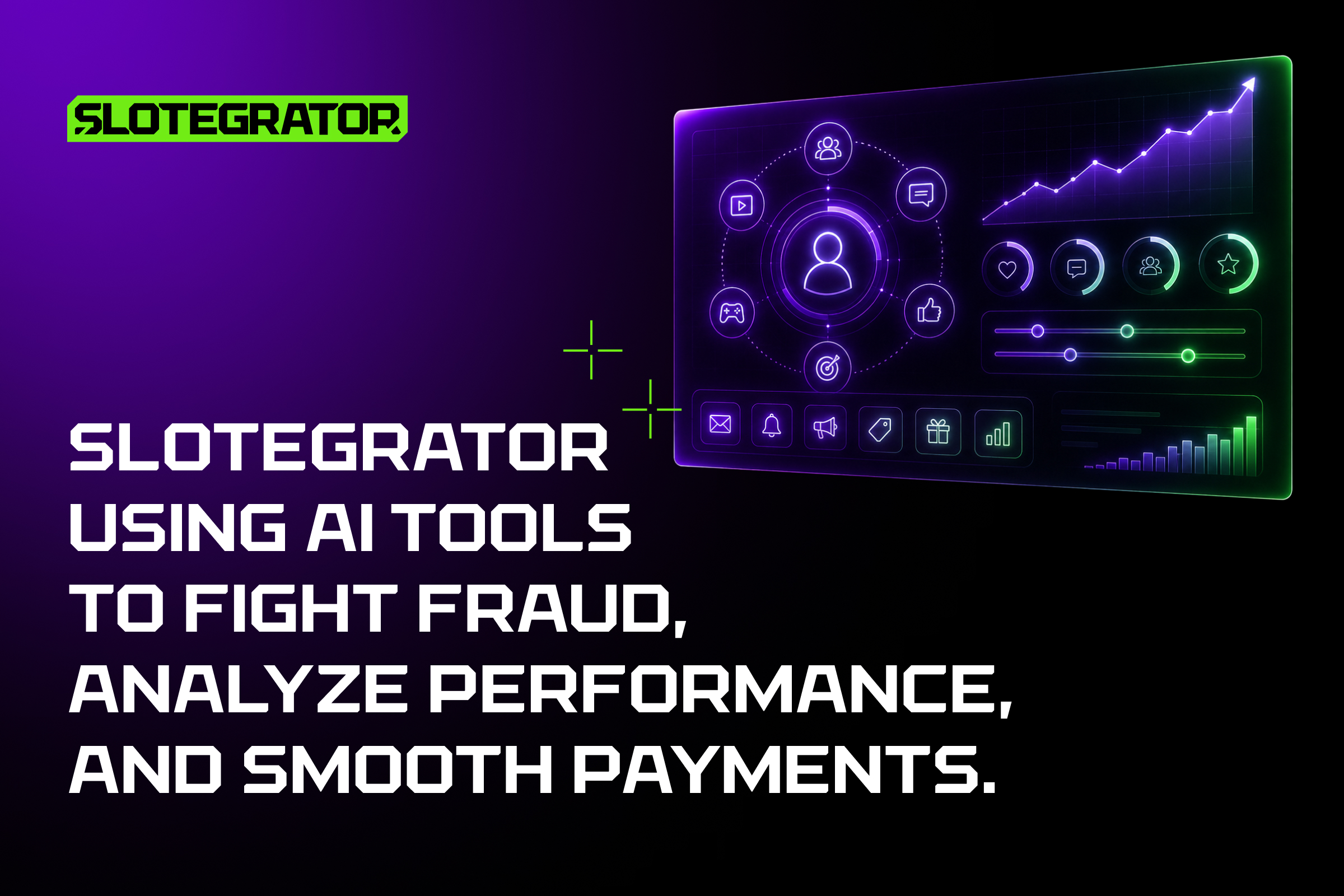
When everyone has access to AI, the future belongs to those who use it strategically. Slotegrator’s updated platform has a suite of AI-powered tools that do the heavy lifting so clients can focus on strategy and business development.
Suppliers are racing to incorporate AI features. Instead of just keeping up with the hype, Slotegrator updated its platform with a suite of AI tools that help its clients by doing most of the heavy lifting and handling tasks that require large amounts of processing power. The company’s platform software now features AI tools for fighting fraud, analyzing essential business data, and reducing payment friction.
Fraud is a major concern for online casino operators, particularly when it comes to bonus abuse.
Bonus abusers are constantly developing new techniques and tactics to defraud casinos — even more so now that they have access to AI tools. Good deepfakes can potentially even pass liveness checks, and synthetic IDs (fake IDs made of real parts) are difficult to spot.
Slotegrator’s Anti-fraud module has an AI assistant to help operators combat fraud. The assistant provides summaries of real-time situations with just the touch of a button. Operators choose from one of three preset questions: 1. What is the overall risk situation? 2. Which risk categories are currently the most critical? And 3. What should be prioritized right now?
When they choose one of them, the assistant automatically analyzes the relevant data, yields structured conclusions, and makes recommendations for next steps. After you’ve made a selection, the AI assistant instantly processes dashboard metrics and provides a brief summary. The assistant works at both the project and individual level.
“As artificial intelligence becomes commonplace, the companies that integrate AI into core aspects of their business will be the ones that get ahead,” explains Slotegrator COO Olga Ivanchik. “AI is capable of more than automation. Incorporating AI at a strategic level, making it a core part of the business architecture, is the only way to stay competitive in the long run.”
Slotegrator’s platform also has an AI business intelligence module.
The AI BI module not only tracks KPIs such as GGR, unique players, active players, average bet sum, average withdrawal sum, average FD sum, profitability, CPR, and others, but filters and presents them for the chosen period and the particular project. All the data are displayed in convenient and clear tables and diagrams and can be exported as CSV and XLS files for convenience.
Users can segment players and apply bulk actions, depending on whether they need to be encouraged with a bonus or blocked due to risky behavior. Additionally, the module can filter players by affiliate partner ID to see which partner sent them.
Payments always present complex issues. Slotegrator’s Moneygrator simplifies payments by providing a unified infrastructure for managing payment providers in different GEOs.
But the Moneygrator AI bot takes the service to a new level.
The Moneygrator AI Bot automatically processes up to 80% of standard requests that previously required the involvement of an account manager. Instead of studying documentation or waiting for a response, teams receive structured data in minutes, significantly accelerating time-to-market.
ABOUT THE COMPANY
Since 2012, Slotegrator has been one of the iGaming industry’s leading software and business solution providers for online casino and sportsbook operators.
The company’s main focus is software development and support for online casino platforms, as well as the integration of game content and payment systems.
The company works with licensed game developers and offers a vast portfolio of casino content: slots, live casino games, poker, virtual sports, table games, lotteries, casual games, and data feeds for betting.
Slotegrator also provides consulting services in gambling license acquisition and business incorporation.
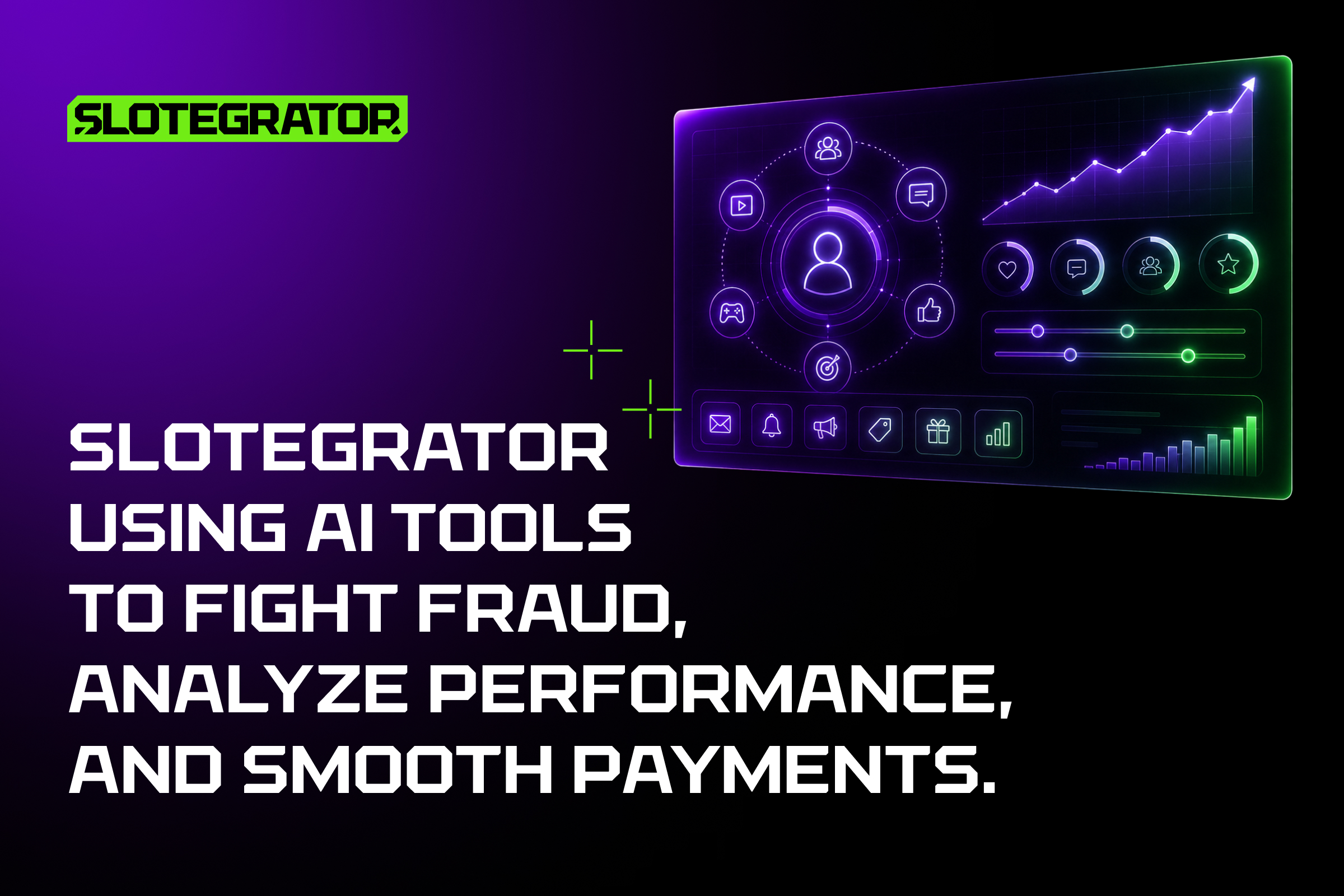
When everyone has access to AI, the future belongs to those who use it strategically. Slotegrator’s updated platform has a suite of AI-powered tools that do the heavy lifting so clients can focus on strategy and business development.
Suppliers are racing to incorporate AI features. Instead of just keeping up with the hype, Slotegrator updated its platform with a suite of AI tools that help its clients by doing most of the heavy lifting and handling tasks that require large amounts of processing power. The company’s platform software now features AI tools for fighting fraud, analyzing essential business data, and reducing payment friction.
Fraud is a major concern for online casino operators, particularly when it comes to bonus abuse.
Bonus abusers are constantly developing new techniques and tactics to defraud casinos — even more so now that they have access to AI tools. Good deepfakes can potentially even pass liveness checks, and synthetic IDs (fake IDs made of real parts) are difficult to spot.
Slotegrator’s Anti-fraud module has an AI assistant to help operators combat fraud. The assistant provides summaries of real-time situations with just the touch of a button. Operators choose from one of three preset questions: 1. What is the overall risk situation? 2. Which risk categories are currently the most critical? And 3. What should be prioritized right now?
When they choose one of them, the assistant automatically analyzes the relevant data, yields structured conclusions, and makes recommendations for next steps. After you’ve made a selection, the AI assistant instantly processes dashboard metrics and provides a brief summary. The assistant works at both the project and individual level.
“As artificial intelligence becomes commonplace, the companies that integrate AI into core aspects of their business will be the ones that get ahead,” explains Slotegrator COO Olga Ivanchik. “AI is capable of more than automation. Incorporating AI at a strategic level, making it a core part of the business architecture, is the only way to stay competitive in the long run.”
Slotegrator’s platform also has an AI business intelligence module.
The post Slotegrator using AI tools to fight fraud, analyze performance, and smooth payments appeared first on EE Gaming | Global iGaming & Tech Intelligence Hub.

21.com has launched as an online casino and sportsbook, naming industry veteran Michael Carlton as Founder & CEO, the company said on 16 June 2026.
The operator said it is targeting a range of global jurisdictions and plans to differentiate through a “modern technology stack” and “AI-centric operations.” It did not disclose target markets, licensing status, launch territories, or product partners.
Carlton previously served 13 years at EY as a Chartered Accountant before entering gaming in 1997, according to the company. He later spent 17 years as CEO of BetVictor and has since invested in betting and gaming companies.
Carlton said 21.com is being built without legacy platform constraints. “Having started in the gaming industry prior to the launch of the internet and then having the privilege of being involved as the industry evolved and adapted to the opportunities, there is now a further revolution occurring with the power created by embracing AI helping us to move faster and tailor personalised experience to the player.
“One of 21.com’s greatest strengths is that it is being developed for the current market, rather than an after-thought adaptation of an existing one. Many operators have been around for a long time and continue to be defined by legacy platforms and pre-crypto payment customer journeys that existed long before the modern technical tools that exist now became a reality. 21.com has embraced AI to deliver unparalleled customer experiences.
“With a team of industry leading experts with the motivation and ability to achieve our goals but without any legacy systems, 21.com is able to take advantage of new technologies to become a market leader in the gaming industry”.
The company also set aggressive commercial targets. “21.com will be one of the top three operators in every market it operates and in the world within two years,” Carlton said.
The post 21.com launches online casino and sportsbook led by ex-BetVictor CEO Michael Carlton appeared first on EE Gaming | Global iGaming & Tech Intelligence Hub.

-

 2026 World Cup7 days ago
Superbet launches ‘As Odds do Penta’ hub tracking Brazil 2026 title odds
-
Latest News3 days ago
Connect with N1 Partners at G Gate Conf 2026
-
América Latina3 days ago
Las diferencias locales de Argentina representan tanto un desafío como una oportunidad para el sector del iGaming
-
game-launch3 days ago
Million Games launches East West Wild slot with progressive multipliers
-
Africa3 days ago
Booming Games signs content deal with World Sports Betting in South Africa
-
AI3 days ago
Veikkaus rolls out OpenBet’s Neccton responsible gambling platform ahead of 2027 reform
-
Compliance Updates3 days ago
Why licensing will always be about jurisdiction, not harmonisation
-
FIFA 2026 World Cup3 days ago
Connect with N1 Partners at G Gate Conf 2026