blask
Blask launches real-time, global casino game ranking


Reading Time: < 1 minute
Blask, the AI-driven market intelligence ecosystem, has launched Global Games, a real-time dashboard that ranks more than 26,000 online casino games by brand coverage and country reach.
Debuting at the top of the charts is Pragmatic Play blockbuster Gates of Olympus 1000, which features across a remarkable 606 operator brands. Gate of Olympus Super Scatter and Aviator complete the top three, with Pragmatic Play holding seven of the top 10 positions.
Max Tesla, CEO of Blask, said: “Our industry has been operating in the dark for too long. With Global Games, we’re shining a light on which titles are succeeding in a real-time, global context. It is just the latest step in Blask’s mission to build the first truly comprehensive, data-driven picture of iGaming worldwide, with plenty more to come.”
The Global Games dashboard covers 17 countries where Blask Games Analytics is live, with more markets and metrics to be added soon.
For game providers, distributors and operators, understanding where a title is surfaced has become a competitive edge. Until now, assembling that picture meant manual checks or partial reports, but Global Games has consolidated every market signal in one place, cutting time‑to‑insight from hours to seconds.
This includes a global list view, which ranks titles by brand and country coverage; a per-game global page, which break down brands, lobbies and average lobby visibility; and a selection of power tools so users can search games by name and filter by provider or genre.
The post Blask launches real-time, global casino game ranking appeared first on European Gaming Industry News.








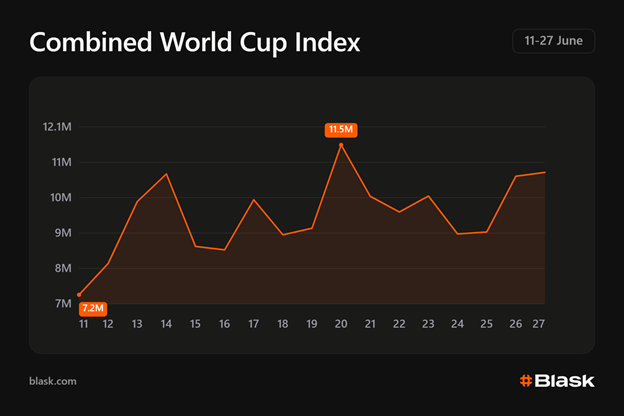
Search demand for the FIFA World Cup group stage in the US, Mexico and Canada did not peak uniformly across participating markets, according to new data from Blask tracking World Cup-related queries from 11 to 27 June.
Blask said it measures daily World Cup-related search demand at a country level and converts it into a “World Cup Index (WCI)”, based on the same logic as its Blask Index but adapted from brand-level search to event-related keyword demand. The dataset covers 43 countries out of 48 participating in the tournament, excluding Iran, Uzbekistan, Iraq, Cape Verde and Curaçao because Blask said its tracker’s Category feature is not yet available in those markets.
Across the 17-day group stage window, Blask reported that only 12 days produced a peak WCI in at least one country. Five days — 11, 15, 18, 19 and 22 June — were not the top day for any market in the sample.
At the other end of the range, the final group matchday, 27 June, produced peak WCI in 16 countries: Algeria, Argentina, Austria, Belgium, Colombia, Croatia, the Czech Republic, Ecuador, Egypt, France, Japan, Panama, Portugal, Qatar, Saudi Arabia and Uruguay. Two other dates saw seven markets peak each: 14 June (Canada, Germany, Haiti, the Netherlands, Turkey, England and Scotland) and 26 June (Australia, Brazil, Ivory Coast, Mexico, Paraguay, Senegal and Sweden).
Blask also pointed to the weight of the US in combined demand. While 27 June had the most country peaks, Blask said the highest day for combined World Cup-related search demand was 20 June, when the United States peaked. “The US alone makes up 26–36% of combined interest,” the company said. Blask added that the US pattern did not fully align with the combined total, with the US’s weakest day at 15 June and its smallest share of total interest on 27 June.
The post Blask data shows uneven World Cup search peaks across group stage appeared first on EE Gaming | Global iGaming & Tech Intelligence Hub.
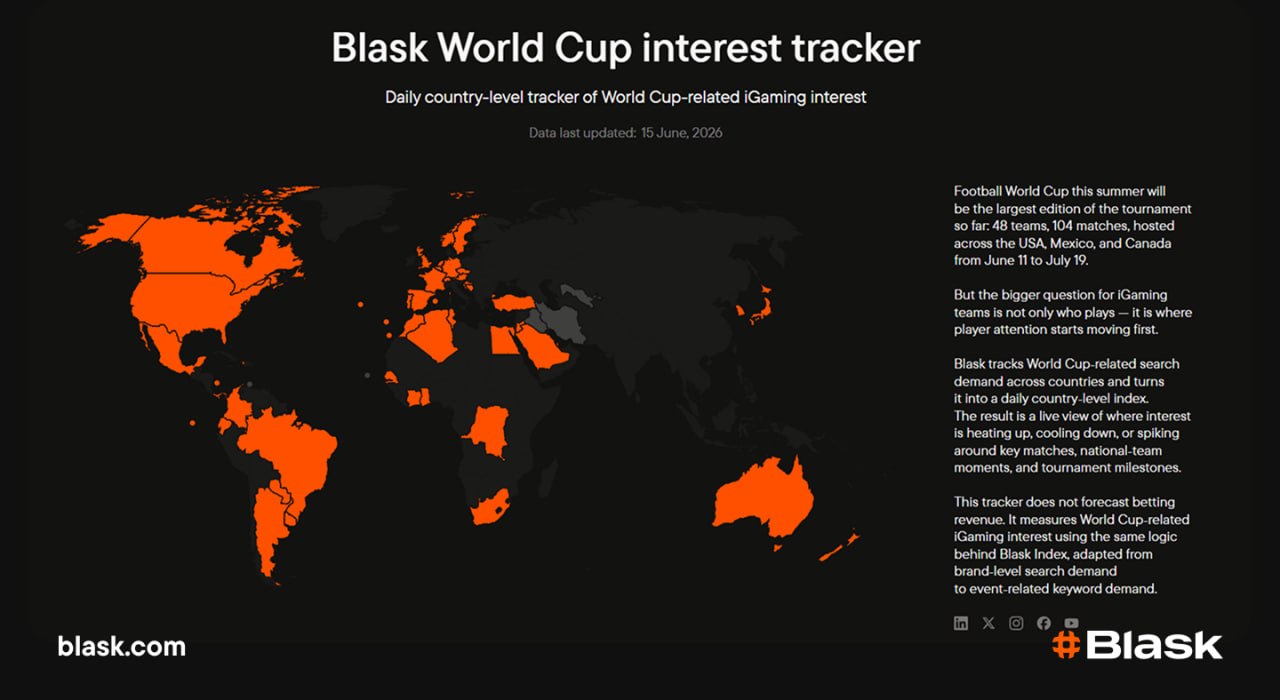
Blask has launched the Blask World Cup Index, a free interactive map showing daily interest across the majority of the 48 nations competing in the 2026 tournament. It runs for the duration of the competition.
Blask updates the map every 24 hours. Countries where interest towards the major football tournament grows over the previous day turn green. Countries where it fell turn red. Unchanged markets stay grey. Hover over any country for a quick snapshot, click through for a multi-day view, or follow the leaderboard of the fastest-rising and falling markets.
What the Blask World Cup Index measures
Blask World Cup Index draws from the Blask Index, Blask’s measure of iGaming search volume within a given market. On the landing page it tracks football related categories: how actively people in each country are searching for odds, match markets and other football-related content tied to the 2026 tournament.
Country cards show day-by-day trends; a daily leaderboard surfaces the daily World Cup Index and its change with the previous day. Visitors can track how interest in their country builds in the days before their team’s next match and how fast it collapses after an exit. The leaderboard shows which nation leads the index and how that position shifts with results. For operators and affiliates, the most actionable view is a market where interest is growing faster than the team’s performance would predict — the signal that precedes a volume spike.
After a 4-1 victory over Paraguay, the United States leads our World Cup Interest Index with 14.4 million demand points — more than three times ahead of second-placed Brazil (4.28 million), despite the Seleção’s global popularity. Germany sits third with 3.15 million following a 7-1 win over Curaçao, while England (2.53 million) and Egypt (2.22 million) round out the top five ahead of their opening group-stage matches.
To put the 2026 data in context, Blask has published two research reports drawing on iGaming activity across the 2018 and 2022 World Cups — one covering six European markets (UK, Germany, France, Spain, the Netherlands, Italy), one covering six LATAM markets.
The data shows the effect is not automatic: Germany posted positive acquisition signals at both tournaments despite group-stage exits; Peru surged +41% in 2022 without qualifying; Colombia fell 14% the same year.
Both reports include country-level APS data, cross-market patterns, and 2026 projections.
The post New Blask heatmap tracks real-time interest across World Cup 2026 nations appeared first on EE Gaming | Global iGaming & Tech Intelligence Hub.
3 Oaks Gaming
Pragmatic Play leads across Europe while RTG and 3 Oaks Gaming dominate US and Australia, new Blask data shows

Tier-1 casino lobbies are becoming less concentrated as regional challengers gain ground.
New data from Blask reveals that while Pragmatic Play remains the dominant game provider across most tier-1 European iGaming markets, regional dynamics are becoming increasingly fragmented as competitors such as Playtech, Evolution, Hacksaw Gaming, RTG and 3 Oaks Gaming rapidly expand their positions in local casino lobbies.
According to Blask’s latest analysis of tier-1 operator lobbies across Europe, North America and Australia, no single provider now holds an overwhelming market monopoly in most mature jurisdictions — with several countries showing signs of diversification and aggressive competition between suppliers.
In the United Kingdom, Pragmatic Play retained the leading position despite its market share declining year-over-year from 15.53% to 13.99%. At the same time, Reel Kingdom nearly doubled its presence, while Playtech also strengthened its position, reflecting increasing pressure on the long-time market leader.
Spain emerged as one of the most competitive European jurisdictions. While Pragmatic Play and Playtech both expanded their shares, the standout growth came from Evolution, which surged from 0.33% to 5.58% in just one year, signaling a major expansion of live casino content within the market.
Italy showed an even sharper shift toward supplier parity. Pragmatic Play and Playtech both lost substantial market share year-over-year, leaving the country without a clearly dominant provider. Evolution also accelerated its presence in the market, growing from 0.13% to 3.41%.
Germany remained one of Pragmatic Play’s strongest territories despite a decline from 17.39% to 14.40%. However, the market’s fastest-growing supplier was Hacksaw Gaming, which more than doubled its share and entered direct competition for a top-tier position.
France demonstrated one of the most balanced supplier landscapes in Europe. While Pragmatic Play overtook Play’n GO to become the leading provider in 2026, the difference between major suppliers remains minimal, suggesting that player demand in the country is spread across a wide range of content studios.
The Nordic markets also showed signs of changing player preferences. In Sweden, all top-five providers lost market share year-over-year while smaller suppliers expanded, indicating rising demand for newer studios. Denmark showed particularly strong momentum for Evolution, whose growth correlated with increasing live casino demand tracked by Blask.
Outside Europe, market structures differed significantly.
In the United States, RTG remains the dominant supplier with an 18.05% share, far ahead of competitors that struggle to exceed the 6% threshold. Meanwhile in Australia, 3 Oaks Gaming emerged as the leading provider, narrowly competing with Playson in one of the most distinct supplier ecosystems among tier-1 markets.
“Tier-1 markets are no longer moving toward monopoly dynamics,” said Vitaly Zubtsov, Head of PR at Blask. “What we see instead is fragmentation: local player preferences, live casino expansion, and new-generation studios increasingly reshape supplier hierarchies country by country.”
The report is based on Blask’s proprietary lobby-tracking technology, which continuously monitors game visibility and supplier presence across major regulated iGaming markets.
The post Pragmatic Play leads across Europe while RTG and 3 Oaks Gaming dominate US and Australia, new Blask data shows appeared first on Eastern European Gaming | Global iGaming & Tech Intelligence Hub.

-

 Amusnet7 days ago
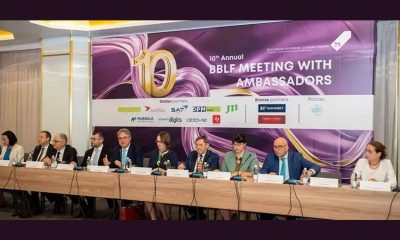
Connecting Business and Diplomacy: Amusnet Supports BBLF’s Annual Meeting of the Diplomatic Corps
-
AGCO6 days ago
AGCO Fines Great Canadian Entertainment $120,000 for Using Unauthorised Gaming System Software at Four Casinos
-
Affiliate Industry4 days ago
Hub Affiliations Triumphs at the iGB Affiliate Awards 2026: Winner of Programme/Network Campaign of the Year
-
Latest News4 days ago
N1 Partners at iGB L!VE 2026: Bringing Together Affiliates, Art and Innovation
-
certification7 days ago
PopOK Gaming secures certification for Portugal iGaming market
-
Latest News6 days ago
LEON announces LEON.bet Masters, a new CS2 tournament in Portugal
-
Canada6 days ago
St8 expands Octoplay aggregation deal to Ontario and the UK
-
Asia6 days ago
The UAE Lottery joins SAGIP outreach with Philippine Consulate and Infinite Communities