Latest News
Brightstar Lottery Reports Second Quarter 2025 Results


Brightstar Lottery PLC has reported the financial results for the second quarter ended June 30, 2025.
“We achieved several important milestones over the last few months. We secured the Italy Lotto license through November 2034, closed the sale of our Gaming & Digital business for $4 billion in cash, and announced plans to return significant capital to shareholders. With a singular focus on lottery and unmatched industry expertise, we are well positioned to create value for all stakeholders with our mission to elevate lotteries and inspire players around the world,” said Vince Sadusky, CEO of Brightstar.
“Our second quarter results reflect sustained global demand for instant ticket and draw games. We are investing in key initiatives to drive sustainable, long-term growth, while also delivering structural cost reductions to right-size the business. The Company’s attractive profit profile and strong, predictable cash flows support our balanced approach to capital allocation,” said Max Chiara, CFO of Brightstar.
Key Highlights
• Successful completion of Gaming & Digital sale for approximately $4.0 billion of net cash proceeds on July 1, 2025.
• Secured several meaningful contract wins and extensions including a nine-year Lotto operator license in Italy, an eight-year contract in Missouri which includes a fully-integrated OMNIA retail and digital solution, and several multi-year instant ticket printing contract extensions.
• Expanding OPtiMa 3.0 cost reduction programme to $50 million to right-size the business following the Gaming & Digital sale.
Second Quarter 2025 Financial Highlights
Second quarter revenue was $631 million, up 3% or stable at constant currency.
• Instant ticket & draw same-store sales increased across geographies with Italy increasing 3.7%, U.S. higher by 0.6%, and Rest of World climbing 8.4%.
• Product sales rose 59% on higher instant ticket printing and terminal sales.
• Foreign currency translation had a positive impact on growth.
• Growth from the drivers above was partially offset by elevated U.S. multi-state jackpot activity and associated LMA incentives in the prior year.
Loss from continuing operations was $60 million compared to income from continuing operations of $84 million in the prior year period.
• Incurred a foreign exchange loss versus a foreign exchange gain in the prior year, primarily reflecting the non-cash impact of fluctuations in the EUR/USD exchange rate on debt.
• Operating income was lower, driven by the high profit flow-through from elevated U.S. multi-state jackpot sales and associated LMA incentives in the prior year and restructuring charges related to the expanded OPtiMa 3.0 cost reduction programme in the current year.
• Increased provision for income taxes.
• Dynamics noted above were partially offset by reduced interest expense.
Adjusted EBITDA was $274 million compared to $290 million in the prior-year period, demonstrating resiliency despite incremental investments in the business and multi-state jackpot and LMA dynamics.
• Prior year results include the high profit flow-through from elevated U.S. multi-state jackpot sales and associated LMA incentives.
• Selling, general, and administrative costs were modestly higher as ongoing investments in the business were partially offset by OPtiMa cost savings.
• The Q2’25 period benefited from positive foreign currency translation.
Diluted loss per share from continuing operations was $0.47 compared to diluted earnings per share from continuing operations of $0.21 in the prior year. Adjusted diluted earnings per share from continuing operations was $0.12 compared to $0.20 in the prior year, primarily driven by lower operating income.
YTD 2025 Financial Highlights
Year-to-date revenue of $1.2 billion compares to $1.3 billion in the prior-year period.
• The decline was due to higher U.S. multi-state jackpot activity and associated LMA incentives in the prior year.
• Global instant ticket & draw same-store sales rose 1.2%.
Loss from continuing operations was $52 million compared to income from continuing operations of $200 million in the prior year period.
• Lower operating income, primarily due to the items affecting Adjusted EBITDA as noted below.
• Foreign exchange loss versus foreign exchange gain in the prior year, primarily reflecting the non-cash impact of fluctuations in the EUR/USD exchange rate on debt.
Adjusted EBITDA of $524 million compares to $617 million in the prior-year, primarily driven by high profit flow-through from elevated U.S. multi-state jackpot sales and associated LMA incentives in the prior year, partially offset by positive foreign currency translation.
Diluted loss per share from continuing operations was $0.59 compared to diluted earnings per share from continuing operations of $0.56 in the prior year. Adjusted diluted earnings per share from continuing operations of $0.20 compares to $0.47 in the prior year primarily driven by lower operating income, partially offset by reductions in net interest and income tax expense.
Net debt was $5.2 billion compared to $4.8 billion at December 31, 2024. The increase was primarily driven by an approximate $340 million impact from fluctuations in the EUR/USD exchange rate. Net debt leverage was 3.0x pro forma for $2 billion debt reduction completed in July.
Cash and Liquidity Update
Total liquidity was $2.9 billion as of June 30, 2025 with $1.3 billion in unrestricted cash and $1.6 billion in additional borrowing capacity from undrawn credit facilities.
Other Developments
The Company plans to launch a $250 million accelerated share repurchase programme (ASR) by entering into an accelerated share repurchase agreement with a counterparty bank. The Company plans to execute the ASR as part of its $500 million share repurchase authorization outlined below and in accordance with the share repurchase authorisation provided by the Company’s shareholders at the Company’s 2025 Annual General Meeting. The Company has been informed by De Agostini S.p.A., that it does not intend to participate in the ASR.
The Company’s Board of Directors declared a quarterly cash dividend of $0.20 per common share with a record date of August 12, 2025 and a payment date of August 26, 2025.
Completed the sale of the Gaming & Digital business on July 1, 2025. The Company received approximately $4.0 billion of net cash proceeds that are expected to be allocated in the following manner:
$2.0 billion used to reduce debt (completed in July 2025).
• Redeemed in whole the 4.125% Senior Secured U.S. Dollar Notes due April 2026 and the 3.500% Senior Secured Euro Notes due June 2026.
• Prepaid €300 million of the Term Loan Facilities due January 2027.
• The remaining amount was allocated to prepay the Revolving Credit Facilities due July 2027.
$1.1 billion to be returned to shareholders.
• The Company’s Board of Directors declared a special cash dividend to common shareholders in the amount of $3.00 per share. The record date of the distribution was July 14, 2025, and it is payable July 29, 2025.
• In addition, the Board authorized a $500 million, two-year share repurchase programme. The new authorisation replaces the Company’s existing share repurchase programme.
$500 million to partially fund upcoming Italy Lotto license payments.
$400 million to be used for general corporate purposes.
The U.S. federal income tax consequences of distributions by the Company will depend, in part, on whether the Company has current or accumulated earnings and profits (“E&P”), as determined under U.S. federal income tax principles. Based on preliminary estimates, the Company does not expect to have current E&P for fiscal year 2025 or accumulated E&P from prior fiscal years that would offset the current year expected E&P deficit. Accordingly, the Company anticipates that the special dividend, the Q1 dividend paid on June 12, and any future dividends paid in the current fiscal year will be treated for U.S. income tax purposes as a non-taxable return of capital to the extent of a shareholder’s basis in its shares, and thereafter as capital gain, although no assurances can be provided because the determination of E&P is a full-year calculation which depends upon facts that are not known as of the date hereof.
FY’25 Outlook: Adjusted EBITDA Reaffirmed, Cash Flow Improved
• Revenue of approximately $2.50 billion; adjusting revenue down $50 million compared to the previous outlook to reflect a timing shift in product sales and increased amortization related to Italy Lotto upfront license fee (which is treated as contra-revenue).
• Adjusted EBITDA of approximately $1.10 billion, in line with the previous outlook as incremental benefit from foreign currency translation is offset by higher-than-expected U.S. multi-state jackpot and LMA impacts.
• Net cash used in operating activities of approximately $275 million reflects a $75 million improvement versus the previous outlook driven by interest, income taxes, and other working capital items.
• Capital expenditures of approximately $375 million, a $75 million improvement from the previous outlook to reflect timing shifts related to recent contract extensions.
• Increasing FY’25 EUR/USD assumption to 1.12.
The post Brightstar Lottery Reports Second Quarter 2025 Results appeared first on European Gaming Industry News.












124 countries and territories registered for selection; the 32nd “Solidarity” Wildcard slot is still to be confirmed.
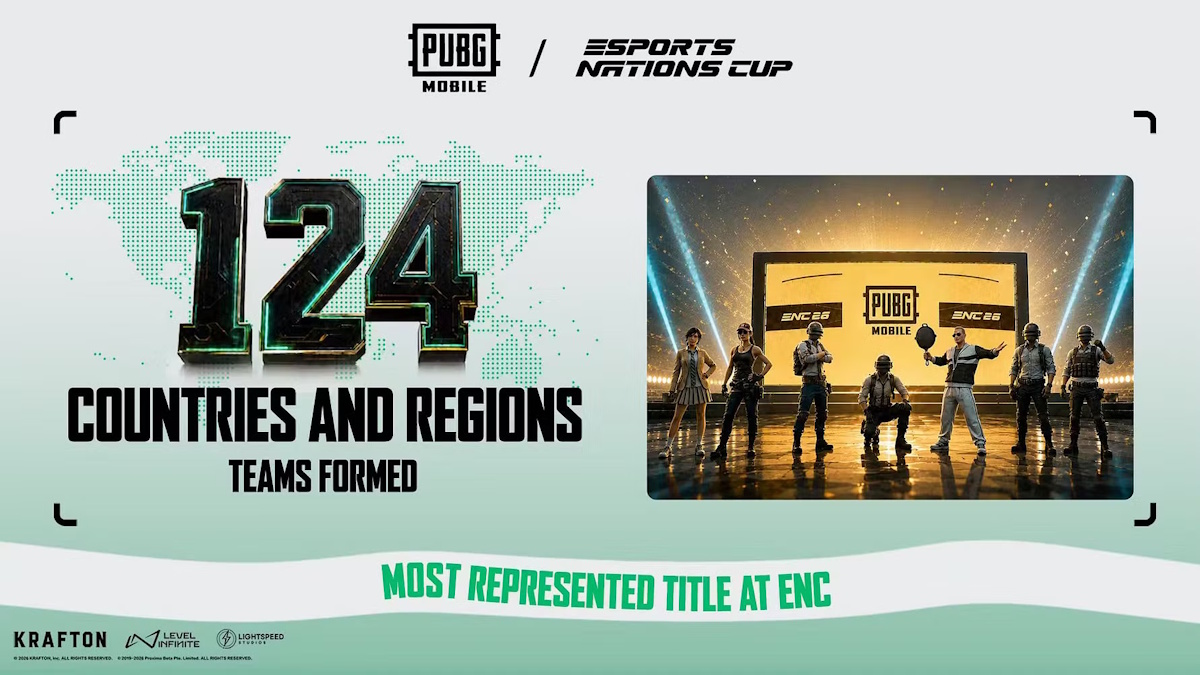
PUBG MOBILE has confirmed 31 of the 32 national teams for PUBG MOBILE at the Esports Nations Cup 2026, scheduled for November 3-8 in Riyadh. The publisher said 124 countries and territories registered and submitted official rosters for the selection process. The event will play for a $1.32 million USD prize pool.
The confirmed lineup includes 14 teams advancing from nine regional qualifiers: Indonesia, Cambodia, Hong Kong, Kyrgyzstan, Uzbekistan, Jordan, KSA, France, Italy, Mexico, Colombia, Chile, Mauritania and Madagascar.
A further 12 teams are invited via ENC Rankings: Türkiye, Mongolia, Brazil, Pakistan, Myanmar, Vietnam, Thailand, Nepal, South Africa, United States, Ukraine and Argentina. Four Special Invite teams—China, South Korea, India and Japan—also join the Group Stage.
Two Wildcard slots are listed: Kuwait as the Host Region representative, and one “TBD (Solidarity)” team still to be confirmed. From November 3, teams will be split into four groups of eight for a round-robin Group Stage, with the top four from each group advancing to the Grand Finals.
The Esports Nations Cup was announced in August 2025 as a multi-title national-team competition, with future international iterations planned, according to the company. PUBG MOBILE also claimed it is the “#1 game title at the Esports Nations Cup in terms of participating countries and territories,” citing the 124 registered countries and territories for its selection process.
The post PUBG MOBILE confirms 31 teams for Esports Nations Cup 2026 in Riyadh appeared first on EE Gaming | Global iGaming & Tech Intelligence Hub.
Tonybet says a player in Laurier-Station, Canada has claimed the “golden card” prize worth $20,000 CAD in the operator’s World Cup Card Collection. The announcement was made Tuesday 21st July 2026.
The World Cup collection featured 51 cards in total, including 48 digital cards representing participating World Cup nations, plus three unique prize cards in bronze, silver and gold. Tonybet said the bronze card—available during the group stage—was previously found by a customer in Saint-Colomban, Canada, while the silver card—available during the knockout rounds up to the quarter-finals—was won by a player in County Kildare, Ireland.
The golden card became available for the semi-final, third-place play-off and final, and has now been claimed, Tonybet said.
Tonybet Head of Product Kiryl Liudvikevich said: “You can plan a campaign down to the last detail, but you can’t plan what the World Cup brings.
“We designed the collection to evolve with the tournament, and every knockout round created new stories we couldn’t have predicted. Seeing players complete their collections and discovering who would uncover each prize was the most rewarding part of the campaign.
“I hope everyone enjoyed the experience for what it was meant to be: a fun addition to the tournament, played responsibly and always within their limits.”
Tonybet said the collection will remain open until 31 July for players who are still completing sets and spending coins, although all grand prizes have been awarded.
The post Tonybet player in Canada claims $20,000 CAD golden World Cup card prize appeared first on EE Gaming | Global iGaming & Tech Intelligence Hub.

Tonybet says a player in Laurier-Station, Canada has claimed the “golden card” prize worth $20,000 CAD in the operator’s World Cup Card Collection. The announcement was made Tuesday 21st July 2026.
The World Cup collection featured 51 cards in total, including 48 digital cards representing participating World Cup nations, plus three unique prize cards in bronze, silver and gold. Tonybet said the bronze card—available during the group stage—was previously found by a customer in Saint-Colomban, Canada, while the silver card—available during the knockout rounds up to the quarter-finals—was won by a player in County Kildare, Ireland.
The golden card became available for the semi-final, third-place play-off and final, and has now been claimed, Tonybet said.
Tonybet Head of Product Kiryl Liudvikevich said: “You can plan a campaign down to the last detail, but you can’t plan what the World Cup brings.
“We designed the collection to evolve with the tournament, and every knockout round created new stories we couldn’t have predicted. Seeing players complete their collections and discovering who would uncover each prize was the most rewarding part of the campaign.
“I hope everyone enjoyed the experience for what it was meant to be: a fun addition to the tournament, played responsibly and always within their limits.”
Tonybet said the collection will remain open until 31 July for players who are still completing sets and spending coins, although all grand prizes have been awarded.
The post Tonybet player in Canada claims $20,000 CAD golden World Cup card prize appeared first on Americas iGaming & Sports Betting News.

-

 ESPN Networks4 days ago
THE 57th ANNUAL WORLD SERIES OF POKER® CONCLUDES AN EXTRAORDINARY SUMMER OF GLOBAL ENGAGEMENT AND ELITE COMPETITION
-
Latest News5 days ago
Booming Games launches Tasty Bonanza Max Scatter slot
-
Latest News6 days ago
SCCG Management Launches Dedicated SCCG Brazil Division with Local Partner Thomas Carvalhaes
-
Latest News7 days ago
Esportes Gaming Brasil takes two ClienteSA Awards 2026 wins; exec named Personality of the Year
-
Canada5 days ago
PENN Entertainment Launches theScore Bet Sportsbook & Casino and theScore Casino and Hollywood Casino Standalone Apps in Alberta
-
Canada5 days ago
Peter & Sons launches full game portfolio in Alberta
-
Latest News6 days ago
QTech signs EXCO Game Studio slots for emerging markets
-
Compliance Updates6 days ago
Merkur Group Strengthens Global Compliance Strategy