AI
Why operators are choosing to buy in their AI strategy


In an industry where margins are thin and player loyalty is fleeting, customer experience has become a key differentiator for operators. As AI becomes a core operational requirement, leadership teams face a clear choice: build proprietary technology in house, or partner with purpose built AI CX providers.
Alex Gould, CTO at Conduet, explains why more operators are choosing the latter.
What industry-specific CX challenges can an exterior solution address ‘out of the box’ compared to a generic build?
Generic AI struggles in sports betting and iGaming because player inquiries are shaped by complex, domain-specific rules and edge cases. Questions about settlements, promotions, withdrawals, or cash outs are rarely straightforward. They depend on wager structure, timing, eligibility criteria, and operator-specific logic.
Over 80% of player inquiries require pulling live, account-specific information from the PAM and applying it correctly within that broader rule set. Without purpose-built logic to interpret both the data and the edge cases around it, responses quickly become incomplete or incorrect.
This limitation is reflected more broadly in enterprise AI adoption. Research from MIT found that 95% of enterprise AI initiatives fail to deliver measurable business impact, often because broadly trained models are pushed into live environments without the domain context needed to handle real-world variability. What appears to work in controlled testing breaks down once exposed to operational complexity.
Purpose-built platforms are designed around this reality. By training on gaming-specific data, workflows, and failure modes, they can interpret live PAM data in context and handle both common and complex inquiries accurately from day one, without relying on extensive rules, manual escalation, or post-deployment patchwork.
How would you characterise the current skills gap within operator teams regarding AI implementation?
Operator CX teams are closest to the customer and understand where friction exists. The challenge is not identifying opportunities, but delivering AI that performs reliably in production. Turning insight into production-ready capability requires technical depth, dedicated ownership, and sustained iteration that sit outside the remit of most CX organisations.
Deploying AI in gaming requires expertise across model evaluation, conversation design, failure handling, and real-time interaction with PAMs and ticketing systems. It also requires ongoing investment to monitor performance, manage edge cases, and improve outcomes as volumes and player behaviour change. CX teams are structured to run day-to-day operations, which makes sustaining this work in parallel difficult.
As a result, many internal AI CX efforts stall or remain narrow in scope, not because the opportunity is unclear, but because the execution burden is too high.
What is the average time to market using a specialist platform, versus a full in-house build?
In-house AI efforts typically take 18 to 36 months to reach enterprise-ready scale. The delay is driven by the need to coordinate across CX, product, data, and engineering while establishing new ownership and operating models inside live CX environments.
A specialist platform compresses this timeline materially. With gameLM, operators can move from concept to live inbound CX in six to 12 weeks. Operators achieve 60%+ resolution within 90 days, scaling toward 80%+ shortly thereafter.
Why does a purpose built partnership model matter in iGaming & OSB CX?
In iGaming and online sports betting, the challenge is not adopting AI, but making it work reliably at scale. Generic platforms often shift the burden onto operators after deployment, requiring significant time and internal effort to adapt the technology to gaming-specific realities. That effort compounds as complexity grows.
A purpose built partnership model changes that dynamic. Instead of operators spending months closing gaps, AI is deployed using operating patterns already proven in live gaming CX. Common failure modes, escalation paths, and performance tradeoffs are understood upfront, reducing the need for downstream rework and ongoing firefighting.
Conduet applies this approach through gameLM, informed by operating a 500+ agent gaming CX organisation. That operating knowledge functions as an embedded R&D capability, shaping how the platform is tuned, prioritised, and extended alongside each operator’s environment. Inbound CX performance today directly informs the development of additional, gaming-specific capabilities such as reactivation, payments optimisation, and fraud prevention.
The result is a partnership model that delivers strong outcomes without transferring the hidden cost of adaptation and maintenance back to the operator, allowing CX capability to keep pace as the industry evolves.
Alex Gould is the CTO at Conduet, where he leverages his technical and strategic background to guide technology strategy and innovation. He is also the Founder and CTO of Everyday AI and previously founded computer vision company ViewX. Alex’s earlier experience includes roles at Primary Venture Partners and Bain & Company, and he holds an MBA from Columbia Business School and a Bachelor of Engineering (Hons) from the University of Canterbury.
The post Why operators are choosing to buy in their AI strategy appeared first on Eastern European Gaming | Global iGaming & Tech Intelligence Hub.













AI
2026 Rewards AI Capability, Not AI Talk – HIPTHER Prague Summit Unveils the Next-Era HIPTHER Academy
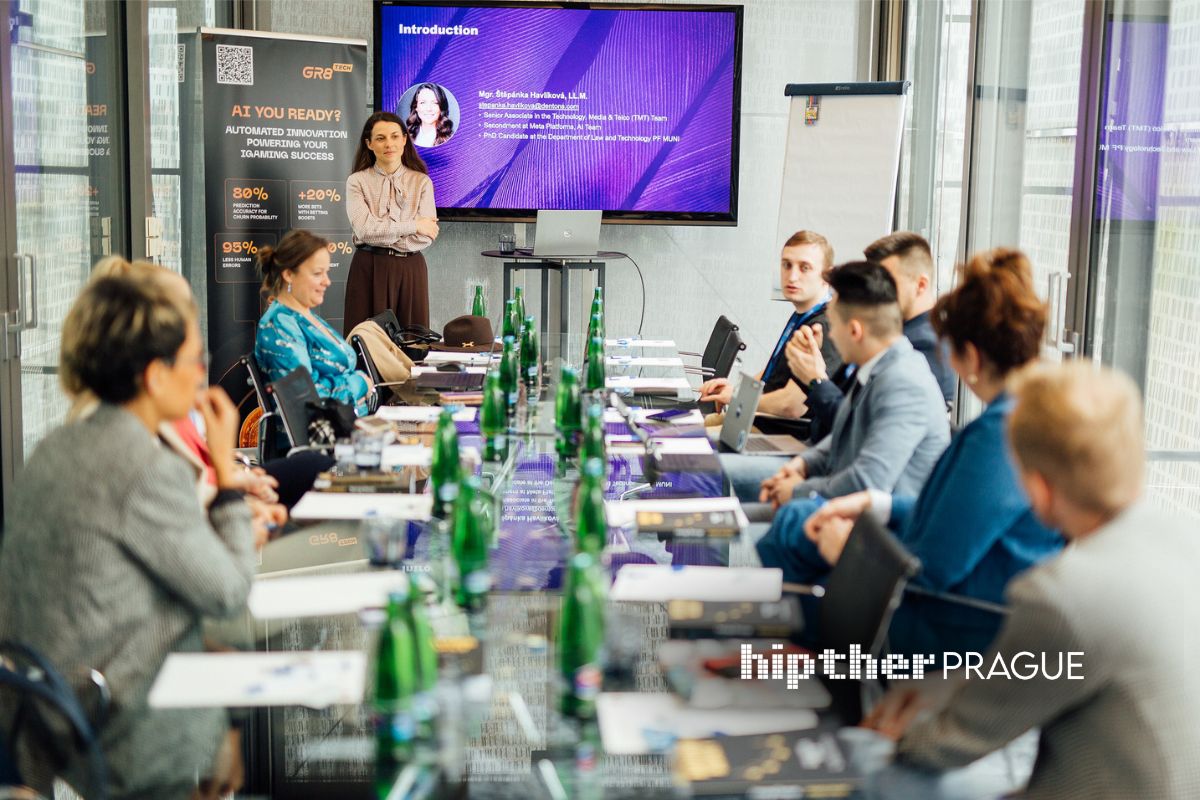
HIPTHER Prague Summit proudly introduces the Hands-On HIPTHER Academy and next-gen career advancement. Because 2026 won’t reward AI Talk – It will reward AI Capability.
As the HIPTHER Prague Summit celebrates 10 years of impact across Gaming & Tech, the 2026 edition shifts the spotlight toward what truly defines the next era of professional growth: practical AI capability, personal authority, and reputational strength.
This year, HIPTHER places a powerful new emphasis on the HIPTHER Academy – the summit’s applied learning environment designed to move beyond theory and into real execution professionals can use immediately.
From AI Hype to Real-World Application
The message shaping 2026 is clear:
The future won’t reward those who talk about AI.
It will reward those who know how to use it.
Positioned as the practical layer of the summit, the HIPTHER Academy delivers:
- 80% hands-on, applied AI workshops
- Real operational use cases, including vibe coding, compliance automation, AI-driven workflows, and responsible implementation boundaries
- Immediate, role-ready takeaways professionals can implement the moment they return to work
This applied focus distinctly separates HIPTHER Prague Summit from generic “AI trend” events – emphasizing execution over theory and capability over buzzwords.
Authority, Reputation & the Human Edge
Technical skill alone is no longer enough.
In an AI-accelerated landscape, positioning, leadership presence, and trust define who stands out.
That’s why the HIPTHER Academy integrates human authority and reputational growth alongside AI capability.
Featured workshops include:
- From Profile to Authority: Positioning Your LinkedIn Presence for Trust – Marija Hammond
- Personality and High-Stakes Conversations in the Workplace – Maria Loumpourdi
- How to Build a Company’s Reputation – Magdalena Radomska-Trzaska
Together, these sessions shape a new professional equation:
HIPTHER Academy = AI capability + personal authority + reputational strength.
Inside the 10th Anniversary Edition of HIPTHER Prague Summit
Under the theme “Decoding the Future: 10 Years of Impact,” the 2026 summit marks its most ambitious edition yet.
Taking place at OREA Hotel Andels Praha on 24–25 March 2026, the event brings together a global audience across:
iGaming, eSports, Blockchain, AI, Fintech, Compliance, Regulation
Attendees can expect eight dedicated Academy workshops delivering applied knowledge.
HIPTHER’s Co-Founder & Head of Business Zoltan Tündik, stated about this year’s HIPTHER Academy in Prague: “While 2025 was dominated by conversations about AI, 2026 is the year we are witnessing real acceleration. New developments, real projects, and genuinely useful tools being created at unprecedented speed. I recently noticed this while recording a podcast: we no longer say ‘this wasn’t possible a few years ago.’ We now say ‘this wasn’t possible a few months ago.’ That shift in language says everything about the pace of AI-driven innovation.
The market will not reward AI commentary anymore. It will reward AI capability. That’s exactly why the HIPTHER Academy focuses on practical application, giving professionals the ability to execute, not just discuss. In 2026, competitive advantage belongs to those who can apply AI confidently, responsibly, and effectively in real business environments.”
More Academy Highlights
Insightful sessions expanding the Academy’s practical scope include:
- Branding in the Attention Economy – Marija Hammond, Brand Advisor & Speaker
- LinkedIn as a Dealflow Engine – Marie Zamecnikova, Personal Brand Strategist and Executive Advisor
- Communications & Growth Execution – Wojciech Trzaska, Chief Communications Officer at SB Software
- AI-Powered Marketing & PR – Uliana Korobeynikova, Head of Public Relations at iAffiliate
Alongside AI insights from The Playa, Murmur Intelligence, and further expert-led workshops to be announced.
The Career-Advancement Layer of Prague 2026
With the HIPTHER Academy, the Prague Summit evolves beyond a conference into a career acceleration environment — equipping professionals not just to understand the future, but to operate inside it with confidence, credibility, and authority.
Because in 2026, the real competitive edge isn’t access to AI.
It’s knowing how to apply it — and being trusted when you do.
Join the 10th Anniversary HIPTHER Prague Summit — invest in career-growth and personal authority. See you there!
The post 2026 Rewards AI Capability, Not AI Talk – HIPTHER Prague Summit Unveils the Next-Era HIPTHER Academy appeared first on Eastern European Gaming | Global iGaming & Tech Intelligence Hub.

Gerardo Prieto, Chief Information Security Officer at The Mill Adventure, explores how the rise of generative AI is forcing a total paradigm shift in iGaming security and player verification.
Online gambling’s traditional identity stand-off has reached a breaking point. For years, operators walked a tightrope, balancing rigid AML/KYC regulations against the player’s desire for frictionless onboarding. But as we move through 2026, the ground has shifted substantially. The modern fraudster is no longer a manual actor relying on basic tools like Photoshop, but a 24/7 automated threat, utilising adaptive AI to evolve faster than most development sprint cycles.
For operators, the cost of losing this arms race is staggering. Identity fraud and money laundering have converged as the predominant risks, with 64.8% of businesses citing them as their primary threats. However, the real wake-up call is the point of entry. Recent market analysis reveals that the financial threshold is now the most vulnerable vector, with 41.9% of fraud attempts occurring specifically during the deposit stage. This is now the absolute frontline of defence.
The death of seeing-is-believing
We have moved well beyond the era of scripted attacks. The new frontline is defined by AI-driven abuse, where generative models create synthetic identities and high-fidelity deepfakes. Using real-time FaceSwap and lip-sync algorithms, bad actors can now bypass standard KYC protocols with ease. The traditional liveness check – asking a user to blink or turn their head – is increasingly obsolete against sophisticated generative adversarial networks (GANs).
The nightmare scenario for the modern CISO is the rise of camera injection. In these attacks, fraudsters bypass the device’s physical camera sensor entirely, feeding AI-generated content directly into the verification stream. Because the software believes it is receiving a direct feed from hardware, it misses the red flags of a digital overlay. In this landscape, the human eye has become a vulnerability, and pixels alone can no longer be trusted to verify a soul.
Biology vs. Algorithms: The new verification
To defend the perimeter, operators need to shift to a verification model rooted in physics and biology, not just image recognition. This requires advanced countermeasures like Remote Photoplethysmography (rPPG). This technology analyses minute light absorption patterns to track blood flow changes invisible to the naked eye. An AI deepfake might have perfect skin texture and flawless movement, but it does not have a pulse. By detecting the heartbeat in a video stream, we can distinguish between a living human and a digital mask.
We must also utilise 3D geometry and lighting physics to validate that a user’s environment is a physical reality. While a deepfake can simulate a face, it often fails to replicate the complex interaction between environmental light and the 3D topography of human skin. If the light source doesn’t wrap around the subject correctly, or if the depth map detects a planar surface, the system exposes the image for what it is: a flat counterfeit. We are essentially moving toward a proof-of-presence model that demands physical consistency.
The lifecycle defence
Resilience in 2026 requires a ‘shift left’ strategy. This means intercepting fraud at the absolute earliest stage. However, security cannot simply end at the front door and needs to evolve into a lifecycle defence system.
At onboarding, the priority is stopping synthetic identities. At the deposit stage, operators must employ multi-signal matching to validate KYC names against cardholders, dismantling muling rings before they can load funds. During gameplay, behavioural AI is essential to analyse betting patterns for bot signatures. Finally, at withdrawal, we must replace simple passwords with biometric step-up checks to prevent Account Takeover (ATO) fraud.
The operational standard is now risk-based authentication. Instead of rigid ‘allow or block’ rules, operators must move toward dynamic risk profiles for every session. By ingesting over 100 different signals, including biometric, IP, and device data, a system can apply friction only where it is explicitly needed. Low-risk users on trusted devices enjoy a seamless experience, while medium-risk anomalies trigger a passive biometric scan. Only overt threats are blocked immediately.
In this new reality, survival is about agility and not budget. Annual audits and static policies are relics of the past. If your security strategy is static, you are effectively opening the door to attackers. It is time to cultivate an adaptive immune system that evolves faster than the threat.
The post Confronting the age of AI-driven fraud appeared first on Eastern European Gaming | Global iGaming & Tech Intelligence Hub.

The Investments team at RedCore held dozens of meetings at ICE Barcelona with projects from MarTech/Traffic, iGaming, AI/ML, and RegTech. We share our observations on the direction of the market and changes in the approach of startups.
Technology is the main trend
The products at the conference focused on offering fundamentally new solutions rather than competing head-on. There were a huge number of game providers, but the ones that attracted attention were those betting on technological innovation.
“The trend is clear: products are trying to offer something completely new, rather than just competing in their niche,” notes Andrei Alexandrov, Investment Portfolio Manager at RedCore.
The influx of incoming applications confirmed this: even without a targeted search, most projects fell within the fund`s priority areas — MarTech/Traffic, iGaming solutions, AI/ML, and RegTech.
AI and data are changing the traffic game
At iGB Affiliate, which ran parallel to ICE, AI solutions for traffic were everywhere: trackers, predictive models, player behavior analysis panels. This reflects the maturity of the market — traffic optimization is no longer possible without ML/AI approaches.
The main competitive asset today is data and segmentation. Those who segment more deeply, personalize, and truly understand the behavior of their audience will win. Granular data, behavior by micro-segments, is no longer a “nice-to-have” but a necessity.
“Affiliates are increasingly acting not just as CPA traffic partners, but as full-fledged marketing experts who use data and content to improve engagement,” notes Iryna Yeromenko, Investment Portfolio Manager at RedCore.
Startups have become more mature
Just a few years ago, conferences were often attended by teams with raw ideas. Now the situation has changed: founders come with well-developed pitches, clear business models, and a clear understanding of the market.
“Startups are particularly impressive this year: everyone comes prepared and tries to present themselves in the best way. There was almost no one who came with just an idea,” says Andrei Alexandrov. “Some said that we are their priority fund. This level of trust confirms that we are moving in the right direction.”
Record dealflow, but quality is more important
The volume of incoming applications for ICE Barcelona exceeded the total for all other events last year. But a large flow also means risk: without clear selection criteria, it is easy to waste time on irrelevant projects.
“There are a lot of introductions, pitches, and “let`s talk”. At the same time, it is important to remember that quantity does not equal quality. ICE reinforces the need for strict investment filtering, as without clear criteria, it is easy to get lost in the noise,” explains Oleksandr Briukhovetskyi, Investment Portfolio Manager at RedCore.
This principle also works in traffic: the best affiliates focus on data strategies, mobile-first and video-first content, as well as player behavior patterns. Affiliates get access to more metrics, which lets them buy better traffic.
Long-term value instead of quick deals
ICE Barcelona isn`t about closing deals on the spot. The main value of the conference lies in the opportunity to create the foundation for partnerships for the next 6–12 months.
“Conferences bring strategic value. In terms of the density of quality contacts, long-term deals, and relevant contextual conversations, they are confidently ahead of most other channels,” — notes Oleksandr Briukhovetskyi.
Industry boundaries are blurring
ICE attracts a large number of cross-industry projects that are not formally related to iGaming but seek to integrate into this market. This creates new opportunities for investors who can see synergies between different verticals.
“ICE is a rare case where all elements of the iGaming chain are gathered in one space: operators, providers, payments, RegTech, AI, traffic, media buying, crypto, Web3. The boundaries of the industry are blurring right in front of our eyes,” Oleksandr sums up.
Where is the market headed
The market is moving towards consolidation. The trend towards aggregators and super apps is growing stronger, and now AI has joined the mix. The greatest potential lies in automated management systems, data aggregators, big data products, and predictive analytics.
In iGaming, there is growing demand for infrastructure solutions: tools for Retention, Customer Support, Antifraud, Responsible Gaming, and regulation. There is particular interest in products that allow operators to independently create loyalty systems, custom games, and analytics.
The focus of investors has shifted. Previously, they pursued ideas, but now expertise and team stability matter more. The number of startups has grown, as it is easier than ever to create an MVP in the AI era. Therefore, Due Diligence is critical: how well does the product solve a real market problem, and whether the team is ready to develop and monetize it.
Are you building a product in MarTech, iGaming, AI/ML, or RegTech? Tell the Investments team at RedCore about your project: https://redcore.group/lets-cooperate/
The post Investor`s perspective: highlights from ICE Barcelona 2026 appeared first on Eastern European Gaming | Global iGaming & Tech Intelligence Hub.

-

 Aphrodite’s Kiss5 days ago
Love on the Reels: Slotland Introduces “Aphrodite’s Kiss”
-
Amusnet5 days ago
Week 7/2026 slot games releases
-
Denmark6 days ago
RoyalCasino Partners with ScatterKings for Company’s Danish Launch
-
Baltics6 days ago
Estonia to Reinstate 5.5% Online Gambling Tax From March 1
-
Booming Games6 days ago
Treasure Hunt Revival — Booming Games Launches Gold Gold Gold Hold and Win
-
Brino Games5 days ago
QTech Games integrates more creative content from Brino Games
-
Bet Rite6 days ago
Spintec Expands into Canada with Bet Rite
-
ELA Games6 days ago
ELA Games Unveils Tea Party of Fortune — A Magical Multiplier Experience