Latest News
Vixio announces the finalists for the 2023 Global Regulatory Awards

Now in its seventh year, the GRAs recognise and celebrate the achievements of individuals, teams and organisations across the gambling industry who have excelled in compliance, corporate social responsibility and safer gambling.
“We received a record number of submissions, making this year’s awards the most competitive since inception. The quality of nominations demonstrates how the industry views the importance of compliance and the ongoing requirement to maintain compliance excellence,” stated Mike Woolfrey, CEO of Vixio. “Thank you to the judging panel for your hard work and rigorous and independent judging to ensure the awards are hotly contested. Those who made the shortlist should consider this a significant achievement.” Woolfrey further stated.
The 2023 Global Regulatory Awards presentation will take place on November 29th at the De Vere Grand Connaught Rooms in London. Due to the popularity of the awards, tables will sell out fast. Vixio advises booking now to ensure you don’t miss out.
The official 2023 shortlist is as follows:
AML/MLR Professional of the Year
- Antonello Cuschieri, Greentube
- Camila Caresi, Pay4Fun
- Laura Kolens–Matley, Flutter Entertainment
- Ross Ferguson, Genting Casinos
Award for Commitment to Compliance by an Affiliate Company
- Better Collective
- Gambling.com Group
Award for Outstanding Contribution to Safer Gambling – Category Sponsor: San Manuel Tribal Gaming Commission
- 888 William Hill
- Betsmart Consulting
- Betting and Gaming Council
- Casino Guru
- DraftKings
- Entain
- EPIC Risk Management
- Gauselmann
- Genting Casinos
- Kaizen Gaming
- Ontario Lottery and Gaming Corporation
- YGAM
Award for Outstanding Individual Contribution to Responsible Gambling – Category Sponsor: BetConstruct
- Aaron GlynWilliams, Ontario Lottery and Gaming Corporation
- Anna Davies, Metropolitan Gaming
- Martin Lycka, Entain
- Paul Buck, EPIC Risk Management
Best Regulatory Law Firm of the Year
- Bird & Bird
- CCA Law Firm
- CMS
- Greenberg Traurig
- GTG Advocates
- Herzog Fox & Neeman
- Kyriakides Georgopoulos Law Firm
- RM Legal
- Segev LLP
- Simion & Baciu
Best Regulatory Lawyer or In–House Counsel of the Year
- Alcina de Oliveira Alves, CCA Law Firm
- Andy Danson, Bird & Bird
- Cosmina Maria Simion, Simion & Baciu
- Emeline d’Ollone, Catena Media
- Erica Okerberg, Greenberg Traurig
- Filipe Mayer, CCA Law Firm
- John Kyriakides and John Broupis, Kyriakides Georgopoulos Law Firm
- Matthew Plampton, Bally’s Interactive
- Sue Dawson, Light & Wonder
- Thalia Siamani, OKTO
Chief Compliance Officer of the Year – Category Sponsor: DraftKings
- Alex Henderson, GIMO
- Ashley Padgett, Flutter Entertainment
- David Webb, BetConstruct
- Jimmy Howard, Metropolitan Gaming
- Tom Cunningham, National Indian Gaming Commission
- Zeljka Perkovic, Huddle
Compliance Innovator of the Year
- ArdentSky
- Compliable
- Department of Trust
- Docaposte
- Neccton
- OneComply
- Pay4Fun
- SQR Group
Compliance Professional of the Year
- Blaine Preston, Light & Wonder
- Christina Thakor–Rankin, 1710 Gaming
- David Webb, BetConstruct
- Helen Davies, Flutter Entertainment
- Jessica Feil, OpenBet
- Jimmy Howard, Metropolitan Gaming
- Karine Kocharyan, BetConstruct
- Mike Robbins, Gaming Laboratories International
- Roxana Numa, Department of Trust
- Roxane Scicluna, Greentube
- Sara Condo, IGT
- Sarah–Jayne Van Greune, Ilixium
Compliance Rising Star Special Award
- Adelayo Banjo, Games Global
- Antoine Vandemoortele, Ontario Lottery and Gaming Corporation
- Daniel Spencer, EPIC Risk Management
- Jessica Keogh, Games Global
- Johannes Ingi Kolbeinsson, PAYSTRAX
- Melanie Dunmar, Design Works Gaming
- Oana–Adina Rusu, Greentube
- Thomas Zhong, IMG Arena
Compliance Team of the Year
- BetConstruct
- Estoril Sol Digital
- EveryMatrix
- Flutter Entertainment
- Gauselmann
- Genting Casinos
- Gaming Laboratories International
- Huddle Tech
- Kaizen Gaming
- Metropolitan Gaming
- Scientific Games
- Videoslots
Head of Regulatory Affairs/Government Relations of the Year
- Adam Torres, San Manuel Tribal Gaming Commission
- Antony Gevisser, Super Group
- Charmaine Hogan, Playtech
- David Foster, Entain
- Jessica Feil, OpenBet
Legal Team of the Year
- Campeón Gaming
- EveryMatrix
- Kambi
- Light & Wonder
- Oryx Gaming
- Paysafe
- Segev LLP
- Soft2Bet
Outstanding Contribution to Safer Game Design
- Design Works Gaming
- Light & Wonder
- Print Studios
Outstanding Contribution to Sports Betting Integrity Award
- Entain
- Flutter Entertainment
- Genius Sports
- Neccton
- Sportradar
Payment Service or Solution Provider of the Year
- Freemarket
- Ilixium
- OKTO
- Paramount Commerce
- Passport Technology
- Pay4Fun
- Paysafe
- PAYSTRAX
Regtech Provider of the Year
- BetConstruct
- Department of Trust
- Gaming Innovation Group
- GeoComply
- IDnow
- Mindway AI
- Neccton
- OneComply
- Playtech
- Rightlander
- SG:certified
- Synalogik
Regulatory Initiative of the Year – Category Sponsor: Docaposte
- DGOJ (Spain)
- iGaming Ontario
- San Manuel Tribal Gaming Commission
- Slovak Gambling Regulatory Authority
Responsible Approach to Advertising or Marketing Award
- Flutter Entertainment
- Ontario Lottery and Gaming Corporation
- Slovak Gambling Regulatory Authority
Responsible Gambling Service or Solution Provider of the Year – Category Sponsor: Kaizen Gaming
- Betknowmore UK
- Department of Trust
- EPIC Risk Management
- Focal Research Consultants Limited
- Gamban
- GamCare
- GBG
- Gordon Moody
- LexisNexis Risk Solutions
- Mindway AI
- Neccton
- YGAM
The 2023 recipient of the Compliance Lifetime Achievement Special Award, sponsored by eCogra, will be named via a separate special announcement prior to the Global Regulatory Awards ceremony.











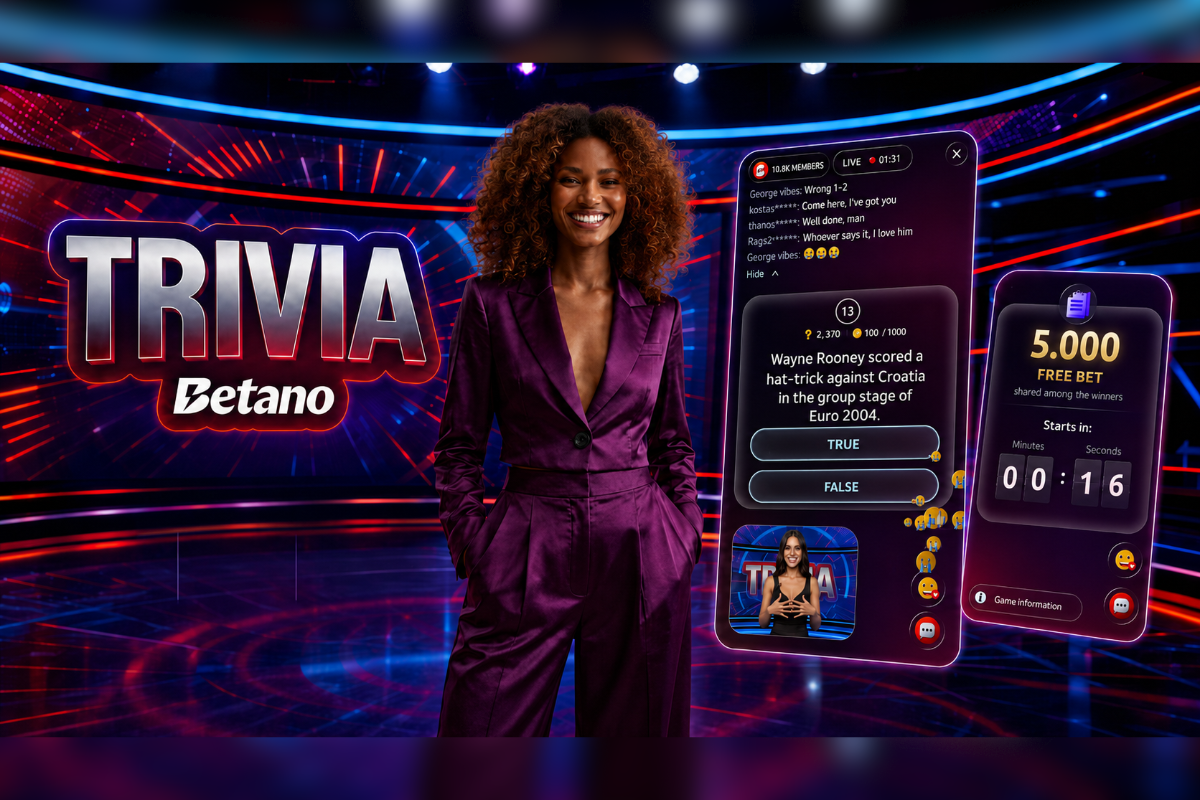
Kaizen Gaming has launched Betano Trivia, a live trivia product it describes as the world’s first fully GenAI-powered live trivia experience. The free-to-play game is now available across the 20 markets where Kaizen Gaming operates.
The product was developed by Kaizen Labs, the company’s innovation incubator. Kaizen Gaming said Betano Trivia uses generative AI to power the avatar presenter, create dynamic trivia content, and generate supporting audiovisual assets, positioning it as a new engagement format inside the Betano brand.
Players are invited to answer questions spanning sports, entertainment and pop culture and compete for prizes, according to the company. Kaizen Gaming also tied the timing of the launch to heightened global football attention, pitching the game as a second-screen-style entertainment layer for fans.
George Kourakos, Director of Innovation at Kaizen Gaming, stated: “Betano Trivia demonstrates how AI can be used to create entirely new forms of entertainment and customer engagement. At Kaizen Gaming we never use technology for its own sake. We have a clear goal to elevate the world-class gaming experience we offer to our customers. What makes this achievement particularly special is that it was developed entirely by our internal teams, combining creativity, engineering excellence and a shared passion for innovation across the board.”
Kaizen Gaming framed the release as part of its broader generative AI push, arguing that internal teams can use the technology to scale new product experiences across multiple regulated markets.
The post Kaizen Gaming rolls out GenAI-powered Betano Trivia across 20 markets appeared first on EE Gaming | Global iGaming & Tech Intelligence Hub.

Deal expands ELA Games’ distribution under its Hellenic Gaming Commission licence, with localized titles now live on Fonbet’s Greek site.
ELA Games has partnered with Fonbet to roll out a selection of its slot titles to Greek players via Fonbet.gr.
The supplier said the integration makes its portfolio available through Fonbet’s Greek-facing operation, including titles such as Piñatas Festival, Flame Fruit Frenzy and Riches Express. The release positions the launch as a lobby expansion for Fonbet and a further distribution step for ELA Games in the market.
ELA Games said the deal builds on its existing presence in Greece, citing its Hellenic Gaming Commission licence. The company also claimed active users in Greece rose 86.3% over the last two quarters, while bet counts increased 201.9% over the same period.
Yaroslav Soloshenko, Business Development Team Lead at ELA Games, said: “Partnering with Fonbet is a brilliant step forward for our brand visibility in Greece. The Greek market means a great deal to us and has been a strong focus for our growth strategy recently. Having our content available on their well-respected platform allows us to showcase the true depth of our portfolio to a dedicated audience. We welcome the opportunity to offer players and partners a full, detailed presentation of the immersive mechanics, unique art styles, and gamified features our team puts into every single release.”
The post ELA Games adds slots portfolio to Fonbet.gr in Greece appeared first on EE Gaming | Global iGaming & Tech Intelligence Hub.

A Pioneering Premium Platform Connecting Organizations with Elite Compliance Professionals, Legal Operations Experts, and Trusted Industry Vendors
Europe — HIPTHER proudly announces the launch of HALLO (Highly Aligned Leaders in Legal Operations), a pioneering platform redefining how organizations discover, connect with, and engage compliance expertise.
Embodying the tagline “The Standard in Compliance Expertise,” HALLO combines a premium professional directory, industry intelligence hub, community platform, and visibility ecosystem into a single destination for compliance professionals and the organizations that rely on them.
At a time when regulation is becoming more complex across gaming, fintech, payments, AI, cybersecurity, digital identity, AML, blockchain, and emerging technologies, the need for trusted expertise has never been greater. HALLO addresses that challenge by creating a structured environment where qualified professionals, legal operations specialists, compliance leaders, and service providers can be discovered, evaluated, and engaged with confidence.
Beyond a Directory
HALLO is built as more than a professional directory.
It serves as a dedicated ecosystem for compliance excellence, enabling organizations to identify the right expertise while giving professionals a platform to showcase their experience, achievements, thought leadership, and industry contributions.
Memberships Tailored for Professionals and Organizations
HALLO offers flexible participation options designed to support everyone from independent compliance professionals to large organizations building regulatory, legal, and compliance capabilities.
There is an Individual Professional Membership available as well as an Enterprise Membership for teams and organizations seeking expanded access, visibility, and networking opportunities. All memberships include a 14-day free trial.
Free Expert Profiles, Premium Visibility Opportunities
One of HALLO’s core principles is making compliance expertise discoverable.
Compliance professionals can join HALLO free of charge as Experts, creating publicly visible profiles that showcase their experience, areas of specialization, professional achievements, and industry expertise.
Whether joining as an independent expert, a growing consultancy, or an established enterprise, HALLO provides multiple pathways to build credibility, expand reach, and engage with a highly targeted audience of compliance, legal, regulatory, and operational decision-makers.
Introducing HALLO Resources: A Living Compliance Intelligence Hub
Alongside its directory and community functions, HALLO launches with one of its most powerful features: HALLO Resources.
The Resources section serves as a continuously updated compliance intelligence center featuring more than 17,000 regulatory and compliance-focused articles, bringing together regulatory updates, jurisdictional developments, enforcement news, legal analysis, compliance guidance, and industry intelligence from across the HIPTHER media network.
Designed to support both practitioners and decision-makers, HALLO Resources offers:
- Daily updates with continuously refreshed content
- Powerful search functionality by topic, jurisdiction, and keyword
- Open access with no login required
- Coverage spanning gaming, fintech, AI, payments, AML, digital policy, cybersecurity, and regulatory affairs
By combining expert discovery with practical intelligence, HALLO is a daily destination for compliance professionals.
Advertising & Thought Leadership
HALLO also introduces premium visibility opportunities through the Wayseers Booklet, the annual compliance handbook distributed at HIPTHER conferences across Europe.
The publication reaches more than 1,500 professionals across gaming, fintech, AI, compliance, and regulatory sectors, creating a unique opportunity for organizations to showcase expertise, promote services, and contribute thought leadership to the wider compliance community.
Advertising opportunities range from directory listings to half-page, full-page, and double-page placements through Standard, Premium, and Platinum packages.
Furthermore, HALLO serves as a trusted source of compliance expertise for HIPTHER’s media and conference initiatives, creating additional opportunities for members to contribute thought leadership, industry insights, and expert perspectives.
Building the Future of Compliance Collaboration
With regulatory complexity increasing across industries and jurisdictions, HALLO arrives at a critical moment for businesses navigating compliance, governance, risk management, legal operations, and regulatory change.
Zoltan Tuendik, Co-Founder & Head of Business at HIPTHER, stated about HALLO: “Navigating the modern regulatory landscape requires more than just standard legal advice; it demands highly specialized, agile compliance expertise. With the launch of HALLO, we are bridging the critical gap between organizations facing complex global standards and the elite professionals who can guide them through. By combining an active directory with a massive intelligence hub, we are setting a new standard for compliance collaboration and empowering businesses to move forward with absolute confidence.”
Join HALLO
Compliance professionals can create their Expert profiles free of charge.
Organizations can explore Professional and Enterprise memberships through a 14-day free trial.
For more information, visit: https://hallocompliance.net/
The post HIPTHER Launches HALLO: The Standard in Compliance Expertise appeared first on EE Gaming | Global iGaming & Tech Intelligence Hub.

-

 América Latina6 days ago
Las diferencias locales de Argentina representan tanto un desafío como una oportunidad para el sector del iGaming
-
Africa6 days ago
Booming Games signs content deal with World Sports Betting in South Africa
-
Latest News6 days ago
Connect with N1 Partners at G Gate Conf 2026
-
game-launch6 days ago
Million Games launches East West Wild slot with progressive multipliers
-
Gmonitor.ai6 days ago
Gmonitor llega a Latinoamérica: la plataforma de inteligencia de mercado para operadores debuta en seis mercados regulados
-
 Latest News6 days ago
Sportradar Report | World Cup 2026: Opportunities for the Latin American Sports Betting Market
-
eSports7 days ago
G2 partners with PUBG MOBILE Esports to scale Western Europe competition
-
AI6 days ago
Veikkaus rolls out OpenBet’s Neccton responsible gambling platform ahead of 2027 reform