blask
When LATAM gambles: Blask reveals seasonality patterns across six countries

Brazil, Argentina, Mexico, Chile, Peru, and Colombia — six markets, six regulatory environments, six distinct player bases. Yet they share the same underlying drivers: domestic football leagues wrapping up in Q4, mandatory year-end bonuses injecting billions into the economy, and national holidays that can stretch into week-long celebrations.
The regional patterns are clear, the local nuances — less so. Peru’s players favor daytime weekend sessions while Mexico sees peak activity at 2 AM. Chile’s biggest month isn’t December but September. Colombia’s engagement follows primetime TV schedules almost exactly.
We used Blask’s Seasonality feature to analyze player activity across all six markets and map when engagement peaks — by month, by day, and by hour. Here’s what the data shows.
Brazil: Q4 convergence
Three factors converge at year’s end to make November–December the peak season. The Brasileirão wraps up in early December, with title races and relegation battles driving betting interest through the final matchdays. Copa Libertadores semis and final fall in October–November — and Brazilian clubs have won seven straight editions, keeping local engagement at maximum.

The timing also aligns with the décimo terceiro, Brazil’s mandatory 13th salary paid in two installments by November 30 and December 20. In 2024, this injected R$321 billion into the economy, part of which flows into entertainment spending, including betting.
Saturday edges out Sunday as the peak day, driven primarily by the Brasileirão match schedule — most fixtures are concentrated on Saturday evenings, creating a natural betting window around live games.
Weekends see the highest activity, with a notable spike between 1 AM and 5 AM on Friday-to-Saturday nights. After a long workweek, players unwind with casino games and place bets on upcoming weekend fixtures.
Argentina: Aguinaldo season
December stands out as the peak month, driven by the same mechanics as Brazil: the Liga Profesional wraps up in mid-December, and the aguinaldo (Argentina’s mandatory 13th salary) lands in two installments — by June 30 and December 18. The year-end payout coincides with league finales and playoff drama, creating a natural surge in betting activity.
Sunday leads the weekly cycle, with Saturday close behind — both days see concentrated Liga Profesional fixtures.

The peak window of midnight to 3 AM on Saturday-to-Sunday nights reflects pre-match anticipation. Players stay up late placing bets on Sunday’s fixtures and unwinding with casino games after the week ends.
Mexico: Liguilla time
December marks the peak month, coinciding with the Liga MX Apertura playoffs (Liguilla) that culminate in the championship final in mid-December. The aguinaldo — Mexico’s mandatory Christmas bonus equivalent to at least 15 days’ salary — must be paid by December 20, injecting extra disposable income right as the league crowns its champion.

Sunday leads the weekly cycle, with Saturday close behind. Liga MX spreads fixtures across the week, but weekend evenings remain prime time, with regulations requiring final-round matches to be played on Sunday prime time to maximize TV audiences.
The consistent 2–3 AM peak across all days — amplified on weekends — points to a strong late-night gambling culture. This suggests casino verticals (slots, crash games, live dealer) drive the pattern as much as sports betting, with players staying up late regardless of whether matches are on.
Chile: Fiestas Patrias peak
September dominates the calendar thanks to Fiestas Patrias — Chile’s most important national holiday, celebrated more intensely than Christmas. The festivities center on September 18-19 but often stretch into a full week when dates align favorably. Fondas (temporary festival venues) stay open late with music, dancing, and drinking, creating a nationwide party atmosphere that naturally spills over into online gambling.

Saturday is the clear leader, with activity elevated throughout the entire day. The strongest peaks hit around midnight on Friday-to-Saturday nights and again during Saturday afternoon (3–5 PM local time) — a pattern that suggests both late-night casino sessions and daytime sports betting on weekend fixtures.
Peru: Purple month
October–November emerges as the peak period, with November slightly ahead. The timing aligns with the Clausura tournament’s decisive final stretch — Liga 1 wraps up its regular season in early November before playoffs. October is also Peru’s “purple month” dominated by Señor de los Milagros, the country’s largest religious festival with massive processions on October 18, 19, and 28. The celebrations flow directly into All Saints’ Day (November 1) and Day of the Dead (November 2), creating an extended festive atmosphere across both months.

Saturday and Sunday share the spotlight, with Liga 1 fixtures spread across both weekend days. The emphasis on morning and afternoon hours — rather than late night — distinguishes Peru from its neighbors.
The daytime activity pattern on weekends (morning to afternoon) likely reflects match kick-off times and a cultural preference for daytime leisure. Unlike Brazil or Mexico where late-night casino sessions drive activity, Peru’s peak hours suggest sports betting around live Liga 1 fixtures takes precedence over casino play.
Colombia: Cuadrangulares and prima de servicios
November takes the lead as peak month, with October close behind. The Torneo Finalización enters its decisive phase during these months — the cuadrangulares (semifinal groups) typically run through late October and November, with the championship final in mid-December. This playoff intensity coincides with anticipation of the prima de servicios, Colombia’s mandatory service bonus equivalent to half a month’s salary, due by December 20.

Sunday dominates the weekly cycle, with Saturday as a secondary peak. Liga BetPlay fixtures are spread across the weekend, but Sunday consistently draws the largest TV audiences and betting interest.
The evening peak on Sunday stands out — activity concentrates in prime time when Liga BetPlay matches are broadcast, suggesting sports betting drives the pattern more than casino play. Unlike markets with strong late-night casino cultures, Colombian players appear to time their gambling around live football action rather than after-hours sessions.
The bigger picture
The Q4 bonus cycle — décimo terceiro, aguinaldo, prima de servicios, gratificaciones — isn’t just a regional quirk. It’s a predictable liquidity event that hits six major markets within the same eight-week window, right as domestic football seasons reach their climax.
But timing isn’t uniform. A campaign that lands at 2 AM in Mexico might miss Peru’s daytime crowd entirely. September matters more than December in Chile. Sunday primetime drives Colombia, while Brazil peaks on Saturday nights.
The pattern is regional, but the execution has to be local.
The post When LATAM gambles: Blask reveals seasonality patterns across six countries appeared first on Americas iGaming & Sports Betting News.










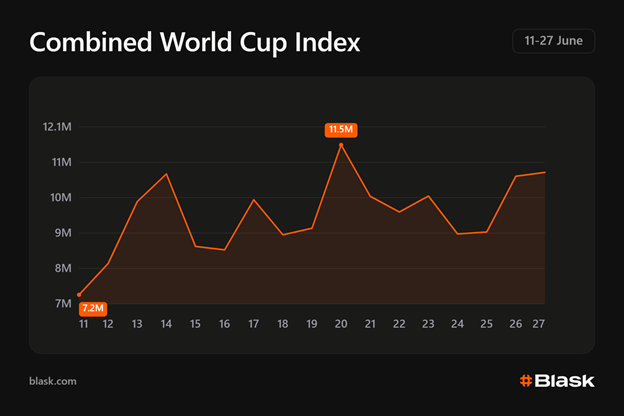
Search demand for the FIFA World Cup group stage in the US, Mexico and Canada did not peak uniformly across participating markets, according to new data from Blask tracking World Cup-related queries from 11 to 27 June.
Blask said it measures daily World Cup-related search demand at a country level and converts it into a “World Cup Index (WCI)”, based on the same logic as its Blask Index but adapted from brand-level search to event-related keyword demand. The dataset covers 43 countries out of 48 participating in the tournament, excluding Iran, Uzbekistan, Iraq, Cape Verde and Curaçao because Blask said its tracker’s Category feature is not yet available in those markets.
Across the 17-day group stage window, Blask reported that only 12 days produced a peak WCI in at least one country. Five days — 11, 15, 18, 19 and 22 June — were not the top day for any market in the sample.
At the other end of the range, the final group matchday, 27 June, produced peak WCI in 16 countries: Algeria, Argentina, Austria, Belgium, Colombia, Croatia, the Czech Republic, Ecuador, Egypt, France, Japan, Panama, Portugal, Qatar, Saudi Arabia and Uruguay. Two other dates saw seven markets peak each: 14 June (Canada, Germany, Haiti, the Netherlands, Turkey, England and Scotland) and 26 June (Australia, Brazil, Ivory Coast, Mexico, Paraguay, Senegal and Sweden).
Blask also pointed to the weight of the US in combined demand. While 27 June had the most country peaks, Blask said the highest day for combined World Cup-related search demand was 20 June, when the United States peaked. “The US alone makes up 26–36% of combined interest,” the company said. Blask added that the US pattern did not fully align with the combined total, with the US’s weakest day at 15 June and its smallest share of total interest on 27 June.
The post Blask data shows uneven World Cup search peaks across group stage appeared first on EE Gaming | Global iGaming & Tech Intelligence Hub.
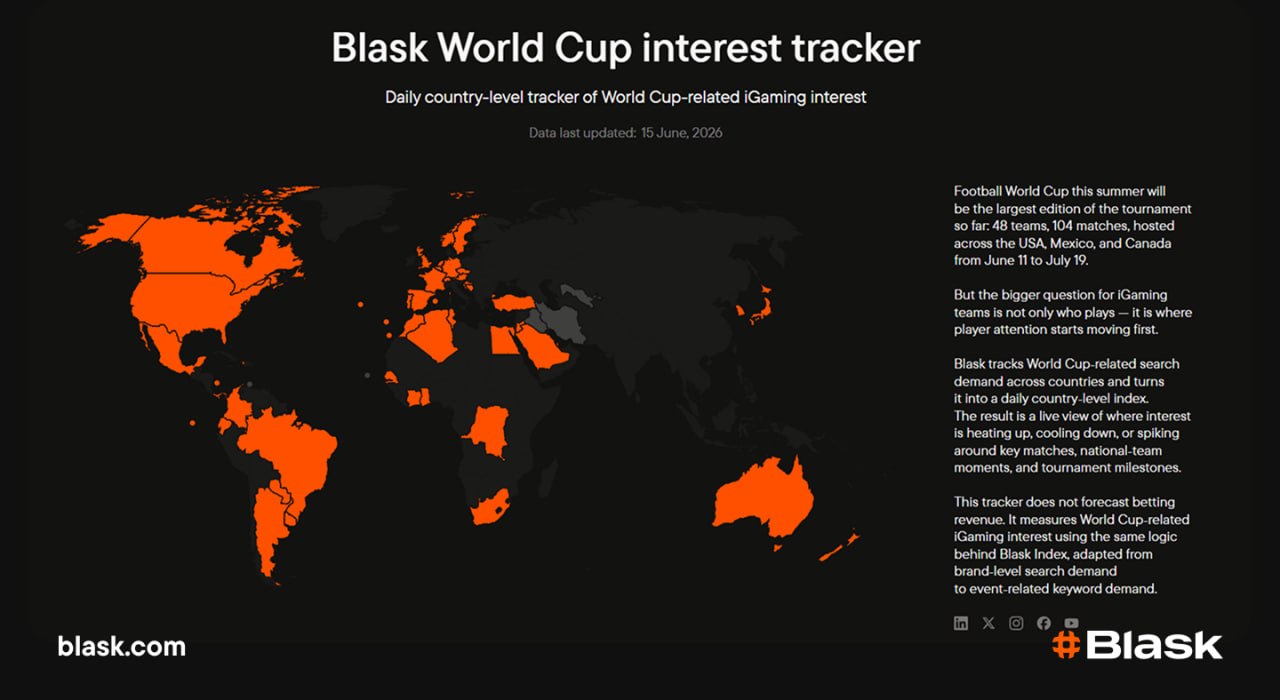
Blask has launched the Blask World Cup Index, a free interactive map showing daily interest across the majority of the 48 nations competing in the 2026 tournament. It runs for the duration of the competition.
Blask updates the map every 24 hours. Countries where interest towards the major football tournament grows over the previous day turn green. Countries where it fell turn red. Unchanged markets stay grey. Hover over any country for a quick snapshot, click through for a multi-day view, or follow the leaderboard of the fastest-rising and falling markets.
What the Blask World Cup Index measures
Blask World Cup Index draws from the Blask Index, Blask’s measure of iGaming search volume within a given market. On the landing page it tracks football related categories: how actively people in each country are searching for odds, match markets and other football-related content tied to the 2026 tournament.
Country cards show day-by-day trends; a daily leaderboard surfaces the daily World Cup Index and its change with the previous day. Visitors can track how interest in their country builds in the days before their team’s next match and how fast it collapses after an exit. The leaderboard shows which nation leads the index and how that position shifts with results. For operators and affiliates, the most actionable view is a market where interest is growing faster than the team’s performance would predict — the signal that precedes a volume spike.
After a 4-1 victory over Paraguay, the United States leads our World Cup Interest Index with 14.4 million demand points — more than three times ahead of second-placed Brazil (4.28 million), despite the Seleção’s global popularity. Germany sits third with 3.15 million following a 7-1 win over Curaçao, while England (2.53 million) and Egypt (2.22 million) round out the top five ahead of their opening group-stage matches.
To put the 2026 data in context, Blask has published two research reports drawing on iGaming activity across the 2018 and 2022 World Cups — one covering six European markets (UK, Germany, France, Spain, the Netherlands, Italy), one covering six LATAM markets.
The data shows the effect is not automatic: Germany posted positive acquisition signals at both tournaments despite group-stage exits; Peru surged +41% in 2022 without qualifying; Colombia fell 14% the same year.
Both reports include country-level APS data, cross-market patterns, and 2026 projections.
The post New Blask heatmap tracks real-time interest across World Cup 2026 nations appeared first on EE Gaming | Global iGaming & Tech Intelligence Hub.
3 Oaks Gaming
Pragmatic Play leads across Europe while RTG and 3 Oaks Gaming dominate US and Australia, new Blask data shows

Tier-1 casino lobbies are becoming less concentrated as regional challengers gain ground.
New data from Blask reveals that while Pragmatic Play remains the dominant game provider across most tier-1 European iGaming markets, regional dynamics are becoming increasingly fragmented as competitors such as Playtech, Evolution, Hacksaw Gaming, RTG and 3 Oaks Gaming rapidly expand their positions in local casino lobbies.
According to Blask’s latest analysis of tier-1 operator lobbies across Europe, North America and Australia, no single provider now holds an overwhelming market monopoly in most mature jurisdictions — with several countries showing signs of diversification and aggressive competition between suppliers.
In the United Kingdom, Pragmatic Play retained the leading position despite its market share declining year-over-year from 15.53% to 13.99%. At the same time, Reel Kingdom nearly doubled its presence, while Playtech also strengthened its position, reflecting increasing pressure on the long-time market leader.
Spain emerged as one of the most competitive European jurisdictions. While Pragmatic Play and Playtech both expanded their shares, the standout growth came from Evolution, which surged from 0.33% to 5.58% in just one year, signaling a major expansion of live casino content within the market.
Italy showed an even sharper shift toward supplier parity. Pragmatic Play and Playtech both lost substantial market share year-over-year, leaving the country without a clearly dominant provider. Evolution also accelerated its presence in the market, growing from 0.13% to 3.41%.
Germany remained one of Pragmatic Play’s strongest territories despite a decline from 17.39% to 14.40%. However, the market’s fastest-growing supplier was Hacksaw Gaming, which more than doubled its share and entered direct competition for a top-tier position.
France demonstrated one of the most balanced supplier landscapes in Europe. While Pragmatic Play overtook Play’n GO to become the leading provider in 2026, the difference between major suppliers remains minimal, suggesting that player demand in the country is spread across a wide range of content studios.
The Nordic markets also showed signs of changing player preferences. In Sweden, all top-five providers lost market share year-over-year while smaller suppliers expanded, indicating rising demand for newer studios. Denmark showed particularly strong momentum for Evolution, whose growth correlated with increasing live casino demand tracked by Blask.
Outside Europe, market structures differed significantly.
In the United States, RTG remains the dominant supplier with an 18.05% share, far ahead of competitors that struggle to exceed the 6% threshold. Meanwhile in Australia, 3 Oaks Gaming emerged as the leading provider, narrowly competing with Playson in one of the most distinct supplier ecosystems among tier-1 markets.
“Tier-1 markets are no longer moving toward monopoly dynamics,” said Vitaly Zubtsov, Head of PR at Blask. “What we see instead is fragmentation: local player preferences, live casino expansion, and new-generation studios increasingly reshape supplier hierarchies country by country.”
The report is based on Blask’s proprietary lobby-tracking technology, which continuously monitors game visibility and supplier presence across major regulated iGaming markets.
The post Pragmatic Play leads across Europe while RTG and 3 Oaks Gaming dominate US and Australia, new Blask data shows appeared first on Eastern European Gaming | Global iGaming & Tech Intelligence Hub.

-

 Africa7 days ago
Booming Games renews Hollywoodbets Durban July activation partnership
-
Africa6 days ago
SpringbokCasino ties July free spins to ‘Minions in the Wild’ campaign
-
Evoplay7 days ago
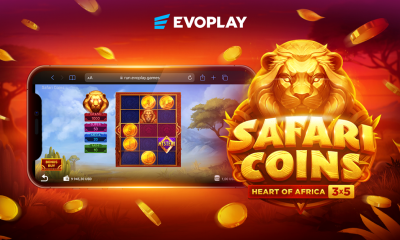
Evoplay launches Safari Coins slot with fixed jackpots and collector mechanic
-
Baltics7 days ago
From Ronaldinho Roulette to Next-Generation Game Shows: How CreedRoomz is Expanding Live Casino Entertainment
-
game launches7 days ago
Habanero launches Happy Hatchlings slot with screen-wide Wild transforms
-
 Arizona Department of Gaming6 days ago
Arizona Department of Gaming Concludes Legislative Session with Approved Agency Continuation and Enhanced Spending Authority for Problem Gambling
-
Amusnet6 days ago
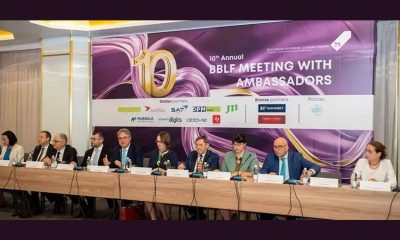
Connecting Business and Diplomacy: Amusnet Supports BBLF’s Annual Meeting of the Diplomatic Corps
-
Andreas Ottenschläger7 days ago
Austria: Draft bill entered parliamentary consultation