Gambling in the USA
Here Comes the Hot Stepper: AGS Unveils its First Mechanical Stepper and More at IGA 2024

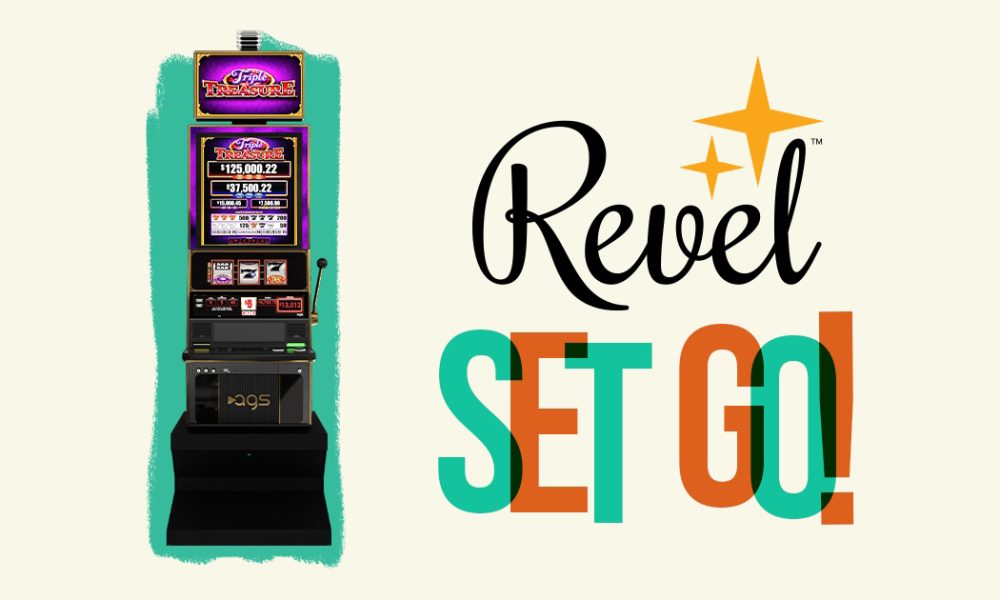
AGS, a global gaming supplier of high-performing slot, table, and interactive products, steps into a new vertical as it unveils its first mechanical reel cabinet among a diverse lineup of new products at the 2024 Indian Gaming Association (“IGA”) trade show in Anaheim, CA.
AGS is set to sizzle with a stunning array of new products, from mesmerizing slot hardware and cutting-edge core and premium games to its ultra-reliable card shufflers, award-winning table progressives, and growing library of online games.
Where Nostalgia and Modern Technology Collide
At IGA in booth 460, AGS transcends time with the highly anticipated launch of its classic Revel cabinet. Featuring traditional stepper elements reminiscent of gaming’s golden age, Revel transports players back in time with its authentic jackpot bell, mechanical arm-pull, and champagne gold accents. The classic-meets-modern cabinet seamlessly interlaces approachable modern touches such as game-state controlled reel LED lights and a vivid 4K high-definition video paytable display, all framed by AGS’ iconic twinkling eclipse lighting. The combination of these features sets the framework for AGS to offer unmatched three-reel games, including the first four mechanical stepper games premiering at IGA: Triple Treasure, Liberty Diamond, Flaming Reels, and Diamond Reels.
Heavy-Hitters Stepping Up to the Plate
But that’s not all – AGS will reveal new core and premium games to support its recently launched Spectra UR49 and Spectra UR43 Premium form factors, including the Triple Coin Treasures Gold brand extension from the award-winning Triple Coin Treasures® games and the trending Bacon Riches games displayed on the chart-topping Spectra UR43 portrait cabinet.
The Crescendo of Online Gaming
AGSi, AGS’ Interactive division, is making waves in the online gaming world, earning the number two spot in the most recent Eilers-Fantini Online Game Performance Report and picking up momentum leading into IGA with its successful cross-channel debut of Rakin’ Bacon Odyssey® in New Jersey and its expansion with multiple operator partners in West Virginia. AGSi continues executing on its game roadmap with new high-performing real-money online games released into the market–most recently earning five spots per the March ‘24 Eilers-Fantini Online Game Performance 25 New Top Game Ranks: Platinum 8X8X8X (#2), AGSi’s interactive-first game Double Shamrock (#14), Rakin’ Bacon Deluxe® Golden Blessings® (#16), Gold Inferno® (#21), and Mine Blast (#25).
Bringing Industry-Leading Innovations to the Table
AGS’ single-deck shuffler, Pax S® will be on display at IGA. Its unmatched reliability provides operators with more optionality, and its hassle-free setup has made it possible to quickly go live in over 65 casinos across 20 states and provinces since first launching in 2022. In addition, AGS’ award-winning side bet progressive system Bonus Spin Xtreme continues to create celebratory jackpots by linking all table games on a floor and recently awarded its highest progressive jackpot to date of over $1.5 million. The Tables division continues to innovate on the popular progressive system and will showcase an added high-hand option to operators looking to award players for high-ranking hands.











Arizona Department of Gaming
Arizona Department of Gaming Concludes Legislative Session with Approved Agency Continuation and Enhanced Spending Authority for Problem Gambling

Department is continued for six years to regulate an extensive portfolio: tribal gaming, event wagering and fantasy sports, horse racing and simulcast wagering, and boxing and mixed martial arts
State budget includes a 20 percent increase in problem gambling treatment and prevention appropriations
The Arizona Department of Gaming (Department) announced today that with Governor Hobbs’ signature on Senate Bill 1671, the Department has received continuation approval by the Arizona State Legislature, which periodically reviews state agencies for performance and authority. Additionally, through Senate Bill 1847 and the state’s Fiscal Year 2027 budget, the Department’s Division of Problem Gambling received expanded expenditure authority, enabling additional investments in problem gambling prevention, education, treatment, and recovery services across Arizona.
“Arizona first established the Department of Gaming in 1995 – and more than thirty years later, we remain excited about world-class regulation benefiting the entire state,” said Jackie Johnson, Department Director. “I’m grateful to Governor Hobbs and leaders in the state legislature, particularly continuation bill sponsor State Senator Shawnna Bolick, who thoroughly reviewed our agency with a deep commitment to public service, and I am pleased that the Department secured its continuation, which will allow us to strengthen our focus points in robust consumer protection and integrity.”
The Department, the Arizona State Boxing and Mixed Martial Arts Commission, and the Arizona Racing Commission are continued by the legislature for six years, per the enactment of Senate Bill 1671, sponsored by Senator Shawnna Bolick, in the 2026 legislative session that adjourned on June 12, 2026. This continuation affirms the Department’s and both Commissions’ authority to carry out the roles and responsibilities delegated by the legislature.
The Department’s Division of Problem Gambling marked the legislative session with the passage of a new state budget that grants $4,000,000 in total authorized spending for the Division. The $4,000,000 authority represents a 20 percent increase from the FY26 budget. Additionally, the legislature granted an annual $500,000 expenditure authority for the agency to use Event Wagering funds to support problem gambling. Finally, the Division will have grant oversight authority for the first time– allowing the Division to expand programs to assist those in need.
“The new state budget will strengthen longstanding investments in problem gambling assistance made possible through partnerships with Arizona’s Tribal Nations and the Arizona Lottery,” said Elise Mikkelsen. “We continue to see strong demand from individuals and families seeking information, resources, and treatment for gambling-related harm. This increased funding will help us expand the continuum of care and ensure more Arizonans have access to effective, inclusive, and timely support.”
In addition to supporting the Division in state-wide access to problem gambling prevention and treatment, the Department is actively engaged in responsible gaming and safer play initiatives. Now in its first year of the campaign, the Department’s Take Back the Game initiative in partnership with the Arizona Media Association is raising awareness of gambling self-exclusion options available through the agency. The campaign, which runs in English and Spanish across Arizona media outlets, lets viewers know that if gambling is no longer fun, they can Take Back the Game and self-exclude from Arizona casinos, sportsbooks, and fantasy sports operators. Also in 2026, the Department’s Too Young to Bet campaign emphasizes the risks associated with youth gambling.
To learn more about the Arizona Department of Gaming, visit gaming.az.gov. To learn more about problem gambling prevention and treatment, visit problemgambling.az.gov.
The post Arizona Department of Gaming Concludes Legislative Session with Approved Agency Continuation and Enhanced Spending Authority for Problem Gambling appeared first on Americas iGaming & Sports Betting News.
Gambling in the USA
Wind Creek Hospitality Celebrates “Winner Takes All” Champion After $1 Million Win, Chance at Up to $11.8 Million
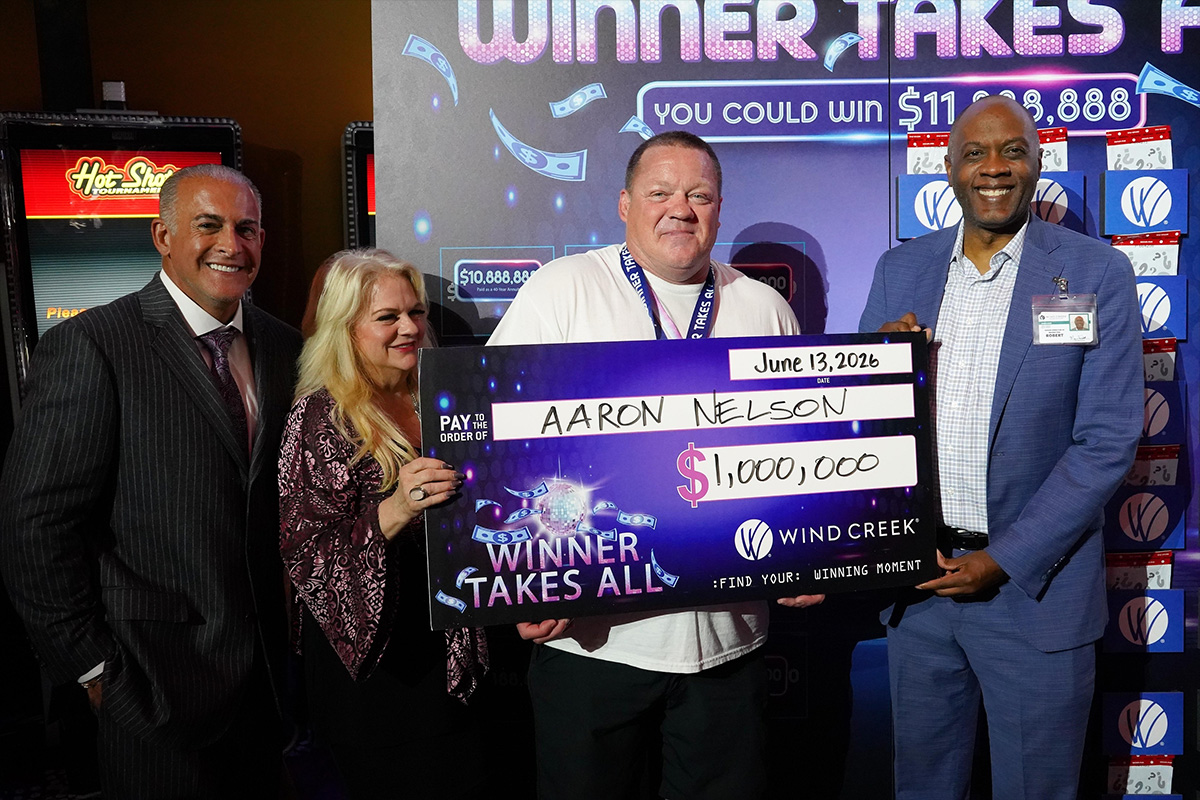
Wind Creek Hospitality has announced the winner of its cross-property “Winner Takes All” casino promotion, which culminated in a championship event held at Wind Creek Chicago Southland. The event brought together finalists from across Wind Creek’s portfolio for a high-stakes grand prize championship competition and VIP Guest experience.
Finalists qualified through slot tournaments at their home properties and advanced through quarterfinal and semifinal rounds before earning their place in the final championship event in Chicago. The finale featured a series of timed slot tournaments held on June 13, progressively narrowing the field of competitors through elimination rounds until the final winner was determined.
At the conclusion of the tournament on June 13, Aaron Nelson from Wind Creek Atmore was crowned the winner of the “Winner Takes All” competition, claiming a $1,000,000 prize in the tournament’s final round, and earning the opportunity to compete for the promotion’s ultimate grand prize of up to $11,888,888. “Winner Takes All” finalists were also awarded more than $200,000 in cash and prizes in the finale tournament, including a $100,000 second-place prize followed up by a drawing with a $50,000 prize pool, including a $25,000 top prize and multiple $1000 prize winners.
In addition to the competition, finalists participated in curated Wind Creek Rewards experiences designed to highlight Chicago’s cultural and hospitality offerings. Experiences included a Chicago River architectural boat cruise and a guided Chinatown culinary tasting tour, alongside a welcome reception featuring food and beverage service. Travel and accommodations were provided by Wind Creek Hospitality as part of the finalist experience.
The “Winner Takes All” promotion marked one of Wind Creek Hospitality’s most expansive cross-property tournament experiences, combining competitive gaming with destination-based Guest programming and elevated hospitality.
The post Wind Creek Hospitality Celebrates “Winner Takes All” Champion After $1 Million Win, Chance at Up to $11.8 Million appeared first on Americas iGaming & Sports Betting News.

Limited-run “Super By Superbet” launch includes the “Camisa Cafu,” with 150 numbered and signed units referencing his 150 Brazil caps.
Superbet honored former Brazil captain Cafu on Monday (15) with a campaign displayed on a Times Square billboard in New York City. The company said the activation promoted its “Super By Superbet” exclusive collection created for the 2026 edition, which includes a special piece dedicated to the player.
According to the company, Cafu attended the display in person, drawing a crowd of fans seeking photos and chanting his name in one of the city’s busiest tourist areas.
“The shirt is wonderful. I feel very happy for all the incredible moments I’ve experienced here. I receive so much affection everywhere I go. Receiving recognition while still alive is one of the best things in the world.”.
“It’s an inexplicable energy to feel the love of the Brazilian people for me, right there in Times Square. Only we Brazilians know what that means.”
The centerpiece of the launch, which Superbet said totals 3,000 pieces, is the “Camisa Cafu.” The item is a limited run of 150 numbered and autographed units, which the company said references Cafu’s 150 matches for the Brazilian national team, and includes the inscription “Jardim Irene,” highlighting the player’s roots.
The post Superbet honors Cafu with Times Square campaign for 2026 collection appeared first on Americas iGaming & Sports Betting News.

-

 Asia7 days ago
PhilWeb Secures ₱2.02 Billion Strategic Investment from Lance Y. Gokongwei to Accelerate AI-Driven Technology Expansion
-
Africa7 days ago
BGaming signs PlaylogiQ distribution deal to grow Africa reach
-
BGaming7 days ago
LatAm: Beyond Brazil – Chile, Uruguay and Peru’s Regulatory Trajectories
-
Canada6 days ago
Gaming Corps goes live with OLG iCasino in Ontario
-
Compliance Updates6 days ago
PlayCity Partners with Streaming Platform Kick to Block Illegal Gambling Ads
-
3 Oaks Gaming6 days ago
Weekend Reels | Week 26: Slot Drops & Trends
-
3 Oaks Gaming6 days ago
3 Oaks Gaming releases Joker Glitz x1000 slot with stacked multipliers
-
Latest News6 days ago
Relax Gaming Releases its Latest Slot Game “Midnight Marauder – ClusterBreaker”