Betnacional
PRAGMATIC PLAY TAKES MULTI-PRODUCT OFFERING LIVE WITH BETNACIONAL IN BRAZIL

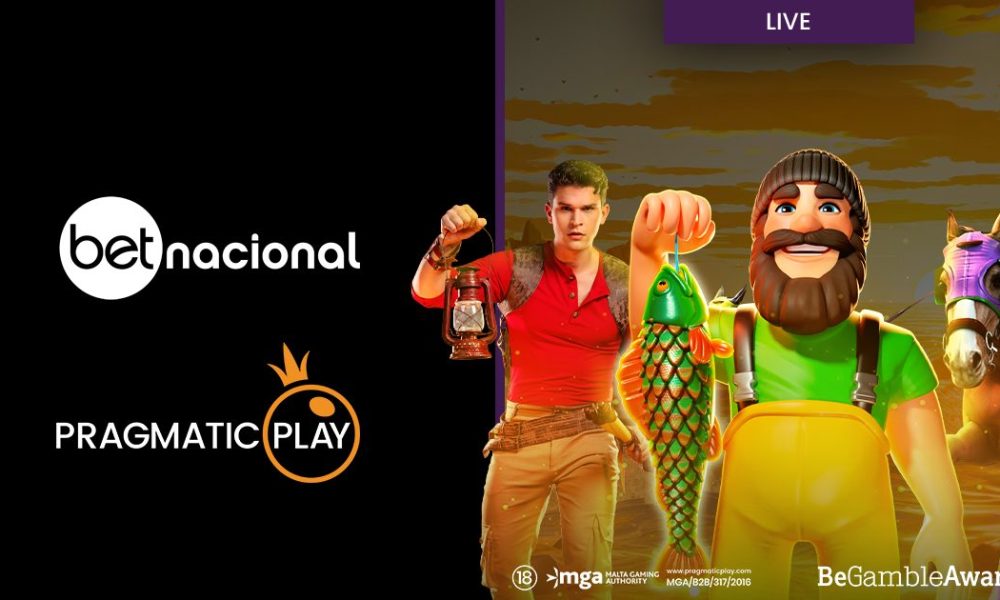
The provider rolls out three of its popular verticals with Betnacional in Brazil
Pragmatic Play, a leading content supplier to the iGaming industry, has taken three of its popular product suites live with Betnacional, the leading Brazilian brand.
Players of the NSX-owned brand can now enjoy Pragmatic Play’s expansive collection of Slot games, including the hugely popular Big Bass series, as well as Sweet Bonanza and Gates of Olympus.
As part of the deal, Pragmatic Play’s portfolio of groundbreaking Live Casino products is also now live for Betnacional customers, including player favourites such as Vegas Ball Bonanza and Sweet Bonanza CandyLand alongside classic live dealer titles such as Blackjack and Roulette.
Furthermore, players can now enjoy the supplier’s acclaimed range of immersive Virtual Sports titles, including horse and greyhound racing alongside popular release Force 1.
Pragmatic Play continues to build upon its impressive position in the Latin American market, with a significant presence in multiple jurisdictions. The partnership follows recent signings with the likes of Salsa Technology and Jogar.com.vc, with the supplier’s content continuing to perform exceptionally well in the market.
Victor Arias, Vice President of Latin American Operations at ARRISE powering Pragmatic Play, said: “Betnacional is an emerging brand throughout Brazil, and I’m thrilled Pragmatic Play is further strengthening its position in the Latin American market through this partnership”.
“Pragmatic Play has seen tremendous success in the region with its wide range of Slots, Live Casino and Virtual Sports products, and I am confident that visitors to the Betnacional brand will embrace and enjoy everything on offer.”
Luiz Andrade Lima from Betnacional, added: “Pragmatic Play continues to be one of the most in-demand suppliers throughout Latin America, and especially in Brazil, so we’re extremely excited to be bringing its titles to our casino.
“Taking such a comprehensive array of content live has allowed us to start 2024 with a real statement of intent, and we’re confident we’ll reap the rewards.”













Betnacional
Brazil: Betting pressures household budgets and reshapes the competition for consumer spending

As the industry prepares for BiS SiGMA South America 2026, the largest and most influential iGaming event in Latin America, real market data begins to reveal a profound transformation in the behavior of the Brazilian consumer.
It is no longer just about “betting volume”, but about a reconfiguration of the Share of Wallet (participation in household spending).
The unprecedented study “Bets na Mesa, Consumo em Jogo”, carried out by NielsenIQ Brazil, sheds light on a reality that will be the center of technical debates at the Transamerica Expo Center: in 2025, 26.3% of Brazilian households participated in some form of betting.
This figure is not just a number; it is the reflection of a “new parallel shopper journey” that is capturing the attention and income of the population.
Radiography of Consumption: Who and what is being bet?
The Brazilian market in 2026 shows a clear fragmentation.
Despite the explosion of digital platforms, traditional modalities maintain notable resilience, creating a hybrid ecosystem between analog and digital.
Dominant Modalities
According to the NielsenIQ study, preferences are distributed as follows:
• Mega-Sena: 15.8% of households.
• Video Slots (such as the “Jogo do Tigrinho”): 7.7%.
• Jogo do Bicho: 3.9%.
• Sports Betting (Bets): 3.6%.
Socioeconomic and generational profiles in Brazil
The study reveals that bettors are not a homogeneous group. There is a marked division by Socioeconomic Level (SEL) and age:
• The Slots phenomenon: The “Jogo do Tigrinho” concentrates bettors from middle SEL (63.3%) and a notably young audience, with 42.4% of bettors up to 35 years old.
• The maturity of Mega-Sena: It predominates in high SEL (45.5%) and in a more mature profile, where 49.1% are over 51 years old.
As Gabriel Fagundes, Insights Leader for the Industry at NielsenIQ, points out: “We had already identified that betting became a popular and common practice in the routine of the Brazilian consumer.”
“Now, the numbers also point to the dimension that this practice is taking within household expenses and in the income of bettors.”
The Economic Motivation: Extra Income or Entertainment?
One of the most critical points for operators that will meet at BiS SiGMA is to understand the “why” behind betting.
The data from 2026 shows a diffuse frontier between gambling as leisure and gambling as economic hope.
For 49% of bettors, the main motivation is to obtain extra income, while 43.5% expect a “radical change of life”.
This second profile is more common in casual Mega-Sena players.
Classification by Intensity
The market is divided into three levels of commitment:
- Casual (73%): They play at least once a month.
- “Pro” (28%): They bet once a week. From this group, 65.8% seek extra income.
- “Elite” (9.3%): They bet weekly and spend more than R$ 100 per month.
This “gaming intensity” is, according to the study, the real driver of the economic impact on households, especially in the Northeast regions (29% penetration) and South (28.3%).
The Impact on Retail and the Consumption Basket
For the iGaming industry, understanding which expenses are being substituted is vital for sustainability and social responsibility.
The study reveals that only 10% of households admit substituting expenses directly for betting, but the affected categories are alarming.
Affected Categories
Among those who substitute expenses:
• Food: 47% of the cases.
• Fixed bills (water, electricity, internet): 45.3%.
• Beer: It is the category with the greatest retraction, registering a drop of 1.7 percentage points in the participation of spending.
• Cookies, perfumes and soft drinks: They also present negative impacts.
The main strategy of the consumer to accommodate spending on betting has been to reduce the quantity of items purchased; in fact, 60% of the consumption categories registered a decrease in the volume acquired in 2025.
Strategic Challenges for the Legal Market in 2026
The NielsenIQ data presents a direct challenge for brands and operators that seek to consolidate themselves in “Legal Brazil”.
The pressure on the domestic budget forces manufacturers of fast-moving consumer goods (FMCG) and betting operators to compete for the same currency.
“Betting is a new competitor in the consumer’s Share of Wallet.
This pressures manufacturers to act with more precision in communication, price and activation to recover relevance in front of this new competitor: the habit of betting itself.”
Towards BiS SiGMA 2026
As we approach the largest event in the region, this study serves as a warning and an opportunity. The Brazilian market of 2026 is mature, but it is under intense social scrutiny due to the impact on low-income families.
Operators that wish to have long-term success must:
- Differentiate the profiles: It is not possible to treat the young middle SEL slot player the same as the high SEL Mega-Sena bettor.
- Promote Responsible Gaming: The substitution of food and fixed bills for betting is a regulatory “red flag” that could tighten laws in the near future.
- Regional Innovation: The Northeast and the South are the markets with the highest intensity, requiring more aggressive localization strategies.
BiS SiGMA South America will be the perfect stage to discuss how the industry can grow without compromising the economic stability of Brazilian households, ensuring that iGaming is seen as entertainment and not as an unsustainable financial burden.
Superscore consolidates in Brazil and launches weekly analysis for the press.
The platform offers statistical analysis of the Brazilian Championship and of the main national and international championships, such as the Copa Libertadores, the World Cup and the Champions League, among others, with metrics that go beyond goals and assists for fans and sports experts.
Superscore Insights is the new newsletter for the press, with a weekly publication and another analysis of the latest news.
Superscore, a sports intelligence application associated with Superbet, advances and consolidates itself in Brazil as a strategic platform to transform data into reliable information for football fans in real time and without advertising.
With its own methodology, the solution establishes itself as a reference among sports fans, bringing together advanced statistics, rankings and in-depth analysis of the main tournaments, players and coaches in the country.
Now, the platform takes a new step with the launch of Superscore Insights, expanding its collaboration with the press by offering even more solid analysis, contextualized data and specialized support for sports coverage.
On Mondays, journalists will receive an exclusive bulletin with deep and original analysis of the weekend matches, a specialized analysis of the most important events of the day, as well as predictions and statistics of upcoming events.
With global coverage, Superscore already gathers more than 1,900 competitions, 63,000 teams and more than 480,000 monitored players, offering a solid base for historical and real-time analysis.
The data from Superscore comes from leading partners worldwide in the collection and distribution of sports data, the same ones used by Superbet and the main companies in the sector.
These providers offer high precision, low latency and comprehensive coverage of competitions worldwide.
“Superscore was born as a free sports intelligence application, without advertising, that goes beyond the basics by offering a wide database and statistics for those who want to understand the game in depth.
In just one year, it has already achieved thousands of users and grows approximately 30% monthly, climbing positions in the Google Play ranking.”
“The platform offers a solid experience for both fans and professionals, in addition to facilitating more informed decisions in sports betting, thus reinforcing the commitment to responsible gaming,” states Patrícia Prates, Marketing Director of Superbet and of the alliance with Superscore.
Superscore: Exclusive data and decades of history
In a context where sports coverage increasingly requires qualified data and contextualization, Superscore distinguishes itself by going beyond traditional indicators, incorporating metrics such as accurate shots, passes in the offensive third, tackles, recoveries, participation in decisive plays and time on the field, among other indicators.
These data are translated into the Superscore Score, a proprietary index that allows building Top 5 or Top 10 rankings of the best players of each round, with graphical visualizations and quick analysis.
Another differentiating factor is the expanded historical database, which gathers information from the Brazilian Championship since 1937, the Copa Libertadores since 1960 and the Champions League since 1992, which allows comparative analysis and identifying patterns over decades.
“We are talking about a platform built on a solid technological base, which combines a large volume of unique data, history and a team prepared to transform this information into relevant content for football fans.
Superscore organizes and translates these data so that they can also be used in sports coverage,” states Guilherme Simantob, director of Superscore in Brazil.
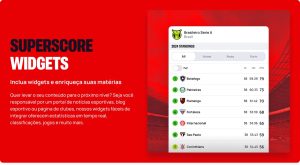
Superscore offers free and integrable widgets for the press and content creators, facilitating the incorporation of statistics, graphics and comparisons directly into articles, enriching journalistic narrative with reliable and visually accessible data.
The app is available in the App Store and Google Play.

Reevo arrives in Brazil with Betsson
Reevo has expanded its presence in Latin America after launching its aggregation platform and its own games catalog in Brazil in collaboration with Betsson.
The integration, carried out through a single connection, allows the operator to expand its content offering with Reevo’s own titles and third-party titles.
The movement reinforces the alliance between both companies and is part of a growth strategy in regulated markets, especially Brazil, considered one of the most promising in the region after regulatory advances.
From Betsson, Andrea Rossi highlighted the impact of the agreement by stating that the incorporation of Reevo’s content “expands the entertainment offer available for our players in one of the fastest-growing markets in the region.”
Additionally, both companies anticipated new joint expansions in other markets, after a recent launch also in Mexico.
Reevo continues to bet on its aggregation model as a way to facilitate access to multiple studios through a single integration, while expanding its global distribution network.
BTG launches prediction platform and increases the dispute between banks, stock exchange and betting
The launch of BTG Trends by BTG Pactual marks a new chapter in the growth of prediction markets in Brazil, intensifying competition between banks, the stock exchange and the betting sector.
This new platform allows investors to operate binary contracts (“yes” or “no”) based on probabilities about financial events, such as the dollar, the Ibovespa or interest rate decisions, using already regulated derivative instruments.
The movement is not isolated. The Brazilian stock exchange (B3) also advances in this direction, with the development of financial event contracts and digital derivatives, although restricted to professional investors.
At the same time, the platform XP established a partnership with Kalshi, facilitating access for Brazilian investors to international predictive markets, while new startups such as VoxFi explore broader applications, including geopolitics and culture.
At a global level, these markets have gained relevance and volume, driven by platforms such as Polymarket and Kalshi.
However, their regulation continues to be a subject under debate. In the United States, the CFTC considers these contracts as financial derivatives, although discussions still exist about limits and risks, especially in sensitive events.
In Brazil, authorities, including the CVM and the Secretariat of Prizes and Betting, are already analyzing how to frame these activities from a regulatory point of view, especially when they overlap with sports events.
The advance of these products has also generated reaction from the betting sector.
The Brazilian Institute of Responsible Gaming (IBJR) maintains that, when there is money involved in uncertain events, it is essentially betting, regardless of the format, and warns about risks such as unfair competition and lower consumer protection if they operate outside the regulated framework.
The main difference between betting and prediction markets lies in their structure: in betting, the user plays against the house, while in prediction markets prices are formed among participants and reflect collective probabilities.
Even so, the boundary between both models remains diffuse.
With banks, stock exchange and new platforms advancing simultaneously, prediction markets stop being an emerging trend and become a new field of dispute within the financial system.
The regulatory framework is still under construction, and the evolution of the sector will depend on how the limits between investment and betting are defined as these products scale.
The post Brazil: Betting pressures household budgets and reshapes the competition for consumer spending appeared first on Americas iGaming & Sports Betting News.
apuestas
Brasil 2026: Bets presionan el presupuesto de los hogares y redefinen la competencia por el consumo

A medida que la industria se prepara para el BiS SiGMA South America 2026, el mayor y más influyente evento de iGaming en Latinoamérica, los datos del mercado real comienzan a revelar una transformación profunda en el comportamiento del consumidor brasileño.
Ya no se trata solo de “volumen de apuestas”, sino de una reconfiguración del Share of Wallet (participación en el gasto) de los hogares.
El estudio inédito “Bets na Mesa, Consumo em Jogo”, realizado por NielsenIQ Brasil, arroja luz sobre una realidad que será el centro de los debates técnicos en el Transamerica Expo Center: en 2025, el 26,3% de los hogares brasileños participó en alguna modalidad de apuesta.
Esta cifra no es solo un número; es el reflejo de un “nuevo shopper journey paralelo” que está capturando la atención y la renta de la población.
Radiografía del Consumo: ¿Quién y qué se está apostando?
El mercado brasileño en 2026 muestra una fragmentación clara. A pesar de la explosión de las plataformas digitales, las modalidades tradicionales mantienen una resiliencia notable, creando un ecosistema híbrido entre lo analógico y lo digital.
Modalidades Dominantes
Según el estudio de NielsenIQ, las preferencias se distribuyen de la siguiente manera:
- Mega-Sena: 15,8% de los hogares.
- Video Slots (como el “Jogo do Tigrinho”): 7,7%.
- Jogo do Bicho: 3,9%.
- Apuestas Deportivas (Bets): 3,6%.
Perfiles socioeconómicos y generacionales en Brasil
El estudio revela que los apostadores no são un grupo homogéneo. Existe una división marcada por el Nivel Socioeconómico (NSE) y la edad:
- El fenómeno de los Slots: El “Jogo do Tigrinho” concentra a los apostadores de NSE medio (63,3%) y a un público notablemente joven, con un 42,4% de apostadores de hasta 35 años.
- La madurez de la Mega-Sena: Predomina en el NSE alto (45,5%) y en un perfil más maduro, donde el 49,1% tiene más de 51 años.
Como señala Gabriel Fagundes, Líder de Insights para la Industria de NielsenIQ: “Ya habíamos identificado que apostar se convirtió en una práctica popular y común en la rutina del consumidor brasileño.”
“Ahora, los números apuntan también la dimensión que esta práctica está tomando dentro de los gastos del domicilio y en la renta de los apostadores.”
La Motivación Económica: ¿Renta Extra o Entretenimiento?
Uno de los puntos más críticos para los operadores que se reunirán en el BiS SiGMA es entender el “porqué” detrás de la apuesta. Los datos de 2026 muestran una frontera difusa entre el juego como ocio y el juego como esperanza económica.
Para el 49% de los apostadores, la motivación principal es obtener renta extra, mientras que un 43,5% espera un “cambio radical de vida”. Este segundo perfil es más común en los jugadores casuales de la Mega-Sena.
Clasificación por Intensidad
El mercado se divide en tres niveles de compromiso:
- Casuales (73%): Juegan al menos una vez al mes.
- “Pro” (28%): Apuestan una vez por semana. De este grupo, el 65,8% busca renta extra.
- “Elite” (9,3%): Apuestan semanalmente y gastan más de R$ 100 por mes.
Esta “intensidad de juego” es, según el estudio, el verdadero motor del impacto económico en los hogares, especialmente en las regiones Noreste (29% de penetración) y Sur (28,3%).
El Impacto en el Retail y la Cesta de Consumo
Para la industria del iGaming, entender qué gastos están siendo sustituidos es vital para la sostenibilidad y la responsabilidad social.
El estudio revela que solo el 10% de los hogares admite sustituir gastos directamente por apuestas, pero los rubros afectados son alarmantes.
Categorías Damnificadas
Entre quienes sustituyen gastos:
- Alimentos: 47% de los casos.
- Cuentas fijas (agua, luz, internet): 45,3%.
- Cerveza: Es la categoría con mayor retracción, registrando una caída de 1,7 puntos porcentuales en la participación de los gastos.
- Galletas, perfumes y refrescos: También presentan impactos negativos.
La estrategia principal del consumidor para acomodar el gasto en apuestas ha sido reducir la cantidad de ítems comprados; de hecho, el 60% de las categorías de consumo registraron una disminución en el volumen adquirido en 2025.
Desafíos Estratégicos para el Mercado Legal en 2026
Los datos de NielsenIQ presentan un desafío directo para las marcas y operadores que buscan consolidarse en el “Brasil Legal”.
La presión sobre el presupuesto doméstico obliga a los fabricantes de bienes de consumo masivo (FMCG) y a los operadores de apuestas a competir por la misma moneda.
“Las apuestas son un nuevo competidor en el Share of Wallet del consumidor. Esto presiona a los fabricantes a actuar con más precisión en comunicación, precio y activación para recuperar relevancia frente a este nuevo competidor: el propio hábito de apostar.”
Hacia el BiS SiGMA 2026
A medida que nos acercamos al mayor evento de la región, este estudio sirve como una advertencia y una oportunidad.
El mercado brasileño de 2026 es maduro, pero está bajo una vigilancia social intensa debido al impacto en las familias de bajos ingresos.
Los operadores que deseen tener éxito a largo plazo deberán:
- Diferenciar los perfiles: No se puede tratar igual al joven de NSE medio que busca slots que al apostador de NSE alto de la Mega-Sena.
- Promover el Juego Responsable: La sustitución de alimentos y cuentas fijas por apuestas es un “red flag” regulatorio que podría endurecer las leyes en el futuro cercano.
- Innovación Regional: El Noreste y el Sur son los mercados de mayor intensidad, exigiendo estrategias de localización más agresivas.
El BiS SiGMA South America será el escenario perfecto para discutir cómo la industria puede crecer sin comprometer la estabilidad económica de los hogares brasileños, asegurando que el iGaming sea visto como entretenimiento y no como una carga financiera insostenible.
Superscore se consolida en Brasil y lanza análisis semanales para la prensa.
La plataforma ofrece análisis estadísticos del Campeonato Brasileño y de los principales campeonatos nacionales e internacionales, como la Copa Libertadores, la Copa Mundial y la Liga de Campeones, entre otros, con métricas que van más allá de goles y asistencias para aficionados y expertos en deportes.
Superscore Insights es el nuevo boletín informativo para la prensa, con una publicación semanal y otro análisis de las últimas noticias.
Superscore, una aplicación de inteligencia deportiva asociada con Superbet, avanza y se consolida en Brasil como una plataforma estratégica para transformar datos en información confiable para los aficionados al fútbol en tiempo real y sin publicidad.
Con su propia metodología, la solución se establece como un referente entre los aficionados al deporte, reuniendo estadísticas avanzadas, clasificaciones y análisis en profundidad de los principales torneos, jugadores y entrenadores del país.
Ahora, la plataforma da un nuevo paso con el lanzamiento de Superscore Insights, ampliando su colaboración con la prensa al ofrecer análisis aún más sólidos, datos contextualizados y apoyo especializado para la cobertura deportiva.
Los lunes, los periodistas recibirán un boletín exclusivo con análisis profundos y originales de los partidos del fin de semana, un análisis especializado de los eventos más importantes del día, así como predicciones y estadísticas de los próximos eventos.
Con cobertura global, Superscore ya reúne a más de 1900 competiciones, 63 000 equipos y más de 480 000 jugadores monitorizados, ofreciendo una base sólida para el análisis histórico y en tiempo real.
Los datos de Superscore provienen de socios líderes a nivel mundial en la recopilación y distribución de datos deportivos, los mismos que utilizan Superbet y las principales empresas del sector.
Estos proveedores ofrecen alta precisión, baja latencia y una cobertura integral de las competiciones en todo el mundo.
“Superscore nació como una aplicación gratuita de inteligencia deportiva, sin publicidad, que va más allá de lo básico al ofrecer una amplia base de datos y estadísticas para quienes desean comprender el juego en profundidad.”
“En tan solo un año, ya ha conseguido miles de usuarios y crece aproximadamente un 30 % mensualmente, escalando posiciones en el ranking de Google Play”.
“La plataforma ofrece una experiencia sólida tanto para aficionados como para profesionales, además de facilitar decisiones más informadas en las apuestas deportivas, reforzando así el compromiso con el juego responsable”, afirma Patrícia Prates, directora de marketing de Superbet y de la alianza con Superscore.
Superscore: Datos exclusivos y décadas de historia
En un contexto donde la cobertura deportiva exige cada vez más datos cualificados y contextualización, Superscore se distingue por ir más allá de los indicadores tradicionales, incorporando métricas como tiros precisos, pases en el tercio ofensivo, entradas, recuperaciones, participación en jugadas decisivas y tiempo en el campo, entre otros indicadores.
Estos datos se traducen en el Superscore Score, un índice propio que permite construir clasificaciones Top 5 o Top 10 de los mejores jugadores de cada jornada, con visualizaciones gráficas y análisis rápidos.
Otro factor diferenciador es la base de datos histórica ampliada, que reúne información del Campeonato Brasileño desde 1937, la Copa Libertadores desde 1960 y la Liga de Campeones desde 1992, lo que permite realizar análisis comparativos e identificar patrones a lo largo de las décadas.
«Hablamos de una plataforma construida sobre una sólida base tecnológica, que combina un gran volumen de datos únicos, historia y un equipo preparado para transformar esta información en contenido relevante para los aficionados al fútbol. Superscore organiza y traduce estos datos para que también puedan utilizarse en la cobertura deportiva», afirma Guilherme Simantob, director de Superscore en Brasil.
Superscore ofrece widgets gratuitos e integrables para la prensa y los creadores de contenido, facilitando la incorporación de estadísticas, gráficos y comparaciones directamente en los artículos, enriqueciendo la narrativa periodística con datos fiables y visualmente accesibles.
La aplicación está disponible en la App Store y Google Play.
Reevo llega a Brasil de la mano de Betsson
Reevo ha expandido su presencia en Latinoamérica tras lanzar su plataforma de agregación y catálogo de juegos propios en Brasil en colaboración con Betsson.
La integración, realizada mediante una única conexión, permite al operador ampliar su oferta de contenido con títulos propios de Reevo y de terceros.
El movimiento refuerza la alianza entre ambas compañías y forma parte de una estrategia de crecimiento en mercados regulados, especialmente en Brasil, considerado uno de los más prometedores de la región tras los avances regulatorios.
Desde Betsson, Andrea Rossi destacó el impacto del acuerdo al afirmar que la incorporación del contenido de Reevo “amplía la oferta de entretenimiento disponible para nuestros jugadores en uno de los mercados de mayor crecimiento de la región”.
Además, ambas compañías anticiparon nuevas expansiones conjuntas en otros mercados, tras un reciente lanzamiento también en México.
Reevo continúa apostando por su modelo de agregación como vía para facilitar el acceso a múltiples estudios a través de una sola integración, mientras amplía su red de distribución global.
BTG lanza plataforma de predicción y aumenta la disputa entre bancos, bolsa y apuestas
El lanzamiento de BTG Trends por parte de BTG Pactual marca un nuevo capítulo en el crecimiento de los mercados de predicción en Brasil, intensificando la competencia entre bancos, la bolsa y el sector de apuestas.
Esta nueva plataforma permite a los inversores operar contratos binarios (“sí” o “no”) basados en probabilidades sobre eventos financieros, como el dólar, el Ibovespa o decisiones de tasas de interés, utilizando instrumentos derivados ya regulados.
El movimiento no es aislado. La bolsa brasileña (B3) también avanza en esta dirección, con el desarrollo de contratos de eventos financieros y derivados digitales, aunque restringidos a inversores profesionales.
Al mismo tiempo, la plataforma XP estableció una alianza con Kalshi, facilitando el acceso de inversores brasileños a mercados predictivos internacionales, mientras que nuevas startups como VoxFi exploran aplicaciones más amplias, incluyendo geopolítica y cultura.
A nivel global, estos mercados han ganado relevancia y volumen, impulsados por plataformas como Polymarket y Kalshi.
Sin embargo, su regulación sigue siendo un tema en debate. En Estados Unidos, la CFTC considera estos contratos como derivados financieros, aunque todavía existen discusiones sobre límites y riesgos, especialmente en eventos sensibles.
En Brasil, las autoridades, incluida la CVM y la Secretaría de Premios y Apuestas, ya analizan cómo encuadrar estas actividades desde el punto de vista regulatorio, especialmente cuando se superponen con eventos deportivos.
El avance de estos productos también generó reacción del sector de apuestas.
El Instituto Brasileño de Juego Responsable (IBJR) sostiene que, cuando hay dinero involucrado en eventos inciertos, se trata esencialmente de apuestas, independientemente del formato, y advierte sobre riesgos como competencia desleal y menor protección al consumidor si operan fuera del marco regulado.
La principal diferencia entre apuestas y mercados predictivos radica en su estructura: en las apuestas, el usuario juega contra la casa, mientras que en los mercados predictivos los precios se forman entre participantes y reflejan probabilidades colectivas.
Aun así, la frontera entre ambos modelos sigue siendo difusa.
Con bancos, bolsa y nuevas plataformas avanzando simultáneamente, los mercados de predicción dejan de ser una tendencia emergente para convertirse en un nuevo campo de disputa dentro del sistema financiero.
El marco regulatorio aún está en construcción, y la evolución del sector dependerá de cómo se definan los límites entre inversión y apuesta a medida que estos productos ganen escala.
The post Brasil 2026: Bets presionan el presupuesto de los hogares y redefinen la competencia por el consumo appeared first on Americas iGaming & Sports Betting News.


Playson, the established digital entertainment supplier, has strengthened its presence in Brazil after going live with leading local operator Betnacional, marking another key milestone in its Latin American growth strategy.
Owned by Flutter, Betnacional is a prominent sportsbook and casino brand focused on the Brazilian market, known for its strong local reach and expanding player base. Through the partnership, Betnacional’s customers now gain access to a selection of Playson’s top-performing titles, including 4 Pots Riches and Diamonds Power—both featuring the popular Hold and Win mechanic—as well as Sugar Teddy x1000, all recognised for their engaging gameplay and proven success in regulated markets.
The agreement highlights Playson’s ongoing strategy of collaborating with trusted, high-impact operators in key growth regions. Brazil continues to be a major focus for the supplier, driven by rising demand for high-quality, mobile-optimised content tailored to local player preferences.
This latest deal further strengthens Playson’s foothold in the country, where it is rapidly expanding its network of operator partners and solidifying its role as a key content provider in the region.
“Partnering with Betnacional is an important milestone for us in Brazil,” said Cristhian Zito, Head of LatAm at Playson.
“As a highly respected local brand with a deep understanding of its audience, we are confident our content will resonate strongly with its players. This launch reinforces our position in the market and our commitment to delivering engaging, high-performing games across Latin America.”
Frederico Cunha, Head of Comercial at Betnacional, added: “We are delighted to welcome Playson’s portfolio to our platform. Their games are known for their quality, strong mechanics, and consistent performance, making them a valuable addition to our offering. We look forward to working closely together to enhance the entertainment experience for our players.”
The post Playson strengthens Brazilian presence with Betnacional partnership appeared first on Eastern European Gaming | Global iGaming & Tech Intelligence Hub.

-

 Asia7 days ago
GLI Becomes the First Company Accredited by PAGCOR to Test and Certify iGaming Platforms in the Philippines
-
Betnacional5 days ago
Operational Leadership and the Driving Force Behind LatAm’s Largest Event
-
Compliance Updates7 days ago
Playtech Enters Connecticut iGaming Market
-
Asia7 days ago
Team India and Türkiye Win Gold at the Global Esports Games Mumbai
-
Australia6 days ago
NSW: More Than 650 Gaming Machine Exemptions Revoked to Address Gambling Harm
-
Compliance Updates6 days ago
UK Government proposals to undermine the ‘aim to permit’ of the Gambling Act 2005?
-
2026 SPiCE South Asia Awards6 days ago
QTech Games wins Innovation of the Year at the 2026 SPiCE South Asia Awards
-
eSports5 days ago
Esports Nations Cup 2026 Awards Official Partner Status Across 100+ Nations to Build the Future of Nation-Based Esports