Press Releases
Create an offline game for Opera GX to never get bored when your WiFi is out

We all know the horror of bad online connections. Ever lost the game due to lag? Got kicked out from a server when your WiFi went crazy? The Internet is great when it works. But what if it doesn’t?
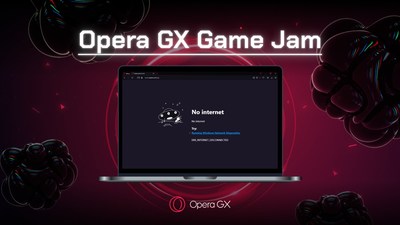
Opera GX [NASDAQ: OPRA], the world’s first web browser built specifically for gamers, today announced a challenge for the best in-browser offline game: the Opera GX Game Jam 2021.
‘When the internet is out, some browsers get on our nerves with dinosaurs or surfing games which only reminds gamers that without the internet we’re back to the stone age and can’t surf the web. We created the Opera GX Game Jam to call on all artists and creative gamers to make the offline experience fun,’ said Maciej Kocemba, Product Director of Opera GX.
The Opera GX Game Jam competition will give one winner the unique opportunity for their game to be played by millions in the Opera GX offline page. The top three artists will also win cash prizes of $3k, $7k and $10K. The winning game will gain the prestige of becoming the first playable game to ever feature in Opera GX, helping to entertain gamers during those rare offline moments that would otherwise make them cry.
The GX Game Jam is being hosted with GameMaker Studio 2 – the world’s leading 2D game development engine, and in collaboration with Game Jolt, one of the largest communities for games and the people who make and play them.
The best game will receive expert development support from the GameMaker team, before being unleashed within the Opera GX desktop browser. Once completed, it will also be promoted to Opera GX’s millions of users through the browser’s GX Corner and across the social accounts of Opera GX, GameMaker Studio 2 and Game Jolt.
The Opera GX Game Jam will be open for submissions starting on the 29th of July, when the theme for the event will be revealed.
The expert jury includes:
-
Maciej Kocemba (Opera GX Product Director)
-
Russell Kay (GameMaker Studio 2 CTO)
-
Yaprak DeCarmine (Game Jolt co-founder and CEO)
-
GameMaker game creators:
-
Johan Vinet (Canari Games – LUNARK),
-
David Galindo (AKA chubigans – Cook, Serve Delicious!)
-
dietzribi (Toodee and Topdee)
-
Artists and game creators can register their interest, receive a free GameMaker Studio 2 licence for the duration of the jam, and read the terms and conditions by visiting this LINK.
“GameMaker Studio 2 is the perfect engine for Game Jams, as it allows anyone to convert creative ideas into playable games quickly. Whether using the intuitive no-code/low-code Drag and Drop system or it’s powerful GameMaker Language (GML), anyone can use GameMaker to take part in the Opera GX Game Jam 2021,” commented Russell Kay, CTO for GameMaker Studio 2. “It’s imagination that counts most, so get involved!”

Latest News
Optimove Insight Analysis of NFL 2025-2026 Planned v. Actual NFL Wagering Intentions Through the Wild Card Round

This analysis compares what NFL bettors said they planned to bet before the 2025–26 season with what they actually did through the end of the Wild Card round, using observed behavior from nearly 4.0 million bettors alongside a pre-season survey of 425 bettors. The results show that while high-level intentions broadly align with reality, bettors consistently overestimate how often, how live, and how much they will bet, especially once the season is underway.
The regular season remains the backbone of NFL betting. Both stated intent and actual behavior confirm that most wagering activity is anchored there, accounting for roughly three-quarters of all bets. However, interest in fringe periods is overstated. Pre-season betting and Wild Card betting both sound appealing in theory, but actual participation is far lower than expected. In particular, nearly half of the surveyed bettors anticipated betting during the Wild Card, yet real activity through that round is closer to one-sixth of bettors, underscoring that playoff “excitement” does not automatically translate into betting volume when the window is short.
Live betting is consistently over-promised and under-delivered. While bettors express strong interest in live wagering before the season, actual behavior skews heavily toward pre-game bets. That said, many bettors blend behaviors in practice, moving between pre-game and live depending on context. This suggests opportunity lies less in converting bettors to “live-only” and more in designing experiences that fluidly support both.
Bet structure shows the strongest alignment between intent and reality. Multi-leg bets, particularly parlays, dominate both planned and actual behavior. This confirms that bettors’ appetite for higher-engagement, multi-outcome tickets is real and durable. As the playoff slate narrows, this preference is likely to shift toward same-game parlays rather than traditional multi-game builds.
The largest disconnect appears in stake size. Bettors systematically overestimate how much they expect to wager. In reality, small bets placed frequently dominate observed behavior, with low-stake wagers far more common than survey responses suggest. While $11–$50 emerges as the true “default” stake band, higher stakes are significantly rarer in practice than bettors predict before the season.
Looking ahead, intensity, not volume, is likely to define the later playoff rounds. As the number of games shrinks, total betting volume may not rival the regular season, but engagement among remaining bettors typically deepens. This often manifests as more bets per game, greater use of live betting moments, and heavier reliance on parlays rather than larger single-ticket stakes.
Bottom line:
NFL bettors are directionally honest about how they want to bet, but consistently optimistic about how much and how often they will do so. For operators, the opportunity lies in recognizing where intent reliably converts (regular season, parlays, pre-game betting) and where friction emerges (live betting adoption, playoff participation, higher stakes). Designing experiences that emphasize intensity, flexibility, and frequent low-stake engagement is likely to outperform strategies built on assumed playoff spikes or inflated stake expectations.
Detailed Results:
This report compares the following:
- Actual Bets of 3,991,737 NFL bettors covering the 2025/26 NFL season through the end of the Wild Card round; and
- Planned Bets of 425 NFL Bettors surveyed before the start of the season.
Regular Season, As Expected – Wild Card, Not So Much
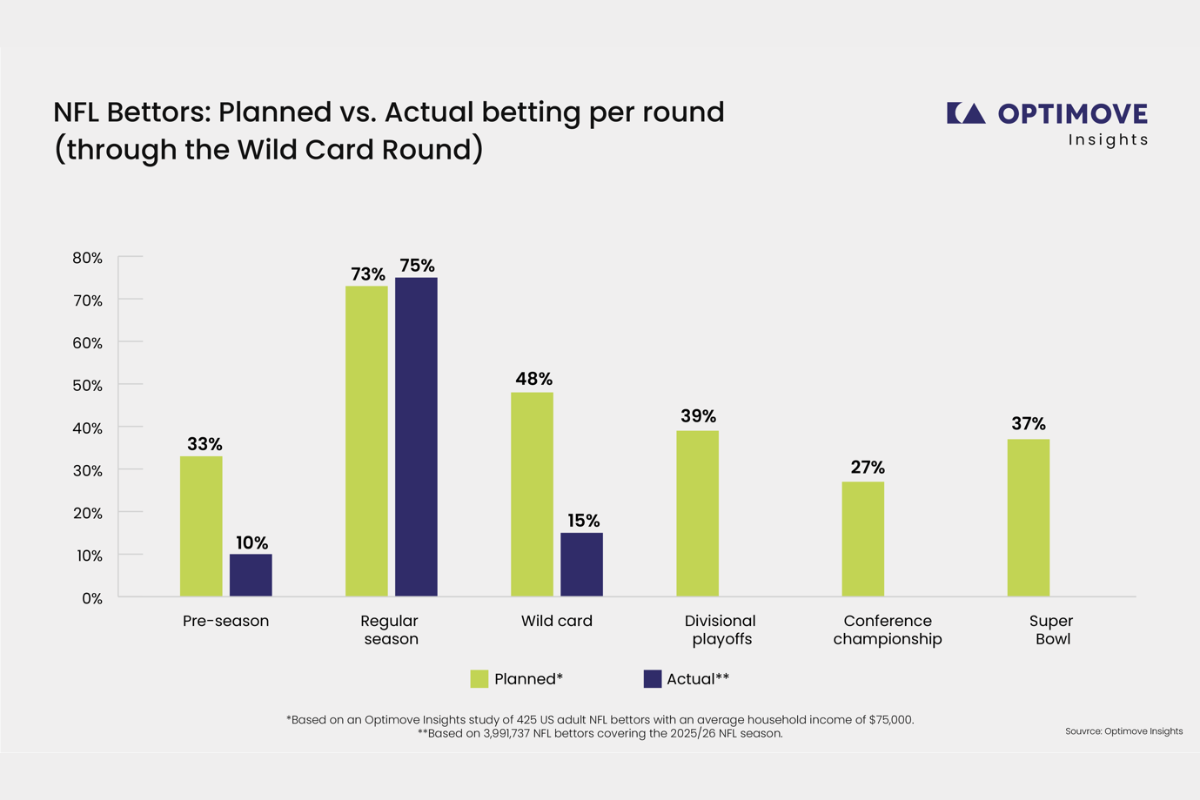
This chart compares what NFL bettors said they were most likely to bet on (planned bets) versus bets in the 2025/26 season (actual betting behavior) through the end of the Wild Card round.
A few things jump out immediately:
- The regular season is the clear anchor in both datasets. Survey respondents before the start of the season overwhelmingly pointed to the regular season as their primary betting period (73%), and real behavior supports that, as (75%) of observed betting activity happened during the regular season.
- Pre-season betting is meaningfully lower in reality than in stated intent. While 33% of survey respondents said they’d be likely to bet in the pre-season, real activity through our benchmark is closer to ~10%. Bottom line: pre-season sounds appealing in theory, but far fewer people follow through once games start.
- Wild Card interest is overestimated in the survey before the season. The survey suggests nearly half of bettors (48%) expected to bet during Wild Card, but real behavior in our data is much lower (~15%). That gap is a big signal that “high-stakes playoff excitement” doesn’t automatically translate to volume, especially when the round is short and concentrated.
What we’d expect to see next:
- Because this analysis only includes activity through Wild Card, the later playoff rounds are reported the survey before the NFL season start.
Based on how betting typically behaves as stakes rise, we expect a concentration effect – Fewer days, bigger moments: The Divisional Round, Conference Championships, and Super Bowl have fewer games, so raw volume may not match the regular season but attention is higher, which often shows up as more bets per game, higher average stake, and heavier live-betting mix.
- A “late-stage spike” among engaged bettors: Even if overall volume stays lower than the regular season, the bettors who remain active tend to be more committed, which can make the later rounds disproportionately valuable from a revenue and engagement perspective.
If the regular season is where breadth happens, the next rounds are where intensity can show up.
Bettors Say They Want Make Live Bets; But Primarily Bet Pre-Game
This chart compares stated preference (survey before the season start) with observed behavior across three types of bets: 1) pre-game, 2) live, and 3) both.
Here’s what stands out:
- Pre-game betting is executed as planned. Nearly half of respondents said they typically prefer pre-game (48%), and real behavior comes in slightly higher at 50%. That’s a strong alignment between intent and reality. Pre-game betting remains the default mode for most bettors.
- Live betting is the biggest gap between planned and actual betting. In the survey, 31% said they planned live betting, but in practice only 17% did.
- “Both” is under claimed but over delivered. Only 21% said they have no preference and do both (pre-game and live), yet actual behavior suggests 33% of bettors mix pre-game and live. So even if bettors identify with one style, many still shift modes depending on context.
What we’d expect to see next:
- As the NFL season progresses, this mix between live and pre-game betting can change: Later playoff rounds tend to be more “appointment viewing,” which can naturally lift live betting, especially in close games and high-profile matchups.
- Even if the share of “live only” bettors remain modest, we’d expect live engagement to deepen as games become must watch events.
Intent Matches Reality: Multi Bets Lead the Way
Next, we analyzed how bettors build their tickets: single bets versus multi-leg parlays, comparing survey intent with actual behavior through the end of the Wild Card round.
Unlike other comparisons, this shows minimal gap between what bettors said and what they actually did:
- Multi bets (parlays) dominate in both views. The survey shows 72% planning to primarily place multi bets, and real behavior comes in almost the same at 70%.
- Single bets are only slightly higher in reality. Actual betting shows 30% single vs. 28% in the survey.
What we’d expect to see next:
- Fewer games = fewer traditional parlays. With a smaller slate, multi-game parlays become harder to build.
- More Same-Game Parlays. Bettors who want multi legs still have a clear outlet: stacking outcomes within one matchup.
Where the Money Really Sits: Smaller Bets, More Often
Finally, we compared what bettors said they typically wager in the survey with what we actually observed in the data through the end of the Wild Card round. The pattern is hard to miss: real-world stakes tend to come in lower than the amounts people anticipated before the season.
- Low-stake bets over-index in real behavior. In the data, $1–$5 (26%) and $6–$10 (19%) make up a much larger share than in the survey before the season (8% and 9%, respectively). In practice, bettors place far more “small” bets than they thought.
- The survey overestimates mid-to-higher stakes. The biggest mismatch is in the $51–$100 range: 29% in survey responses vs. only 6% in actual observed behavior. The same pattern shows up again at $101–$499 (19% survey vs. 4% actual).
- The center of gravity shifts downward. Both sources revealed that $11–$50 is the most common range, but actual bets in the data lean even more into it (37% actual vs. 31% survey), suggesting $11-50 is the “true default” stake band.
What we’d expect to see next:
As the playoffs continue, we may likely see:
- More casual bettors enter, which can lower the average stake among those who remain active (lots of people place a bet on the Super Bowl who are “one and done” players)
- As the number of games shrinks, so many bettors may keep stakes conservative and instead express confidence via more legs (parlays) rather than bigger single-ticket amounts.
Conclusion – Why Positionless Marketing Matters
The gap between planned intent and real betting behavior underscores a core reality: player preferences are situational and dynamic, not fixed before the season begins. Bettors shift when they engage, how they bet, and how much they wager based on context, momentum, and the moment.
Meeting players in those moments requires marketing teams to act with speed, flexibility, and precision. That’s where Positionless Marketing becomes essential. By removing dependencies on fixed roles, long planning cycles, and manual handoffs, Positionless Marketing empowers teams to respond immediately to real player behavior, not pre-season assumptions.
Instead of relying on static campaigns built around predicted intent, Positionless Marketing enables marketers to continuously adapt messaging, offers, and journeys as preferences reveal themselves in real time. This ability to move at the player’s speed (and adjust to actual behavior as it unfolds) is what allows operators to stay relevant, personalized, and effective throughout the season.
In an environment where intent rarely matches reality, Positionless Marketing is what turns insight into action at exactly the right moment.
The post Optimove Insight Analysis of NFL 2025-2026 Planned v. Actual NFL Wagering Intentions Through the Wild Card Round appeared first on Americas iGaming & Sports Betting News.

Hub88 has been named Customer Services Company of the Year at the International Gaming Awards 2026, recognising the aggregator’s commitment to delivering outstanding support and service to its partners.
The award celebrates excellence in customer service, highlighting companies that recognise the importance of responsive, efficiency and high-quality support as a differentiator. Hub88 was selected from a strong field of leading suppliers and operators for its partner-first approach and continued investment in customer-centric innovation.
At the end of 2025, the aggregator announced a strategic shift towards regulated markets after being awarded a UAE licence, reinforcing its commitment to responsible gaming. During the same period, the B2B brand also launched its new embedded AI assistant, HubAI, as part of wider upgrades to its Operator and Supplier Zones.
Hub88’s Supplier Zone and Operator Zone are designed to streamline day-to-day operations, offering partners a centralised area for integrations, onboarding, reporting and troubleshooting. These zones are supported by the new HubAI tool, an instant multilingual assistant that provides guidance and fast access to relevant information, freeing up human support for more complex customer needs.
The Customer Services Company of the Year award follows a landmark year for Hub88, which also saw the appointment of a new CEO, Lara Falzon, and the platform surpassing 550 partners.
Ollie Castleman, Managing Director of Hub88, said: “Being recognised as Customer Services Company of the Year is incredibly rewarding, as trust and effectiveness sit at the heart of everything we do. Every new piece of technology developed for partners is designed to make their lives easier.
“We believe outstanding customer service is about combining great people with smart tech, and this award really highlights the dedication of our team to supporting partners in the most effective way.”
The post Hub88 wins Customer Services Company of the Year at International Gaming Awards 2026 appeared first on Eastern European Gaming | Global iGaming & Tech Intelligence Hub.

SEON, the command centre for real-time fraud prevention and AML compliance, today announced the launch of its AI-powered Identity Verification solution, bringing ID verification, liveness detection and proof of address checks into its unified risk platform.
Unlike traditional tools that only validate documents, SEON’s solution is built on more than 900 real-time fraud signals, helping organisations assess not just whether an ID is real, but whether the person can be confidently approved based on identity and risk signals.
Most identity verification tools focus on validating documents, but lack the risk context needed to determine whether a user meets an organisation’s risk-based requirements. As a result, both high-quality fakes and legitimate documents used by fraudsters can still pass these basic checks. SEON’s Identity Verification solution addresses this gap by combining core KYC checks with live fraud intelligence. This allows teams to filter out low-risk users through onboarding, while filtering out high-risk users before they consume KYC resources.
The solution supports identity document verification for global government-issued IDs, biometric liveness checks, proof of address verification and optional government database checks. Organisations can build verification workflows tailored to customer segment, risk profile or regulatory requirement, combining fraud signals, identity checks and AML screening based on their specific needs. All identity and fraud signals are surfaced in a single dashboard, reducing friction and eliminating silos among fraud, compliance and risk teams.
“Organisations have told us they’re managing separate tools for fraud detection, identity verification and AML compliance – each with its own data, workflows and operational overhead,” said Tamas Kadar, CEO and Co-Founder, SEON. “We built Identity Verification to bring those decisions together. When you combine AI-powered document checks with real-time fraud intelligence, you stop attacks earlier, reduce wasted KYC spend and make faster, more confident approval decisions with a clear audit trail.”
The initial Identity Verification rollout focuses on Europe’s demanding regulatory environment. SEON worked closely with gaming and betting operators to meet strict compliance requirements while maintaining operational efficiency and improving both conversion and fraud outcomes. The solution strengthens SEON’s position across regulated industries including iGaming, fintech and digital platforms.
“The industry is moving toward bringing identity verification, fraud and AML into one decision layer, and SEON is helping to lead that shift,” said Filip Gvardijan, Head of Fraud Prevention at industry leading operator, Superbet. “That shift matters. It cuts out pointless and expensive KYC cycles on users who were never legitimate, and also clears a faster path for legitimate users, removing a huge amount of avoidable and often manual work.”
The post SEON Launches Identity Verification Built on Real-Time Fraud Intelligence appeared first on Eastern European Gaming | Global iGaming & Tech Intelligence Hub.

-

 Carl Gatt Baldacchino Head of Account Management SlotMatrix7 days ago
SlotMatrix revives classic slot action with Crazy 777 U.S launch
-
Compliance Updates6 days ago
Romanian B2B Licence Granted to iGP, Boosting Its Regulated Operations in Europe
-
Africa7 days ago
Soccabet goes live with QTech Games retail solution in Ghana
-
Compliance Updates6 days ago
Global Gaming Solutions welcomes the Isle of Man Government’s commitment to the iGaming sector
-
Latest News3 days ago
SKIP THE QUEUE WITH THE MIDNITE SHUTTLE: MIDNITE TEAMS UP WITH SNOOKER LEGEND TO OFFER FANS A FREE SHUTTLE SERVICE FROM ALLY PALLY STATION
-
BETER6 days ago
BETER enters sixth US state with North Carolina approval
-
Continent 8 Technologies3 days ago
Continent 8 and CEO Michael Tobin claim number one spot in GamblingIQ’s global ‘Security 10’ rankings
-
Alex Baliukonis Game Producer at BGaming4 days ago
Crack the Vault in BGaming’s Mystery Heist