Latest News
Revealed: The emotional, social, and developmental benefits of gaming


- 28% of internet users play games to meet new people
- A third of gamers say they play because they like to challenge themselves.
- There are 20,000 gaming jobs in the UK, providing plenty of opportunity for a career in the industry
- We spoke to three experts in the field who gave their insights into the gaming industry
There are lots of negative misconceptions about gaming, many of which are far from the truth. A new study turns stereotypes on their heads and reveals the emotional, social, and developmental benefits of gaming. Dr Rachel Kowert, Research Director of Take This – a mental health non-profit; Dr Matthew Barr, a lecturer of Game Studies at the University of Glasgow; and Noel McDermott, a psychotherapist and presenter of The Well-Being Show podcast, provide their thoughts and insights. Here are some of the highlights:
Gaming can boost mental wellbeing and help with feelings of loneliness
- Thanks to well-crafted storylines and lifelike graphics, games are the perfect form of escapism
- 34% of gamers identify the feeling of being immersed in a game as a key motivation to play
- The global gaming population is likely to have increased by 4% since the outbreak of Covid-19
Especially in challenging times, activities that provide a positive distraction and allow an individual to put their worries to the back of their mind can have a beneficial impact on mental wellbeing. Gaming is an excellent example of this, offering an immersive experience that can mentally transport you to another world.
Barr says, “Video games are good at getting players into the state of optimal experience that psychologists call ‘flow’, by offering an appropriate balance of challenge versus achievement. It’s that feeling of being ‘in the zone’, where you’re totally absorbed in the task at hand, and you’re operating at the top of your game. In turn, this has a positive impact on how players feel.”
This is because the sense of reward releases feel-good hormones called dopamine that boost the player’s mood. What’s more, gaming can offer meditative benefits by fully occupying your mind with the objectives of the game.
Kowert adds that, “Gameplay can also teach skills that have long been associated with increased happiness and prolonged life satisfaction, including openness to experience, self-care, a growth mindset, solution-focused thinking, mindfulness, persistence, self-discovery, and resilience.”
Gaming can maintain and build new relationships
- Half of gamers play with their real-life friends
- 28% of internet users play games to meet new people
- 1 in 3 internet users in the UK say the main reason they game is to have fun with people they know
Contrary to popular belief, gaming can be a sociable activity. Many games offer multiplayer modes or are designed to be played in teams, providing the opportunity for individuals to join forces with their existing friends or virtually meet new people – located anywhere in the world.
McDermott says, “Gaming, especially online, can provide immeasurable benefits to those who are lonely and isolated. It provides safe social contact and a place where skills can be developed. These skills can provide a much-needed boost to self-esteem.”
Research found that 60% of gamers report playing more games with social elements since the beginning of the pandemic, suggesting gaming can play a positive and pivotal role in connecting people at a time when face-to-face contact isn’t always possible.
Kowert explains, “Shared experiences, like playing games together, have been linked to increased self-esteem and a sense of belonging, as well as decreased feelings of depression, anxiety, and isolation.”
Gaming can teach life skills and cognitive abilities
- There are 20,000 gaming jobs in the UK, providing plenty of opportunity for a career in gaming
- Minecraft: Education Edition, for example, has applications in geography, history, engineering, and physics
- A third of gamers say they play because they like to challenge themselves.
While gaming can provide a fun form of entertainment, it can also contribute to the player’s cognitive development. For example, many titles involve problem solving, strategy and multi-tasking, among other skills.
Kowert explains, “Games are fantastic learning tools, particularly for children, because they are so engaging. Video games are also great vehicles for sharpening cognitive skills because they provide a range of different challenges within a single space. Gameplay has been associated with the improvement of a range of cognitive skills, including:
- improved creative thinking
- problem solving
- time management
- leadership skills
- goal setting
- initiative taking
- decision making
- persistence in the face of difficult challenges.”
It’s estimated that children aged 12-15 years old spend an average of 11.6 hours a week gaming. So, with gaming being such a widely enjoyed hobby, it’s encouraging to note that it could be effectively harnessed as an educational tool to teach numerous skills and knowledge. What’s more, with the gaming industry growing year-on-year (and estimated to be worth £3.86 billion in 2020), it could also open doors for careers in the industry.
Barr explains, “We all learn new skills through practice, whether that’s learning how to play an instrument or training to play sports more proficiently. Learning from a video game is no different – you’re exercising skills all the time, whether it’s figuring out puzzles or using your communication and language skills to talk to and strategize with your fellow players.”
Gaming myths debunked
- 52% of Brits play video games, demonstrating its popularity and prevalence in daily life
- Gaming is the nation’s second favourite pastime, after watching TV
- Brits spend an average of 7 hours a week gaming, which is just a third of the time spent watching TV (22.5 hrs)
Over the years, gaming has been associated with negative stereotypes and behaviours, such as laziness, violence, and isolation. There is little evidence to prove any of these correct. Instead, in many cases, gaming can be more beneficial for the player’s health, development, and social abilities than it is detrimental. In fact, with over half of Brits playing games, it’s apparent that gaming is just a part of modern life for many.
Kowert explains, “There is no evidence to suggest that playing games online has a negative impact on our ability to socialise. However, research has found that playing games with our friends online can strengthen our offline friendships and relationships.”
Another concern that often arises is the amount of time people spend gaming and whether gaming has addictive qualities. Talking on the topic, Barr explains that, “People talk about players becoming ‘addicted’ to games, without really considering what that word means, in a clinical sense. We don’t bat an eyelid when someone becomes so engrossed in a book that they sit there reading for hours on end, but somehow this sort of behaviour is perceived as problematic when it comes to games.”
Powered by WPeMatico



REEVO has announced that it is now live with Betsson in the Brazil market, marking another important milestone in the companies’ expanding global partnership. This launch represents the next step in REEVO’s rollout across Betsson’s international markets and reinforces the company’s growing presence across Latin America.
As part of the launch, Betsson Brazil now features both REEVO’s aggregation platform and REEVO’s in-house games, delivering a powerful combination of premium third-party content alongside REEVO’s original titles through a single, seamless integration.
Brazil represents one of the most dynamic and fast-growing gaming markets in the region. By going live with Betsson in this market, REEVO continues to strengthen its international distribution network while supporting leading operators with scalable technology, engaging content, and efficient integration.
Karl Grech, Head of Business Development at REEVO, said: “Going live with Betsson in Brazil is a fantastic milestone for REEVO and an important step forward in our expanding partnership. Brazil is one of the most exciting markets in the region, and we are proud to bring both our aggregation platform and our in-house games to Betsson’s players. This launch reflects our commitment to supporting operators with high-quality content, reliable technology, and scalable solutions that help them grow.”
Andrea Rossi, Commercial Director for LatAm at Betsson, said: “The launch of REEVO’s content on our Brazilian platform expands the range of entertainment available to our players in one of the fastest growing markets in the region. Brazil is an important market for Betsson, and partnerships like this allow us to continue strengthening our offering with high quality content that reflects local player preferences. We look forward to working with REEVO as we continue to grow in the newly regulated Brazilian market.”
The post REEVO Goes Live with Betsson in Brazil appeared first on Americas iGaming & Sports Betting News.
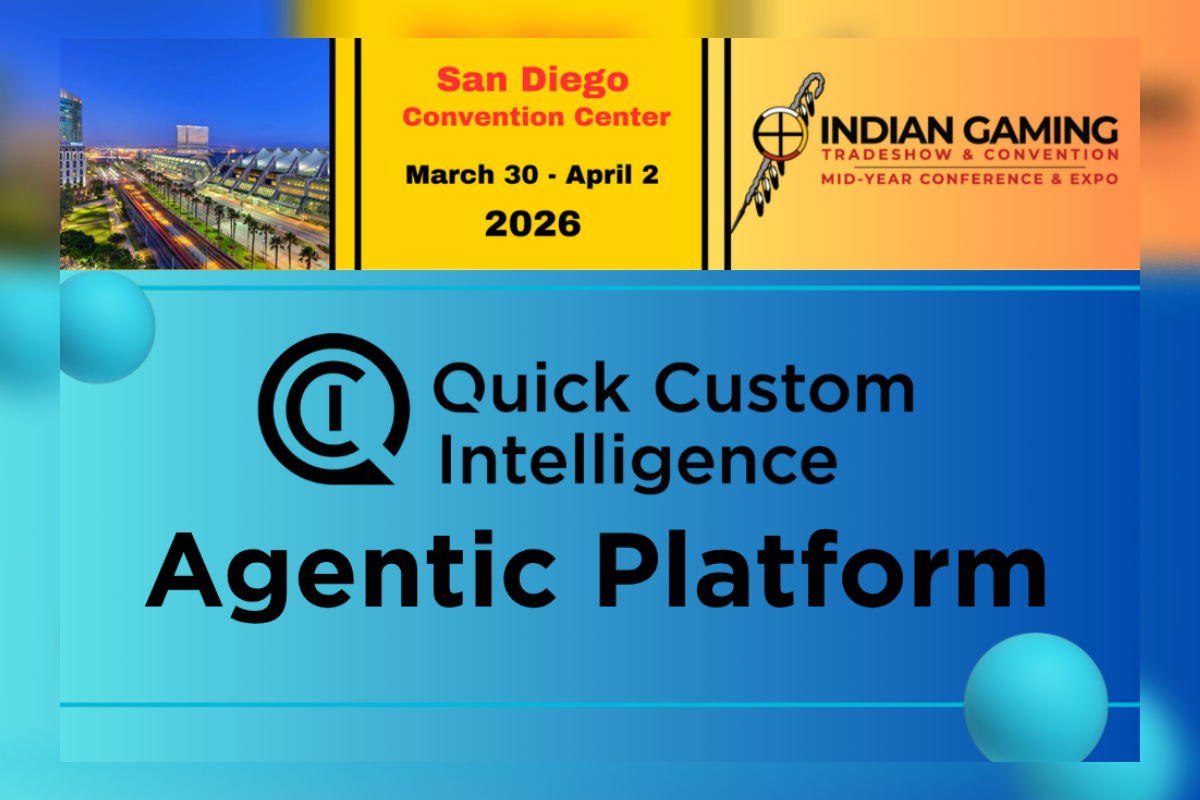
Quick Custom Intelligence (QCI), a leading provider of AI-driven operations software for tribal gaming resorts, announced it will showcase its evolving QCI Agentic Platform at the Indian Gaming Association (IGA) Tradeshow & Convention, March 31–April 2, 2026, at the San Diego Convention Center (Booth #2735).
The QCI Agentic Platform reflects the continued advancement of the company’s enterprise system, enabling operators to move from real-time insight to real-time action across gaming, marketing, player development, and hotel operations. Designed for on-premise and hybrid environments, the platform supports secure, property-level AI deployment while maintaining full operational control.
Rather than introducing a new system, QCI’s approach extends the capabilities operators already use—bringing analysis and execution closer together within a unified operational environment.
“This is a continuation of the platform our customers already rely on. We’re building on what works and extending it, so operators can act on information faster, without changing the way their business runs,” said Dr. Ralph Thomas, Co-Founder and CEO of QCI.
The QCI Agentic Platform builds on QCI’s established product suite, including:
• AGI56.1, a major platform release featuring more than 1000 enhancements across operations
• Chatalytics, QCI’s conversational analytics interface for real-time data access
• QCI Dispatch, a new core operational tool supporting real-time coordination and execution
Together, these capabilities enable operators to unify data, streamline workflows, and respond more quickly to changing conditions across the property.
Attendees will experience how QCI connects data, decision-making, and execution within a single operational system.
“We’re focused on practical improvements that help teams do their jobs more effectively. This is about making systems more responsive, more connected, and easier to use in day-to-day operations,” added Thomas.
The post QCI to Showcase Agentic Platform Capabilities at IGA 2026 appeared first on Americas iGaming & Sports Betting News.

Eeze, the next-generation casino supplier, has announced a comprehensive global distribution agreement with EveryMatrix, extending the reach of its live dealer and upcoming slots portfolio to EveryMatrix’s worldwide partner network.
Under the partnership, Eeze’s full range of live dealer titles, including its recently launched Fusion Roulette, alongside forthcoming slot releases, will be made available across EveryMatrix’s Game Aggregator Network. The deal covers EveryMatrix’s active markets globally, marking a key milestone for the supplier’s international expansion.
Mikko Hoglund, Partnership Manager at Eeze, said:
“Partnering with EveryMatrix is an important moment for us as we look to push our games to a wider network of players than ever before. We have a lot of exciting product releases to come in the next few months, and know that these games, as well as our existing portfolio, will be well received across EveryMatrix’s customer base.”
Bjorn Sjoberg, Chief Commercial Officer at EveryMatrix, added:
“We are very pleased to be adding Eeze’s full product suite to our aggregation offering. With best-in-class live products and an exciting array of RNG games on the roadmap, we’re confident that our customers will enjoy the differentiation these titles bring to market.”
With this partnership, Eeze strengthens its footprint in regulated markets and positions its Fusion Roulette and slot titles for maximum visibility, giving operators a compelling mix of content to offer players worldwide.
The post Eeze signs global partnership with EveryMatrix appeared first on Eastern European Gaming | Global iGaming & Tech Intelligence Hub.

-

 Centurion Winner Grand Chance™6 days ago
New from Inspired: Luck It Up™ and Centurion Winner Grand Chance™ available online & on mobile
-
Blazin' Bonus6 days ago
Booming Games releases Blazin’ Bonus
-
Australasian Hospitality and Gaming Expo7 days ago
IGT Showcases Integrated Gaming, Systems, and FinTech Innovations Designed to Drive Growth at Australasian Hospitality and Gaming Expo 2026
-
Cristiano Blanco CEO of SpinCore Group6 days ago
SpinCore Group Enters Finnish Market via Finnplay Partnership
-
Conferences6 days ago
NOVOMATIC Gaming Colombia to Showcase its Latest Innovations at GAT Cartagena 2026
-
Enjoy7 days ago
ENJOY Unveils Hotfire Diamonds XXL to Elevate an Iconic Franchise
-
Aristocrat Gaming7 days ago
Aristocrat Gaming to Participate in Australian Hospitality & Gaming Expo
-
Alberta market7 days ago
Soft2Bet Evaluates Alberta Market Entry to Strengthen its Canadian Footprint