Connect with us

Latest News

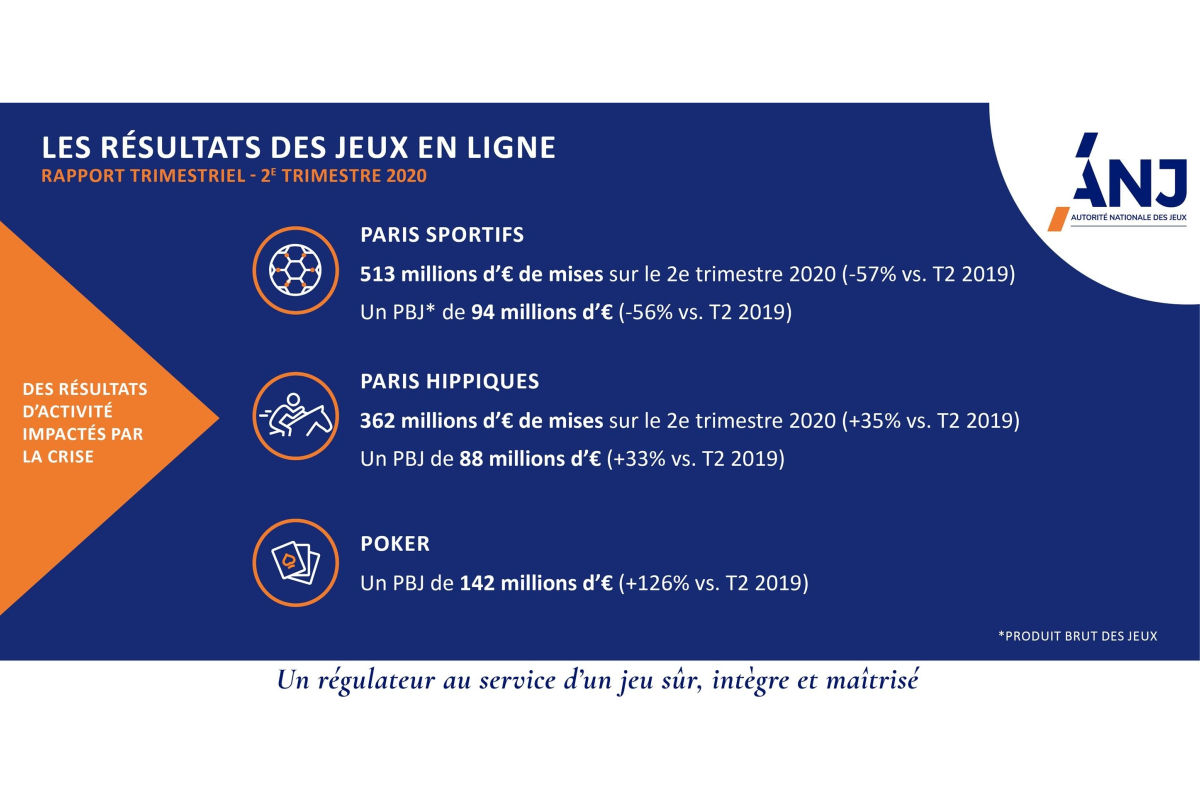
The ANJ publishes the results of the online gambling market for the 2nd quarter of 2020: the sectors are very differently impacted by the COVID crisis

Published

on

Reading Time: 4 minutes


In the 2nd quarter of 2020, the online gambling market recorded a decrease of 6% of its GGR[1] and a decrease in active player accounts of 9%. It is the sports betting sector that has been the most affected by the effects of the health crisis with a decrease of 56% of its GGR. Conversely, the poker and, to a lesser extent, horseracing betting segments recorded a sharp increase of their GGR.

The lockdown (from 16 March to 10 May) was particularly handicapping for operators, who recorded a decrease of 24% over the period compared to 2019.

However, despite this health crisis, the GGR of the legal online market reached 758 million euros over the first 6 months of the year, an increase of 8% compared to the first half of 2019.

The collapse of online sports betting : -56% of the GGR

The online sports betting segment is generally the most dynamic part of the online gambling market. On the flip side of this trend, the sports betting offer for the quarter was profoundly altered by the massive cancellations or the delayed recovery of sporting events. With this reduction of the supply, and in order to support the market, the ARJEL Board authorized the add of 7 competitions to the list of sporting events, allowing them for sports betting in France (Australian football, 1st Australian soccer league, Hungarian football cup, 1st South Korea and China football leagues, baseball in Korea and hockey in Belarus).

These new competitions, while meeting ARJEL’s requirements regarding the fight against sports manipulation, have made it possible for operators to maintain a sports betting offer throughout the period of suspension of major competitions. All in all, operators’ GGR in the sports betting market amounted to 94 million euros in the second quarter, a decrease of 56% compared to 2019. The decline in operators’ turnover fell to 87% over the lockdown period.

As a result of this unprecedented situation, the number of active player accounts fell by 36%, albeit at a slower pace than the decrease of the GGR. The average spending per active player account over the quarter[2] amounted to 86€ compared to 126 € in Q2 2019 (-32%).

While operators had planned to make a significant marketing effort for EURO 2020, they sharply reduced their sports betting advertising spending during the 2nd quarter of 2020[3] in response to the decline in their activity.

The results provided by the FDJ demonstrate similar difficulties in the sports betting segment. The monopoly recorded indeed a decrease of 39% in sports betting stakes, all channels combined, in the first semester and up to around 61% in the second quarter alone.

An increase of online horseracing betting: +33% of the GGR

The horseracing betting offer was significantly affected this quarter following the interruption of French horseraces until 11 May 2020. However, the bets recorded during this period increased by 16%, in particular thanks to the maintenance and additions of foreign horseraces to the French horseraces betting calendar, approved by the Ministry of Agriculture and Food after an informal advice from ARJEL[4]. The increase of horseracing stakes is also due to the shift of some sports bettors to horseracing betting during the period. As soon as French races resumed, the market recorded an increase of the number of players, that accelerated the growth of the stakes over the quarter.

The online horseracing betting market activity is once again growing at a rate not observed since the market opened in 2010. The players’ stakes reached 362 million euros this quarter, up 35% compared to the second quarter of 2019. This volume of stakes also corresponds to the highest level generated over a quarter. At the same time, the GGR of the quarter increased by 88 million euros in proportions almost similar to stakes (+ 33%), its highest level since the opening of the market.

The PMU, operator under exclusive rights regarding offline horseracing betting, reported a decrease of 31% of the stakes in the 1st half of the year, all channels combined. However, business results improved at the end of the semester, thanks to the gradual reopening of points of sale and racecourses.

The booming of online poker: +126% of the GGR

The lockdown period has been very advantageous to the online poker segment. The popularity for this activity has led to the recruitment of many new players. As a result, nearly 1.100.000 active player accounts (APAs) participated in online poker games during the quarter, an increase of 68% relative to last year.

As a result, the poker GGR reached 142 million euros in the second quarter, its biggest result for a quarter and 44 million higher than the GGR of the first quarter of 2020. The growth of the poker GGR is of 126% compared to Q2 2020, which corresponds to the most significant increase recorded over a quarter.

This growth is due both to an increase in the number of active players (+ 68% compared to Q2 2019) and to the intensification of gambling. The average spending per active player account thus increased sharply in Q2 2020 (+ 34%), reaching € 134 compared to € 99 in Q2 2019.

The ANJ in brief

The “Pacte” Act and the ordinance of October 2, 2019 reforming the regulation of gambling have set up a new gambling regulatory authority (ANJ). It follows ARJEL with a significantly extended regulatory scope and enhanced powers.


The ANJ is now responsible for all components of the legal gambling market, both online andoffline:

  • online games that ARJEL regulated, such as sports betting and horse racing betting and poker offered by the 14 licensed operators ;
  • all the games of La Française des Jeux or the PMU sold in physical points of sale or online;
  • 237 racecourses;
  • 202 casinos, with the exception of anti-money laundering issues and the integrity of the games offered, which remain under the responsibility of the Ministry of Home Affairs.


Methodology

The following elements have been compiled using data provided by licensed online gambling and betting operators on a weekly and quarterly basis. The ANJ communications take account of statistical confidentiality. It cannot publish information relating to the activity of monopoly markets (FDJ and PMU) other than that already disclosed by operators under exclusive rights.

Complete report available here in French

Powered by WPeMatico

Continue Reading
Advertisement

eSports

G2 partners with PUBG MOBILE Esports to scale Western Europe competition

Published

on

g2-partners-with-pubg-mobile-esports-to-scale-western-europe-competition

Deal starts with the 2026 PMCO Western Europe Wildcard and adds a JanickaGaming ambassador program.

G2 and PUBG MOBILE Esports have announced a partnership aimed at growing the PUBG MOBILE esports ecosystem in Western Europe, the companies said on June 15, 2026 in Berlin.

The partnership begins with the 2026 PUBG MOBILE Club Open (PMCO) Western Europe Wildcard, with registration open now. G2’s in-house media and production unit, 62, will support tournament operations and community activations, spanning creator campaigns, media buying, and event management.

The first major activation under the agreement will be the 2026 PUBG MOBILE Global Open (PMGO) Western Europe Finals, scheduled for 11–13 September, with registration opening today, according to the announcement.

The companies are also launching an ambassador program for the region, naming German PUBG MOBILE content creator JanickaGaming as the Western Europe ambassador. PUBG MOBILE said she will stream PUBG MOBILE weekly and cover esports topics and tournaments alongside her existing social content.

“PUBG MOBILE has built something really special over the years. It’s one of the biggest games in the world and one of the most impressive esports ecosystems,” said Alban Dechelotte, CEO of G2.

Shaowei Chen, Head of Western Europe Publishing at PUBG MOBILE, added: “Western Europe represents one of the most promising growth frontiers for PUBG MOBILE esports, and G2 stands as a great strategic partner to drive this expansion.”

The post G2 partners with PUBG MOBILE Esports to scale Western Europe competition appeared first on EE Gaming | Global iGaming & Tech Intelligence Hub.
Continue Reading

Gambling in the USA

Las Vegas Inflation Index: Cost of visiting Sin City for one night has more than doubled in the last 12 years

Published

on

las-vegas-inflation-index:-cost-of-visiting-sin-city-for-one-night-has-more-than-doubled-in-the-last-12-years
    • An average spend for one night on the Las Vegas Strip now reaches nearly $670, compared to $319 in 2014.
    • Resort fees have seen a 194% rise in that period – the steepest increase of all.
    • Nevada’s live poker table count has fallen by 38% since 2011 – from 957 tables to 595 – while the number of active Strip poker rooms has halved.
    • Strip poker rooms are taking an average of $300 more per five-hour session compared to 2014.
    • With a $500 blackjack budget, you will bust nearly two hours quicker on average in 2026 compared to 2014.

    The average cost for a one-night stay in Las Vegas has risen by almost 109% in the last 12 years, as revealed by research from Ignition Casino.

    Based on the average cost of a basket of a typical visitor’s stay – hotel, food, drinks, entertainment and parking – guests are spending nearly $350 more per night in 2026 than they were in 2014.

    That basket includes the average minimum blackjack bet, a one-night hotel stay, resort fee, a domestic beer, bottle of water, dinner (entrée and drink), a show ticket and valet parking. All recorded prices are Strip averages in 2014 and 2026.

    The steepest single increase is resort fees: the add-ons charged on top of base room rates averaged $19.43 on the Strip in 2014 and have risen to $48.49 today – a 194.5% jump. Almost every other line item has at least doubled, with blackjack minimum bets up 124%, water up 133%, show tickets up 112% and valet parking going from free to $40.


    Feature (On Strip)

    2014

    2026

    % Increase

    Blackjack minimum bet

    $50.00

    $112.17

    +124.3%

    Average resort fee/night

    $19.43

    $48.49

    +194.5%

    Weekend one-night hotel stay

    $125.80

    $207.28

    +64.8%

    Domestic beer

    $6.00

    $10.00

    +66.7%

    Bottle of water

    $3.00

    $7.00

    +133.3%

    Dinner (entrée + drink)

    $32.00

    $67.00

    +109.4%

    Show ticket

    $82.86

    $175.91

    +112.3%

    Valet parking

    $0.00

    $40.00

    N/A

    TOTAL

    $319.09

    $667.85

    +109.3%


    But rising prices are only half the story. For poker players specifically, the cost of a Las Vegas trip has increased at the same time as the product itself has quietly contracted – fewer rooms, fewer tables, and higher costs per hand once you sit down.

    Fewer tables, higher rake: Las Vegas poker’s shrinkflation squeeze

    Las Vegas remains the live poker capital of the world – but the infrastructure supporting that reputation has been quietly hollowed out, and the players who remain are paying significantly more for a shrinking product.

    According to data compiled by UNLV’s Center for Gaming Research from Nevada Gaming Commission Quarterly Reports, the state’s live poker table count stood at 957 tables in 2011. By end-2025, that figure had fallen to 595 – a reduction of 38% over 14 years, with no return to pre-2016 levels in sight.

    The decline is structural and predates COVID. From 957 tables in 2011, Nevada’s count fell steadily to 587 by 2018 as casinos converted poker floor space to higher-margin baccarat. The pandemic accelerated the attrition – tables collapsed to just 413 in 2020 – and the recovery has been incomplete. Today’s total of 595 remains roughly 38% below its 2011 level.

    On the Strip specifically, the picture is even starker. From approximately 17 active poker rooms in the late 2000s, just eight remain today: Aria, Bellagio, Caesars Palace, Horseshoe, Mandalay Bay, MGM Grand, The Venetian and Wynn. For Texas Hold’em and Omaha players, this consolidation means less table availability and less competition between rooms – and with fewer operators competing for players, there has been little pressure to keep rake in check.

    Metric

    2011

    2025/26

    Change

    Nevada poker tables (statewide)

    957

    595

    –38%

    Active Strip poker rooms

    ~17

    8

    –53%

    Average rake cap per hand

    $4

    $5–$7

    ↑ significantly


    Are Las Vegas poker rooms still good value amid rising costs?

    The rake compounds the shrinkflation picture. Of the eight active Strip rooms, Aria charges a rake of 10% of the pot up to a maximum cap of $7 per hand, Bellagio’s cap is $6, and the remaining rooms sit at $5. In 2014, the Strip average was 10% up to a $4 cap.

    Considering a fast dealer pushes out 30 raked hands per hour, an extra $2 in rake per hand – at rooms where the cap is reached – means an extra $60 per hour going to the house. Over a five-hour session, that is $300 less in players’ stacks compared to 2014.

    Factor in the broader 109.3% price hike across the average Las Vegas stay and there is a serious debate to be had over value for money. Players are paying more to stay, more to eat, more to park – and then paying more rake across fewer available tables once they sit down.

    The same squeeze is visible at the blackjack tables, where minimum bet increases have made a given budget go significantly less far than it did 12 years ago – offering a precise illustration of what the broader cost increases mean in practice.

    You will bust two hours earlier in Las Vegas today compared to 2014 with a $500 blackjack budget

    The blackjack minimum bet increase tells a sharp story about what rising costs mean in practice. Based on the average Strip minimum in 2014, a $500 budget would last approximately two hours and 22 minutes before a player would be expected to bust against the house. Taking into account the 124% increase in average minimum bet since then, that same $500 would now be expected to last just 28 minutes.

    This is calculated using a methodology applied by casino risk analysts and quantitative mathematicians, factoring in betting units, the standard deviation of blackjack (1.15, accounting for doubling down, splitting and natural blackjack payouts), and an average table speed of 70 hands per hour. Full methodology is set out in the appendix below.

    Las Vegas blackjack average time to bust (hr:min)

    Budget

    2014 (hr:min)

    2026 (hr:min)

    $100

    0:06

    N/A

    $200

    0:23

    0:04

    $300

    0:51

    0:10

    $500

    2:22

    0:28

    $1,000

    9:29

    1:53


    Shrinkflation is usually associated with a chocolate bar that got smaller without the price changing. In Las Vegas, the same principle has played out across an entire recreational economy — only here, the price went up too. Fewer poker rooms, higher rake, steeper minimum bets and a resort bill that has more than doubled: the product has contracted while the cost of accessing it has soared.

    Appendix: Blackjack time-to-bust methodology

    The following explains how estimated survival times for a given blackjack budget are calculated, using the $500 at a $50 table example (median survival: 2 hours 22 minutes in 2014).

    Step 1: Normalisation. Currency is standardised into Betting Units. $500 / $50 minimum bet = 10 units.

    Step 2: Volatility Index. Standard deviation is defined. A simple coin-flip game has a standard deviation of 1.0; blackjack, with doubling down, splitting and 3:2 naturals, carries an accepted standard deviation of 1.15.

    Step 3: Absorbing Barrier Formula. Median hands to bust is calculated as: n ≈ 1.66 × (betting units)².

    Step 4: Executing the calculation. For 10 units: 10² = 100 × 1.66 = 166 hands to bust.

    Step 5: Translating to casino time. 166 hands / 70 hands per hour = 2.37 hours = 2 hours and 22 minutes. The same formula applied to a $112.17 minimum bet ($500 / $112.17 = ~4.46 units; 4.46² × 1.66 = ~33 hands; 33 / 70 = 0.47 hours = approximately 28 minutes.

The post Las Vegas Inflation Index: Cost of visiting Sin City for one night has more than doubled in the last 12 years appeared first on Americas iGaming & Sports Betting News.

Continue Reading

Latest News

NyesteCasino.com Reports: iGaming Industry Navigates Dual Pressures of Regulation and Growth

Published

on

Norwich, United Kingdom, June 15th, 2026, PlayNewswire

NyesteCasino.com, a leading iGaming analysis resource, released its latest industry overview, highlighting a week defined by intensifying regulatory scrutiny alongside continued global market expansion.

From U.S. Senate hearings and a widening circuit split to the localisation of crypto casinos and a surge in World Cup betting activity, iGaming operators have been balancing risk management with aggressive growth strategies.

Over the past week, the global iGaming sector has faced two powerful and often conflicting forces. Regulators across the United States, Europe, Southeast Asia, and South America have tightened rules around prediction markets, sweepstakes casinos, and credit card usage for deposits. At the same time, online gambling platforms, content providers, and policy advisors have accelerated product innovation and executed timely, region-specific sports marketing campaigns.

According to NyesteCasino.com’s team, these developments signal a broader structural transition across the industry—one in which compliance agility is rapidly becoming as critical to success as product quality. Despite increasing regulatory headwinds, the pace of innovation and market demand continues to point toward sustained sector growth.

Prediction Markets: Courtrooms, Congress, and Cross-Border Bans

The week started with a long-awaited US Senate Commerce Subcommittee gathering. The hearing named “No Sure Bets” took place on May 20 under Chair Marsha Blackburn, and Blackburn indicated more sessions were to come. The debate between American Gaming Association CEO Bill Miller and former Congressman Patrick McHenry quickly turned into a clash over the future of prediction markets. While Miller named the sports event contracts as backdoor betting operations bypassing the state licences, tax regulations, and integrity safeguards, McHenry talked on behalf of the Coalition for Prediction Markets and opposed him, stating that the current CFTC supervision is working perfectly.

On 22 May, a panel from the Ninth Circuit rejected the stay requests filed by both Kalshi and Polymarket, refusing to halt state enforcement proceedings in Nevada and Washington, which complicated the legal situation even more. The court ruled that a federal preemption defence under the Commodity Exchange Act cannot, on its own, establish federal jurisdiction. The ongoing disagreement in the appeals court of New Jersey, which had previously upheld a Kalshi injunction, has gained strength with this decision. Moreover, the process leading to a Supreme Court review of state jurisdiction over event contracts has accelerated even more. 

Indonesia’s Ministry of Communication and Digital Affairs categorised Polymarket as an online gambling site, disregarding its crypto-based structure, and has requested a national ban on the market platform on May 25. The reason for this request was a viral contract regarding whether President Prabowo Subianto would resign before the end of his term in October 2029. The contract generated a trading volume of approximately $46,000. The number of jurisdictions where Polymarket is inaccessible is growing, exceeding 33 around the world now, including India, Brazil, and Singapore, among other new blockers.

State-Level Regulations: An Anti-Sweepstakes Bill from Tennessee

There have also been state-level restrictions in Tennessee on online gambling law. During the same week, Governor Bill Lee signed two vital bills. Senate Bill 2136 made Tennessee the ninth US state banning sweepstake casinos and dual-currency systems completely, which grants the attorney general the power to enforce it. And according to the SB 1992, the second bill signed by the governor, anyone who deliberately influences the outcome of an event whilst holding a prediction market contract will be charged with a Class E felony. It is expected that these bills will guide other state legislatures who are planning similar regulations at the moment.

Europe and Brazil: Tax Proposals, Ad Restrictions, and Credit Bans

The European Parliament held a plenary debate on May 20 on a proposed EU-level gambling levy. Budget Commissioner Piotr Serafin confirmed the Commission is actively assessing the option alongside digital services and crypto-asset levies as part of the next Multiannual Financial Framework. Proponent MEP Victor Negrescu estimated the levy could raise between €2 and €4 billion annually for education, youth, and addiction prevention programmes. Opponents from EPP and ECR blocs raised concerns over subsidiarity, competitiveness, and national tax sovereignty, with any operational package targeted for January 2028.

Belgium’s Kansspelcommissie and the Netherlands Gambling Authority separately issued formal World Cup advertising warnings to licensed operators ahead of the June 11 to July 19 FIFA tournament. France’s ANJ flagged a year-on-year rise of more than 25% in operator marketing budgets as the tournament approaches. Meanwhile, Brazil formalised rules on May 25 to close off Pix Crédito as a deposit method on regulated betting platforms, a move prompted in part by a Folha de São Paulo audit revealing that major banks including Bradesco and Banco do Brasil, were still processing credit transfers into betting accounts as recently as mid-May.

Editorial Perspective

“What this week makes clear is that the iGaming sector is entering a phase where regulatory IQ is as strategically important as product development,” said the editorial team at NyesteCasino.com. “The prediction markets debate alone spans courtrooms, congressional hearings, and international bans and it is far from resolved. Operators who can track and adapt to this multi-jurisdictional complexity while still executing on World Cup campaigns and localisation strategies will be best positioned for the second half of 2026.”

About NyesteCasino.com

NyesteCasino.com is a leading independent iGaming review and analysis platform. The editorial team tracks regulatory developments, operator news, and product releases across global markets to help players and industry professionals navigate the evolving online casino landscape. Users can learn more at nyestecasino.com.

Contact

Author

Anita Haugen

Nyestecasino

[email protected]

Continue Reading

Trending

Get it on Google Play

Fresh slot games releases by the top brands of the industry. We provide you with the latest news straight from the entertainment industries.

The platform also hosts industry-relevant webinars, and provides detailed reports, making it a one-stop resource for anyone seeking information about operators, suppliers, regulators, and professional services in the European gaming market. The portal's primary goal is to keep its extensive reader base updated on the latest happenings, trends, and developments within the gaming and gambling sector, with an emphasis on the European market while also covering pertinent global news. It's an indispensable resource for gaming professionals, operators, and enthusiasts alike.

Contact us: [email protected]

Editorial / PR Submissions: [email protected]

Copyright © 2015 - 2024 - Recent Slot Releases is part of HIPTHER Agency. Registered in Romania under Proshirt SRL, Company number: 2134306, EU VAT ID: RO21343605. Office address: Blvd. 1 Decembrie 1918 nr.5, Targu Mures, Romania