Latest News
Online Gambling Regulations in Europe


The European online gambling market is one of the most lucrative and dynamic in the world, attracting millions of players and hundreds of licensed operators. However, unlike other industries that follow uniform regulations across the European Union (EU), gambling laws differ significantly from one country to another. Each nation has the autonomy to establish its own rules, licensing procedures, and player protection measures, making the regulatory landscape both diverse and complex.
Alt text: Man playing with poker chips and cards.
For players and operators alike, understanding these legal frameworks is essential to ensuring compliance and a safe gaming experience. Whether you’re a casual player looking for licensed platforms or an investor exploring the market, knowing the ins and outs of European gambling laws is key. That’s why many prefer to play at EU casinos that adhere to strict national and international regulations, ensuring fair play and security.
The European Union’s Stance on Online Gambling
The European Union (EU) does not impose a standardized regulatory system for online gambling across its member states. Instead, each country retains the autonomy to craft and enforce its own laws governing gambling activities. This approach acknowledges the principle of subsidiarity, allowing nations to regulate gambling in a manner that aligns with their societal values and public policy objectives. Consequently, the legal status and regulatory requirements for online gambling vary significantly across the EU.
Country-Specific Regulatory Frameworks
United Kingdom
The United Kingdom maintains a comprehensive regulatory framework for online gambling, primarily governed by the Gambling Act 2005 and overseen by the UK Gambling Commission (UKGC). In April 2023, the government published a white paper titled “High Stakes: Gambling Reform for the Digital Age,” outlining significant reforms to modernize gambling regulations. One key proposal is the introduction of a statutory levy on all licensed gambling operators, set to commence in April 2025. This levy aims to fund research, prevention, and treatment of gambling-related harms, with rates varying depending on the sector and nature of the gambling activity.
Germany
Germany’s online gambling landscape has undergone significant changes with the enactment of the Interstate Treaty on Gambling (ISTG) 2021. This treaty permits the federal licensing of sports betting, virtual slot machines, and online poker. Notably, online slot stakes are capped at €1 per spin to promote responsible gambling. The regulation of traditional online casino games, such as roulette and blackjack, is delegated to individual states, resulting in varied rules and licensing requirements across the country. The Joint Gambling Authority (GGL) serves as the central regulatory body, ensuring compliance and overseeing licensed operators.
France
In France, the online gambling market is regulated by the National Gaming Authority (Autorité Nationale des Jeux – ANJ), established under the French Gambling Act 2010. The legislation permits online betting on sports, horse racing, and poker, while online casino games like slots and roulette remain prohibited. Operators must secure a license from the ANJ and comply with strict regulations to protect consumers and uphold gaming integrity.
Spain
Spain’s online gambling activities are governed by the Spanish Gambling Act, with oversight provided by the Directorate General for the Regulation of Gambling (Dirección General de Ordenación del Juego – DGOJ). The act legalizes various forms of online gambling, including sports betting, poker, and casino games. Licensed operators are required to implement measures promoting responsible gambling and ensuring the protection of vulnerable individuals.
Italy
Italy has embraced a regulated online gambling market, with the Autonomous Administration of the State Monopolies (AAMS) responsible for licensing and supervision. The regulatory framework permits a broad spectrum of online gambling activities, including poker, casino games, and sports betting. Operators must adhere to the provisions of the Finance Act, which has been amended over time to accommodate the evolving gambling landscape.
Netherlands
The Netherlands introduced the Remote Gambling Act to regulate online gambling, with the Dutch Gambling Authority (Kansspelautoriteit – KSA) serving as the regulatory body. The act allows operators to obtain licenses to offer online sports betting, casino games, and poker to Dutch residents. The KSA enforces strict guidelines to ensure player protection, game fairness, and the prevention of gambling addiction.
Malta
Malta stands out as a hub for online gambling operators, largely due to its comprehensive regulatory framework and favorable business environment. The Malta Gaming Authority (MGA), established under the Gaming Act 2018, licenses and regulates a wide array of online gambling activities. The MGA has taken decisive actions, including revoking licenses of non-compliant operators to uphold the integrity of the gaming industry.
Ireland
Ireland’s approach to online gambling regulation has been evolving, with the passage of the Gambling Regulation Act in October 2024 marking a significant milestone. This legislation led to the creation of the Gambling Regulatory Authority of Ireland (GRAI), tasked with overseeing both online and land-based gambling activities. The GRAI aims to establish a robust regulatory environment that safeguards players and ensures fair play across all gambling platforms.
Common Regulatory Themes Across Europe
Despite the diversity in regulatory approaches, several common themes emerge across European countries:
- Licensing Requirements: Operators are generally required to obtain a license from the relevant national authority to offer gambling services legally. This process involves rigorous vetting to ensure the operator’s suitability and commitment to maintaining industry standards.
- Player Protection Measures: Regulations often mandate the implementation of measures to protect players from gambling-related harm. This includes self-exclusion options, deposit limits, and access to support services for problem gambling.
- Anti-Money Laundering (AML) Compliance: Operators must adhere to strict AML protocols to prevent the misuse of gambling platforms for illicit financial activities. This involves customer verification processes and the monitoring of transactions for suspicious activity.
- Advertising and Promotion Controls: Many jurisdictions impose restrictions on the advertising of gambling services to prevent targeting vulnerable populations and to promote responsible marketing practices.
The Role of the European Gaming and Betting Association (EGBA)
The European Gaming and Betting Association (EGBA) advocates for a well-regulated and competitive online gambling market in the EU. Representing top operators, it works with national and EU authorities to align regulations and encourage industry best practices. The EGBA prioritizes consumer protection, responsible gambling, and maintaining integrity in gaming operations.
The Future of Online Gambling Regulation in Europe
The European online gambling industry is constantly evolving, with regulatory changes being introduced regularly. Some trends shaping the future include:
Tighter Responsible Gambling Controls: More countries are adopting affordability checks and restrictions on VIP programs.
Cross-Border Licensing Discussions: The EU may push for more harmonization of gambling laws, though this remains a challenge.
New Technologies: AI, blockchain, and cryptocurrency gambling may introduce new regulatory challenges in the coming years.
As European gambling laws continue to shift, both players and operators need to stay informed. Playing at licensed platforms and understanding national regulations is the best way to ensure a safe and fair gaming experience.
The post Online Gambling Regulations in Europe appeared first on Gaming and Gambling Industry in the Americas.









REEVO has announced that it is now live with Betsson in the Brazil market, marking another important milestone in the companies’ expanding global partnership. This launch represents the next step in REEVO’s rollout across Betsson’s international markets and reinforces the company’s growing presence across Latin America.
As part of the launch, Betsson Brazil now features both REEVO’s aggregation platform and REEVO’s in-house games, delivering a powerful combination of premium third-party content alongside REEVO’s original titles through a single, seamless integration.
Brazil represents one of the most dynamic and fast-growing gaming markets in the region. By going live with Betsson in this market, REEVO continues to strengthen its international distribution network while supporting leading operators with scalable technology, engaging content, and efficient integration.
Karl Grech, Head of Business Development at REEVO, said: “Going live with Betsson in Brazil is a fantastic milestone for REEVO and an important step forward in our expanding partnership. Brazil is one of the most exciting markets in the region, and we are proud to bring both our aggregation platform and our in-house games to Betsson’s players. This launch reflects our commitment to supporting operators with high-quality content, reliable technology, and scalable solutions that help them grow.”
Andrea Rossi, Commercial Director for LatAm at Betsson, said: “The launch of REEVO’s content on our Brazilian platform expands the range of entertainment available to our players in one of the fastest growing markets in the region. Brazil is an important market for Betsson, and partnerships like this allow us to continue strengthening our offering with high quality content that reflects local player preferences. We look forward to working with REEVO as we continue to grow in the newly regulated Brazilian market.”
The post REEVO Goes Live with Betsson in Brazil appeared first on Americas iGaming & Sports Betting News.
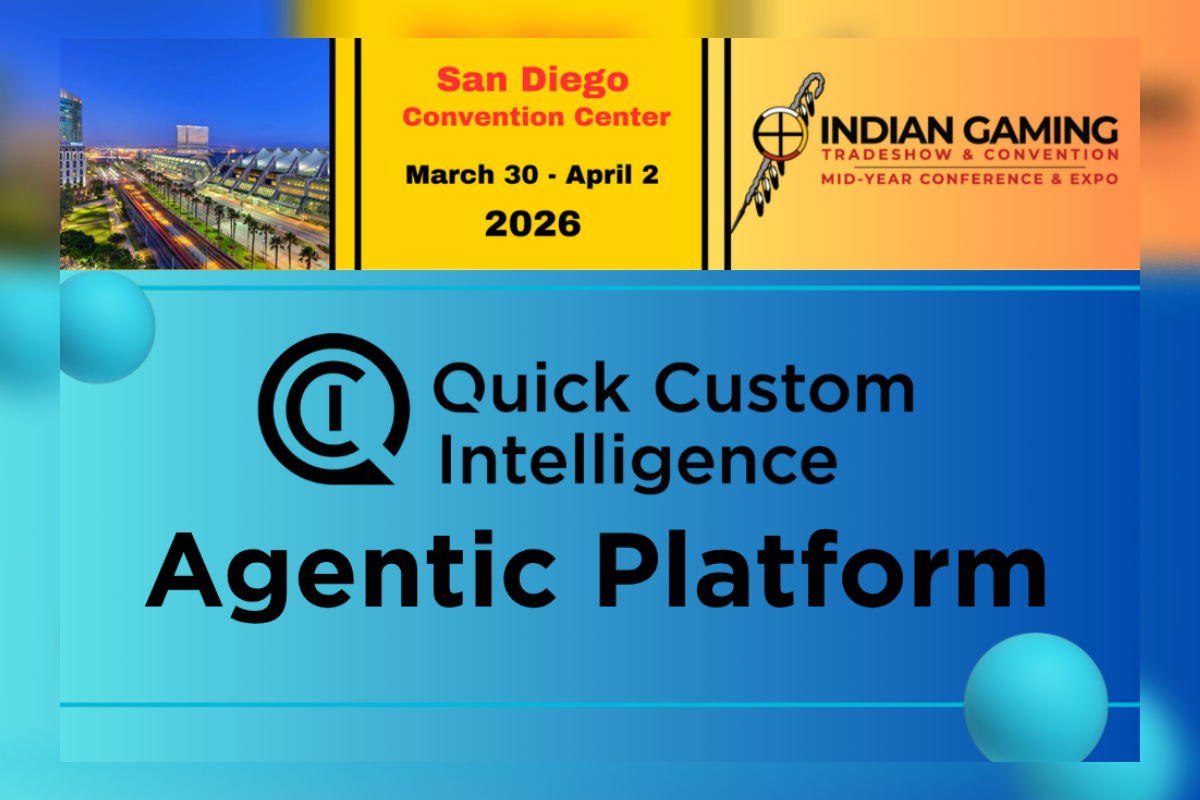
Quick Custom Intelligence (QCI), a leading provider of AI-driven operations software for tribal gaming resorts, announced it will showcase its evolving QCI Agentic Platform at the Indian Gaming Association (IGA) Tradeshow & Convention, March 31–April 2, 2026, at the San Diego Convention Center (Booth #2735).
The QCI Agentic Platform reflects the continued advancement of the company’s enterprise system, enabling operators to move from real-time insight to real-time action across gaming, marketing, player development, and hotel operations. Designed for on-premise and hybrid environments, the platform supports secure, property-level AI deployment while maintaining full operational control.
Rather than introducing a new system, QCI’s approach extends the capabilities operators already use—bringing analysis and execution closer together within a unified operational environment.
“This is a continuation of the platform our customers already rely on. We’re building on what works and extending it, so operators can act on information faster, without changing the way their business runs,” said Dr. Ralph Thomas, Co-Founder and CEO of QCI.
The QCI Agentic Platform builds on QCI’s established product suite, including:
• AGI56.1, a major platform release featuring more than 1000 enhancements across operations
• Chatalytics, QCI’s conversational analytics interface for real-time data access
• QCI Dispatch, a new core operational tool supporting real-time coordination and execution
Together, these capabilities enable operators to unify data, streamline workflows, and respond more quickly to changing conditions across the property.
Attendees will experience how QCI connects data, decision-making, and execution within a single operational system.
“We’re focused on practical improvements that help teams do their jobs more effectively. This is about making systems more responsive, more connected, and easier to use in day-to-day operations,” added Thomas.
The post QCI to Showcase Agentic Platform Capabilities at IGA 2026 appeared first on Americas iGaming & Sports Betting News.

Eeze, the next-generation casino supplier, has announced a comprehensive global distribution agreement with EveryMatrix, extending the reach of its live dealer and upcoming slots portfolio to EveryMatrix’s worldwide partner network.
Under the partnership, Eeze’s full range of live dealer titles, including its recently launched Fusion Roulette, alongside forthcoming slot releases, will be made available across EveryMatrix’s Game Aggregator Network. The deal covers EveryMatrix’s active markets globally, marking a key milestone for the supplier’s international expansion.
Mikko Hoglund, Partnership Manager at Eeze, said:
“Partnering with EveryMatrix is an important moment for us as we look to push our games to a wider network of players than ever before. We have a lot of exciting product releases to come in the next few months, and know that these games, as well as our existing portfolio, will be well received across EveryMatrix’s customer base.”
Bjorn Sjoberg, Chief Commercial Officer at EveryMatrix, added:
“We are very pleased to be adding Eeze’s full product suite to our aggregation offering. With best-in-class live products and an exciting array of RNG games on the roadmap, we’re confident that our customers will enjoy the differentiation these titles bring to market.”
With this partnership, Eeze strengthens its footprint in regulated markets and positions its Fusion Roulette and slot titles for maximum visibility, giving operators a compelling mix of content to offer players worldwide.
The post Eeze signs global partnership with EveryMatrix appeared first on Eastern European Gaming | Global iGaming & Tech Intelligence Hub.

-

 Centurion Winner Grand Chance™6 days ago
New from Inspired: Luck It Up™ and Centurion Winner Grand Chance™ available online & on mobile
-
Blazin' Bonus6 days ago
Booming Games releases Blazin’ Bonus
-
Australasian Hospitality and Gaming Expo6 days ago
IGT Showcases Integrated Gaming, Systems, and FinTech Innovations Designed to Drive Growth at Australasian Hospitality and Gaming Expo 2026
-
Cristiano Blanco CEO of SpinCore Group6 days ago
SpinCore Group Enters Finnish Market via Finnplay Partnership
-
Conferences5 days ago
NOVOMATIC Gaming Colombia to Showcase its Latest Innovations at GAT Cartagena 2026
-
Alberta market6 days ago
Soft2Bet Evaluates Alberta Market Entry to Strengthen its Canadian Footprint
-
Enjoy6 days ago
ENJOY Unveils Hotfire Diamonds XXL to Elevate an Iconic Franchise
-
Aristocrat Gaming6 days ago
Aristocrat Gaming to Participate in Australian Hospitality & Gaming Expo