iGaming
Experience the Thrill of Live Roulette


Gamblers have been enthralled by the intriguing and thrilling game of live roulette for centuries. Live roulette provides a realistic and immersive gambling experience by combining the fun of a real casino with the convenience of online gaming. This article will examine the history of live roulette, go over its fundamental principles, and showcase some of the most well-liked game types.
Introduction to Live Roulette
Live roulette lets you enjoy a casino experience in the convenience of your own home. It links players to live dealers and actual roulette tables using live video streaming technologies. Players may observe the action from various angles and receive a close-up view of the wheel and ball thanks to the usage of multiple cameras.
You must pick a reliable online casino that provides live dealer games if you want to play live roulette. You can access the live roulette section after creating an account and making a deposit. The live video feed, a virtual betting table, and many interactive features that improve the gaming experience are frequently included in the game interface.
General Rules of Live Roulette
Live roulette has simple rules that are easy to understand. The ball is released in the opposite direction after the dealer spins the wheel in one way. The ball eventually rests in one of the wheel’s numbered pockets as it begins to lose momentum. Players’ objective is to correctly predict the result by betting on the matching numbers or other available wagering alternatives.
The available bets in live roulette can be broadly categorized into two groups: inside bets and outside bets. Chips are placed inside the main grid of the betting table on specific numbers or groupings of numbers, known as inside bets. Although the odds of winning are smaller, these wagers feature greater payouts. On the other hand, outside bets cover a wider area of the table and have higher winning odds but lesser rewards.
Popular Live Roulette Game Variations
Live roulette offers several exciting variations that cater to different player preferences. Here are a few popular game variations you might encounter:
- European Roulette: This is the most common variation of live roulette, featuring a single zero pocket and a house edge of approximately 2.7%.
- American Roulette: In American roulette, an additional double zero pocket is added to the wheel, increasing the house edge to around 5.26%. It is less favorable for players due to the higher house edge.
- French Roulette: Similar to European roulette, French roulette also features a single zero pocket. However, it includes additional rules like La Partage and En Prison, which provide certain advantages to players when the ball lands on zero.
- Speed Roulette: This fast-paced variant of live roulette aims to maximize the number of spins per hour, allowing players to place bets more frequently.
- Immersive Roulette: Immersive roulette offers a highly immersive gaming experience with multiple camera angles, slow-motion replays, and captivating visual effects.
Conclusion
With its spectacular live roulette game, players may enjoy both the ease of online gambling and the adrenaline of a real-world casino. Live roulette has a long history, simple rules, and several game versions that continue to draw in gamblers from all over the world. Try your luck at a live roulette table and savor the enduring charm of this traditional casino game whether you’re an experienced gambler or new to the world of online gambling.














The prediction market is beginning to gain traction in Brazil at a time of transformation for the gaming industry and probability-based digital products.
Although it is still an emerging concept in the country, and a controversial one in neighboring markets, this model, which combines elements of financial markets, technology, and user behavior, has already demonstrated its potential in other regions by offering collective estimations of future events.
However, its development has been uneven across Latin America.
In markets such as Argentina, for example, it has faced restrictions and even bans, amid regulatory debates over its nature and its possible similarity to traditional betting.
In this context, Brazil emerges as a market still in formation, where the recent regulation of sports betting opens the door to discussions around new probability-based digital formats.
It is in this scenario that the figure of Carlos Santos emerges, CEO and one of the promoters of this segment in the Brazilian market with the launch of Previlabel.
With prior experience in the betting ecosystem, Santos chose to move beyond the traditional model and focus on building a new category in the country: prediction markets.
Through his vision and his project, the executive aims not only to introduce this concept in Brazil, but also to develop the technological infrastructure needed for new operators and companies to participate in this emerging ecosystem.
In this interview, Carlos Santos discusses the potential of prediction markets in Brazil, the challenges of their development, and the opportunities that could shape the future of this segment in the region.
Prediction Markets in Brazil
The prediction market is still relatively unknown in Brazil. How would you explain this concept to someone who has never heard of it?
Prediction markets are platforms where people trade probabilities about future events. Instead of simply betting on an outcome, users buy or sell positions based on the likelihood of something happening.
The price of these positions ultimately reflects what the market believes is the probability of that event.
That’s why many people describe this model as a kind of stock exchange for probabilities, where information, opinion, and money come together to form a collective estimate of the future.
Why do you believe Brazil could become a relevant market for prediction platforms?
Brazil has several factors that strongly support this type of market.
First, it is a highly digitally connected country with strong adoption of new financial technologies. Second, there is a strong cultural interest in sports and public events, which naturally drives interest in predictions.
Additionally, the recent regulation of sports betting has opened the door to discussions around products related to probabilities and digital markets.
The country has just regulated sports betting. Are prediction markets a natural evolution of this, or a different industry?
They are related, but not exactly the same. In traditional sports betting, probabilities are set by the bookmaker. In prediction markets, however, users themselves create those probabilities by trading positions with each other.
This creates a dynamic closer to a financial market, where prices change as new information emerges and as people adjust their expectations.
What types of events do you believe could become popular in this market in Brazil?
Sports will likely be the most natural entry point, as there is already a large audience interested in this type of content.
But over time, these markets can expand into areas such as politics, economics, entertainment, and even technology.
In other countries, prediction markets already exist around elections, economic indicators, and major global events.
This shows that the model has the potential to go beyond entertainment.
Is there a risk that prediction markets could be confused with traditional betting?
Yes, especially in the early stages. Since both involve money and probabilities, some confusion is natural. However, the key difference lies in the market dynamics.
In prediction platforms, users can trade probabilities and react to new information, making the system closer to a financial market than a traditional bet.
Over time, as users better understand how it works, this distinction tends to become clearer.
Abroad, prediction platforms have existed for some time. What can Brazil learn from these experiences?
The main lesson is that these markets work best when there is transparency, liquidity, and clear operational rules.
International experiences show that, when well structured, prediction markets can generate highly accurate estimates of future events.
However, they also highlight the importance of integrity mechanisms and a regulatory environment that keeps pace with innovation.
Brazil has the advantage of being able to observe these examples and adapt best practices to its own context.
What made you look at prediction markets instead of continuing only in the traditional betting industry?
At the last SBC in Lisbon, I had a very clear moment of realization about the market.
I understood that I was trying to compete in a very difficult environment for new companies, going directly against well-established giants in the betting sector.
The regulated betting market in Brazil is extremely competitive and dominated by companies with significant capital.
It’s like trying to swim alongside sharks in an ocean that already belongs to them.
That’s when I realized that the opportunity might not be to compete in that market in the traditional way, but rather to help build a new category within the industry.
Prediction markets are still at an early stage in Brazil, which creates space for innovation, technology, and leadership.
I saw that I could bring all the knowledge I developed in the betting sector to help structure this new phase of the market in the country.
When did you decide to turn this into a business?
When I returned to Brazil after SBC Lisbon, my business perspective changed completely.
I began studying prediction markets more deeply and realized that this was not just a global trend, but also a real opportunity to build infrastructure for this sector in Brazil.
From that point, we started a partnership with Mercado Bitcoin, leveraging the company’s expertise in Web3 and digital infrastructure to develop this technology.
The idea was to combine this blockchain experience with our product and market vision, creating a technological foundation capable of bringing more competitiveness and innovation to this new segment.
What were the biggest challenges when starting in this sector?
The main challenge was building the technology.
Prediction markets require very specific infrastructure, including probability trading systems, liquidity management, event handling, and integrity mechanisms.
Since this is still a very new market in Brazil, there were virtually no ready-made solutions adapted to the local reality.
This required a significant development effort to build a robust technology capable of supporting the growth of this ecosystem.
Is the Brazilian public ready to understand and use prediction markets?
I believe so. Brazilians have already demonstrated a strong ability to adapt to new digital products.
Just look at the growth of sports betting, cryptocurrencies, and financial platforms in recent years.
When the model is well explained and the user experience is simple, adoption tends to happen quickly.
What exactly does Previlabel do within this market?
Previlabel is a technology company focused on infrastructure for prediction markets.
We develop the technology that allows entrepreneurs to create their own prediction platforms and build businesses within this new segment that is starting to emerge in Brazil.
Our goal is to make it easier for new operators to enter this market.
You don’t operate just one platform, you sell technology for others to build their own. How does this model work?
Exactly. Previlabel operates as a technology provider for this market. Instead of running a single platform, we develop the infrastructure that operators can use to launch their own brands within the prediction market space.
This allows entrepreneurs and companies to enter the sector much faster, without needing to build the entire technology from scratch.
Do you believe we will see many prediction platforms emerging in Brazil in the coming years?
I believe this will happen very quickly. In the coming months, we should already see several platforms emerging in Brazil.
Historically, the country has always attracted new digital business models due to the size of its market and the high level of technological engagement.
When a promising new segment appears, Brazil often becomes one of the main markets for experimentation.
Is there a kind of “race” to create the first major Brazilian prediction market?
Yes, this is natural in any emerging industry.
When a new market begins to take shape, there is always an initial competition between companies to see who can position themselves first and become a reference.
We are likely at the beginning of this process in Brazil, and those who manage to build solid technology, gain user trust, and scale quickly will have a significant advantage.
The post Prediction Markets Gain Ground in Brazil as Previlabel Enters the Market appeared first on Americas iGaming & Sports Betting News.

BetConstruct AI, a global iGaming platform provider, will present its full ecosystem at Stand N150 during SiGMA South America 2026, taking place from April 7–9 in São Paulo, Brazil.
With South America rapidly emerging as one of the most dynamic iGaming regions, BetConstruct AI is positioning itself as a key partner for operators looking to scale efficiently and competitively. The company delivers a vast offering, including over 140,000 pre-match events, 90,000+ live matches monthly, and 45,000+ casino games from 350+ providers.
One Platform, Multiple Growth Drivers
Visitors to Stand N150 will experience live demos across six core solution areas:
Acquisition, Content & Entertainment
A comprehensive offering spanning sportsbook, casino aggregation, affiliate marketing through Affigates, and six flexible front-end solutions, including crypto-ready platforms.
Payments & Licensing
With 500+ payment integrations and a fully managed licensing service, BetConstruct AI enables operators to enter regulated South American markets with confidence and compliance.
Retention & CRM
AI-powered CRM tools predict churn up to 14 days in advance, identify high-value players early, and automate personalized engagement across multiple channels. A game recommendation engine further enhances player activity and revenue potential.
Risk Management
The Umbrella AI system combines sportsbook and casino risk, AML, and responsible gaming into a unified solution. Advanced tools detect fraudulent behavior early and forecast negative-value players well in advance.
Operational Services
End-to-end support includes licensing, digital marketing, CRM management, trading, risk control, and infrastructure protection.
BetConstruct AI Poker
A flexible B2B poker network offering turnkey, white-label, or API integration, supported by strong liquidity, built-in security, and Web3-ready infrastructure.
World Cup-Focused Engagement Tools
To help operators maximize opportunities around the 2026 World Cup, BetConstruct AI is introducing two zero-cost promotional solutions:
Powerfull (Pre-Tournament Campaign)
A challenge-based campaign running before kickoff, rewarding players with Free Bets that accumulate and activate during the tournament—driving engagement, reactivation, and cross-product activity.
Bet on League (In-Tournament Hub)
A fully integrated World Cup hub featuring standings, schedules, and interactive tools that convert fan engagement into betting activity. It includes AI-powered bet suggestions and requires no additional development or fees.
Beyond the Expo
In addition to the exhibition, BetConstruct AI will host an exclusive Harmony ChoiceMe event on April 7 at Tetto Lounge in São Paulo, offering industry leaders a premium networking environment.
As the South American market accelerates, BetConstruct AI invites operators to visit Stand N150 to explore how its platform, tools, and expertise can drive the next phase of growth.
The post BetConstruct AI Showcases Full Platform at SiGMA South America 2026 appeared first on Eastern European Gaming | Global iGaming & Tech Intelligence Hub.
First Look Games
First Look Games Launches FLG Analytics – The First Marketing Intelligence Platform Built for iGaming Studios

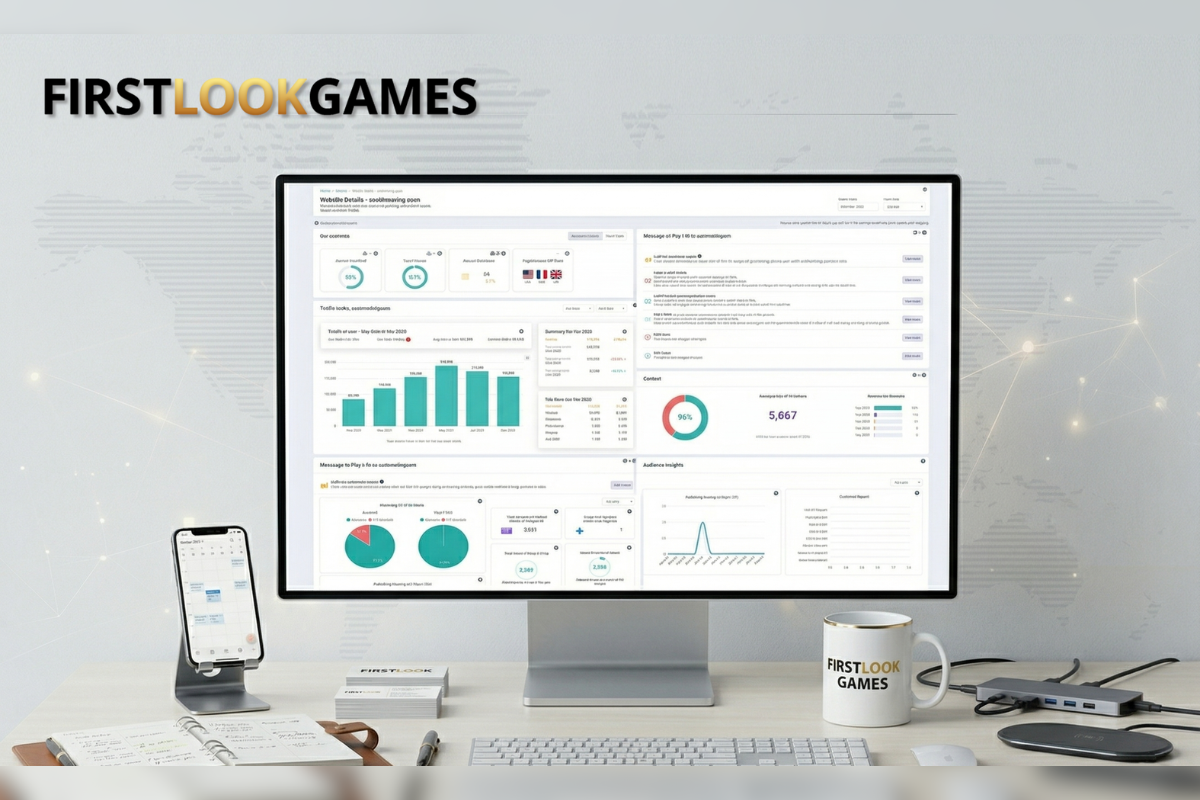
First Look Games (FLG), the data-driven iGaming marketing intelligence platform connecting game studios and affiliate publishers, has launched FLG Analytics: a comprehensive marketing intelligence suite giving game studios unprecedented visibility into how their titles are represented, reviewed and ranked across the iGaming affiliate market.
Game studios invest heavily in developing and launching titles, yet have historically had limited insight into how those games are marketed by the affiliate websites that drive a significant proportion of new depositing customers for operators.
FLG Analytics addresses this blind spot across five core modules:
- Website Directory – A searchable database of 1,000+ vetted iGaming affiliate publishers, filterable by country, traffic, SEO performance and keyword relevance, enabling studios to build targeted outreach strategies.
- Studio Benchmarking – Live competitive benchmarking across share of voice, player reach, review volume and AI-powered sentiment analysis, covering over 740 indexed studios.
- Game Benchmarking – Title-level performance tracking against competitor releases, including review coverage, publisher performance and affiliate engagement.
- Content Monitor – Real-time tracking of all content published about a studio’s games across the FLG publisher network, with filtering by site, game, geography and date.
- Instant Messaging – A built-in channel for studios to contact verified affiliate publishers directly to establish commercial and marketing partnerships, replacing fragmented email and LinkedIn exchanges with a single, purposeful interface.
These new product features have been developed as a result of game studio client and publisher user feedback as First Look Games seeks to continue to deliver value to its partners as it scales its pathfinder technology platform.
Tom Galanis, CEO of TAG Media and First Look Games, commented: “Game studios spend significant resources developing world-class games, but have historically had almost no visibility into how those games are truly presented to players by the affiliate community. FLG Analytics changes that. For the first time, studios can identify the best affiliate partners, target specific markets, benchmark against competitors and track content in real time – all from one platform. We’ve built the studio-affiliate marketing intelligence layer that the iGaming industry has been sorely missing.”
The platform now serves 1,000+ vetted publishers reaching more than 50 million casino players worldwide. The business case for better affiliate intelligence is stark: affiliates drive between 19 and 95 percent of new depositing customers for operators depending on the market. In the UK alone – where affiliate influence is at its lowest from a percentage perspective – the slots market generates an estimated £798m annually through affiliate activity, translating to an average of £57k per slot game and in excess of £300k for top-performing titles.
Galanis added: “Despite this, there has never been a structured way for studios to understand, evaluate and engage with affiliate publishers at scale. FLG Analytics provides that structure. Our ultimate mission is to demonstrate just how valuable individual publishers are to a game studio’s revenue performance – at a game level and in total.”
FLG Analytics is available now.
The post First Look Games Launches FLG Analytics – The First Marketing Intelligence Platform Built for iGaming Studios appeared first on Eastern European Gaming | Global iGaming & Tech Intelligence Hub.

-

 Asia7 days ago
GLI Becomes the First Company Accredited by PAGCOR to Test and Certify iGaming Platforms in the Philippines
-
Betnacional6 days ago
Operational Leadership and the Driving Force Behind LatAm’s Largest Event
-
Compliance Updates7 days ago
Playtech Enters Connecticut iGaming Market
-
Asia7 days ago
Team India and Türkiye Win Gold at the Global Esports Games Mumbai
-
Australia6 days ago
NSW: More Than 650 Gaming Machine Exemptions Revoked to Address Gambling Harm
-
Compliance Updates6 days ago
UK Government proposals to undermine the ‘aim to permit’ of the Gambling Act 2005?
-
2026 SPiCE South Asia Awards6 days ago
QTech Games wins Innovation of the Year at the 2026 SPiCE South Asia Awards
-
Andrea Rossi7 days ago
REEVO Goes Live with Betsson in Brazil