Baltics
Modern Oracles & Smart Payments: Finrax’s Vision for Blockchain, AI & Beyond


Finrax steps into the spotlight as the official Lanyards Sponsor at HIPTHER’s MARE BALTICUM Gaming & TECH Summit 2025 in Vilnius, bringing with them a next-gen crypto payment gateway and a bold vision that extends far beyond payments.
We sat down with Konstantinas Balakinas, CEO of Finrax, to discuss the future of AI in finance, the real-world potential of blockchain beyond the buzzwords, and how Finrax plans to bridge fintech innovation with eCommerce and beyond.
Konstantinas, thank you for joining us! Can you please introduce yourself to our readers, and share more about your professional background and role in Finrax?
Thank you — it’s a pleasure to be part of this conversation, especially as Finrax steps into a more visible role at this year’s summit.
I’ve been working in the financial industry since 1999, mostly in regulated environments. The bulk of my career has been in consumer finance, where I had the chance to grow several companies from the ground up and eventually guide one through the process of securing a specialized bank license. That experience taught me a lot about how to build resilient financial infrastructure — and how to adapt when the rules, tools, and expectations shift.
My interest in AI came later. I had a first-hand look at its practical impact while working with a Lithuanian EMI that was really leaning into AI-driven operations. That sparked something — and eventually led me to study AI for Business Analytics at Turing College, where I’m currently sharpening both technical and strategic understanding of how AI can reshape financial services.
At Finrax, I serve as CEO and Chair of the Management Board in its Lithuanian entity. Our mission goes beyond crypto payments — we’re focused on building real utility for digital assets in a way that businesses can trust and adopt without friction.
How do you see today’s AI solutions? Can they be truly predictive, like “modern oracles”, or are we still in the realm of reactive technology?
AI today is generative AI — especially large language models (LLMs), which have made impressive progress in producing human-like text and anticipating user intent. So in a technical sense, yes — these systems are predictive, but not in the way many assume. What they predict is not the future itself, but the next statistically likely word or phrase based on patterns learned from massive datasets. That creates the appearance of intelligence, but not true comprehension.
This distinction is essential. As Carl Bergstrom and Jevin West explain in The Bullshit Machines, LLMs can sound coherent and authoritative while having no actual grasp of truth. They generate content that feels convincing, regardless of whether it’s accurate or logically sound. That’s not a flaw — it’s how they’re designed.
One should approach these tools with both optimism and caution. Today’s AI still sits within the boundaries of Artificial Narrow Intelligence — excellent at specific tasks like pattern recognition, anomaly detection, and content generation, but still a long way from Artificial General Intelligence, which would reason and adapt like a human across any domain. And Artificial Superintelligence, capable of recursive self-improvement and independent thought, remains firmly theoretical.
So, while we admire the capabilities of today’s generative AI, we don’t mistake fluency for understanding. These are powerful tools — but not oracles. The real challenge is using them responsibly and building systems around them that make sense in the real world.
What are some practical ways AI is and could be integrated into Finrax’s crypto payment platform? Are there use cases you’re already exploring or see as promising?
I see three core domains where AI tools offer real practical value — not just for Finrax, but for any fintech building towards efficiency, scale, and regulatory clarity.
The first is internal productivity. AI works well as a personal assistant for employees — helping with everything from drafting emails to summarizing documents or generating code. Off-the-shelf tools like ChatGPT are already useful for this, but their impact depends heavily on how well people know how to prompt them. That’s why custom GPTs are especially promising: they allow us to build tailored assistants with topic-specific knowledge and clear task guidance. For instance, an onboarding specialist might use one to walk through a compliant KYC checklist, while a developer could use another to generate smart contract boilerplate or debug Python scripts.
The second domain is AI agents — and this space is moving fast. These systems handle automated, rule-based workflows, often collaborating with other agents to move tasks along. They’re more constrained than LLMs, but more reliable when used within predefined rules. For a crypto payment platform like ours, agents could eventually assist in payment routing, compliance alerts, or even technical monitoring — anything repetitive that benefits from low-latency automation.
The third area is pattern recognition, where AI’s value is most proven. We see strong potential in using it to support fraud detection and ML/TF screening — not to replace human oversight, but to enhance it. Spotting unusual activity, flagging anomalies, or refining transaction scoring — these are all areas where AI can quietly but meaningfully improve risk management.
That said, we’re also realistic about the limits. With the EU AI Act now on the horizon, every integration has to pass the test of explainability, compliance, and accountability. Any system we deploy will need a clear inventory, GDPR alignment, risk assessment, and, in some cases, staff training. We’re already looking into how these rules will apply — especially as we explore the potential of agent-based systems.
So yes, we’re enthusiastic — but we’re moving deliberately. We’re not building AI from scratch, but we are actively exploring how to apply it in meaningful ways — both internally and within our services. Our business development team is already using tools like ChatGPT in their day-to-day work, and we see real gains in productivity and clarity. That’s the direction we’re leaning into: using AI where it helps people do their jobs better, not just to check a box.
Finrax has built a strong reputation for reliability and speed – processing crypto payments in under a minute. What differentiates your platform from other solutions currently available on the market?
Reliability is the real star here. Speed is expected in blockchain-based systems — but combining that speed with stability, predictability, and regulatory clarity is a much harder problem to solve. That’s exactly where Finrax delivers.
We’ve built a platform that doesn’t just move fast — it does so in a way businesses can actually depend on. We offer fixed-rate settlements to remove volatility, giving partners certainty about what they’ll receive. That’s especially important in high-volume environments, where financial precision matters just as much as transaction speed.
Compliance is also baked in. Every transaction goes through full AML/CTF screening, and our onboarding and monitoring standards are designed to meet the expectations of regulated businesses. That’s not a side feature — it’s part of our foundation.
And while many of our clients have international operations, we’re careful to operate only where we’re permitted to do so. With MiCA coming into force, we’re preparing to scale responsibly, aligned with the new rulebook.
So yes, we’re fast — but more importantly, we’re reliable. And in this space, that’s what truly sets us apart.
What opportunities do you see in the field of eCommerce for a crypto-first payment provider, and what role could Finrax play in shaping the future of online payments?
Crypto is here to stay — and with that in mind, we’re building the tools to help eCommerce businesses accept crypto as naturally as they would any traditional payment method. Our goal at Finrax is to provide plug-and-play solutions that allow online stores across the EU to accept payments in stablecoins or major cryptocurrencies without having to rethink their entire checkout process.
The opportunity goes beyond retail. We see strong potential in industries like logistics, aviation, luxury, and of course, gaming platforms — areas where cross-border payments, speed, and transparency really matter. That said, everything still depends on how quickly users adopt crypto in their day-to-day transactions.
What gives us optimism is the direction regulation is moving. With MiCA coming into effect in the EU, we’re finally getting a clear rulebook — and that’s exactly what’s needed to build trust. Once customers know that only licensed, properly regulated providers can offer these services, it changes the perception. It brings structure to the market — and with structure comes wider adoption.
At Finrax, we’re preparing for that shift. We don’t just want to be ready for the future of payments — we want to help shape it in a way that’s both efficient and trusted.
As the world becomes increasingly automated, how do you see Finrax maintaining a balance between innovation and user-centric service, especially amidst the fast-evolving tech and regulatory landscapes?
Automation, at its core, is about efficiency — but that doesn’t mean we lose sight of the human side. In fact, I’d argue that smart automation should strengthen customer-centricity, not weaken it.
At Finrax, we see automation as a way to free up our people to focus on what actually matters — understanding the client’s real needs, solving problems, and making sure the experience feels consistent and supportive across the board. It also helps us align internal processes more clearly, so that we’re not sending mixed messages to clients. That’s often where customer frustration begins — not with the technology, but with the gaps between systems and people.
Another benefit is the ability to understand customers more precisely. With better data and well-designed workflows, we can respond faster and more accurately, without adding friction.
But none of this can come at the expense of trust. As regulations like MiCA, GDPR, and the EU AI Act begin shaping the environment, it’s clear that automation must be explainable, compliant, and ethically sound. For us, innovation isn’t just about what’s possible — it’s about what’s responsible. And we see that as a competitive advantage, not a constraint.
You’ll be joining the panel “Beyond the Hype” at MARE BALTICUM, discussing blockchain and AI applications in finance and governance. What are you most looking forward to sharing with the audience – and what do you hope to take away from the conversation?
A lot of the hype around AI comes from not really understanding how it works — and I think it’s important to go back to the basics. Most people still assume these systems “know” things. But in reality, large language models are built by training on massive volumes of data — much of it containing human bias, errors, or even outright misinformation. They don’t reason. They predict. They break down language into tokens and map those tokens across hundreds of abstract dimensions — far beyond how we perceive space — then generate output that mimics meaning, even if it’s not grounded in real understanding. But it’s not grounded in fact unless you make it so.
Even the best models will produce an answer to almost anything — even if that answer is fabricated. That’s why we see hallucinations. Unless you know how to prompt properly and critically assess the output, the result might sound confident while being completely off. This is why I always say: at this stage, AI should be seen as an assistant, not an authority. The human must remain in the loop — and at the top.
That said, the future isn’t bleak — it’s exciting, if we use these tools responsibly. One example that stands out to me is what Stripe recently did. They trained an AI model not on words or code, but on tens of billions of payment transactions. The model learned the “language” of money — identifying how payments behave, how fraud patterns look, and what hidden connections exist between different data points. The result? They went from detecting 59% of sophisticated card testing fraud attempts to 97% — almost overnight. That’s not just a technical win — it’s a complete shift in how we think about structured financial data.
So on this panel, I’m hoping to bring two things to the table: first, a grounded reminder that no model is infallible, and second, a practical optimism. AI has the potential to make finance faster, smarter, and safer — but only if we stay thoughtful about how we design, train, and regulate it. Humans should come first — but we don’t need to fear the future if we build it wisely.
Meet Konstantinas Balakinas and the Finrax team live at the MARE BALTICUM Gaming & TECH Summit 2025 on 27–28 May in Vilnius.
🔗 Register now to learn more about blockchain-powered finance, crypto innovation, and the real tech shaping tomorrow’s payments.
The post Modern Oracles & Smart Payments: Finrax’s Vision for Blockchain, AI & Beyond appeared first on European Gaming Industry News.














Digitain has been recognised as Best Sportsbook Provider at the HIPTHER Baltic & Nordics Gaming Awards 2026, showcasing its continued commitment to delivering high-performance sportsbook technology for operators across regulated markets.
The HIPTHER Baltic & Nordics Gaming Awards celebrate the operators, suppliers, technology innovators and industry leaders shaping the gaming ecosystem across the Baltic and Nordic regions. Receiving this award reflects Digitain’s ongoing investment in product innovation, trading excellence and technology designed to support long-term operator success.
Digitain’s sportsbook combines proprietary trading, advanced risk management, flexible localisation and scalable infrastructure, enabling operators to deliver competitive betting experiences across diverse markets.
This recognition is shared with the operators who trust Digitain to power their businesses and with the teams across a company whose expertise continues to drive innovation across every product and market.
As Digitain continues to expand its global presence, their mission remains unchanged: empowering ambitious operators with technology built for performance, partnership, and sustainable growth.
The post Digitain Named Best Sportsbook Provider at HIPTHER Baltic & Nordics Gaming Awards 2026 appeared first on EE Gaming | Global iGaming & Tech Intelligence Hub.

Comtrade Gaming, a leading iGaming platform provider delivering enterprise‑level technology for operators worldwide, announced a strategic partnership with 7bet to support the operator’s continued growth across Northern and Eastern Europe.
Under the agreement, 7bet will deploy Comtrade Gaming’s advanced iGaming platform to launch operations in Latvia and Estonia, as well as enter the newly regulated Finnish market upon its opening.
The partnership marks a significant milestone for both companies, combining 7bet’s strong regional presence with Comtrade Gaming’s proven platform capabilities, designed to deliver flexibility, compliance and high-performance player experiences.
Steven Valentine, Chief Commercial Officer at Comtrade Gaming, said: “We are delighted to partner with 7bet at such an exciting stage of their growth journey. This agreement reflects the strength and scalability of our iGaming platform, particularly in regulated and soon-to-regulate markets such as Finland. Supporting 7bet’s expansion across Latvia, Estonia, and Finland, highlights our ability to deliver seamless multi-market solutions for established operators who want to expand. We look forward to a long and successful collaboration.”
Justinas Sliazas, CEO of 7bet, said: “Partnering with Comtrade Gaming is a key step in our strategy to expand and strengthen our presence across regulated European markets. Their technology provides the flexibility and reliability we need to scale efficiently while maintaining a high-quality player experience. We are particularly excited about the opportunities in Finland and confident that this partnership positions us strongly for future growth.”
The collaboration underscores Comtrade Gaming’s continued momentum in regulated markets and reinforces its position as a trusted partner for ambitious operators seeking scalable, compliant and future-ready iGaming solutions.
The post Comtrade Gaming Announces Strategic Partnership with 7bet appeared first on EE Gaming | Global iGaming & Tech Intelligence Hub.
Baltics
HIPTHER Baltics 2026 Concludes Landmark Three-City Series, Bringing Together 430 Industry Leaders

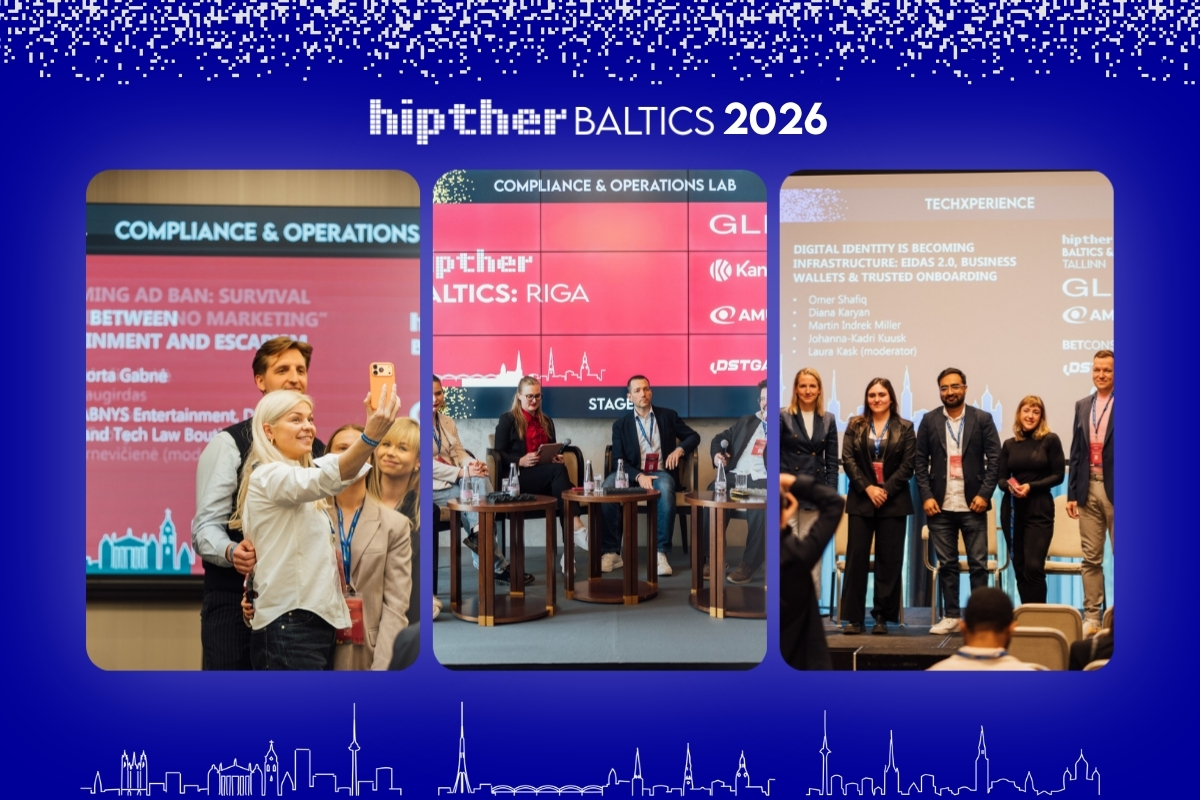
HIPTHER proudly concludes the inaugural edition of its expanded HIPTHER Baltics 2026 conference series, successfully bringing together a total of 430 participants across three dedicated events in Vilnius, Riga, and Tallinn.
Building on the legacy of the MARE BALTICUM Gaming & TECH Summit and introducing a new, country-focused format, HIPTHER Baltics 2026 delivered three high-impact conferences designed around the most pressing regulatory, technological, and business developments shaping the Baltic and Nordic regions. The series focused on creating meaningful dialogue between regulators, operators, fintech leaders, technology innovators, legal experts, investors, and compliance professionals.
The 2026 edition featured:
- HIPTHER Baltics: Vilnius – iGaming Regulation & Fintech Integration
- HIPTHER Baltics: Riga – Cross-Border Compliance & Player Protection
- HIPTHER Baltics & Nordics: Tallinn – Digital Governance & Startup Innovation
Vilnius: Exploring Lithuania’s Regulatory Transformation
The series launched on 21 April in Vilnius, where discussions focused on Lithuania’s evolving regulatory landscape and the increasing convergence of fintech, payments, blockchain, and iGaming.
Industry leaders examined topics including MiCA implementation, AML requirements, digital assets, banking transformation, tokenisation, AI adoption in financial services, next-generation payments, and the growing role of compliance in sustainable business growth. The event marked the beginning of a new chapter for Baltic-focused industry conversations and set the tone for the months ahead.
Riga: Regulation, Risk and Growth in a Changing Market
On 11 May, HIPTHER Baltics arrived in Riga, bringing together experts from gaming, fintech, legal, compliance, and technology sectors for a day dedicated to practical business realities.
Key conversations addressed responsible gaming, player protection, AML implementation, fraud prevention, AI in supervision and taxation, payments innovation, cross-border licensing, data protection, affiliate marketing, and the transition from traditional SEO to AI-powered discoverability. The Riga edition highlighted how businesses can remain compliant while continuing to innovate and grow in increasingly regulated environments.
Tallinn: Digital Governance Meets Innovation
The series concluded on 2 June in Tallinn, one of Europe’s most digitally advanced capitals.
The event explored the intersection of digital governance, startup ecosystems, digital identity, compliance, investment, fintech innovation, and iGaming. Discussions ranged from eIDAS 2.0 and trusted digital onboarding to sustainable player acquisition, operational partnerships, AI-powered business growth, and the future of digital societies.
Tallinn also hosted the HIPTHER Baltic & Nordics Gaming Awards 2026, celebrating excellence across operators, suppliers, technology providers, and industry leaders from the Baltic and Nordic regions.
Beyond Conferences: Building a Regional Community
Throughout all three events, participants benefited from curated networking opportunities and practical learning sessions through the HIPTHER Academy, HIPTHER’s educational platform focused on delivering hands-on skills, professional development, and industry certifications.
The combination of boutique-format events, high-level content, and meaningful networking once again demonstrated why the Baltics continue to attract increasing attention as a hub for innovation, regulation, and cross-border collaboration.
Looking Ahead – HIPTHER Baltics 2027
Reflecting on the success of the series, Zoltan Tündik, Co-Founder and Head of Business at HIPTHER, commented: “We are incredibly proud of what we achieved across the Baltics in 2026, but this is only the beginning. The success of the three-city series has provided us with valuable insights, feedback, and inspiration that we are already incorporating into the planning of HIPTHER Baltics 2027. The Baltics have a unique energy when it comes to business events, innovation, and networking, and we are excited to continue growing alongside this vibrant community. Our commitment remains the same: delivering meaningful conversations, practical learning opportunities, and exceptional networking experiences that bring together the region’s most influential stakeholders.”
After the successful completion of HIPTHER Baltics 2026 and the overwhelmingly positive feedback received from participants, the #hipthers team is already working on an exciting and enhanced next edition.
With the HIPTHER Warsaw Summit set to take place on 27–28 October 2026 and an ambitious roadmap for 2027–2030 already taking shape, HIPTHER continues its mission of connecting industries, markets, and ideas through premium learning, meaningful networking, and cross-border collaboration across Europe.
About HIPTHER
HIPTHER is a media hub and events organizer serving the Gaming and Technology industries, including Fintech, Blockchain, Crypto, AI, Cybersecurity, Compliance, and Digital Innovation. Through its conferences, media platforms, awards programs, and community initiatives, HIPTHER connects decision-makers, innovators, regulators, and business leaders across Europe and beyond.
The post HIPTHER Baltics 2026 Concludes Landmark Three-City Series, Bringing Together 430 Industry Leaders appeared first on EE Gaming | Global iGaming & Tech Intelligence Hub.

-

 Australia6 days ago
Former Star Entertainment Executives Mathias Bekier and Paula Martin Disqualified and Ordered to Pay Penalties
-
Alejandra Burato6 days ago
Record Attendance, Exciting New Releases, and a Resounding Success: This was Zitro Experience Peru
-
Amusnet6 days ago
Weekend Reels | Week 25: Slot Drops & Trends
-
ArenaPlus6 days ago
DigiPlus Wins “Digital Operator of the Year” Award at 2026 Global Gaming Awards Asia-Pacific
-
Anthony Dalla-Giacoma6 days ago
Elysium Studios Releases its Latest Slot Game “Hood and Loot”
-
Greece6 days ago
SYNOT Games Announces New Partnership with Superbet
-
BurraPay6 days ago
Byte Federal Announces Successful Launch of Custom-Built Integration Supporting BurraPay’s Historic Entry into America’s Regulated Gaming Market
-
Bragg Gaming Group3 days ago
Massive Gaming launches Blitzcrown titles on Superbet Brazil via Bragg Hub