Canada
Fewer Canadians gamble than 20 years ago. So why is Canada’s market still growing?

By CasinoCanada.com
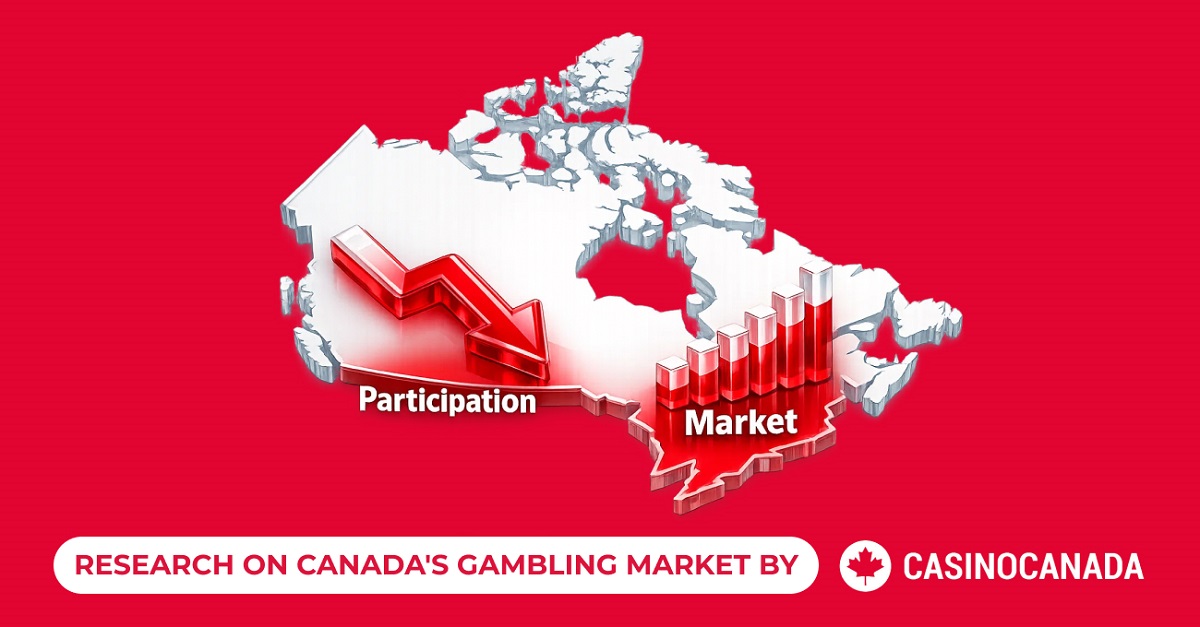
In 2002, 76 percent of Canadians aged 15 and over reported gambling in the previous year, according to Statistics Canada’s report Fighting the Odds. By 2018, that figure had fallen to 64.5 percent, based on the agency’s Gambling Rapid Response module.
At first glance, that suggests gambling participation in Canada has declined over the past two decades.
Yet over the same period, gambling has become more visible, more digital and more embedded in sport and everyday life. Sports betting brands sponsor professional teams, betting segments are embedded in live broadcasts, and provincial regulators report billions of dollars in annual online wagering.
How can participation fall while the industry expands? The answer lies in how Canada’s gambling market has changed, and in who is driving its growth.
This analysis draws on national participation surveys and provincial financial reporting to compare long-term participation trends with recent regulated market performance.
Research highlights of this article
- National gambling participation declined from 76% in 2002 to 64.5% in 2018.
- Ontario’s regulated online market generated approximately CAD 1.3 billion in revenue in 2022–23, rising to CAD 2.9 billion in 2024–25.
- Total wagers in Ontario increased from approximately CAD 63.2 billion in 2023–24 to CAD 82.7 billion in 2024–25.
- Online casino accounted for roughly three quarters of Ontario’s regulated online revenue in 2024–25.
- Approximately 2.6 million active player accounts were recorded in Ontario in 2024–25.
Growth without more players
If fewer Canadians report gambling today than in the early 2000s, market growth cannot simply be explained by expanding participation. Since its launch in April 2022, Ontario’s regulated online gambling market has grown year over year. According to iGaming Ontario’s Annual Reports, in its first full fiscal year, the market generated approximately CAD 1.3 billion in gaming revenue. That rose to CAD 2.2 billion in 2023–24, before reaching CAD 2.9 billion in 2024–25. Total wagers also significantly increased from approximately CAD 63.2 billion in 2023–24 to CAD 82.7 billion in 2024-25.
The latest annual report also recorded approximately 2.6 million active player accounts in a province of roughly 15 million residents. Even allowing for multiple accounts per individual, the figures suggest a highly active digital environment concentrated among a defined segment of players.
The implication is clear: recent market growth appears to be driven less by an expanding audience and more by increased activity per active player.
Operators active in the market say the same shift is visible in player behaviour since Ontario introduced its regulated online framework. Dmitry Arabuli, CEO at Tonybet, said: “Since regulation launched in Ontario, the player landscape has changed significantly as many of the largest North American operators entered the market. Competition increased, with the focus shifting from chasing large volumes of casual participants to building stronger relationships with more informed and engaged players. These players tend to interact more frequently with betting products and show stronger loyalty to the platforms they trust.”
“Regulation also drew a clearer line between grey-market operators and licensed platforms. Many players who were previously using offshore sites have migrated towards regulated products. This did not necessarily expand the total number of gamblers, but it redirected an existing player base into the licensed ecosystem.”
Despite sports betting dominating headlines since the passage of Bill C-218 in 2021, online casino remains the commercial engine of Ontario’s regulated market. iGaming Ontario’s 2024–2025 annual report shows that online casino generated approximately CAD 2.2 billion of the CAD 2.9 billion in total gaming revenue.
In other words, casino accounts for roughly three quarters of the province’s regulated online revenue.
Sports betting reshaped visibility, but casino sustains the economics.
Modern growth appears to be driven less by player acquisition and more by retention and increased engagement within the existing customer base.
A provincial and digital transformation
One reason the national picture can appear contradictory is that Canada does not operate a single gambling model.
Ontario runs a competitive regulated online market with dozens of licensed operators. Other provinces continue to rely primarily on government-operated platforms. Alberta has signalled plans to introduce its own regulated framework.
Since 2018, most of the meaningful growth data has been provincial and digital, not national and survey-based. While participation surveys provide a broad snapshot, provincial market reports reveal how play is evolving in practice.
The shift from retail-based lottery and venue gambling to app-based multi-vertical platforms represents a structural transformation. Gambling is increasingly platform-based, integrated into smartphones and digital ecosystems rather than tied to specific locations.
That structural change helps explain how the industry can grow even without broader participation.
Visibility versus participation
Following the legalisation of single-event sports betting, sportsbook partnerships and advertising have expanded across professional sport. Major leagues, including the National Hockey League, have entered into official betting partnerships at the league level, while Canadian competitions such as the Canadian Football League and Canadian Premier League have also announced sponsorship agreements with licensed operators.
Betting brands now feature prominently in arena signage, broadcast integrations and digital content, embedding gambling directly into the commercial presentation of professional sport.
Dmitry Arabuli, CEO at Tonybet, said: “Ontario regulation made gambling become much more visible in sports broadcasts, live events and daily sports culture. It opened significant opportunities for operators such as Tonybet to do business in Canada legally and build brand awareness through marketing and PR campaigns. For example, Tonybet has previously partnered with the Canadian Premier League and currently works with the Canadian Elite Basketball League.”
Arabuli added that these partnerships help operators connect with highly engaged sports audiences. “These partnerships help strengthen brand awareness, target high-value players, and improve customer retention by building trusted and long-term relationships in the Canadian market.”
Yet fewer Canadians report gambling than two decades ago.
This disconnect between rising visibility and declining participation creates a cultural tension. Gambling is increasingly framed as a routine extension of sport rather than a distinct commercial activity.
For younger audiences in particular, repeated exposure through live broadcasts and social media feeds helps position betting as part of the sporting experience itself, regardless of whether participation is expanding.
Visibility, in other words, is reshaping how gambling is perceived, even if it is not expanding its audience.
Selected examples of publicly announced partnerships, as of 13 March 2026, are outlined below.
Selected Professional Sports Betting and iGaming Partnerships in Canadian Sport
| League / Organisation | Betting Partner | Nature of Partnership | Scope |
| National Hockey League (NHL) | ESPN BET; theScore Bet | Official league betting partner | North America / Canada |
| Canadian Football League (CFL) | ToonieBet | Official sports betting and casino partner | Canada |
| Canadian Elite Basketball League (CEBL) | TonyBet | Official online sportsbook partner | Canada |
| Maple Leafs Sports & Entertainment (MLSE) | Betty | Official online casino partner | Ontario |
Sources: Various league and operator press releases; compiled by CasinoCanada.com.
Risk concentration and policy relevance
If growth is increasingly driven by more intensive digital play among a defined group of participants, the social and regulatory implications become more complex.
Market expansion rooted in activity rather than recruitment raises questions about how gambling risk is distributed. A smaller base of highly active players may account for a disproportionate share of wagering volume.
At the same time, regulators are increasingly focused on channelisation, responsible gambling tools and sustainable market design. If the future of Canada’s gambling market depends more on engagement intensity than expanding participation, policy debates may shift accordingly.
The conversation may move away from how many Canadians gamble and towards how gambling is structured, monitored and integrated into daily digital life.
The next phase
Alberta’s regulatory plans suggest Canada’s gambling evolution is not over. But the next stage may not be about expanding participation. It may be about managing a digital market driven by deeper engagement among a smaller group of players.
Canada’s gambling market is no longer expanding simply because more people are playing. It is expanding because the way people play has fundamentally changed.
The paradox remains: fewer players, larger market.
Methodological note: National participation figures are drawn from Statistics Canada surveys conducted in 2002 and 2018. More recent insights are based on publicly available provincial regulator reporting, which measures wagering, revenue and account activity rather than survey participation. As such, national participation trends and provincial activity data are not directly equivalent but are analysed comparatively to assess structural change.
The post Fewer Canadians gamble than 20 years ago. So why is Canada’s market still growing? appeared first on Americas iGaming & Sports Betting News.














Wealthsimple announced the release of Wealthsimple Predict, providing retail investors the ability to trade event contracts on Kalshi. The standalone application is scheduled to launch this summer. Through the app, users will have access to approximately 4000 Kalshi event-based contracts in categories Wealthsimple is authorized to offer in the Canadian market, specifically climate, financial markets, and economic indicators.
“Prediction markets are the fastest-growing segment of global financial markets, letting traders turn an opinion into a position on the factors that shape our world – where inflation is headed, what happens to rates, or how the year unfolds. Until now, Canadians have had limited access. Wealthsimple Predict gives Canadians a clean, well-designed way to access these markets, with education and guardrails built in from day one,” said Brett Huneycutt, co-founder and Chief Product Officer, Wealthsimple.
“Kalshi was founded on a simple belief: views on the future should have markets, and those markets should be available to everyone. That’s why we’re partnering with Wealthsimple, Canada’s leading financial innovator – to give everyday investors in Canada access to fair, secure, and regulated prediction markets,” said Alex Cuoci, Kalshi.
In March, the Canadian Investment Regulatory Organization (CIRO) authorized Wealthsimple to offer event and forecast contract trading, also known as prediction markets. These contracts are regulated as futures contracts (derivatives). The approval covers contracts with a 30-day settlement period or longer, within the categories of economic indicators, financial markets, and climate. Wealthsimple is the second investment dealer to receive regulatory approval from CIRO for prediction markets.
To access trading through Wealthsimple Predict, new clients must complete a standard Know Your Client (KYC) process. Education is built into every stage of the experience, including a guided orientation of a client’s first trade. The app also shows users key disclosures and definitions, including trading risk reminders, contract resolution information, notices that positions can be sold at any time, and liquidity risk warnings on lower-activity markets. Wealthsimple Predict will only be available to Canadian residents.
Kalshi is authorized to operate in the US as an event contracts exchange, with federal authority from the Commodity Futures Trading Commission (CFTC), the regulatory authority for the U.S. derivatives market. Prediction markets follow the same regulatory framework applied to other financial assets traded in the US, such as equities, bonds, and traditional derivatives, with clear rules for price formation, settlement, and governance.
The post Wealthsimple and Kalshi Partner to Bring Prediction Markets to Canada appeared first on Americas iGaming & Sports Betting News.


MediaTroopers said it is preparing to launch in Alberta’s regulated gaming market on July 13, as Canada’s next regulated commercial gaming market opens.
The digital marketing and customer acquisition firm said it plans to enter Alberta alongside eight “premium operator” clients, which it said are also preparing for their own market entries. MediaTroopers did not name the operators.
The company said its Alberta offering will mirror its work in Ontario, including localized acquisition strategies, compliance-focused marketing, regional player education, and market-tailored performance campaigns.
MediaTroopers also said it has seen “strong interest” from Alberta players through pre-registration activity, without providing figures.
“Alberta represents an exciting next step for regulated iGaming in Canada, and Media Troopers is ready to support operators from day one,” said Shmulik Segal, CEO of Media Troopers. “Our experience in Ontario has given us a strong understanding of what it takes to enter a new Canadian market successfully, from compliance and localization to scalable player acquisition. With eight of our premium clients already preparing for launch and early pre-registration traction underway, we see Alberta as a market with tremendous potential.”
The post MediaTroopers lines up eight operator partners ahead of Alberta launch appeared first on EE Gaming | Global iGaming & Tech Intelligence Hub.
Canada
MediaTroopers Makes Preparations for Upcoming Alberta Launch with Eight Premium Operator Partners

MediaTroopers, the leading digital marketing and customer acquisition firm, has announced that preparations are underway for its upcoming launch in Alberta’s regulated gaming market, scheduled to go live on July 13. As part of those preparations, MediaTroopers will enter the province with eight of its premium operator clients, who are already preparing for their own entries.
With the launch of Canada’s second regulated commercial gaming market, Alberta has quickly become one of the most anticipated market opportunities for operators looking to expand. MediaTroopers has already cemented itself as a reliable partner in Ontario’s regulated market, supporting operators in one of North America’s most competitive markets, and it will bring that same expertise as it enters Alberta.
Much like Ontario, MediaTroopers will continue to support operators in Alberta with localized acquisition strategies, compliance-focused marketing, regional player education, and market-tailored performance-driven campaigns.
MediaTroopers has already seen strong interest from Alberta players through pre-registration activity. With eight of its premium clients also preparing to go live, the company expects to play a pivotal role in helping other licensed operators to build up brand visibility and recognition among players in the region from day one.
With its launch in Alberta, MediaTroopers remains committed to supporting sustainable, responsible, and compliant growth across Canada’s regulated market.
“Alberta represents an exciting next step for regulated iGaming in Canada, and Media Troopers is ready to support operators from day one,” said Shmulik Segal, CEO of Media Troopers. “Our experience in Ontario has given us a strong understanding of what it takes to enter a new Canadian market successfully, from compliance and localization to scalable player acquisition. With eight of our premium clients already preparing for launch and early pre-registration traction underway, we see Alberta as a market with tremendous potential.”
The post MediaTroopers Makes Preparations for Upcoming Alberta Launch with Eight Premium Operator Partners appeared first on Americas iGaming & Sports Betting News.

-

 América Latina6 days ago
Las diferencias locales de Argentina representan tanto un desafío como una oportunidad para el sector del iGaming
-
Latest News7 days ago
Connect with N1 Partners at G Gate Conf 2026
-
Africa7 days ago
Booming Games signs content deal with World Sports Betting in South Africa
-
Gmonitor.ai6 days ago
Gmonitor llega a Latinoamérica: la plataforma de inteligencia de mercado para operadores debuta en seis mercados regulados
-
game-launch7 days ago
Million Games launches East West Wild slot with progressive multipliers
-
 Latest News6 days ago
Sportradar Report | World Cup 2026: Opportunities for the Latin American Sports Betting Market
-
AI7 days ago
Veikkaus rolls out OpenBet’s Neccton responsible gambling platform ahead of 2027 reform
-
Baltics6 days ago
Digitain Named Best Sportsbook Provider at HIPTHER Baltic & Nordics Gaming Awards 2026