AGA
AGA Announces Gaming Hall of Fame Class of 2023

Anoatubby, Miodunski, Murren, Whittemore to be Inducted
The American Gaming Association (AGA) announced the Gaming Hall of Fame Class of 2023, honoring four leaders for their significant contributions to the industry:
* Bill Anoatubby, Governor, Chickasaw Nation
* Robert Miodunski, Former Chief Executive Officer, American Gaming Systems; Former President and Chief Executive Officer, Alliance Gaming and President, Bally Gaming
* Jim Murren, Former Chairman and Chief Executive Officer, MGM Resorts International
* Ellen Whittemore, Executive Vice-President, General Counsel and Secretary, Wynn Resorts
“This year’s Gaming Hall of Fame class enshrines industry leaders that have positively transformed businesses and communities through their contributions to gaming,” the President and Chief Executive Officer for the AGA, Bill Miller, said. “From leading casino and supplier operations to advancing industry regulation and tribal gaming, Bill, Ellen, Jim and Robert’s far-reaching impacts on gaming are indelible and undoubtedly worthy of inclusion in the Hall of Fame.”
Since 1989, the Gaming Hall of Fame has recognized gaming legends, pioneers and business leaders for their lasting impacts on the industry. The Class of 2023 will be honored during an invitation-only induction ceremony at the Global Gaming Expo (G2E) in Las Vegas this October.
“The Gaming Hall of Fame honors the diverse ways gaming leaders elevate our industry,” said AGA Chairman of the Board and Hard Rock International Chairman and Seminole Gaming Chief Executive Officer Jim Allen. “This year’s class epitomizes this principle and we look forward to celebrating their accomplishments at G2E 2023.”
Hall of Fame honorees are selected by an independent panel of gaming executives. This year’s selection committee members include:
* Brett Abarbanel, Executive Director, International Gaming Institute, UNLV
* Jim Allen, Chairman, Hard Rock International, and Chief Executive Officer, Seminole Gaming
* Kirsten Clark, Executive Director, International Association of Gaming Advisors
* John Connelly, Chief Executive Officer, Interblock
* Brian Hansberry, President, Gaming, Delaware North
* Bill Lance, Secretary of State, Chickasaw Nation
* Mark Lipparelli, Chairman, International Center for Responsible Gaming
* Cassie Stratford, Senior Vice-President, Legal Operations and Compliance, Boyd Gaming; President and Chair, Global Gaming Women
* Howard Stutz, Senior Reporter, The Nevada Independent
Bill Anoatubby, Governor, Chickasaw Nation
Anoatubby has served as Governor of the Chickasaw Nation since 1987. Early in his tenure, Anoatubby recognized the important role gaming could play in advancing sustainable economic development and self-determination for the tribe. Since 1987, gaming operations have helped drive the number of Chickasaw Nation employees from 250 to more than 14,000, expanding tribal assets two-hundredfold. As Governor, Anoatubby oversees the tribe’s operation of more than 100 diversified businesses, including 24 tribal gaming locations, generating funding for 200-plus programs and services that benefit education, healthcare, housing and more for Chickasaw families, Oklahomans and their communities. Anoatubby also played an integral role establishing the Indian Gaming Association and Oklahoma Indian Gaming Association as well as negotiating the 2004 Oklahoma gaming compact that solidified the future of tribal gaming in the state. Under Governor Anoatubby’s direction,?the?Chickasaw Nation also places a strong emphasis on preserving and sharing its heritage, history, language and culture.
Robert Miodunski, Former Chief Executive Officer, American Gaming Systems; Former President and Chief Executive Officer, Alliance Gaming and President, Bally Gaming
As President of United Coin Machine Company (a division of publicly-traded Alliance Gaming Corporation) from 1994 to 99, Miodunski built the nation’s largest gaming route operation, totaling more than 8,000 gaming devices. He also led the development and launch of Gamblers Bonus, the first patented cardless player tracking and bonusing system for route operation in Nevada. Promoted to President and Chief Executive Officer of Alliance Gaming and President of Bally Gaming in 1999, he led a team that resurrected the venerable Bally brand to its place as one of the global gaming industry’s top casino suppliers, eventually transforming into Bally Technologies. Miodunski retired in 2004 and then returned to the industry in 2010 to head American Gaming Systems (AGS) as Chief Executive Officer, expanding the company’s footprint in Class II and Class III gaming before AGS was acquired by a private equity firm in 2014. Most recently, Miodunski served as a board member of Golden Entertainment from 2015 to 2021.
Jim Murren, Former Chairman and Chief Executive Officer, MGM Resorts International
Murren is the former Chairman and Chief Executive Officer of MGM Resorts International, serving in the role from 2008 to 2020. During his time leading MGM Resorts, Murren guided the company through the wake of the ‘Great Recession’, overhauled the company’s healthcare policy to better serve employees, led technological innovation in gaming and drove increased tourism to Las Vegas. Following his tenure at MGM Resorts International, Murren headed Nevada’s COVID-19 Response, Relief and Recovery Task Force as its gubernatorially-appointed chairman, working closely with local government leaders and the private sector to secure personal protective equipment, establish a robust statewide testing system and ensure Nevada students were provided with the resources to learn remotely. Murren has also been an integral figure in bringing professional sports to Las Vegas, leading the construction of T-Mobile Arena, becoming a founding partner of the Vegas Golden Knights, organizing the purchase and relocation of the Las Vegas Aces and more. He currently serves as Chairman and Chief Executive Officer of Ritz-Carlton Yacht Collection.
Ellen Whittemore, Executive Vice President, General Counsel and Secretary, Wynn Resorts
Whittemore serves as Executive Vice President, General Counsel and Secretary for Wynn Resorts. In her role, she leads the company’s global legal affairs as well as the entirety of its philanthropic, community relations and government affairs activities. She has been instrumental in Wynn Resorts’ efforts to enhance its workplace culture as well as its corporate ethics and governance and was integral in crafting the company’s global response to the pandemic. Whittemore is also a member of the board of directors of Wynn Macau Limited. Her legal career spans more than 30 years in gaming and hospitality, during which she has represented many of the industry’s largest companies in noteworthy regulatory matters. Before her career in private and corporate practice, Whittemore served in the Nevada Attorney General’s Office, Gaming Division, where she authored several Nevada Gaming Commission regulations that remain in place today. Whittemore has long been an active community and industry leader and is the current Chair of the Nevada Resort Association and the former President of the International Association of Gaming Advisors.













AGA
Four in Five U.S. Voters Say Sports Events Contracts Should Be Regulated Like Other Online Sportsbooks
The American Gaming Association (AGA) released new research showing strong sentiment that sports events contracts offered through prediction markets—online platforms where users wager on the outcomes of future events—should be regulated in the same way as other forms of legal, state-regulated sports betting. The study also shows that the public overwhelmingly view them as a form of gambling that requires oversight.
Key Findings:
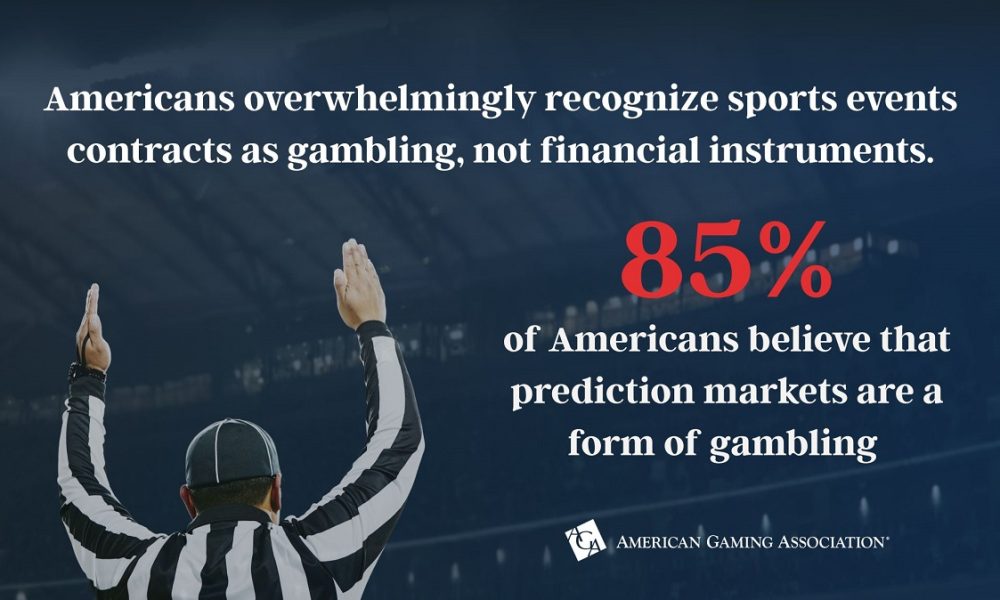
- Americans overwhelmingly recognize sports events contracts as gambling, not financial instruments. 85% say sports events contracts are most like gambling, while only 6% believe they are most like a financial instrument.
- Most Americans want sports events contracts regulated like other forms of sports betting. 80% say that sports event contracts should be regulated like other online sports betting and 65% believe these bets should be overseen by state and tribal gaming regulators, not the federal Commodities Futures Trading Commission (CFTC).
- Adults agree that sports events contracts should only be offered by state-licensed sportsbooks. 84% of Americans, and 69% of sports bettors, say that sports events contracts should only be available in state-licensed sportsbooks in the states where they are offered. 69% of Americans believe each state should have a say on whether sports events contracts can be offered in their state.
- Americans recognize prediction platforms offering sports event contracts are skirting the law. 70% say prediction platforms offering sports event contracts are exploiting loopholes to act as unlicensed sportsbooks.
“This research has made it clear: Americans know a sports bet when they see one—and they expect prediction markets offering sports event contracts to be held to the same rules and consumer safeguards as every other state-regulated sportsbook,” said AGA President and CEO Bill Miller. “This underscores the need for the CFTC to enforce and uphold its own regulations that prohibit gaming contracts, and for Congress to use its oversight power to ensure prediction markets are not used as a backdoor for gaming.”
With sports betting currently operational in 38 states and Washington, D.C., AGA’s research emphasizes the need for consistent oversight of emerging gaming products to maintain consumer trust and uphold responsible gaming standards.
Methodology
YouGov, on behalf of the AGA, conducted an online survey from August 1-8, among a nationally representative sample of 2,025 registered voters. The margin of error is +/- 2 percent and greater among subgroups.
The post Four in Five U.S. Voters Say Sports Events Contracts Should Be Regulated Like Other Online Sportsbooks appeared first on Gaming and Gambling Industry in the Americas.
When the US Supreme Court struck down the Professional and Amateur Sports Protection Act of 1992 (PASPA) in 2018, it opened the floodgates to sports betting in the US. From the middle of 2018 to now, states with some form of legal sports betting went from the four states ‘grandfathered’ by PASPA to 39 states and Washington, D.C. allowing betting. That’s 36 jurisdictions legalizing in eight years.
Soon after the annulment of PAAPA, market activity exploded with several states legalizing and launching every year thereafter. Each state had millions of new customers that operators wanted to reach quickly, and unique regulatory constraints around marketing and betting. That’s where affiliate marketing stepped in, providing local expertise to help these operators rapidly establish a foothold with customers.
That gold rush has now ended. While states with significant populations like Texas and California remain without legal sports betting, the majority of players in the US have access to it. Several states won’t be legalizing sports betting every year like in the past.
If operators no longer rely on affiliates to help them conquer several new markets every year, what roles do these large, third-party marketing companies have to play moving forward? As the market matures, we’re seeing that affiliate marketing has a crucial role to play in the current marketing climate.
What the Mature Market Looks Like
Aside from the lurking possibility of states with huge populations like California and Texas legalizing sports betting, the market is broadly set. Many states that haven’t introduced betting are unlikely to change that position due to the political climate, like in Utah and Alaska.
Sports betting has never been more popular, with total GGR for sports betting hitting $13.71 billion in 2024, according to the American Gaming Association. That was a 25.4% increase year-on-year. However, sports betting has also never been more competitive. Most US states have intense competition between operators competing in saturated ecosystems.
There’s evidence this is impacting affiliate companies, with Catena Media generating 35% less from US operations in 2024 compared to 2023. Another significant operator in US affiliate marketing, Better Collective, saw US revenues drop from $113 million in FY2023 to $112 million in FY2024.
However, this doesn’t spell the end of affiliate marketing. Without the potential to expand into new states, operators are looking to strengthen and grow market share in the states where sportsbooks are already operational and companies have already conducted marketing campaigns with affiliates.
Companies that have quickly grasped this new approach have shown positive signs. Gambling.com Group reported record Q4 revenues in 2024 and finished with full-year revenue of $127.1 million, a 17% rise from the year prior.
It’s made affiliates effectively take a u-turn to recover all the ground they covered so rapidly with the expansion of the market. For example, the first online sportsbooks launched in Michigan in January 2021, so there was a flurry of marketing activity in the state before that attention moved to other states that launched in the same year, like Arizona in September. Now, affiliates are returning to states like Michigan with new approaches.
Trust and Authority and Blitz Tactics
What do these new marketing approaches entail? Rather than acquiring as many users as possible in a short time, affiliates are now focused on increasing brand loyalty. Affiliates want to increase customer lifetime value (CLV), and are more aware of this metric than the base number of how many new users are added.
That’s led to more personalized advertising campaigns with features like exclusive offers, user engagement tools, and more to keep the focus on retaining players rather than adding more and more customers. Brands are looking to build authority and trust with customers.
Adding a few customers with high CLV is priceless for operators compared to hundreds of customers who will drop off quickly. Affiliate marketing supports these platforms with tailored campaigns using specific state knowledge and personalized customer retention measures.
More Sophisticated Customers
When sports betting first started spreading across the US, most people probably confused parlay bets with the French word parley used in popular movie franchises like Pirates of the Caribbean. That was the average American bettor’s education level on the topic.
So, early affiliate marketing efforts focused on introducing common sports betting terminology to customers while explaining the benefits of sports betting brands. Guides would explain how to sign up with a sportsbook and the difference between a moneyline and a point spread. That easy access to sports betting information made it more straightforward for a broader audience to get involved.
It’s a different market eight years on. Most bettors are far more educated than before and don’t need to be babyfed the basics. If an operator wants to appeal to bettors, it must do more than just offer betting.
That’s why affiliate marketing has shifted to a more detailed and data-driven approach. Rather than explaining how American odds work, affiliate marketing campaigns now compare the value of odds between operators and highlight the best value.
Unique betting features are more important to marketing campaigns as these can help attract bettors with accounts at other sportsbooks to sign up with a new platform.
This is where affiliate marketing can help operators in mature markets, as these campaigns can highlight those strengths against other brands and make each platform’s unique proposition clear to savvy bettors.
Broadening Audience Demographics
Considering odds regularly appear on major league broadcasts and are discussed by commentary staff for games, it’s clear that betting is becoming increasingly mainstream. As sportsbooks look to consolidate and compete in competitive markets, reaching new demographics is a valuable marketing tool.
While bettors in the US are more educated now, operators are looking to attract more than just players willing to learn all the jargon. New marketing strategies must make betting relatable and appealing to various ages and demographics.
The campaign to capture the attention of bettors in their 20s should look very different from one for older players, and the best affiliate marketers are helping operators tailor these campaigns to hit specific demographics.
Affiliates’ Role as Strategic Partners to Operators
The relationship between affiliates and operators has shifted as the operators need affiliate marketing companies to deliver different marketing services. Many operators see affiliates as strategic partners rather than just sources of traffic.
These new data-driven dynamics will let affiliates play a wider role in operators’ marketing schemes, providing data integration like live stats, API odds feeds, and more. Additionally, affiliates use years of knowledge and expertise to help these platforms run campaigns through different media sources, including mobile.
Affiliates also play a helpful role in compliance and responsible gambling. Each state has its own requirements, and while no new markets are opening, states that already permit betting can shift rules around what’s available. Scrutiny from regulators is also increasing. Therefore, affiliate marketing can provide operators with tailored campaigns that take a state-by-state approach.
Conclusion
Affiliate priorities have shifted, moving into 2025 and beyond. The gold rush is over, and the market is consolidating. Affiliates need to expand their services to keep up with the evolving demands of sports betting operators, focusing on longer-term customer acquisitions rather than adding masses of low-value players.
Successful affiliate sites will be the platforms that adapt to the new mature market the fastest and with the most effective strategies. Affiliates are no longer just tools that operators use to attract broad traffic. These companies must provide ongoing data and personalized marketing strategies to provide the best support to operators.
Author: Shmulik Segal, Founder and CEO of Media Troopers
The post What a Mature Market Means for US Affiliates appeared first on Gaming and Gambling Industry in the Americas.
The American Gaming Association (AGA) estimates that Americans will legally wager $3.1 billion on the men’s and women’s college basketball tournaments this year, up from $2.7 billion in 2024. This growth underscores the expanding legal sports betting market and the growing trust in legal wagering options.
“March Madness is one of the most exciting times in American sports, with fans fired up for both the men’s and women’s NCAA tournaments,” said AGA SVP of Strategic Communications Joe Maloney. “As legal wagering expands across the U.S., more fans than ever have the opportunity to bet legally and responsibly.”
Throughout the month of March, Have A Game Plan.® Bet Responsibly. campaign will serve important messages to fans, encouraging responsible sports betting. The campaign promotes five key principles:
- Set a Budget: Determine how much you are willing to spend and stick to it.
- Keep it Social: Betting should be a form of entertainment shared with others.
- Know the Odds: Understand the games and your chances of winning.
- Play Legally: Use regulated, legal betting platforms.
- Keep Your Cool: The result of a bet – win or lose – is not an invitation to criticize players, coaches, or officials online or in-person.
“‘Keep Your Cool,’ our newest ‘Have A Game Plan’ principle, is all about keeping betting fun and respecting the game – no matter how unpredictable March Madness becomes,” Maloney added.
Since the U.S. Supreme Court’s decision to overturn PASPA in 2018, legal sports betting has expanded to 38 states and Washington, D.C., offering consumers safe and regulated options to engage with their favorite sports. Americans’ support for legal sports betting continues to grow. According to the AGA’s 2024 American Attitudes Survey, 75% of Americans support legal sports wagering in their home state, and 90% view sports betting as an acceptable form of entertainment.
For more information on responsible sports betting, visit www.haveagameplan.org.
The post Americans to Legally Wager Estimated $3.1 Billion on March Madness appeared first on Gaming and Gambling Industry in the Americas.

-

 Africa7 days ago
SpringbokCasino ties July free spins to ‘Minions in the Wild’ campaign
-
 Arizona Department of Gaming7 days ago
Arizona Department of Gaming Concludes Legislative Session with Approved Agency Continuation and Enhanced Spending Authority for Problem Gambling
-
Amusnet6 days ago
Connecting Business and Diplomacy: Amusnet Supports BBLF’s Annual Meeting of the Diplomatic Corps
-
Arizona7 days ago
Arizona extends Gaming Department for six years; problem gambling budget rises 20%
-
Affiliate Industry4 days ago
Hub Affiliations Triumphs at the iGB Affiliate Awards 2026: Winner of Programme/Network Campaign of the Year
-
AGCO5 days ago
AGCO Fines Great Canadian Entertainment $120,000 for Using Unauthorised Gaming System Software at Four Casinos
-
certification6 days ago
PopOK Gaming secures certification for Portugal iGaming market
-
Latest News5 days ago
LEON announces LEON.bet Masters, a new CS2 tournament in Portugal