Latest News
New Research Shows Early Exposure to Gambling is Linked to Risk of Gambling Harms in Later Life


GambleAware, the leading charity commissioning gambling harm prevention and treatment services, has published its latest annual survey on gambling harms and treatment and support needs among those who gamble and those affected by another’s gambling.
The report, conducted by YouGov using a nationally representative survey of 18,000 adults, found that early exposure – seeing family members gamble or gambling advertising and marketing on TV – can be associated with a greater risk of gambling harms later in life. Almost two in three (64%) of those classified as experiencing significant harm (PGSI 8+) said they knew someone who gambled regularly (e.g. once a week or more) before they turned 18. By comparison, among adults who do not gamble, only 1 in 4 (25%) reported knowing someone else who gambled.
The study sheds light on how many people in Britain were first exposed to gambling when they were a young child, with 1 in 16 (6%) exposed before the age of 5 and over a quarter (28%) between the ages of 6-11. It also reveals that one in five adults (22%) reported first having gambled before they were 18 years old, including one in six (16%) who started between the ages of 12-17. Qualitative responses show that this introduction was seen as a “turning point” by many, or a hobby that they had inherited from their family that led to harmful gambling.
Participants interviewed in the qualitative research also expressed concern over the amount of gambling advertisement on television and mobile phone apps. They said it is extremely difficult to restrict or prevent children from being exposed to such material due to its “always on” nature, leading to fears of harmful gambling becoming a generational issue. The research shows an increase in young people (aged 18-24) experiencing significant harm from gambling (PGSI 8+), rising from 5.1% to 8.5% of this age group.
Those classified at significant-risk (PGSI 8+) of gambling harms remain more likely to have used advice, support and treatment than those with lower scores. While just 5% of those classified as low-risk (PGSI score of 1-2) had used advice, support or treatment, this increases to 17% of those classified as moderate-risk (PGSI score of 3-7), and 66% of those classified as PGSI 8+.
The report found that 7% of the adult population identified as an “affected other” who have been negatively affected by another’s gambling; comparable with 2021. This equates to an estimate of approximately 3.6 million GB adults. On top of this, the survey also suggests that an estimated 1.6 million children under 18 live with an adult experiencing significant harms from their gambling.
The report also shows that nearly half (48%) of those experiencing significant gambling harms felt “embarrassed or ashamed” of their gambling all or most of the time. These findings were a key theme in interviews with participants, where an overwhelming majority felt reluctant to talk about their gambling to family or friends.
The report highlights that stigma (e.g. feeling embarrassed, not wanting people to find out) surrounding gambling is a key barrier to many who gamble when seeking support and can also negatively impact the mental health of many who are at risk.
Among those classified as PGSI 8+, 34% had not used any form of advice, support or treatment to reduce their gambling in the past 12 months. Of those not wanting support, 40% cited stigma as a barrier.
The report also shows that many people who gamble have tried to cut back on gambling in the last year – rising to 3 in 5 (59%) of those experiencing problem gambling (PGSI 8+). However, this often resulted in “relapse” later on with most people who say they attempted to stop or reduce gambling saying they started gambling again. Relapse was highest amongst those with a PGSI score of 8+ (87%), with 72% of those who have a PGSI score of 3+ reporting relapse and 64% of those with a PGSI score of 1+ reporting a relapse in the last 12 months. Qualitative responses from focus groups identified the role that financial circumstances, life events, mental health and gambling promotions can all play as potential triggers for relapse.
Zoë Osmond, Chief Executive of GambleAware, said: “As the lead commissioning charity in Great Britain, we are pleased to publish this year’s landmark Treatment and Support Survey. Gambling harms are a serious public health issue and can affect anyone, including an increasing amount of children and young people.
“We are concerned about the normalisation of gambling across society, with this year’s report clearly highlighting a potential link between early exposure and harms in later life, as well as a worry by parents who feel unable to shield their children from the plethora of advertising and marketing.
“It is also important to end the stigma associated with gambling, which is acting as a key barrier to those wanting advice and support. We encourage people to come forward and open up the conversation about gambling to put an end to stigma and ensure people get the help they need.”
Kate Gosschalk, Research Manager, YouGov, said: “We are pleased to share the findings from the fourth annual treatment and support survey. This year, the research – which included a substantial online survey of 18,000 people and 30 in-depth telephone interviews – explored new areas including when people were first exposed to gambling and the effect gambling has on children. This survey can help us learn more about gambling harms in Great Britain and what can be done to ensure people receive the help and support they need going forward.”













Sponsorship covers the Premiership, Championship and Women’s Premiership and is NIFL’s first deal valued above £1m, per the league.
BOYLE Sports has signed a three-year agreement to become Title Partner of the Northern Ireland Football League (NIFL), expanding its existing relationship with the competition. The sponsorship spans the BOYLE Sports Premiership, BOYLE Sports Championship and BOYLE Sports Women’s Premiership.
The operator had been the League’s Official Betting Partner since December 2025. Under the expanded deal, BOYLE Sports retains existing rights including title sponsorship of the BOYLE Sports Women’s Cup.
NIFL said the agreement is its first partnership valued at more than £1 million. The league also pointed to what it described as a record-breaking season, citing over 100 million digital views last season alongside its strongest performance for viewership and commercial revenue.
Activation will include branding across clubs’ playing kit, matchday environments, broadcast highlights, scoreboards, player of the match activations and league content across social channels. BOYLE Sports will also launch a responsible gambling awareness initiative across NIFL clubs, using matchday and digital platforms to promote safer betting information and conversations.
Vlad Kaltenieks, CEO of BOYLE Sports, said: “Football in Northern Ireland has real momentum and we’re proud to deepen our partnership with the Northern Ireland Football League at such an important time for the League.
“Becoming Title Partner across the Premiership, Championship and Women’s Premiership reflects our belief in the clubs, supporters and communities that make the game so strong. This partnership gives us the opportunity to support that growth, enhance fan experience and use our platform to positively engage with fans and the wider football community.”
Gerard Lawlor, Chief Executive Officer of the Northern Ireland Football League, added: “We are delighted to extend our relationship with BOYLE Sports through this landmark title partnership. This is a major commercial moment for NIFL and reflects the growing strength and ambition of our competitions. BOYLE Sports has already shown real commitment to football in Northern Ireland, and this agreement will deliver meaningful value across our clubs, competitions and communities.”
The post BOYLE Sports signs as Northern Ireland Football League title partner in three-year deal appeared first on EE Gaming | Global iGaming & Tech Intelligence Hub.

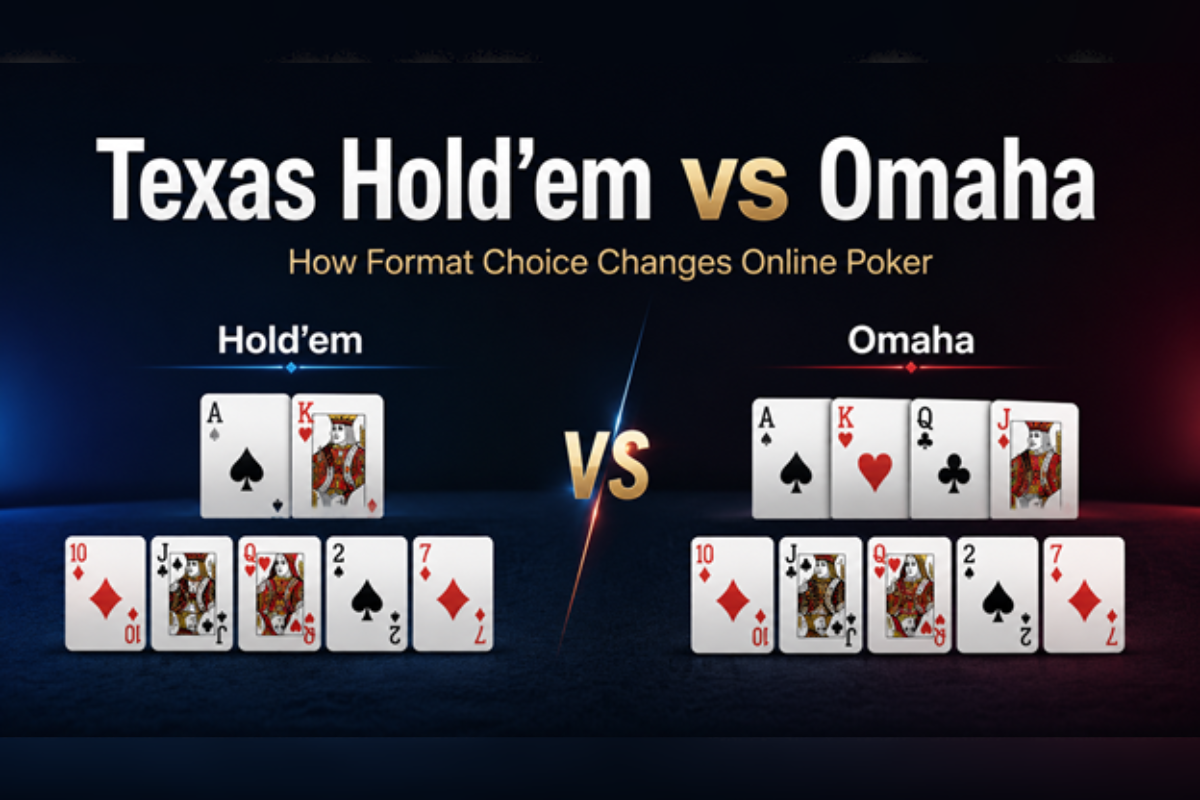
Poker formats share a surface: private cards, community cards, betting rounds, and a final five-card hand. The difference between variants, however, is not cosmetic. Texas Hold’em gives players 2 private cards, so the first decision is narrow and readable. Omaha gives 4, then forces exactly 2 of them into the final hand. That single rule changes the way every board is read.
Adding variety to your poker playing routine can be great fun, but it’s crucial to understand the formats before you do – or you may find yourself struggling at the table!
The Format Is the First Practical Filter
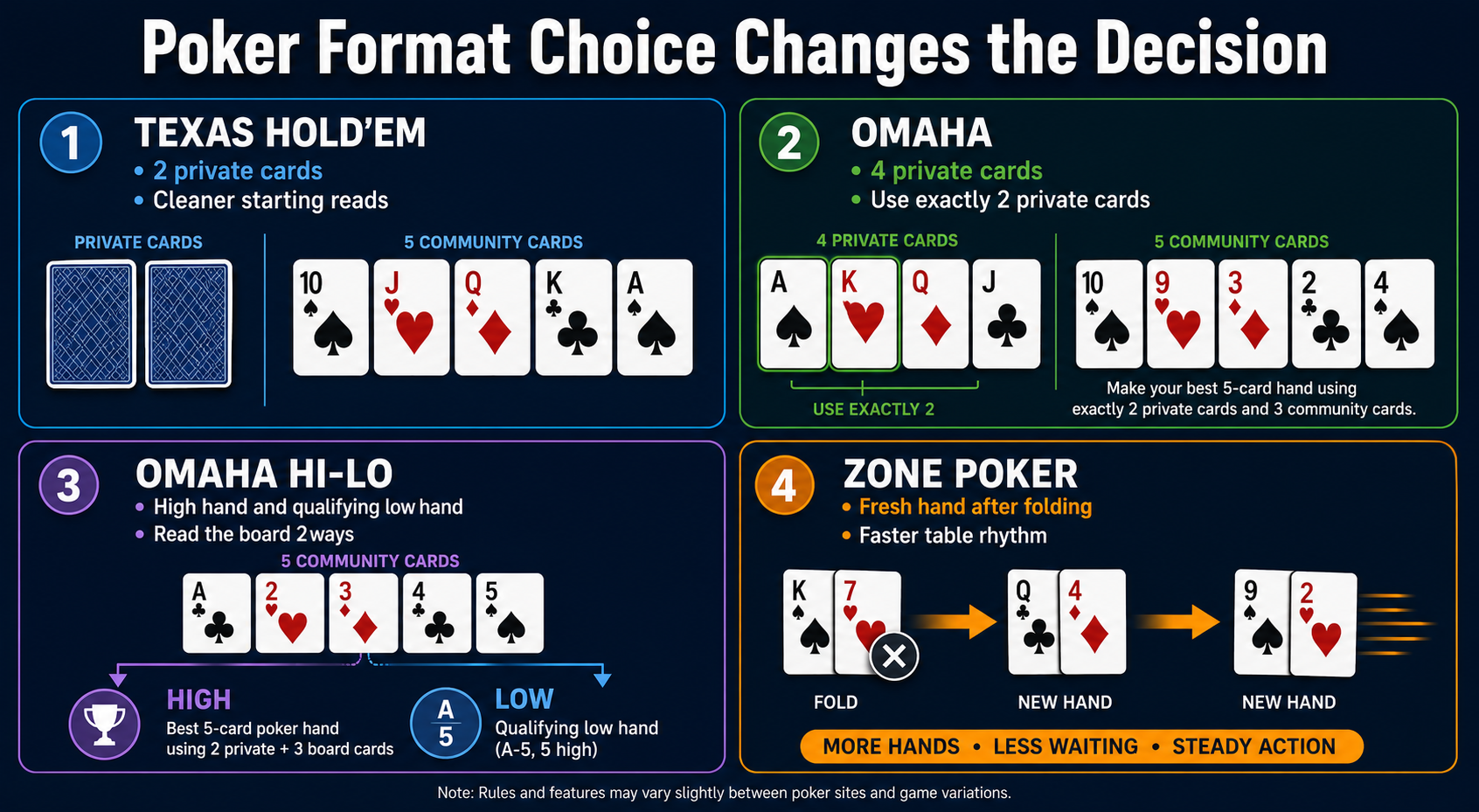
Once the basic rules are familiar, format choice becomes easier to understand when the games are seen side by side. A player comparing Hold’em with Omaha is not only comparing two sets of rules. They are comparing the amount of private information available before the flop, how many possible hand combinations need to be tracked, and how quickly each decision starts to feel comfortable.
That is where an Australian online poker setting gives the comparison more practical shape. A page focused on online poker Australia places Texas Hold’em, Omaha, Omaha Hi-Lo, and Zone Poker in the same playing context, which makes the differences clearer without treating poker as one generic format.
Hold’em starts with 2 hole cards and 5 community cards, giving players a cleaner starting point. Omaha starts with 4 hole cards but still requires exactly 2 private cards and 3 community cards for the final hand. Omaha Hi-Lo keeps that same construction while asking players to think about high and qualifying low hands. Zone Poker changes the rhythm by moving a folded player to a new table and a fresh deal. Seen together, these formats show that poker choice is not only about hand rankings. It is about the kind of attention each version asks from the player.
A recent Ignition Australia post makes the same point in cultural terms, noting that poker in Australia has changed over the years while the heart of the game has stayed intact. The format conversation is not only technical. The same game can move from a physical room to a phone screen, from Hold’em to Omaha, or from a standard table to a faster online format, while still centering on timing, reading, and the next card.
https://www.instagram.com/p/DVM_bPlErLf/
Hold’em Gives Cleaner Reading
Texas Hold’em is often easier to explain because the relationship between private cards and the board is direct. A pair in the hand, a suited ace, or two connected cards creates a clear starting point. After the flop, the player can ask a simple question: did the community cards improve the hand, threaten it, or create a draw worth following?
That clarity does not make Hold’em shallow. It makes the decision tree easier to see. Position, bet size, board texture, and opponent behavior still matter, but the player is not juggling as many private-card combinations. This is why Hold’em has become the main reference point for casual poker viewers and newer online players. The game gives them enough structure to follow the action, while leaving room for deeper judgment as experience grows.
Omaha Creates More Temptation
Omaha can look generous at first because 4 private cards seem to create more routes to a strong hand. That impression is where many Hold’em habits become unreliable. More starting combinations also mean opponents can connect with the board in stronger ways. A hand that feels powerful in Hold’em may be ordinary in Omaha if the board is coordinated.
The exact 2-card rule is the point beginners must absorb early. If the board shows 4 hearts and a player holds only 1 heart, that player does not have a flush. If the board shows pairs, a full house still depends on the required combination of private and community cards. Omaha asks players to slow down the first instinct and rebuild the hand under the format’s rule.
Omaha Hi-Lo adds another reading layer. A player may be looking for a strong high hand while also watching whether a qualifying low hand is available. The board can divide attention, and the clearest decision may depend on whether the hand has a path to one side of the pot or both.
Pace Changes the Same Cards
Zone Poker shows that format choice can also be about rhythm. In a standard table format, folded hands create waiting time. That delay lets players watch other hands finish, notice tendencies, and settle into the table’s pace, but it can feel slow and under-engaging. In a fast-fold format, folding moves the player quickly into a new hand, which makes the session feel sharper and less observational. The cards stay familiar, but the table observation window changes.
Poker formats are easiest to understand when the reader stops treating them as labels and starts treating them as different ways of processing incomplete information. Two private cards, four private cards, a split-pot rule, or a faster table rhythm can all change how a hand feels before the river arrives. The social layer also remains part of online play, as described in 2025 open-access work on multiplayer online games and social connection.
The post Texas Hold’em vs Omaha for Players Comparing Poker Formats appeared first on Americas iGaming & Sports Betting News.

Lottomart has launched Dragon’s Rage, a new S Gaming slot available as a permanent exclusive to Lottomart players in the UK.
The release follows the partnership’s previous exclusive title, Fisherman’s Fortune, and adds another game to Lottomart’s exclusive-content portfolio.
Set in a dragon’s treasure lair, Dragon’s Rage uses a 1,024-ways-to-win format. Features include the Coil Collect mechanic, choice-led Free Spins, and Rage Spins. The game also includes three fixed-level jackpots: Inferno, Flame and Ember.
Chris Ruddock, Commercial Director at Lottomart, commented: “We’re delighted to launch Dragon’s Rage as a permanent UK exclusive. Developed in close collaboration with S Gaming, the game combines a strong fantasy theme with engaging features designed with our players in mind. We’re looking forward to seeing how our customers respond to the launch.”
Charles Mott, CEO of S Gaming, added: “Dragon’s Rage is the latest title developed through our close collaboration with Lottomart. It has been a pleasure working together on the concept and development of the game, and we’re proud to bring this new fantasy adventure exclusively to Lottomart players in the UK.”
The post Lottomart launches S Gaming slot Dragon’s Rage as permanent UK exclusive appeared first on EE Gaming | Global iGaming & Tech Intelligence Hub.

-

 DBET7 days ago
HockeyAllsvenskan names DBET main partner in three-year deal from 2026/27
-
Baltics7 days ago
Digitain Named Best Sportsbook Provider at HIPTHER Baltic & Nordics Gaming Awards 2026
-
Asia7 days ago
S8UL’s League of Legends roster qualifies to represent India at Asian Games 2026
-
Blazing Flower7 days ago
CT Interactive Strengthens its Presence in Romania with Newly Certified Games
-
Australia5 days ago
Former Star Entertainment Executives Mathias Bekier and Paula Martin Disqualified and Ordered to Pay Penalties
-
CFTC6 days ago
Novig Secures CFTC Designation, Bringing the First Prediction Market Built for Sports Fans Nationwide
-
Alberta6 days ago
MediaTroopers lines up eight operator partners ahead of Alberta launch
-
LatAm6 days ago
Innovative payment solutions provider teams up with leading LATAM fintech platform to expand digital wallet access for online betting customers in Mexico