Latest News
TaDa Gaming Releases Storm of Seth 2

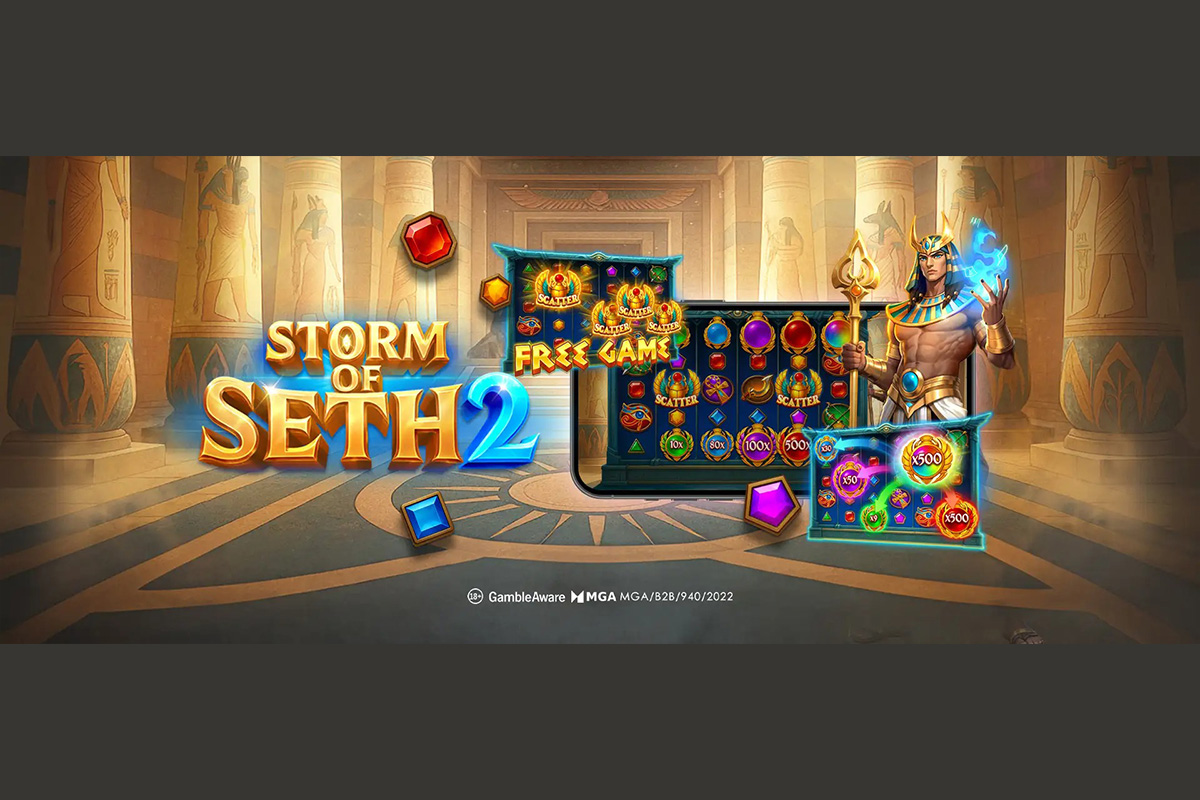
TaDa Gaming has released Storm of Seth 2, the highly anticipated sequel. Building on the momentum of the original title, this new release delivers deeper multiplier mechanics, extended Free Games and a staggering max win potential of up to 100,000x.
Set in a myth-inspired world charged with mystical energy, Storm of Seth 2 blends atmospheric visuals with fast-paced cascading gameplay. Played across six reels and five lines, the game rewards players whenever eight or more matching symbols are eliminated. Winning symbols vanish, new symbols fall into place, and chain reactions continue until no further wins are formed, keeping every spin packed with momentum.
At the core of the experience are Crystal Balls, which appear in different colours to reflect their multiplier values. When a Crystal Ball is present and symbols are eliminated, its multiplier is applied to the round’s total win. Winged Crystal Balls take the excitement further by randomly increasing their multiplier each time they are eliminated, allowing values to grow rapidly as cascades continue.
Adding another layer is the Storm Ball. When it lands, it boosts all other Crystal Balls on the field by adding its own multiplier, creating powerful combinations and explosive payout potential during high-action sequences.
Free Games are triggered when four or more Scatter symbols appear, awarding an initial 15 free spins. During Free Games, landing three or more Scatters grants an additional five spins, allowing the feature to extend significantly. What truly sets Storm of Seth 2 apart is its accumulating multiplier system. Each time a Crystal Ball is triggered in Free Games, its multiplier is added to a growing Accumulating Multiplier. When a Crystal Ball appears again, the accumulated value is first increased, then applied to that round’s win, opening the door to exceptional payout potential. If no Crystal Ball is triggered, the accumulated multiplier remains on hold, adding tension to every spin.
For players who want immediate access to the feature, the Buy Bonus option allows Free Games to be triggered directly for a fixed cost, delivering instant access to the game’s most volatile and rewarding moments.
Sean Liu, Director of Product Management at TaDa Gaming, said: “Storm of Seth 2 takes everything players enjoyed in the original and pushes it much further. The accumulating multiplier system and enhanced Crystal Ball mechanics create a strong sense of progression and anticipation, especially during Free Games. It is designed for players who enjoy high volatility and chasing truly massive wins.”
The post TaDa Gaming Releases Storm of Seth 2 appeared first on Eastern European Gaming | Global iGaming & Tech Intelligence Hub.











Betnacional
Brazil: Betting pressures household budgets and reshapes the competition for consumer spending


As the industry prepares for BiS SiGMA South America 2026, the largest and most influential iGaming event in Latin America, real market data begins to reveal a profound transformation in the behavior of the Brazilian consumer.
It is no longer just about “betting volume”, but about a reconfiguration of the Share of Wallet (participation in household spending).
The unprecedented study “Bets na Mesa, Consumo em Jogo”, carried out by NielsenIQ Brazil, sheds light on a reality that will be the center of technical debates at the Transamerica Expo Center: in 2025, 26.3% of Brazilian households participated in some form of betting.
This figure is not just a number; it is the reflection of a “new parallel shopper journey” that is capturing the attention and income of the population.
Radiography of Consumption: Who and what is being bet?
The Brazilian market in 2026 shows a clear fragmentation.
Despite the explosion of digital platforms, traditional modalities maintain notable resilience, creating a hybrid ecosystem between analog and digital.
Dominant Modalities
According to the NielsenIQ study, preferences are distributed as follows:
• Mega-Sena: 15.8% of households.
• Video Slots (such as the “Jogo do Tigrinho”): 7.7%.
• Jogo do Bicho: 3.9%.
• Sports Betting (Bets): 3.6%.
Socioeconomic and generational profiles in Brazil
The study reveals that bettors are not a homogeneous group. There is a marked division by Socioeconomic Level (SEL) and age:
• The Slots phenomenon: The “Jogo do Tigrinho” concentrates bettors from middle SEL (63.3%) and a notably young audience, with 42.4% of bettors up to 35 years old.
• The maturity of Mega-Sena: It predominates in high SEL (45.5%) and in a more mature profile, where 49.1% are over 51 years old.
As Gabriel Fagundes, Insights Leader for the Industry at NielsenIQ, points out: “We had already identified that betting became a popular and common practice in the routine of the Brazilian consumer.”
“Now, the numbers also point to the dimension that this practice is taking within household expenses and in the income of bettors.”
The Economic Motivation: Extra Income or Entertainment?
One of the most critical points for operators that will meet at BiS SiGMA is to understand the “why” behind betting.
The data from 2026 shows a diffuse frontier between gambling as leisure and gambling as economic hope.
For 49% of bettors, the main motivation is to obtain extra income, while 43.5% expect a “radical change of life”.
This second profile is more common in casual Mega-Sena players.
Classification by Intensity
The market is divided into three levels of commitment:
- Casual (73%): They play at least once a month.
- “Pro” (28%): They bet once a week. From this group, 65.8% seek extra income.
- “Elite” (9.3%): They bet weekly and spend more than R$ 100 per month.
This “gaming intensity” is, according to the study, the real driver of the economic impact on households, especially in the Northeast regions (29% penetration) and South (28.3%).
The Impact on Retail and the Consumption Basket
For the iGaming industry, understanding which expenses are being substituted is vital for sustainability and social responsibility.
The study reveals that only 10% of households admit substituting expenses directly for betting, but the affected categories are alarming.
Affected Categories
Among those who substitute expenses:
• Food: 47% of the cases.
• Fixed bills (water, electricity, internet): 45.3%.
• Beer: It is the category with the greatest retraction, registering a drop of 1.7 percentage points in the participation of spending.
• Cookies, perfumes and soft drinks: They also present negative impacts.
The main strategy of the consumer to accommodate spending on betting has been to reduce the quantity of items purchased; in fact, 60% of the consumption categories registered a decrease in the volume acquired in 2025.
Strategic Challenges for the Legal Market in 2026
The NielsenIQ data presents a direct challenge for brands and operators that seek to consolidate themselves in “Legal Brazil”.
The pressure on the domestic budget forces manufacturers of fast-moving consumer goods (FMCG) and betting operators to compete for the same currency.
“Betting is a new competitor in the consumer’s Share of Wallet.
This pressures manufacturers to act with more precision in communication, price and activation to recover relevance in front of this new competitor: the habit of betting itself.”
Towards BiS SiGMA 2026
As we approach the largest event in the region, this study serves as a warning and an opportunity. The Brazilian market of 2026 is mature, but it is under intense social scrutiny due to the impact on low-income families.
Operators that wish to have long-term success must:
- Differentiate the profiles: It is not possible to treat the young middle SEL slot player the same as the high SEL Mega-Sena bettor.
- Promote Responsible Gaming: The substitution of food and fixed bills for betting is a regulatory “red flag” that could tighten laws in the near future.
- Regional Innovation: The Northeast and the South are the markets with the highest intensity, requiring more aggressive localization strategies.
BiS SiGMA South America will be the perfect stage to discuss how the industry can grow without compromising the economic stability of Brazilian households, ensuring that iGaming is seen as entertainment and not as an unsustainable financial burden.
Superscore consolidates in Brazil and launches weekly analysis for the press.
The platform offers statistical analysis of the Brazilian Championship and of the main national and international championships, such as the Copa Libertadores, the World Cup and the Champions League, among others, with metrics that go beyond goals and assists for fans and sports experts.
Superscore Insights is the new newsletter for the press, with a weekly publication and another analysis of the latest news.
Superscore, a sports intelligence application associated with Superbet, advances and consolidates itself in Brazil as a strategic platform to transform data into reliable information for football fans in real time and without advertising.
With its own methodology, the solution establishes itself as a reference among sports fans, bringing together advanced statistics, rankings and in-depth analysis of the main tournaments, players and coaches in the country.
Now, the platform takes a new step with the launch of Superscore Insights, expanding its collaboration with the press by offering even more solid analysis, contextualized data and specialized support for sports coverage.
On Mondays, journalists will receive an exclusive bulletin with deep and original analysis of the weekend matches, a specialized analysis of the most important events of the day, as well as predictions and statistics of upcoming events.
With global coverage, Superscore already gathers more than 1,900 competitions, 63,000 teams and more than 480,000 monitored players, offering a solid base for historical and real-time analysis.
The data from Superscore comes from leading partners worldwide in the collection and distribution of sports data, the same ones used by Superbet and the main companies in the sector.
These providers offer high precision, low latency and comprehensive coverage of competitions worldwide.
“Superscore was born as a free sports intelligence application, without advertising, that goes beyond the basics by offering a wide database and statistics for those who want to understand the game in depth.
In just one year, it has already achieved thousands of users and grows approximately 30% monthly, climbing positions in the Google Play ranking.”
“The platform offers a solid experience for both fans and professionals, in addition to facilitating more informed decisions in sports betting, thus reinforcing the commitment to responsible gaming,” states Patrícia Prates, Marketing Director of Superbet and of the alliance with Superscore.
Superscore: Exclusive data and decades of history
In a context where sports coverage increasingly requires qualified data and contextualization, Superscore distinguishes itself by going beyond traditional indicators, incorporating metrics such as accurate shots, passes in the offensive third, tackles, recoveries, participation in decisive plays and time on the field, among other indicators.
These data are translated into the Superscore Score, a proprietary index that allows building Top 5 or Top 10 rankings of the best players of each round, with graphical visualizations and quick analysis.
Another differentiating factor is the expanded historical database, which gathers information from the Brazilian Championship since 1937, the Copa Libertadores since 1960 and the Champions League since 1992, which allows comparative analysis and identifying patterns over decades.
“We are talking about a platform built on a solid technological base, which combines a large volume of unique data, history and a team prepared to transform this information into relevant content for football fans.
Superscore organizes and translates these data so that they can also be used in sports coverage,” states Guilherme Simantob, director of Superscore in Brazil.
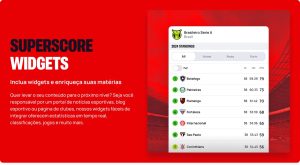
Superscore offers free and integrable widgets for the press and content creators, facilitating the incorporation of statistics, graphics and comparisons directly into articles, enriching journalistic narrative with reliable and visually accessible data.
The app is available in the App Store and Google Play.

Reevo arrives in Brazil with Betsson
Reevo has expanded its presence in Latin America after launching its aggregation platform and its own games catalog in Brazil in collaboration with Betsson.
The integration, carried out through a single connection, allows the operator to expand its content offering with Reevo’s own titles and third-party titles.
The movement reinforces the alliance between both companies and is part of a growth strategy in regulated markets, especially Brazil, considered one of the most promising in the region after regulatory advances.
From Betsson, Andrea Rossi highlighted the impact of the agreement by stating that the incorporation of Reevo’s content “expands the entertainment offer available for our players in one of the fastest-growing markets in the region.”
Additionally, both companies anticipated new joint expansions in other markets, after a recent launch also in Mexico.
Reevo continues to bet on its aggregation model as a way to facilitate access to multiple studios through a single integration, while expanding its global distribution network.
BTG launches prediction platform and increases the dispute between banks, stock exchange and betting
The launch of BTG Trends by BTG Pactual marks a new chapter in the growth of prediction markets in Brazil, intensifying competition between banks, the stock exchange and the betting sector.
This new platform allows investors to operate binary contracts (“yes” or “no”) based on probabilities about financial events, such as the dollar, the Ibovespa or interest rate decisions, using already regulated derivative instruments.
The movement is not isolated. The Brazilian stock exchange (B3) also advances in this direction, with the development of financial event contracts and digital derivatives, although restricted to professional investors.
At the same time, the platform XP established a partnership with Kalshi, facilitating access for Brazilian investors to international predictive markets, while new startups such as VoxFi explore broader applications, including geopolitics and culture.
At a global level, these markets have gained relevance and volume, driven by platforms such as Polymarket and Kalshi.
However, their regulation continues to be a subject under debate. In the United States, the CFTC considers these contracts as financial derivatives, although discussions still exist about limits and risks, especially in sensitive events.
In Brazil, authorities, including the CVM and the Secretariat of Prizes and Betting, are already analyzing how to frame these activities from a regulatory point of view, especially when they overlap with sports events.
The advance of these products has also generated reaction from the betting sector.
The Brazilian Institute of Responsible Gaming (IBJR) maintains that, when there is money involved in uncertain events, it is essentially betting, regardless of the format, and warns about risks such as unfair competition and lower consumer protection if they operate outside the regulated framework.
The main difference between betting and prediction markets lies in their structure: in betting, the user plays against the house, while in prediction markets prices are formed among participants and reflect collective probabilities.
Even so, the boundary between both models remains diffuse.
With banks, stock exchange and new platforms advancing simultaneously, prediction markets stop being an emerging trend and become a new field of dispute within the financial system.
The regulatory framework is still under construction, and the evolution of the sector will depend on how the limits between investment and betting are defined as these products scale.
The post Brazil: Betting pressures household budgets and reshapes the competition for consumer spending appeared first on Americas iGaming & Sports Betting News.
Casino Guru
Casino Guru Awards partner with Ethical Gambling Forum to champion transparency and player protection

Casino Guru is excited to announce a strategic collaboration with the Ethical Gambling Forum (EGF), a leading industry event focused on responsible gambling, sustainability, and ethical business practices. This partnership represents a major step forward in promoting ethics, transparency, and player protection across the iGaming sector.
As part of the initiative, the Casino Guru Awards will take a prominent role during the upcoming EGF conference, bringing the awards process directly into a space where industry stakeholders are united in their commitment to raising standards and safeguarding players.
From April 30 to May 1, Casino Guru will host an exclusive judges’ session during the conference week. This hands-on gathering will allow the Awards jury to actively review shortlisted nominees, conducting direct calls with candidates to gain deeper insight into their operations, values, and dedication to responsible gambling. This approach ensures that the Awards remain rigorous, transparent, and merit-based.
Additionally, Casino Guru will lead a panel discussion at the conference, featuring Awards judges and industry experts. The session will explore the significance of independent evaluation, ethical standards in iGaming, and how initiatives like the Casino Guru Awards contribute to a safer, more transparent gambling environment.
Daniela Sliva, PR & Creative Projects Director at Casino Guru, said:
“This partnership with the Ethical Gambling Forum is a natural fit. We share core values around ethics, transparency, responsible gambling, and player protection. By enabling judges to engage directly with shortlisted candidates, we add an extra layer of integrity and depth to the evaluation process, which truly sets the Casino Guru Awards apart.”
Jo Abergel, Co-Founder of the Ethical Gambling Forum, added:
“Partnering with Casino Guru for the Leeds event reinforces the message that accountability must be at the heart of our industry’s future. Together, we are creating a space for honest dialogue and meaningful progress, celebrating those who lead by example in player protection and industry integrity.”
This collaboration underscores the shared mission of Casino Guru and EGF: to elevate industry standards, support responsible operators, and recognize organizations that prioritize player well-being. By embedding the Awards judging process within the Ethical Gambling Forum, both organizations aim to foster transparency, encourage accountability, and celebrate ethical leadership in iGaming.
The post Casino Guru Awards partner with Ethical Gambling Forum to champion transparency and player protection appeared first on Eastern European Gaming | Global iGaming & Tech Intelligence Hub.
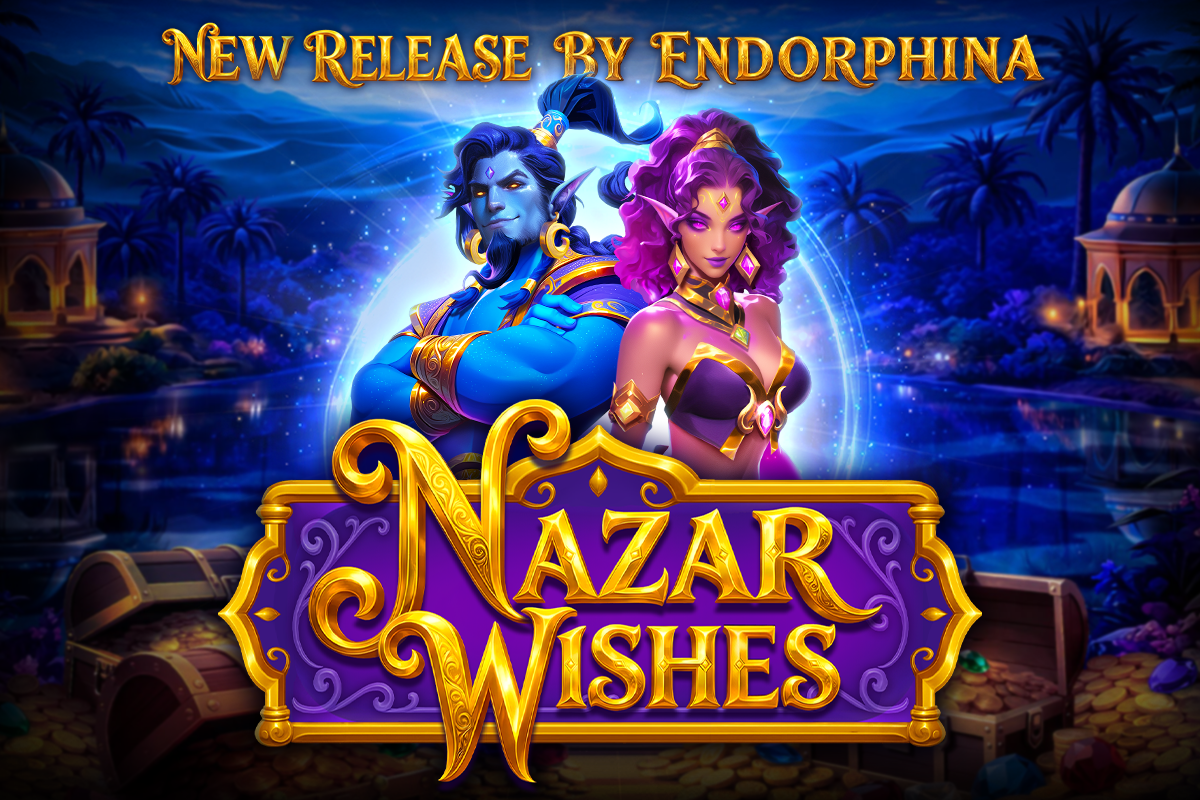
Let your wishes guide you to fortune in Nazar Wishes, the latest visually stunning and immersive online slot from Endorphina.
Players are invited on a mystical journey through an Arabian fantasy world, traveling by camel along a desert path toward a radiant temple brimming with treasures. This enchanting adventure features a 5-reel, 3-row layout with 20 fixed paylines, an RTP of 96.07%, and high volatility, promising thrilling gameplay with every spin.
Along the way, players are guarded by the Nazar Wishes amulet, a symbol of good luck bestowed by friendly genies. This mystical talisman protects against Nazar, the ‘evil eye’, who seeks to claim the prizes for himself.
Why Nazar Wishes Stands Out
Endorphina’s latest release adds a touch of magic to its growing slot portfolio. Players can summon colorful enchantments through Lucky Time Features and Hold & Win Bonus Games, triggered with the help of sacred lamp spirits.
The game also includes a Pick Me Bonus Game with Min, Mid, Max, and Ultra jackpots, offering rewards of up to 1,000x the total bet.
Built for seamless play across desktop, tablet, and mobile, Nazar Wishes delivers fast-loading, flawless performance, allowing players to enjoy their mystical adventure anytime, anywhere.
Double Your Wins with 10 Risk Attempts
Endorphina’s classic Risk Game returns, giving players up to 10 chances to double their winnings, adding extra excitement to each session.
With its enchanting Arabian theme, magical bonus mechanics, and smooth gameplay, Nazar Wishes promises a captivating journey for players seeking high-quality, immersive entertainment.
The post NAZAR WISHES AWAIT YOUR COMMAND appeared first on Eastern European Gaming | Global iGaming & Tech Intelligence Hub.

-

 Alberta7 days ago
Media Troopers Prepares for Alberta iGaming Launch with Canadian Gaming Law Firm
-
40 Sparkling Crown7 days ago
TaDa Gaming Enters South Africa via Strategic Betway Partnership
-
Asia6 days ago
GLI Becomes the First Company Accredited by PAGCOR to Test and Certify iGaming Platforms in the Philippines
-
Bettingbladet.se7 days ago
Bettingbladet Aims to Become Sweden’s Central Hub for Gambling Industry News & Trends
-
Barbie Nerz Head of Online Games at Staatliche Toto-Lotto GmbH Baden-Württemberg7 days ago
Peter & Sons Partners with Staatliche Toto-Lotto GmbH Baden-Württemberg for German Market Entry
-
ADM7 days ago
ENJOY gains Italian approval amid advancing regulated expansion strategy
-
Games Global7 days ago
Games Global and Just For The Win® continue the ghostly adventure in Dark Waters III Power Combo: The Cursed Voyage™
-
Bragg Gaming Group6 days ago
Bragg Gaming Group Reports Record Fourth Quarter and Full Year 2025 Revenues