Brazil
Delasport Now GLI-Certified for Sports Betting in Brazil

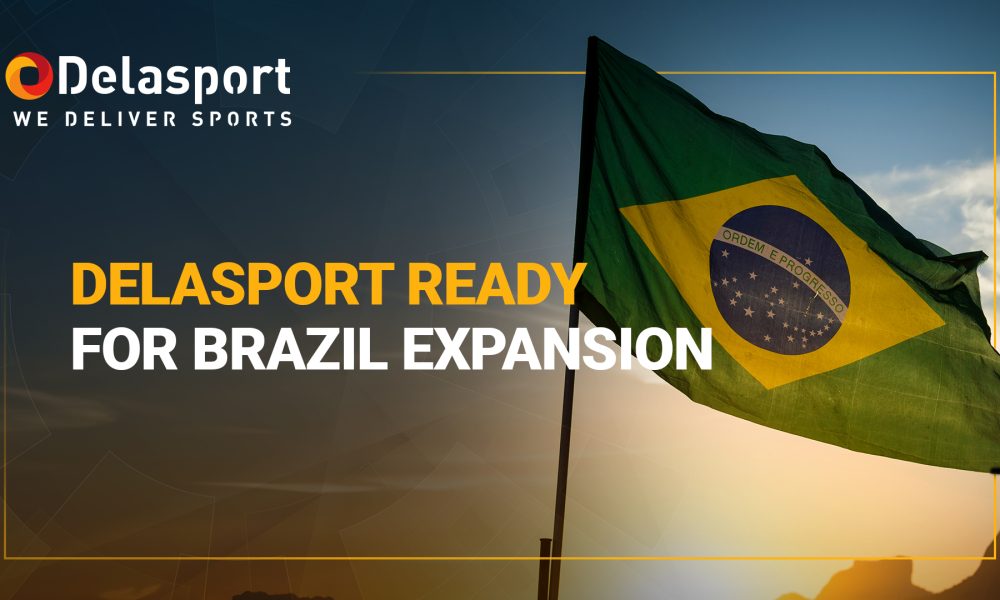
Delasport has just become one of the first suppliers to obtain a GLI certification for its sportsbook in Brazil, two weeks before the historical regulation comes into effect.
Continuing its global growth, Delasport is bringing several operators on board in Brazil. In order to complete the process, operators that are applying for a new Brazilian license have 30 days to provide all relevant platform certificates from the moment that they are notified by the regulator that their initial submission has been accepted. This is also the moment that they can pay the license fee. Still, failure to provide platform certificates will result in the application being placed on hold.
Delasport turned to Gaming Laboratories International (GLI) for the certification of its sportsbook against Brazilian technical standards. The historical partnership with GLI was further strengthened by the news, a few months back, that GLI had become the first laboratory to achieve the local accreditation to certify for betting systems, live game studios, and online games by the Secretaria De Prêmios e Apostas (SPA) in Brazil.
Delasport has successfully met all technical requirements for providing its sports betting solution to the largest country in South America. The certificate is evidence of the team’s experience, expertise, and determination to lead the way in key jurisdictions.
Obtaining a GLI certification for Brazil is a step towards cementing the trust players and operators have for Delasport’s products. This serves to show that the award-winning supplier is capable of meeting even the strictest industry standards for integrity and fairness.
“When we learnt that providing platform certificates to the regulator was on our partner operators’ critical path for obtaining the license, we immediately prioritized submitting the system to GLI for testing”, Delasport’s Chief Compliance Officer Filippo Ferri said. “Needless to say, GLI did a tremendous job of working with us to conduct the tests in record time, to match the submission deadline of some of our clients. I am also very proud of how our internal departments worked together to obtain this certificate, and of how they continue to push forward with the delivery of a datavault system that complies with SIGAP requirements.”
Operators that plan on entering the newly regulated Brazilian market will now have numerous advantages if they partner with Delasport. They will be able to provide their players with personalization features like My Sportsbook, My Event Builder, and My Combo that skyrocket revenues and retention.
Furthermore, Delasport’s KYC and AML provider is a market leader that guarantees the highest level of compliance for all operators that choose to go on this route.
Also, Delasport has already partnered with numerous local payment system providers and offers a real-time AI-powered Responsible Gambling system which can easily adapt to local regulations.
Last, but not least, operators will feel Delasport’s support from the get-go all the way to establishing themselves as a market leader. Delasport is knowledgeable of cultural and regional differences and can address all localization needs from the early stages of engagement.











18th Federal Civil Court of the Federal District blocks enforcement of Brazilian registration No. 501759803 after action by Aviator Studio Brazil.
A Federal Court in Brazil has ordered the suspension of Spribe’s trademark registration for “Aviator,” preventing the company from relying on exclusivity rights tied to Brazilian trademark registration No. 501759803 until a final judgment is issued.
The decision was issued by the 18th Federal Civil Court of the Federal District, following legal action brought by Aviator Studio Brazil. Aviator Studio said the court recognized the strength of its claims on the grounds of invalidation of Spribe’s trademarks.
According to Aviator Studio, the case centers on evidence that the Aviator trademark was created and used years before Spribe obtained trademark protection in Brazil. The company said the court acknowledged evidence that the Aviator brand originated in Georgia in 2016 and was formally registered there in 2018.
The court also took note of prior judicial decisions in Georgia that, according to Aviator Studio, invalidated Spribe’s registration of the Aviator trademark and confirmed the rights of the original trademark owner.
“This decision represents an important step in protecting the Aviator brand and enforcing intellectual property rights internationally. In practical terms, this means that, until the final resolution of the Spribe’s trademark invalidation proceedings, Spribe will no longer be able to continue it’s disruptive practices against operators, including sending threatening letters or initiating legal actions related to the use of Aviator Studio’s trademark.” comments George Pruidze, CEO of Aviator Studio. “We remain committed to defending the integrity of the Aviator brand and ensuring that its legitimate ownership is recognized across all jurisdictions.”
The post Brazil federal court suspends Spribe’s Aviator trademark rights pending final ruling appeared first on EE Gaming | Global iGaming & Tech Intelligence Hub.

The Esportes Gaming Brasil activation aired in two five-minute slots after Brazil’s opening match, alongside a broader SBT sponsorship and bar program.
Esportes da Sorte aired a World Cup-themed activation on Times Square’s large-format screens in New York on 13 and 14 June 2026, following Brazil’s opening match of the tournament. The campaign ran in two continuous five-minute slots and prompted passers-by to sing the chant: “I am Brazilian, with great pride and great love”.
The Times Square creative featured singer Léo Santana and a group of brand ambassadors and influencers named by the company as Carlinhos Maia, Bruno Formiga, Luisinho Freitas and Raul Erlich, who are producing tournament coverage from the US.
The activation was placed by Esportes Gaming Brasil, the holding group behind Esportes da Sorte, Lottu and Onabet. The company said the New York placement formed part of a wider multi-platform World Cup strategy spanning advertising, live activations and real-time content.
Esportes Gaming Brasil is an official sponsor of the tournament broadcasts on SBT, with planned visibility across free-to-air TV, the +SBT streaming platform, N Sports and digital channels. In Brazil, the group said it is also running activations across approximately 130 bars in cities including São Paulo, Recife, Salvador, Belo Horizonte and Fortaleza.
The company is also running two national campaigns during the World Cup period: “Cheer Like a Corinthian” and “Call-Up”.
The post Esportes da Sorte runs World Cup fan chant spot on Times Square screens appeared first on EE Gaming | Global iGaming & Tech Intelligence Hub.
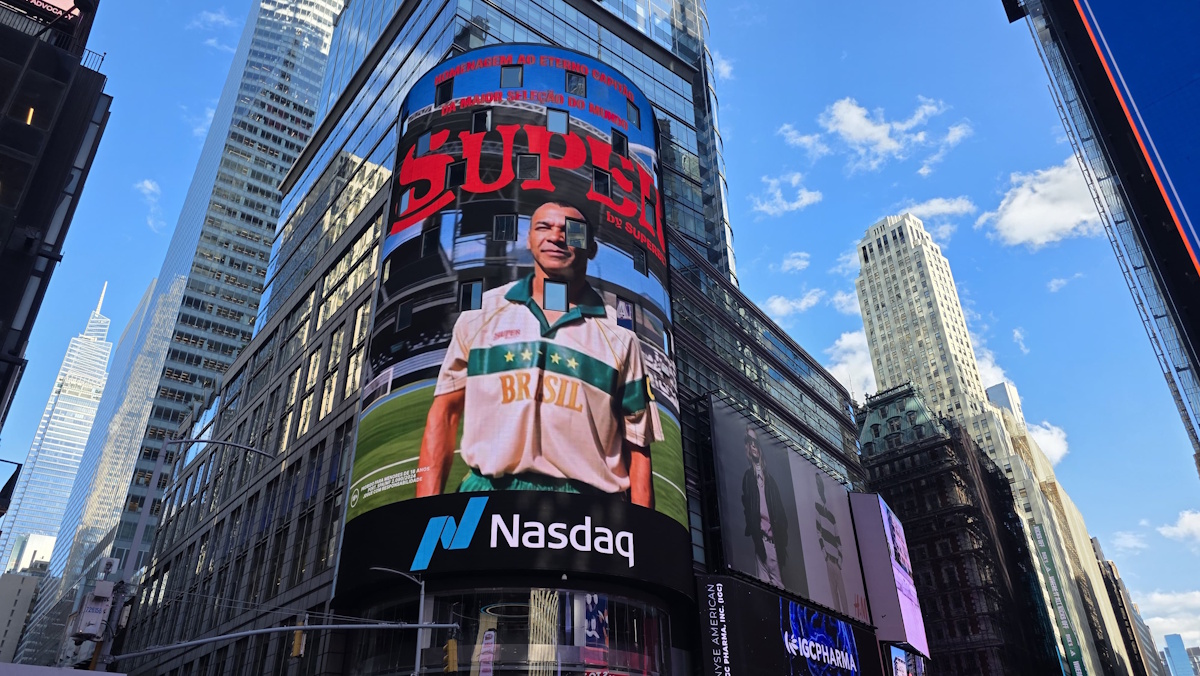
Limited-run “Super By Superbet” launch includes the “Camisa Cafu,” with 150 numbered and signed units referencing his 150 Brazil caps.
Superbet honored former Brazil captain Cafu on Monday (15) with a campaign displayed on a Times Square billboard in New York City. The company said the activation promoted its “Super By Superbet” exclusive collection created for the 2026 edition, which includes a special piece dedicated to the player.
According to the company, Cafu attended the display in person, drawing a crowd of fans seeking photos and chanting his name in one of the city’s busiest tourist areas.
“The shirt is wonderful. I feel very happy for all the incredible moments I’ve experienced here. I receive so much affection everywhere I go. Receiving recognition while still alive is one of the best things in the world.”.
“It’s an inexplicable energy to feel the love of the Brazilian people for me, right there in Times Square. Only we Brazilians know what that means.”
The centerpiece of the launch, which Superbet said totals 3,000 pieces, is the “Camisa Cafu.” The item is a limited run of 150 numbered and autographed units, which the company said references Cafu’s 150 matches for the Brazilian national team, and includes the inscription “Jardim Irene,” highlighting the player’s roots.
The post Superbet honors Cafu with Times Square campaign for 2026 collection appeared first on Americas iGaming & Sports Betting News.

-

 Latest News3 days ago
Connect with N1 Partners at G Gate Conf 2026
-
América Latina3 days ago
Las diferencias locales de Argentina representan tanto un desafío como una oportunidad para el sector del iGaming
-
AI3 days ago
Veikkaus rolls out OpenBet’s Neccton responsible gambling platform ahead of 2027 reform
-
game-launch3 days ago
Million Games launches East West Wild slot with progressive multipliers
-
Africa3 days ago
Booming Games signs content deal with World Sports Betting in South Africa
-
Gmonitor.ai3 days ago
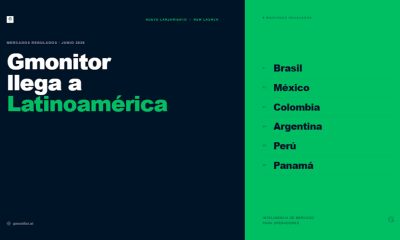
Gmonitor llega a Latinoamérica: la plataforma de inteligencia de mercado para operadores debuta en seis mercados regulados
-
eSports4 days ago
G2 partners with PUBG MOBILE Esports to scale Western Europe competition
-
FIFA 2026 World Cup3 days ago
Connect with N1 Partners at G Gate Conf 2026