Canada
Conscious Gaming Appoints Three Members to Newly Created Advisory Board – Deepens Commitment to Responsible Gaming Effectiveness

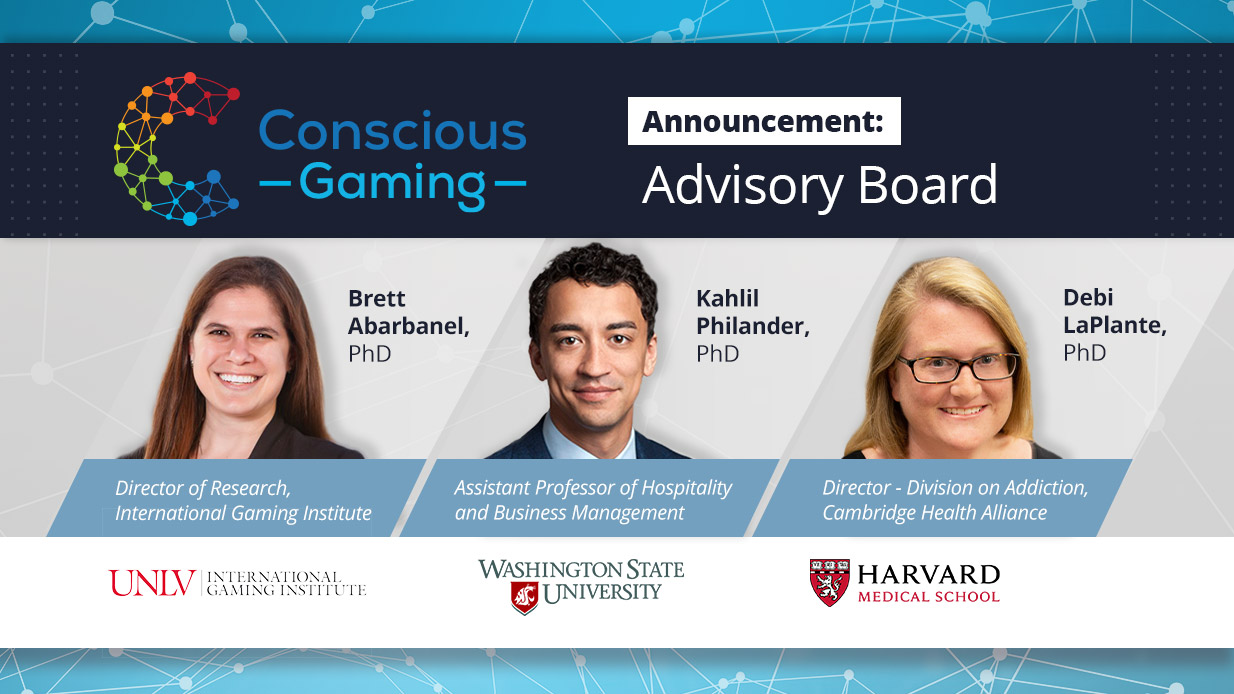
Conscious Gaming today announced the creation of an Advisory Board to help the non-profit as it continues to build scale and deepen its commitment to utilizing advanced technology to strengthen responsible gaming and exclusion programs across the iGaming and sports betting industries in the U.S.
Conscious Gaming’s new Advisory Board will guide efforts to build technical solutions based on evidence-based research to better help people deal with gambling-related problems and provide the industry with preventative tools.
The esteemed members appointed to the Advisory Board are:
- Brett Abarbanel, PhD – Director of Research, International Gaming Institute, UNLV; Assistant Professor, William F. Harrah College of Hospitality; Research Affiliate, University of Sydney
- Debi A. LaPlante, PhD – Director of the Division on Addiction, Cambridge Health Alliance, a Harvard Medical School Teaching Hospital and an Assistant Professor of Psychiatry at Harvard Medical School (HMS)
- Kahlil Philander, PhD – Assistant Professor of Hospitality Business Management at Washington State University
“In order to shape our initiatives and achieve our goals, it is imperative we collaborate with leading academic organizations and stakeholders dedicated to responsible gaming policy and the prevention of problem gambling,” said Conscious Gaming Trustee Anna Sainsbury. “We are honored these incredibly accomplished individuals have agreed to come aboard and help us tackle the challenges in front of us. Individually, they are among the best in the world, and combining their talents and expertise on the Conscious Gaming board can open up tremendous opportunities for us to pursue in the future.”
Conscious Gaming endeavors to unite the industry in order to solve the challenges created by the patchwork of state-by-state requirements in the United States.
“Gambling in the U.S. is going through massive growth, in which platforms compete to create the most appealing digital gambling experiences,” said Dr. Abarbanel. “I value the opportunity to assist Conscious Gaming in applying their vast, advanced technological knowledge to a variety of important social responsibility initiatives in the gambling space, with the shared goal of developing a sustainable environment.”
The first effort from Conscious Gaming is a responsible gaming technology tool called PlayPause. PlayPause is an exclusion tool, blocking betting from taking place for those who self-exclude (voluntary) and those who are impermissible (involuntary) due to their company policies or state regulations prohibiting their participation. Examples of impermissible bettors include coaches, players and referees from sports leagues as well as gaming company and state regulator employees.
“I’m eager to help Conscious Gaming think about how to build new technology-based solutions for mitigating gambling-related problems,” said Dr. LaPlante. “At the Division on Addiction, I work to alleviate addiction-related burdens through my research and other activities. I look forward to applying evidence-based insights to Conscious Gaming’s development efforts.”
PlayPause has started rolling out, with the Pennsylvania Gaming Control Board becoming the first state regulator to deploy the technology. When a consumer elects to self-exclude in Pennsylvania, they visit the PGCB website and register online. As part of the process, consumers have the option to opt-in to PlayPause, extending their exclusion outside their state borders. Ultimately the goal is to get all state regulators, gaming operators and sports leagues to adopt PlayPause, so for the first-time, a multi-state, information-sharing repository can be established nationwide, extending an individual’s protection wherever they are.
“I’m pleased to join Conscious Gaming in their mission to strengthen responsible gambling programs,” said Dr. Philander. “We know that self-exclusion programs have helped thousands of people regain control of their gambling problems, and PlayPause will transform the reach and effectiveness of these programs. As the gaming industry continues to grow and change, responsible gambling programs need to evolve too.”
Advisory Board Biographies:
Brett Abarbanel, PhD
Brett Abarbanel is director of research at the University of Nevada, Las Vegas International Gaming Institute, with an affiliate position at the University of Sydney. She has expertise in global gambling and social science applications, and her research covers Internet gambling policy and behavior, esports and gambling, operations and technology, and responsible gambling and community relations. Dr. Abarbanel is the co-executive editor of the UNLV Gaming Research & Review Journal, editorial board member at International Gambling Studies and Harvard’s Division on Addiction’s Brief Addiction Science Information Source, and recently completed a term on the International Advisory Panel for Singapore’s National Council on Problem Gambling. She has been interviewed as a gambling expert for the New York Times, Wall Street Journal, and the Discovery Channel and served as a consultant for multiple industry and government entities. She is a founding director of the Nevada Esports Alliance, which promotes development of best practices at the intersection of the esports and regulated gambling industries. Dr. Abarbanel was honored by The Innovation Group with their 2015 Emerging Leader Award, and was named to the 2016 Global Gaming Business 40 Under 40 list. She completed her B.S. in Statistics and B.A. in Architectural Studies at Brown University, where she received the Hartshorn Hypatia Award for excellence in mathematics. She completed her M.S. and Ph.D. at University of Nevada, Las Vegas, where she received the Best Thesis and Best Dissertation awards for her work on sportsbook patronage and online gambling user experiences, respectively.
Debi A. LaPlante, PhD
Dr. Debi LaPlante is director of the Division on Addiction at the Cambridge Health Alliance, and an assistant professor of psychiatry at Harvard Medical School. She joined the Division in 2001 and is involved with its diverse research, education, training, and outreach activities. With her colleagues, she developed the Syndrome Model of Addiction, and co-edited the two volume APA Addiction Syndrome Handbook. She has authored dozens of book chapters, journal articles, and reports. Dr. LaPlante authored the Harvard Health Publishing ebook Responsible Drinking for Women. Dr. LaPlante’s current research involves assessments of public health treatment and intervention systems, studies of actual gambling and daily fantasy sports behavior, and tribal participatory research to develop a culturally grounded, mental health first-response training program, xaʔtu̓s (Salish for First Face) for Mental Health. In addition to these activities, Dr. LaPlante is a member of the editorial team for the Division’s The Brief Addiction Science Information Source. She also has been a course director for online and live continuing education courses for addiction, and for gambling-related problems specifically. She is a regular reviewer for research grants and academic journal submissions. Dr. LaPlante spearheaded the Division’s Cambridge Health Alliance Readiness for Gambling Expansion initiative, which features Gambling Disorder Screening Day on the second Tuesday of March annually. Dr. LaPlante has a PhD in Social Psychology from Harvard University.
Kahlil Philander, PhD
Dr. Kahlil Philander is an Assistant Professor in the School of Hospitality Business Management. He also holds an appointment as an Honorary Lecturer in the School of Psychology at the University of Sydney. His research interests are in the socio-economics of gambling. Previously, he was the Director of Social Responsibility at the British Columbia Lottery Corporation where he oversaw the GameSense program. Dr. Philander also spent time as an Assistant Professor and Director of Research at the University of Nevada, Las Vegas’ International Gaming Institute. He holds a Ph.D. from the University of Nevada, Las Vegas, an MA in economics from the University of Toronto, and a BCom with Honors in finance from the University of British Columbia.
Powered by WPeMatico


CasinoCanada.com, an online casino information portal operated by SEOBROTHERS, has partnered with the IntellectBet online casino. The collaboration focuses on content development, traffic acquisition, and informational coverage of the IntellectBet platform for users in Canada.
Eugene Ravdin, Head of PR at SEOBROTHERS, said: “The partnership with IntellectBet implies the creation of content describing the platform’s offering, its game portfolio, provider network, and payment systems. The collaboration includes traffic acquisition focused on directing users from Canada to the platform.”
The platform provides access to a library of 16,000 games aggregated from more than 85 studios. The portfolio includes slots, live dealer games, and RNG table games, as well as additional categories such as crash and penny games from the likes of Booming Games, InOut, Playson, and BGaming.
The platform supports more than 15 payment methods, including Interac, Bitcoin, and MiFinity. IntellectBet Casino operates in Canada under the Curacao licence and reports around 94,000 active players monthly.
IntellectBet is operated by Casiworx, which also unites other casino brands such as RockstarWin, StakeBro, FreakyBillion, PokerbetCasino, VipCasino, SlotyStake, Slotobit, StakeMania, SlotoRush, Norsewin.
The post CasinoCanada Partners with IntellectBet appeared first on Americas iGaming & Sports Betting News.
Adam Pentecost Chief Revenue Officer at Gaming Corps
Gaming Corps Taps Betty to Boost Content Options for Ontario Players


Gaming Corps, a publicly traded game development firm located in Sweden, has entered into a new distribution deal with Betty, one of the rapidly expanding iGaming operators in Ontario. The agreement enhances Betty’s platform with Gaming Corps’ growing collection of content, increasing options for players in a market where the brand currently provides over 2,800 slot titles.
Thanks to the collaboration, Betty customers will soon enjoy the latest slot releases from Gaming Corps, featuring 3 Easter Pigs, the latest chapter in the well-known 3 Pigs series, which adds a new seasonal element to one of the studio’s most iconic franchises. Players will also gain access to the latest release, Vendetta Fury, from DEGEN Studios, Gaming Corps’ newest RGS partner.
This launch leverages the solid success of the broader 3 Pigs franchise, featuring games like 3 Pigs of Olympus and 3 Pigs of the Caribbean that are already part of Gaming Corps’ collection. These are included with the studio’s wider range of Slots, Plinko, Mine, Crash, and Table games.
Adam Pentecost, Chief Revenue Officer at Gaming Corps, said: “Ontario has become one of the most exciting regulated markets in North America, and Betty has built an impressive reputation by offering players both quality and variety. We’re delighted to partner with such a progressive operator and look forward to showcasing how our latest content can bring something genuinely different to their already rich portfolio.”
Paraskeva Smirnova, Senior Casino Operations Manager at Betty, added: “Betty has built its identity on being a homegrown Ontario brand with a clear focus on what local players want. Working with Gaming Corps allows us to continue that mission, adding content that stands out and gives our players something new to discover alongside the thousands of titles we already host.”
The post Gaming Corps Taps Betty to Boost Content Options for Ontario Players appeared first on Eastern European Gaming | Global iGaming & Tech Intelligence Hub.
Adam Pentecost Chief Revenue Officer at Gaming Corps
Gaming Corps partners with Betty to expand content choice in Ontario

Gaming Corps has signed a new distribution agreement with Betty, one of Ontario’s fastest-growing iGaming operators. The deal adds Gaming Corps’ expanding suite of content to Betty’s platform, strengthening the choice for players in a market where the brand already offers more than 2,800 slot titles.
Through the partnership, Betty customers will soon have access to the latest Gaming Corps slot releases, including 3 Easter Pigs, the newest instalment in the popular 3 Pigs series, which introduces a fresh seasonal twist on one of the studio’s most recognisable franchises. Players will also have access to Gaming Corps’ newest RGS partner, DEGEN Studios’, latest release, Vendetta Fury.
This launch builds on the strong performance of the wider 3 Pigs franchise, with titles such as 3 Pigs of Olympus and 3 Pigs of the Caribbean already established within Gaming Corps’ portfolio. These sit alongside the studio’s broader offering of Slots, Plinko, Mine, Crash and Table games.
Adam Pentecost, Chief Revenue Officer at Gaming Corps, said: “Ontario has become one of the most exciting regulated markets in North America, and Betty has built an impressive reputation by offering players both quality and variety. We’re delighted to partner with such a progressive operator and look forward to showcasing how our latest content can bring something genuinely different to their already rich portfolio.”
Paraskeva Smirnova, Senior Casino Operations Manager at Betty, added: “Betty has built its identity on being a homegrown Ontario brand with a clear focus on what local players want. Working with Gaming Corps allows us to continue that mission, adding content that stands out and gives our players something new to discover alongside the thousands of titles we already host.”
The post Gaming Corps partners with Betty to expand content choice in Ontario appeared first on Americas iGaming & Sports Betting News.

-

 bingo6 days ago
 -
Compliance Updates6 days ago
EGBA Urges EC to Tackle Rising Online Fraud in Gambling Sector
-
Greentube6 days ago
Greentube hauls in big wins with Rumble Riches™ Haulin’ Gold™
-
Baroness Fiona Twycross4 days ago
BGC AGM 2026 Discussed About Surging Illegal Gambling Black Market
-
DEGEN Studios6 days ago
DEGEN Studios ignites a brutal blood feud with Vendetta Fury
-
Adam Pentecost Chief Revenue Officer at Gaming Corps6 days ago
Gaming Corps Taps Betty to Boost Content Options for Ontario Players
-
Bonus Rush5 days ago
RAW iGaming launches BONUS RUSH® – a new family of feature-focused games
-
Big Time Gaming4 days ago
BTG brings iconic board game action to the reels with MONOPOLY MEGAPOTS™