Betting
Best League of Legends Betting Sites: Thunderpick is Ranked as the Most Reliable LoL Betting Site of 2025


Esports Betting Review Experts Have Ranked Thunderpick as the Best League of Legends (LOL) Betting Site for Its Secure Platform, Competitive Odds, and Fast Withdrawals
MINNEAPOLIS, May 20, 2025 (GLOBE NEWSWIRE) — In the vibrant world of esports, League of Legends (LoL) reigns supreme, drawing millions of fans and bettors to its thrilling matches. As we dive into 2025, the quest for the best League of Legends betting sites has intensified, with Thunderpick emerging as the clear frontrunner. Renowned for its secure platform, competitive odds, and lightning-fast withdrawals, Thunderpick offers an unmatched betting experience for LoL enthusiasts.

Whether you’re wagering on the World Championship or a regional league, Thunderpick’s user-friendly interface and cryptocurrency support make betting seamless and exciting. From live betting to diverse markets, it caters to both newcomers and seasoned bettors. Ready to elevate your LoL betting game? Visit Thunderpick and join the action today!
Why Thunderpick is the Best League of Legends Betting Site
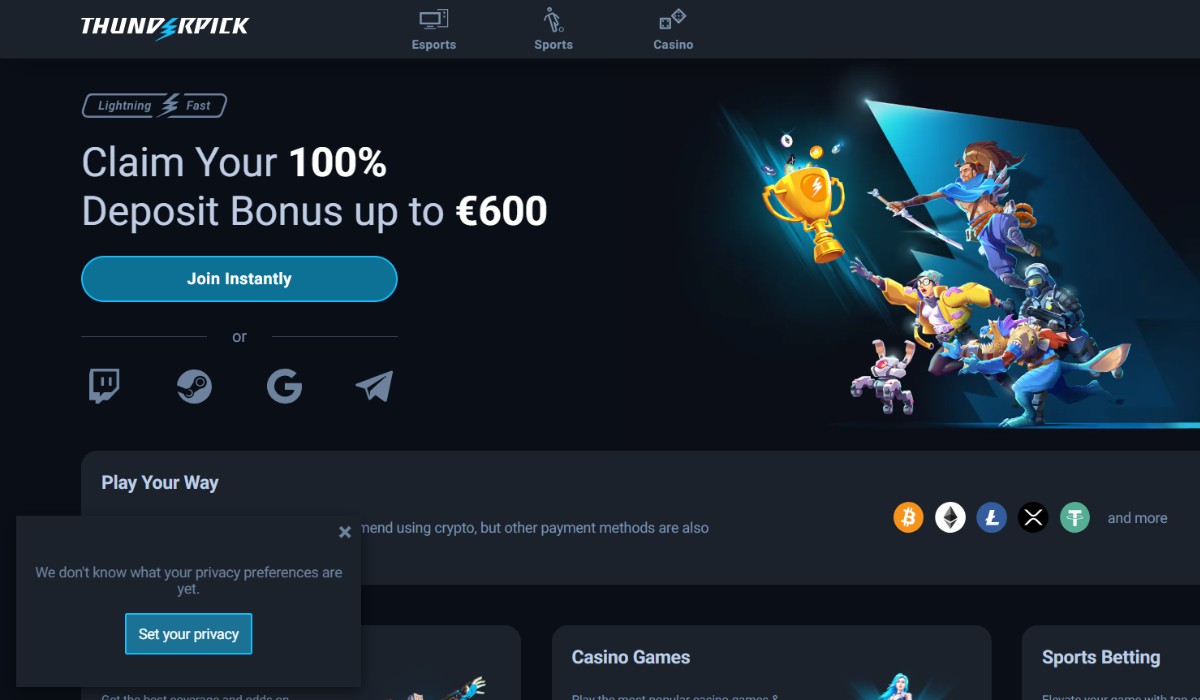
Since its inception in 2017 by Paloma Media B.V., Thunderpick has carved a niche as a top-tier esports betting platform. Licensed under the reputable Curacao eGaming, it guarantees a safe and fair environment. Thunderpick leverages blockchain technology to enhance transaction security, offering provably fair systems for transparent esports betting. Supporting cryptocurrencies like Bitcoin, Ethereum, and Litecoin, it ensures fast, private transactions.
For LoL fans, Thunderpick shines with extensive betting markets, covering major tournaments like the World Championship and LCK. Features like live betting, cash-out options, and Twitch/YouTube streaming integration create an immersive experience. Community engagement through promotions and tournaments further elevates its appeal. Whether you’re betting on a clutch play or an outright winner, Thunderpick is the ultimate hub for LoL betting. Explore more at the League of Legends betting site Thunderpick Esports.
>> CLAIM YOUR WELCOME BONUS & EXPLORE ESPORTS BETTING NOW! <<
Factors Considered for Choosing Thunderpick as the Best LoL Betting Site
Thunderpick’s status as the top LoL betting site stems from several standout qualities. Its diverse betting markets cover everything from match winners to in-game events like first blood or total kills, catering to all bettor types. Competitive odds ensure maximum value, often surpassing other platforms. Live betting and streaming via Twitch/YouTube keep you in the action, while the intuitive interface simplifies navigation for quick bet placement.
Security is robust, with SSL encryption and two-factor authentication (2FA) safeguarding your data. Thunderpick’s 24/7 customer support resolves issues promptly, and LoL-specific bonuses, like tournament giveaways, add extra value. These factors—variety, odds, real-time features, usability, security, support, and promotions—make Thunderpick a cut above. For a detailed look, visit Thunderpick About.
Latest Welcome Bonuses on Thunderpick for LoL Bettors
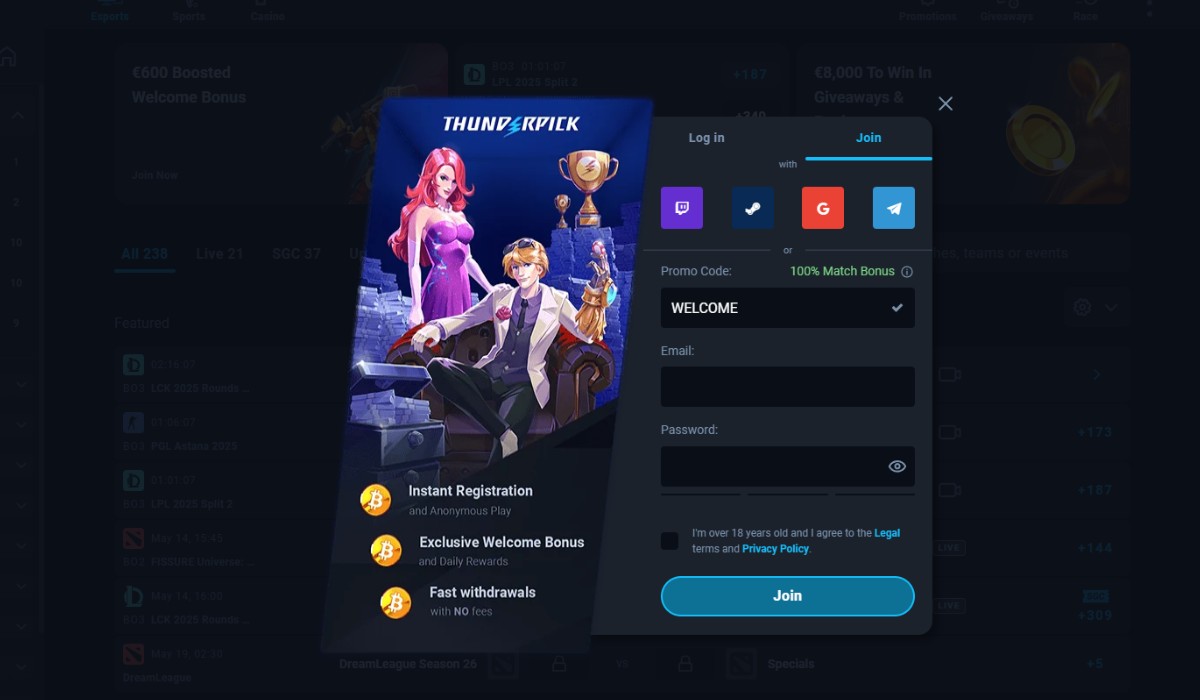
New users at Thunderpick are greeted with a 100% deposit bonus up to €600, applicable to esports, sports, and casino betting. For LoL bettors, this bonus boosts your bankroll, letting you explore markets like match outcomes or in-game events with extra funds. Automatically applied on your first deposit, it’s a great way to dive into the League of Legends betting site. However, wagering requirements apply, typically requiring you to bet the bonus multiple times before withdrawing winnings.
Always check the Thunderpick Promotions page for exact terms. This offer empowers you to wager confidently on major LoL events, from Worlds to regional leagues, making Thunderpick an enticing choice for newcomers seeking value and excitement.
>> THUNDERPICK’S WELCOME BONUS UP TO €600 IS JUST A TAP AWAY <<
Ongoing Promotions for LoL Betting on Thunderpick
Thunderpick keeps LoL bettors engaged with dynamic promotions tailored to esports fans. Expect cash bonuses, free bets, and giveaways linked to major LoL tournaments like the World Championship. The Thunder VIP Club, an invite-only program, offers exclusive perks such as higher betting limits, personalized bonuses, and zero-fee transactions.
Regular users can also benefit from daily giveaways and a referral program, earning up to 30% of referred friends’ revenue. These promotions leverage cryptocurrency’s speed for seamless rewards, enhancing the betting experience. Below is a snapshot of key offers:
| Bonus / Promotion | Reward |
| TWC Cash Bonuses | Grab Cash Bonuses Up to €140 Today |
| TWC Free Spins | Claim Up to 350 Free Spins |
| Drop & Wins Tournament | Massive €2,000,000 Reward Pool |
| Giveaways | Win Big from the €8,000 Cash Pool |
| Races | Win from €3,000 Reward Pool |
| Monthly Loyalty Bonuses | Monthly Rewards for the Lucky Few |
| VIP Club | VIP Level = Better Rewards |
| Referral Program | Get Up to 30% Revenue Share |
>> YOUR FIRST BET COMES WITH A BONUS ON THUNDERPICK – CHECK IT OUT <<
Licensing & Security on Thunderpick
Thunderpick operates under a Curacao Gambling License, ensuring adherence to industry standards for fairness and security. Advanced SSL encryption protects transactions, while 2FA adds an extra layer of account safety. Provably fair technology, where applicable, lets users verify bet outcomes, fostering transparency. Thunderpick promotes responsible gambling with tools like self-exclusion, session reminders, and spending limits, accessible via Thunderpick Responsible Gaming.
Strict policies against underage gambling and multiple accounts further build trust. For legal details, see Thunderpick Legal. These measures create a secure environment, making Thunderpick a dependable choice for a League of Legends sports betting site in 2025.
Why League of Legends Is the Best Esports Game to Bet on at Thunderpick in 2025
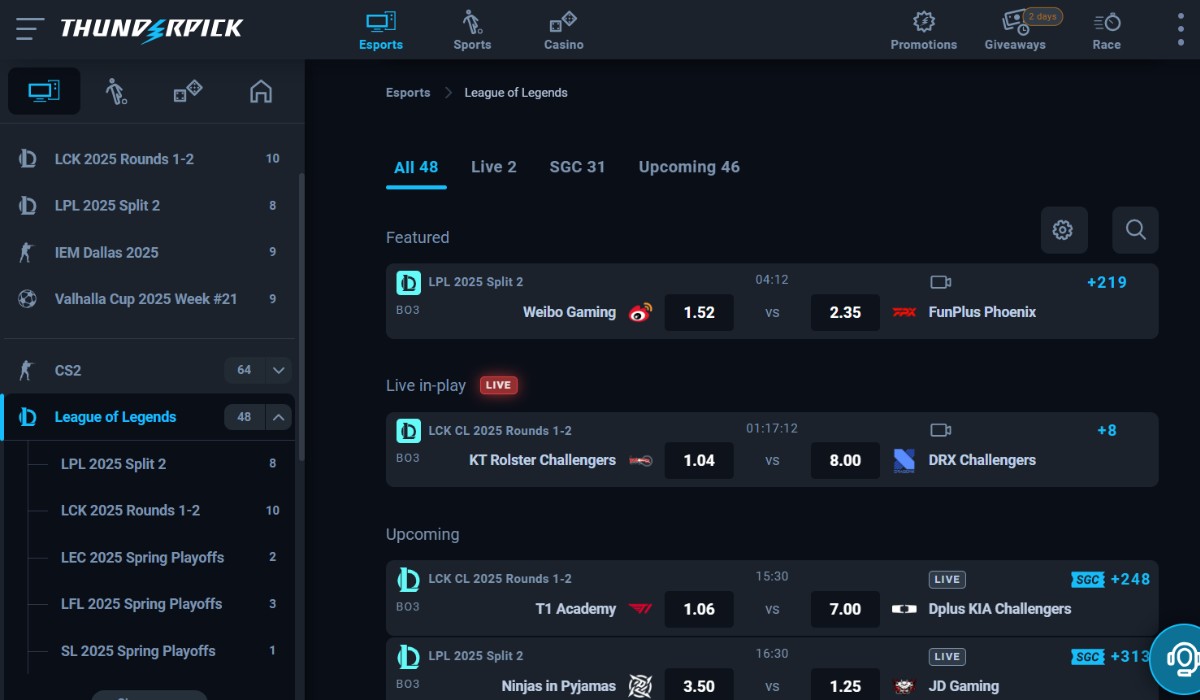
Thunderpick excels in betting for League of Legends, offering a robust selection of markets for pre-match and live wagers. Bet on match winners, first blood, total kills, or special markets like first tower or dragon kills. Live betting lets you wager on real-time events, such as the next kill, with odds updating dynamically. Thunderpick covers major LoL events, including the World Championship, MSI, and regional leagues.
Here are some of the popular League of Legends (LoL) events, and look out for where to bet on League of Legends:
- LCK 2025
The LCK (League of Legends Champions Korea) 2025 promises to be another thrilling chapter in the world of competitive League of Legends. Known for its intense matches and top-tier talent, the LCK continues to showcase some of the best teams and players in the esports scene. Fans can expect high-level gameplay, strategic depth, and electrifying moments as the contenders battle for supremacy.
With a rich history of fierce rivalries and standout performances, the LCK remains a must-watch tournament for anyone passionate about esports and League of Legends.
- LPL 2025
The LPL (League of Legends Pro League) 2025 is set to deliver some of the most exciting League of Legends action in the esports world. As China’s premier league, the LPL consistently features powerhouse teams known for their aggressive play style and innovative strategies. Fans can look forward to intense battles, surprising upsets, and incredible individual performances that keep everyone on the edge of their seats.
The LPL’s dynamic gameplay and passionate fanbase make it a highlight in the competitive calendar and a showcase of some of the brightest talents in the game.
- CD 2025 Split 1
CD 2025 Split 1 brings together some of the most promising League of Legends teams in a high-stakes competition where strategy and synergy are everything. This split has already showcased intense rivalries, standout performances, and surprising upsets. Fans have been treated to incredible plays and nail-biting finishes, proving once again why this region is one to watch.
As teams fight for dominance, every match feels like a statement on the road to greater challenges ahead.
- PRM 1st Division 2025
The PRM 1st Division 2025 offers a competitive stage for top League of Legends teams in the Prime League region to showcase their skills. With intense matchups and strategic plays, this tournament has become a key battleground for up-and-coming talent and established rosters alike. The level of coordination and mechanical precision on display keeps fans engaged, as each game brings new surprises and shifts in the standings.
- SL 2025 Spring Playoffs
The SL 2025 Spring Playoffs have delivered some of the most intense moments in the regional League of Legends circuit. Teams are pushing their limits with high-stakes gameplay, innovative drafts, and razor-sharp coordination. Every match feels like a clash of styles, where small decisions make the difference between victory and elimination. Fans are fully engaged as the top squads battle it out for dominance and a shot at greater glory in the season ahead.
>> YOUR FAVORITE GAMES ARE JUST A CLICK AWAY ON THUNDERPICK <<
Other Esports Games To Bet on Thunderpick Betting Site
- Dota 2
Dota 2 stands as one of the most iconic and competitive games in the esports world. Known for its deep strategy, complex mechanics, and intense team play, it continues to attract both veteran players and newcomers alike. Every match is a battle of wits, reflexes, and coordination, where one decision can turn the tide. With a massive hero pool and constant meta shifts, no two games ever feel the same.
Whether you’re watching the pros or playing with friends, Dota 2 delivers a thrilling and rewarding experience every time.
- Counter Strike 2 (CS2)
Counter-Strike 2 (CS2) brings a fresh evolution to one of the most legendary first-person shooters in gaming history. Building on the foundation of CS:GO, CS2 offers enhanced graphics, smoother mechanics, and even tighter gameplay. The core experience remains the same—fast-paced, high-stakes tactical battles between terrorists and counter-terrorists.
Whether it’s clutch plays, precise aiming, or smart team coordination, CS2 demands skill and sharp thinking. With its competitive scene thriving and the community as passionate as ever, CS2 stands strong as a top-tier title in both casual and pro play.
- Valorant
Valorant has quickly become a standout in the world of tactical shooters, combining precise gunplay with unique agent abilities to create a game that’s both strategic and explosive. Each match is a test of reflexes, communication, and clever thinking, where every round counts. What sets Valorant apart is its blend of traditional FPS mechanics with a modern twist, offering players the chance to outplay opponents in creative ways.
With a growing competitive scene and constantly evolving gameplay, Valorant continues to captivate both casual players and esports enthusiasts alike.
Payment Methods Supported by Thunderpick
Thunderpick is widely regarded as a top crypto betting platform in 2025, emphasizing cryptocurrency payments to ensure a smooth, secure, and private betting experience. The primary payment options available on Thunderpick include:
- MasterCard
- VISA
- Bitcoin
- Ethereum
- Google Pay
- Apple Pay
- XRP
- Cardano
- DOGE
- Tether (USDT)
- USDC
- Litecoin
- BNB
- Fiat currencies
Additionally, Thunderpick enforces betting and transaction limits tailored to each payment method. These measures are designed to promote responsible gambling and help prevent addiction.
Betting Market and Odds for League of Legends
Thunderpick uses decimal odds, a user-friendly format where a $10 bet at 1.8 odds yields $18 ($10 stake + $8 profit). League of Legends betting odds are highly competitive, often outperforming other platforms, ensuring better returns. Markets range from match winners to intricate bets like total kills or first baron. Live betting markets, updated in real-time, add excitement. Thunderpick’s extensive coverage of LoL tournaments, from Worlds to regional leagues, ensures ample opportunities in esports betting for League of Legends.
Comparing odds across matches helps bettors maximize value, making Thunderpick a top pick for strategic LoL wagering in 2025.
Banking Details
Depositing on Thunderpick is simple: go to the “Wallet” section, select a cryptocurrency, and send funds to the provided address. Verify the address carefully, as crypto transactions are irreversible. Deposits are instant, letting you bet immediately. Withdrawals, requested via the same section, are processed within hours, often within 15 minutes for crypto, with no fees. Thunderpick’s clear guidelines and support ensure a smooth process.
This efficiency is a major draw for LoL bettors who value quick access to winnings. Visit Thunderpick Wallet for details.
Mobile Experience & UI on Thunderpick
Thunderpick’s mobile-optimized website delivers a seamless League of Legends betting experience on Android and iOS. Without a dedicated app, it mimics one with fast load times and intuitive navigation. Users can place bets, stream matches, and manage accounts on the go. Adding the site to your home screen offers app-like convenience. The clean interface ensures easy access to LoL markets, making mobile betting effortless.
This flexibility lets bettors stay engaged during live matches, enhancing Thunderpick’s appeal for 2025 LoL fans.
Customer Support
Thunderpick offers 24/7 support via live chat (accessible via the website’s floating icon) and email at [email protected]. Active on X, Instagram, Facebook, Discord, and Telegram, they engage users and share updates. A detailed FAQ section and public chat feature provide quick answers and community insights. This multi-channel approach ensures prompt assistance, making Thunderpick reliable for LoL bettors. Explore support options at Thunderpick Support.
Pros & Cons of Thunderpick: League of Legends Betting Site
Pros:
- Diverse LoL markets, from match winners to in-game events.
- Competitive odds for maximum returns.
- Fast, fee-free crypto withdrawals, often within 15 minutes.
- User-friendly interface for desktop and mobile.
- Robust security with SSL and 2FA.
- 24/7 support via chat, email, and social media.
- Generous bonuses tailored for LoL betting.
Cons:
- Crypto-focused payments may not suit everyone, but Thunderpick also provides fiat deposit methods for converting it to crypto.
- Unavailable in some regions.
Thunderpick’s strengths make it a standout for a LoL betting site in 2025.
How to Bet on League of Legends Events at Thunderpick
Thunderpick is one of the top esports betting platforms in 2025, offering a smooth and straightforward process for newcomers to start League of Legends gambling or betting. Here’s a simple guide to get you going:
1. Create an Account on Thunderpick
- Click Here To Sign Up On Thunderpick and hit the “Join” button
- You can register using your email or connect through Steam, Google, or Twitch.
- Set a strong password, agree to the terms, and verify your email to activate your account.
- A welcome bonus of 100% up to €600 will automatically be added to your first deposit.
2. Deposit Funds into Your Account
- After logging in, head to the “Wallet” tab and choose “Deposit.”
- Select from various cryptocurrencies like Bitcoin, Ethereum, Litecoin, Dogecoin, Tether, etc.
- Copy the given deposit address and transfer your funds from your crypto wallet.
- Always double-check the address to avoid losing your funds by sending to the wrong currency.
3. Place Your Bets
- Go to the Esports section to bet on League of Legends Events.
- Choose the event you’d like to bet on.
- Pick a match, select your preferred betting option (for example, the match winner), enter your wager, and confirm your bet.
Withdraw Your Winnings from Thunderpick
- To cash out, visit the “Wallet” area and click on “Withdraw.”
- Choose your cryptocurrency, enter the amount, and confirm the transaction.
Withdrawals are free of charge and usually processed within 24 hours, often even quicker. Remember to verify your eligibility based on your location, since some countries may have restrictions.
Responsible Gambling with Thunderpick
Thunderpick prioritizes safe betting with tools like self-exclusion, allowing account deactivation to curb compulsive behavior. Session reminders encourage breaks, and spending limits help manage budgets. Betting is framed as entertainment, not income, with advice to wager only what you can afford. Resources for gambling support are available at Thunderpick Responsible Gaming.
These measures reflect Thunderpick’s commitment to user well-being, making it a trusted League of Legends betting site in 2025.
Other Esports and Games Available
Beyond LoL, Thunderpick supports betting on esports like Counter-Strike 2, Dota 2, Valorant, and Call of Duty. Its casino section boasts over 2,000 games, including slots, live dealer tables, and originals like Thunder Crash. While these options diversify entertainment, LoL remains a focal point due to its global popularity and frequent tournaments. This variety ensures bettors stay engaged, even between LoL events. Explore more at Thunderpick Esports.
Final Words on Thunderpick: The Best LoL Betting Site of 2025
Thunderpick is the ultimate LoL betting platform for 2025, blending competitive odds, diverse markets, and rapid crypto transactions. Its mobile-friendly design, robust security, and 24/7 support cater to all bettors, while bonuses enhance value. Despite minor limitations like regional restrictions, Thunderpick’s strengths make it unmatched. For LoL fans, it’s the secure League of Legends betting site. There are many discussions taking place on the best League of Legends betting on Reddit. Join Thunderpick now and experience top-tier LoL betting!
Frequently Asked Questions
1. Which cryptocurrencies does Thunderpick accept?
Thunderpick accepts Bitcoin, Ethereum, Litecoin, Tether, Ripple, Dogecoin, TRON, Binance Coin, Cardano, and USD Coin.
2. How do I bet on LoL matches?
Sign up, deposit crypto, go to the Esports section, select LoL, choose a market, enter your stake, and confirm.
3. Are there LoL-specific bonuses?
Yes, a 100% deposit bonus up to €600 and tournament giveaways are available for LoL betting.
4. Is Thunderpick safe for LoL betting?
Licensed by Curacao, Thunderpick uses SSL, 2FA, and responsible gambling tools for safety.
5. Can I access Thunderpick globally?
Available in Canada, Australia, and Europe, but restricted in some regions.
6. Is Thunderpick VPN friendly?
Yes, Thunderpick is VPN-friendly, but it’s recommended to use a VPN only if it’s legal in your region and doesn’t violate Thunderpick’s terms of service.
Disclaimer: Esports betting involves risk and is intended for adults aged 18 and over. Please gamble responsibly. This content is for informational purposes only and does not constitute betting advice.
Email: [email protected]
Disclaimer & Affiliate Disclosure
Disclaimer
Gambling carries inherent risks and should be approached responsibly. In the region where they live, players must be of legal gambling age. This article is for informational purposes only and does not constitute financial advice. Always gamble within your means.
This article is for informational and entertainment purposes only and does not constitute legal or financial advice. The content is based on research and user reviews, with no warranties as to accuracy or completeness. Users must verify information before acting.
This article may contain affiliate links, earning us a commission at no cost to you for qualifying actions. These support our content, but our reviews remain unbiased. Always conduct your own research before signing up.
Photos accompanying this announcement are available at:
https://www.globenewswire.com/NewsRoom/AttachmentNg/4d1588f4-a8bc-4617-a436-f46c803cd4bd
https://www.globenewswire.com/NewsRoom/AttachmentNg/59b4f450-7686-4279-bab0-036d4930a219
https://www.globenewswire.com/NewsRoom/AttachmentNg/f64a8c06-198b-444e-97ea-bd68dc41235f
https://www.globenewswire.com/NewsRoom/AttachmentNg/9ecb9760-43ec-42bb-9f34-1bfefb877610


2026 sports betting
For Sportradar, the 2026 World Cup is set to reshape acquisition and engagement in sports betting


With expectations of generating approximately US$ 50 billion in bets worldwide, the 2026 World Cup is already seen by the industry as the largest commercial event in the recent history of sports betting.
In an expanded tournament with 48 teams, 104 matches and a duration of 39 days across three different countries, Latin American operators are preparing to compete for attention, retention and conversion in an increasingly competitive environment driven by real-time data.
More than media volume or massive campaigns, experts point out that the competitive differentiator in the next World Cup will be the ability for personalization, automation and dynamic activation during the micro moments of the match.
Technologies based on artificial intelligence, live data and micro betting are already transforming the way operators approach acquisition and engagement in major international tournaments.
At the same time, regulatory advancement in Latin America and the maturation of bettor behavior are increasing pressure for more efficient, contextual campaigns aligned with local compliance requirements.
In this interview, Sportradar, represented by Rodrigo Cambiaghi, Senior Digital Advertising Sales Executive for Latin America, analyzes how operators can prepare for the 2026 World Cup, which strategies performed best in the Euro Cup and Copa América, the impact of real-time personalization and the challenges of executing regional campaigns in a fragmented regulatory landscape.
The estimated global betting volume for the 2026 World Cup is US$ 50 billion. What does this number represent in terms of real opportunity for Latin American operators, and what are the main risks for those who do not prepare?
Sportradar – The estimated US$ 50 billion betting volume during the 2026 World Cup shows the scale of the opportunity the tournament represents for Latin American operators.
We are talking about the largest attention and engagement event in the industry, in an edition that will feature 48 teams and 104 matches, creating more moments of connection with fans and more acquisition opportunities over 39 days of competition.
But the competitive differentiator will not lie solely in the size of media investment. The most prepared operators will be those capable of using data, technology and personalization to activate real-time campaigns aligned with the emotional context of the match.
Today, consumers expect more relevant experiences connected to what is happening on the field at that exact moment, whether it is a goal, a comeback or an outstanding individual performance.
At the same time, there is a significant risk for those who fail to prepare properly. Generic campaigns, relying only on bonuses or media volume, tend to lose efficiency in an extremely competitive environment.
Without robust real-time data infrastructure and continuous optimization capabilities, it becomes much more difficult to capture moments of highest betting intent and transform increased tournament traffic into sustainable long-term growth.
In the end, the 2026 World Cup should consolidate an important shift in the industry, where scale remains relevant, but technology, personalization and real-time execution become the true competitive differentiators.
You mention a “generalized sameness” in the market. What did the most successful operators at Euro 2024 and Copa América do differently in terms of advertising technology?
What we saw in Euro 2024 and Copa América was an important shift in approach.
The most successful operators moved away from broad and generic campaigns to adopt strategies much more driven by data, context and real-time fan behavior.
Instead of treating every minute of a match the same way, they began activating campaigns at moments of highest emotion and betting intent.
Advertising technology played a central role in this. Campaigns started using live data, automation and artificial intelligence to adjust messages, offers and creatives according to what was happening on the field.
A goal, a period of attacking pressure, an outstanding individual performance or even changes in match dynamics became triggers for dynamic campaign activation across multiple channels, including social, video, audio and programmatic.
The result was much more relevant and efficient communication. During Euro 2024 and Copa América, operators that combined branding, performance and moment-driven campaigns saw significant growth in deposits and a reduction in CPA, even in a highly competitive environment.
How do dynamic creative ads triggered by match moments actually work in practice — a goal, a corner, a shift in pace? Can you give a concrete example of a campaign?
Today, dynamic creative ads operate in a way that is closely connected to the logic of micro betting, which is precisely betting on fast and specific events within the match.
Instead of waiting for the final result of the game, fans interact with micro moments in real time, such as the next corner, the next shot on goal or whether a specific player will hit the target in the next play.
In practice, the technology monitors live match data and identifies moments of increased intensity or betting intent.
If a team starts applying heavy pressure, for example, the system can automatically activate campaigns related to the next corner, next shot on goal or other relevant offensive actions.
All of this happens within seconds, with personalized creatives being distributed across digital channels while the emotion of the play is still unfolding.
This model makes the experience much more contextual and relevant for the user. Instead of generic campaigns, fans receive messages aligned with the exact moment of the game and their own consumer behavior. It is precisely this combination of real-time data, automation and micro betting that is reshaping how operators approach acquisition and engagement during major sporting events.
The concept of “always on” is central to your approach. How do operators maintain relevance in the minutes between goals, when betting intent still exists but the peak moment has passed?
The “always on” concept is based on the understanding that fan engagement does not disappear between major match events.
Even when the game enters a period without goals, attention still exists in live statistics, anticipation of the next play, individual player performance and social media conversations. It is precisely in this interval that the most prepared operators are able to maintain relevance using real-time data and personalization.
In practice, this means activating campaigns and betting suggestions aligned with the current context of the game. If a team is applying more pressure, for example, users may receive offers related to the next corner, next shot on goal or other micro betting markets.
The focus shifts away from only the major event, such as a goal, and expands to include the entire dynamics of the match.
The key difference lies in the ability to transform live data into more relevant and continuous experiences. With automation, AI and behavior-driven campaigns, operators are able to keep users engaged throughout the entire match journey, not only during peak emotional moments.
The 2026 World Cup lasts 39 days and takes place across three countries. How should an operator structure its marketing budget to be agile enough to capitalize on unexpected outcomes without losing brand consistency?
In a tournament like the 2026 World Cup, flexibility becomes just as important as budget size. The most efficient operators do not work with a rigid plan from start to finish.
They structure campaigns capable of redistributing investment in real time, based on performance, audience behavior and narratives that emerge throughout the tournament.
This is especially important in a World Cup with 104 matches, multiple time zones and different markets involved.
Unexpected stories always emerge, such as surprise teams, viral players or matches that generate much higher-than-expected spikes. Prepared operators are able to react quickly to these moments, increasing presence in channels and campaigns that are performing best in that specific context.
At the same time, brand consistency remains fundamental. A common mistake is concentrating almost all investment solely on acquisition and immediate performance.
The strongest brands are able to balance awareness, acquisition and retention throughout the 39 days of competition, maintaining a clear identity while adjusting messaging, formats and campaign intensity as fan behavior evolves during the tournament.
What are the main differences between Latin American markets in terms of bettor behavior during major tournaments, and how does this affect campaign strategy?
Although football is a shared cultural element across Latin America, the region’s markets present very different levels of maturity, regulation and digital behavior.
In more mature markets, users already hold multiple accounts and have greater familiarity with live betting, making personalization, retention and user experience key factors. In newer markets, there is still a very strong focus on acquisition and awareness building.
We also see important differences in emotional fan behavior. During major tournaments, engagement tends to grow strongly as local teams progress in the competition.
This makes highly localized campaigns much more impactful than generic regional strategies. User behavior changes rapidly according to narrative, team performance and social media momentum at that moment.
For this reason, campaign strategy must be flexible and driven by real-time data. There is no single approach for the entire region.
The most efficient operators are able to adapt creatives, messaging, channels and even investment intensity based on the specific behavior of each market, maintaining cultural relevance and higher acquisition and retention efficiency.
The regulatory landscape in Latin America is fragmented. How can operators working across multiple markets run efficient campaigns without compromising local compliance?
Regulatory fragmentation is one of the main challenges in the industry today in Latin America, especially for operators working across multiple markets at the same time.
Each country has different rules regarding advertising, targeting, permitted channels and responsible communication, which requires campaigns to be much more adaptable and compliance-driven from the very beginning of planning.
In this scenario, technology and automation play a fundamental role. The most prepared operators work with platforms capable of applying market-specific restrictions in real time, adjusting targeting, formats, frequency and messaging according to local regulation. This allows operational efficiency without compromising compliance or regulatory safety.
At the same time, it is important to find a balance between standardization and local relevance. Regional strategy can be centralized in terms of brand, technology and data intelligence, but activation must respect the cultural and regulatory context of each country.
The most efficient campaigns today are precisely those that manage to combine regional scale with highly localized execution.
The post For Sportradar, the 2026 World Cup is set to reshape acquisition and engagement in sports betting appeared first on Americas iGaming & Sports Betting News.
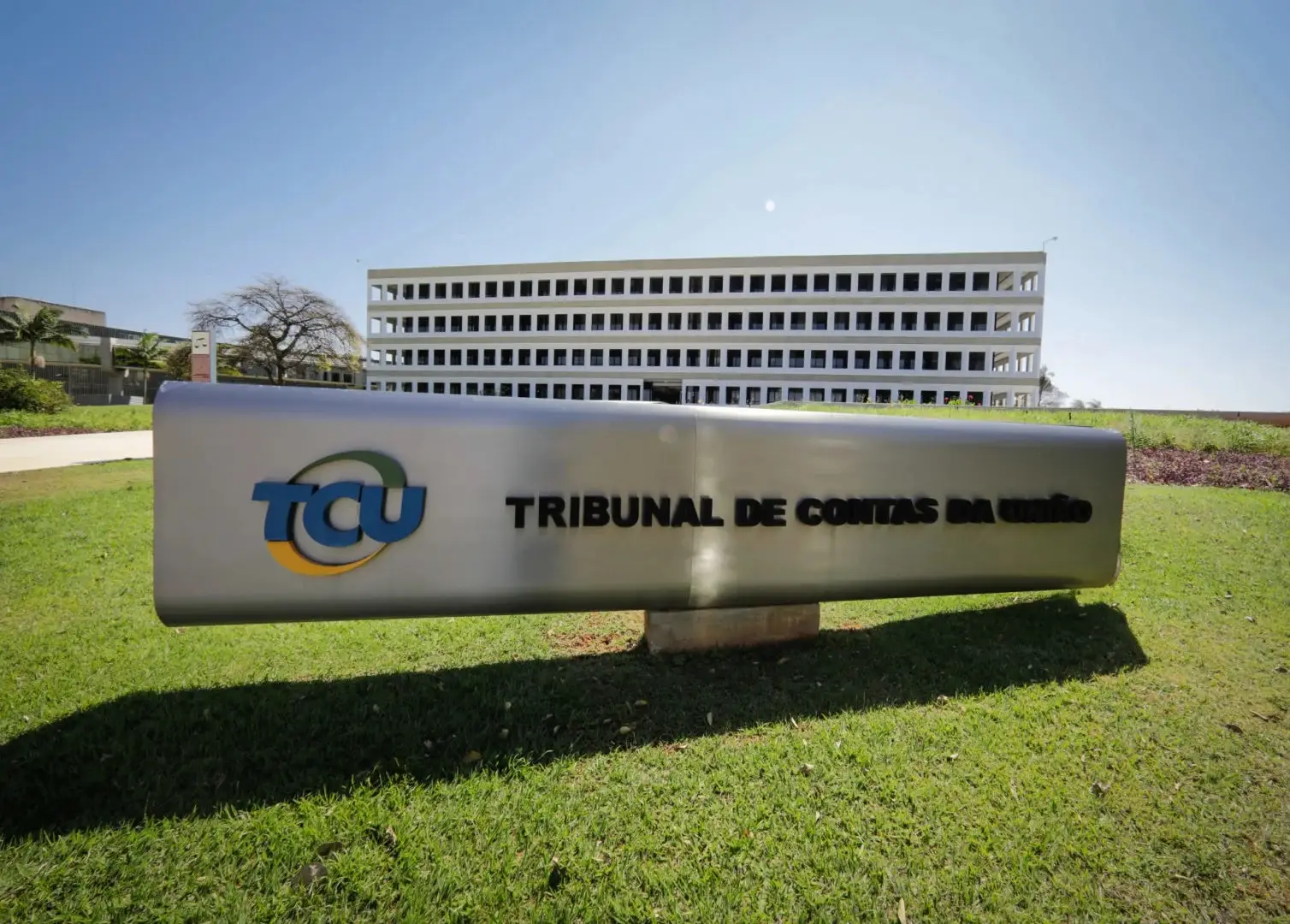
The Brazilian iGaming and sports betting landscape is undergoing rapid transformation, marked by tighter advertising restrictions, strict federal auditing mandates, and an industry-wide push for robust compliance framework integration.
This report synthesizes three major developments shaping the market today: a landmark judicial restriction on state-sponsored holiday advertising, a definitive federal mandate from the Federal Court of Accounts (TCU) to combat money laundering, and the industry’s proactive response to corporate governance.
Court restricts betting ads at state-sponsored “Festas Juninas” in Bahia
A judicial ruling has imposed significant boundaries on sports betting advertisements during the traditional Festas Juninas (Midsummer festivals) sponsored by the State Government of Bahia.
The 6th Court of Public Finance of Salvador granted a 48-hour deadline for the state government to rectify all public notices, agreements, and artistic contracts linked to the celebrations, which have an estimated public budget of R$ 146 million.
Under the new terms, betting brand displays are strictly limited to post-10:00 PM time slots, and any advertising during children’s or family-oriented programming is entirely prohibited.
Furthermore, the court has explicitly banned flyer distribution, direct public approaches, promotional giveaways, and active merchandising by hired artists or bands.
To ensure public safety, event organizers are now required to display mental health alerts and warnings regarding gambling addiction risks directly on the stages’ electronic screens.
The ruling emphasized that while private fundraising is legitimate, it must operate within ethical and public health boundaries to avoid aggressive commercial targeting of vulnerable demographics.
Municipalities failing to comply face the withholding of state funds, and the state government itself remains subject to a daily fine of R$ 50,000 for non-compliance.
Federal Court of Accounts (TCU) mandates permanent anti-money laundering framework
In a unanimous plenary session, the Federal Court of Accounts (TCU) approved Ruling No. 1296/2026, issuing crucial recommendations to enhance Anti-Money Laundering (AML) and Counter-Terrorist Financing (CTF) controls within virtual betting platforms.
The ruling was officially published in the Diário Oficial da União (Federal Official Gazette) following an operational audit conducted by the Specialized Audit Unit for National Defense and Public Security.
The TCU directed the Secretariat of Prizes and Betting of the Ministry of Finance (SPA/MF) to establish a permanent inter-institutional coordination mechanism to detect, block, and sanction unauthorized operators.
This permanent structure will integrate key government bodies, including the National Telecommunications Agency (Anatel), the Central Bank of Brazil, the Council for Financial Activities Control (COAF), the Federal Revenue Service, and criminal prosecution bodies.
This mechanism will utilize formalized protocols to standardize information sharing and establish clear agency responsibilities.
The mandate emphasizes the expanded use of automated solutions to identify suspicious digital domains and applications.
By gradually integrating relevant data modules, including the Betting Management System (SIGAP), the government aims to drastically reduce the timeframe between detecting an illegal operation and enforcing technological and financial blocks.
Furthermore, the Central Bank and SPA/MF will strengthen the sanctioning regime for financial and payment institutions that repeatedly facilitate transactions for unauthorized bookmakers.

BiS Brasília highlights financial integrity and compliance
Amidst escalating regulatory oversight, the industry is proactively organizing forums to address compliance.
The upcoming BiS Brasília conference has reinforced its commitment to transparent market growth by hosting a high-level panel titled “Follow the Money: Integrity, Governance, and Prevention of Money Laundering,” which addresses financial traceability, Corporate Governance, and payment processing security.
The panel brings together crucial public and private stakeholders, including Ricardo Saadi, President of COAF, Lucas Gualtieri, Federal Prosecutor from the Federal Public Ministry, and Ana Helena Pamplona, Legal Director of the Brazilian Gaming Association (ABRAJOGO).
According to Alessandro Valente, co-founder of the event, establishing this direct dialogue between state regulatory bodies and private associations is essential for building a sustainable, safe, and fully compliant business ecosystem in Brazil.

Regional footprint: Esportes da Sorte sponsors São João de Maracanaú
While regulatory frameworks tighten, licensed operators continue to utilize strategic cultural sponsorships to cement market presence.
Esportes da Sorte, a major national brand operating under a license granted by the Ministry of Finance (SPA/MF), has confirmed its official sponsorship of the São João de Maracanaú in Ceará for the second consecutive year.
The event, which attracts an average of 160,000 visitors per day, serves as a cornerstone of the group’s regional engagement.
The operator is deploying immersive interactive spaces that blend traditional cultural elements with sports-themed activations, expanding its footprint across a circuit of twelve major Brazilian cities during June.
The company, certified as a Great Place to Work, balances these massive cultural investments with corporate social responsibility initiatives, including carbon offset projects and partnerships focused on responsible gambling alongside international monitoring entities like IBIA and Sportradar.
The post Brazil betting regulation: new advertising restrictions & AML rules appeared first on Americas iGaming & Sports Betting News.
The Brazilian iGaming, online gaming, and fixed-odds sports betting ecosystem is navigating a critical phase where fiscal data and social impact studies are actively reshaping the federal political discourse.
As the National Congress intensifies its oversight over the noticeable discrepancies between central bank spending estimates and actual federal tax collection, regulatory authorities are preparing for the return of major institutional industry forums to the nation’s capital.
Concurrently, delicate constitutional battles over unilateral regional advertising restrictions are heading directly to the Supreme Federal Court, testing the limits of state versus federal sovereignty.
At the same time, the executive branch is rolling out exhaustive, inter-institutional playbooks to safeguard the structural integrity of professional sports from the persistent threat of cross-border match-fixing syndicates.
Congress disputes R$ 9b tax revenue data
The Chamber of Deputies’ Finance and Taxation Commission officially convened an extraordinary public hearing in Plenary 4 to evaluate the highly debated relationship between federal tax collection on online sports betting houses and its broader socio-economic impacts on Brazilian society.
The high-level parliamentary meeting was formally scheduled following joint procedural requests submitted by Deputy Paulo Guedes and Deputy Marussa Boldrim (Republicanos-GO).
Both parliamentarians sought to clarify escalating concerns regarding structural failures in the calculation, collection, and ultimate public distribution of tax resources derived from the digital gambling sector.
The hearing served as a major confrontational stage for divergent data points, bringing together key representatives from the Federal Revenue Office (Receita Federal), the National Confederation of Commerce (CNC), and the private operators’ sector represented by the Brazilian Gaming and Lottery Association (Abrajogo).
The speakers presented deeply contrasting narratives regarding overall industry taxation, the true nature of household indebtedness, and the real corporate turnover of licensed platforms, highlighting a profound communication gap between macroeconomic monitors and industry realities.
Federal revenue reports 2025 performance
Gustavo Andrade Manrique, the Subsecretary of Collection, Registry, and Customer Service at the Receita Federal, attended as the official representative of the Ministry of Finance.
Manrique provided extensive institutional context regarding the historical and regulatory trajectory of fixed-odds betting in Brazil.
He reminded the commission that while the modality was technically created by Law 13.756 back in 2018 under a previous administration, it remained in a regulatory limbo for years.
It was only fully operationalized through the comprehensive legislative updates passed between 2023 and 2024, following the enactment of Medida Provisória 1.182 and its subsequent conversion into statutory law.
This paved the way for the Secretariat of Prizes and Betting (SPA-MF) to issue formal authorizations for compliant corporate entities.
“During the 2025 calendar year, the very first full fiscal year of structured federal operations, we recorded a definitive tax collection of R$ 9 billion stemming directly from compliant companies authorized by the Secretariat of Prizes and Betting,” Manrique officially informed the panel of deputies.
“Furthermore, looking at the current 2026 fiscal year, the total amount collected by the federal treasury up until the end of April stands at R$ 3.1 billion.”
The subsecretary emphasized that according to current statutory guidelines, these massive funds are strictly earmarked for vital public sectors, including national public health initiatives, tourism infrastructure development, and federal public security forces.
Turning to enforcement metrics, Manrique revealed that the Receita Federal executed a highly targeted, data-driven audit operation during the second half of 2025.
By cross-referencing bank transaction records with declared revenue reports, the tax authority successfully identified 22 authorized corporate operators that had failed to remit their exact due taxes.
This localized evasion resulted in an accumulated tax debt of R$ 111 million.
Manrique confirmed that following the formal issuance of administrative compliance notices, all 22 operators fully regularized their standing with the treasury, avoiding severe license suspensions.
He reiterated that the Fisco maintains continuous, real-time monitoring mechanisms to bring underground operators into the legal fold, primarily to mitigate the severe risks of transnational financial crimes such as money laundering and terrorist financing.
Despite praising the compliance rates of licensed operators, Manrique voiced sharp structural criticisms regarding how the individual Income Tax (Imposto de Renda) is currently levied on player prizes.
The Ministry of Finance had originally proposed a dynamic where the 15% withholding tax would be deducted automatically at the exact moment a player requests a payout.
However, the National Congress ultimately altered this framework during the legislative debates, mandating that the tax be calculated and declared on an annual basis.
The subsecretary argued that because the annual progressive tax table sets an exemption threshold of approximately R$ 30,000 per year, only an incredibly small percentage of recreational bettors ever hit that taxable tier within a 12-month window.
This legislative compromise, he argued, drastically diminishes the effective fiscal collection of the state, missing out on massive potential revenue from the 97% of total funds that flow back into player wallets as prizes.
CNC links bets to severe default rates
Fábio Bentes, the Chief Economist of the National Confederation of Commerce (CNC), countered the state’s fiscal optimism by presenting the empirical results of a highly complex econometric study conducted by the entity.
The CNC study tracked Brazilian household debt and purchasing habits over a multi-year period stretching from January 2023 to March 2026, utilizing data modeling techniques that the confederation has consistently refined since 2010.
Bentes noted that the rapid growth of online betting is an international technological phenomenon facilitated by smartphone penetration, and is by no means isolated to Brazil.
To isolate the specific, unvarnished impact of digital betting on the average family budget, the CNC utilized anonymized tracking data published by the Central Bank of Brazil (Banco Central), which indicated an explosive growth of approximately 500% in digital gambling transfers over the past three years.
The econometric model applied rigid control variables, including regional labor market strength, standard consumer credit expansion, and baseline inflation indexes, to ensure that general macroeconomic shifts were not incorrectly attributed to iGaming platforms.
The final analysis did not conclude that the broad, generalized increase in the overall number of indebted Brazilian citizens was driven exclusively by online betting.
However, the econometric model did isolate a highly severe, statistically undeniable correlation when looking specifically at the metric of “severe default” (inadimplência severa), which Bentes defined as the desperate condition where a household has completely lost the financial capacity to honor its outstanding systemic debts.
“When we drill down into the specific parameters of severe default, we can confidently state that a direct causal effect exists,” Bentes explained to the commission.
“According to our mathematical projections, for every 10% increase in a household’s financial expenditure on online betting platforms, there is a corresponding increase of 0.12 percentage points in severe default rates.”
The study also identified a significant operational drag on general credit timelines.
For every 10% growth in gambling-related digital transfers, the average amount of time a consumer delays the payment of standard household bills increases by nearly half a day (0.45 days).
The CNC estimates that this shifting allocation of capital directly starved the traditional Brazilian retail and commerce sector of R$ 4 billion in consumer spending over the analyzed period, which Bentes contextualized as being equivalent to “losing two complete Christmas shopping seasons for the retail sector.”
Crucially, the data proved that these negative socio-economic effects are profoundly more intense among lower-income households and younger demographics, who routinely risk critical subsistence capital on high-volatility digital games.
In light of these findings, the CNC manifested a strong, formal institutional position favoring the immediate legal exploitation of traditional, land-based gaming options, such as physical brick-and-mortar casinos, integrated resorts, and physical bingo halls, while simultaneously urging the federal government to exercise extreme caution regarding the digital betting environment.
Bentes argued that physical establishments are naturally tied to massive local job creation, require heavy infrastructural real estate investments, and allow for immediate, highly transparent physical oversight and auditing by state authorities.
Digital platforms, by contrast, operate with minimal local physical footprints and represent far more elusive targets for social and financial monitoring.

Industry contests central bank estimates
The private sector pushed back aggressively against the assumptions of the politicians and the retail sector.
Witoldo Hendrich, the President of the Brazilian Gaming and Lottery Association (Abrajogo), joined the parliamentary debate via a live videoconference link due to sudden health issues, while Ana Bárbara, the association’s Director of Government Relations, managed the technical defense directly from the plenary floor.
Hendrich criticized what he described as a severe, persistent “communication problem” between the iGaming industry, the general public, and the federal public powers, which routinely leads to flawed legislative proposals.
The president of Abrajogo launched a direct methodological critique against the consumer spending research presented by the CNC and frequently cited by politicians.
He argued that external econometricians routinely fail to understand the core mathematical design of the gaming industry, mistakenly treating total transaction turnover (volume de apostas) as if it were a standard, irreversible consumer expenditure like purchasing a commercial product or subscribing to a digital streaming service.
“Out of every R$ 100 that a player places into a regulated betting system, approximately R$ 96 to R$ 97 is immediately returned to the player base in the form of prizes,” Hendrich stated emphatically.
“Therefore, gross transaction volume is a fundamentally flawed parameter for measuring the financial drain on our society.
This metric works perfectly for analyzing expenditures on a PlayStation or a Netflix subscription, but it is completely deceptive for bets. Our industry does not simply absorb capital; it provides entertainment while continuously returning the vast majority of that capital back to the consumer.”
Hendrich further dropped a significant market estimate, asserting that despite the implementation of federal licensing, the regulated market in Brazil currently represents only about 50% of the true national volume.
The remaining half of the market, he warned, continues to operate entirely in the shadows of illegality, run by unauthorized offshore networks.
The Abrajogo representative cautioned that the R$ 3.1 billion collected by the government in early 2026 represents “only a fraction” of the true fiscal contribution of the sector, as it completely omits the massive corporate income taxes, payroll taxes, and service taxes paid by localized technology providers, marketing agencies, and platform developers that form the wider industry supply chain.
Hendrich revealed to the deputies that in his private consultancy practice, he currently advises far more international gaming companies that chose not to enter the Brazilian regulated market than companies that did.
He explained that a total lack of regulatory predictability, coupled with constant threats from congressmen to retroactively alter the tax framework, is actively scaring away major tier-one global operators.
The president of Abrajogo defended that the only viable path to expanding the state’s fiscal collection is not to raise existing tax rates, but rather to make life easier for the licensed operator.
This strategy would naturally draw consumers away from clandestine channels. Unregulated websites, he noted, host their operations in distant offshore tax havens and process all financial transactions via un-trackable cryptocurrencies, leaving them entirely outside the reach of the Federal Police or the Receita Federal.
Hendrich urged the commission to protect regulatory stability, noting that the industry’s high Return to Player (RTP) rates are a sign of a healthy, highly competitive legal market that stabilizes consumer entertainment.
Abrajogo details structural taxation framework
Following a series of highly tense exchanges where several parliamentarians openly admitted to being completely confused by the overlapping financial percentages, Ana Bárbara requested the floor to provide an official, step-by-step mathematical breakdown of the industry’s balance sheets.
Deputy Paulo Guedes had explicitly noted that he could not comprehend how an industry generating such massive digital transaction volumes could report such tight corporate margins.
“With your permission, I will explain exactly how the internal financial mechanics operate. Let us start with a basic baseline of R$ 100,” Ana Bárbara explained directly to the plenary.
She detailed that the average competitive Return to Player (RTP) maintained by authorized brands in Brazil sits at 97%. While the official ordinances published by the Secretariat of Prizes and Betting technically permit a minimum RTP of 85%, the fierce commercial competition in the country forces platforms to maintain the 97% tier to retain their user base.
“This means that out of an initial R$ 100 pool, R$ 97 automatically flows right back to the citizens as prize payouts.
This is the exact data point that the government’s systems track, and it is precisely why the Receita Federal mistakenly argues that this R$ 97 pool should be subjected to an aggressive 15% instant withholding tax,” she clarified.
Consequently, the real gross margin available to the betting operator—known globally as the Gross Gaming Revenue (GGR)—is restricted to just 3% of the total volume handled.
Ana Bárbara then detailed how the state heavily taxes this remaining 3% slice:
-
Specific betting tax: A mandatory 15% tax directly levied on the GGR under Law 13.756, which features strict social destitutions for education and security. No other commercial sector in Brazil pays this tax.
-
Standard corporate levies: The GGR is then subjected to the standard corporate tax matrix, including the Social Integration Program (PIS), the Contribution for the Financing of Social Security (Cofins), the Social Contribution on Net Income (CSLL), and the Corporate Income Tax (IRPJ).
“While the vast majority of traditional Brazilian corporate sectors face an effective tax burden ranging between 18% and 20%, regulated betting operators are currently paying approximately 32% of everything they actually earn,” Ana Bárbara detailed.
“In simple terms, one-third of the operator’s real revenue goes straight into the government’s coffers.”
To solidify her defense, the director stated that the real, consolidated corporate turnover (faturamento real) for all regulated bets in Brazil throughout 2025 was R$ 36 billion.
Out of that exact corporate revenue pool, R$ 9 billion was paid directly to the federal government in taxes.
The R$ 9 billion figure reported by the Receita Federal did not represent a small fraction of a multi-hundred-billion-dollar pool; it represented nearly one-third of the industry’s total real gross income.
Ana Bárbara added that on top of this federal 32% burden, operators must also pay between 2% and 4% in municipal Service Taxes (ISS) depending on the city where their operational headquarters are physically registered.

Lawmakers question socio-economic costs
Despite the detailed financial accounting, the political resistance within the commission remained intense.
Deputy Merlong Solano directed a series of sharp questions to the panel regarding the ultimate balance between state tax collection and systemic social costs.
Solano questioned whether the R$ 9 billion collected could ever truly compensate the state for the looming public health crisis driven by gambling addiction (ludopatia), escalating clinical anxiety, and severe depression among citizens.
He specifically demanded that the Ministry of Health provide immediate projections regarding the added financial pressure these mental health conditions will exert on the Unified Health System (SUS).
Furthermore, Solano questioned the industry’s economic utility, noting that because online betting is an heavily automated, digital sector, it creates an incredibly low number of direct local jobs compared to traditional brick-and-mortar commerce.
Deputy Luiz Carlos Hauly followed with a fierce, unconditional ideological attack against the digital gaming industry.
Hauly characterized the sudden expansion of betting platforms as a “plague and a tragedy that has collapsed upon the Brazilian family structure.”
He argued that the high velocity and instant feedback loops of online slots and digital sports books are uniquely destructive compared to old-school federal lotteries.
Hauly announced to the plenary that he has officially drafted and filed a comprehensive legislative project designed to entirely repeal the existing regulatory framework and completely ban all forms of online sports betting nationwide.
“The Brazilian state, acting with the clear connivance of this parliament, has utterly failed in its constitutional duty to protect the basic financial and psychological safety of its citizens,” Hauly declared.
Deputy Mauro Benevides took a more administrative stance, demanding that the Central Bank and the Ministry of Finance cease utilizing speculative private market estimates and immediately provide formal, audited, and consolidated data regarding the industry’s real 2025 performance.
Benevides also raised practical concerns regarding how the banking system will technically operationalize the federal ban preventing citizens registered in debt relief programs like “Desenrola Brasil” from placing digital wagers.
The deputy suggested that the restriction period should be legally extended to a mandatory two-year window, ensuring that individuals attempting to reconstruct their credit health are physically blocked from diverting rehabilitation funds into high-risk platforms.
Inconsistent metrics prompt formal state inquiry
The absolute peak of political tension during the extraordinary hearing arrived when Deputy Paulo Guedes pointed out a massive mathematical contradiction between the state’s official figures and the macroeconomic data published by the Central Bank.
Guedes noted that if the Central Bank’s official consumer tracking data is correct, which states that Brazilians transfer approximately R$ 30 billion per month to betting domains, the total annual transaction volume would sit at a staggering R$ 360 billion.
The deputy argued that even if one applies the industry’s tightest margin models, a 15% statutory tax on that scale of transaction volume should easily generate a federal collection exceeding R$ 40 billion per year.
This projection stands in stark, irreconcilable contrast to the R$ 9 billion in tax revenue reported by the Receita Federal for 2025.
“There is a profound, undeniable error in the data being presented to this parliament,” Paulo Guedes asserted.
“We demand to know exactly where this error lies: is the Central Bank overestimating consumer transfers, is the Ministry of Finance underreporting figures, or are we facing a massive, systemic tax evasion scheme run by operators?”
Guedes referenced an investigative journalism report published by The Intercept Brasil, which claimed that due to a total lack of specialized state auditing tools, betting platforms are routinely manipulating the calculation of their Gross Gaming Revenue (GGR), underreporting their real earnings to avoid paying their full fiscal dues.
Faced with this deep statistical divide and a persistent lack of clarity, the members of the Finance and Taxation Commission voted unanimously to protocol a formal, legally binding Request for Information (Requerimento de Informação) addressed directly to the Minister of Finance, the leadership of the Secretariat of Prizes and Betting, and the Governor of the Central Bank.
The document demands the immediate submission of unified, audited financial data sets.
The commission confirmed that a second public hearing will be scheduled as soon as the official government data is received to continue the cross-examination.
“We will return to this debate very soon, bringing all stakeholders back to this room, to ensure the absolute transparency that Brazilian society deserves,” the president of the commission concluded.

BiS Brasília 2026 confirmed for June
While the intense political debate unfolds within the walls of Congress, the strategic corporate planning for the industry continues to accelerate.
The executive committee behind the Brazilian iGaming Summit (BiS) has officially confirmed that the second edition of BiS Brasília will take place on June 2 and 3, 2026.
The high-level business forum has selected the premium convention spaces of the Royal Tulip Brasília Alvorada as its official venue, aiming to position the nation’s capital as the central geographic hub for technical dialogues between the private sector and federal regulators.
The 2026 program has been tightly structured to address the immediate corporate challenges of the newly regulated market, shifting away from general marketing topics to focus deeply on operational resilience, anti-money laundering (AML) compliance, data privacy, and government relations.
The gathering is designed to facilitate direct networking between licensed operators, global B2B technology providers, legal experts, and state lottery directors who are currently shaping regional frameworks.
The academic agenda features a series of highly specialized panels designed to address the exact regulatory anxieties currently being debated in Congress:
-
International cooperation and strategic bridges: Led by international regulatory specialist John Aquilina, this session will analyze real-world case studies from mature European jurisdictions.
The debate will focus on how Brazil can build institutional relationships with overseas regulators to track illicit financial flows and enforce responsible gaming compliance across international borders.
-
The profile of the Brazilian bettor: Presented by prominent market analyst Thiago Iusim, this data-driven session will dissect localized consumer behavior trends from the first half of 2026.
The analysis will contrast behavioral data from the legal market against underground metrics, focusing heavily on how operators can deploy automated player protection mechanisms without harming user retention.
BiS Brasília operates as a core component of the prestigious corporate portfolio of the SiGMA Group, one of the world’s absolute leaders in B2B events and business platforms for the gaming, lottery, and digital entertainment sectors.
ANJL challenges Rio Grande do Sul ad ban
The legal friction between regional state initiatives and central federal authority has reached a critical flashpoint.
The National Association of Games and Lotteries (ANJL) has officially filed a high-profile Direct Action of Unconstitutionality (Ação Direta de Inconstitucionalidade – ADI 7971) before the Supreme Federal Court (STF), challenging a highly restrictive regional law enacted by the state government of Rio Grande do Sul.
The lawsuit was formally processed and forwarded to the office of Supreme Court Justice Cármen Lúcia for immediate analysis.
The core of the legal battle is state Law 16.508/2026, which was sanctioned by the Rio Grande do Sul executive on April 24, 2026.
The local statute seeks to impose severe unilateral restrictions on the operations of digital gaming companies within state lines.
Specifically, the provincial law mandates that all betting platforms include massive, highly graphic health warnings regarding gambling addiction and severe financial ruin on all marketing materials.
Furthermore, the law introduces an absolute ban prohibiting betting brands from sponsoring any local sporting or cultural events within the state’s territory.
Most damaging to media networks, the state law implements a complete broadcasting ban on all sports betting commercials across traditional television, radio, live streaming, and video-on-demand platforms between the hours of 6:00 AM and 9:00 PM.
Non-compliant corporations face heavy localized administrative fines, asset seizures, and immediate digital domain blocking within state borders.
The constitutional defense of federal supremacy
In the formal petition submitted to the Supreme Court, signed by senior constitutional lawyers Pietro Cardia Lorenzoni and Bernardo Cavalcanti Freire, the ANJL argues that the state government of Rio Grande do Sul has committed a blatant violation of the federal constitution by overstepping its legislative boundaries.
The association maintains that under the constitutional architecture of Brazil, fixed-odds betting has already been fully codified as a legitimate national lottery modality under strict federal regulation.
Consequently, individual states possess the administrative power to operate their own local lotteries, but they have absolutely no constitutional authority to legislate on general commercial advertising or national economic sectors.
The ANJL’s legal counsel points out that the local law directly violates multiple sections of Article 22 of the Federal Constitution, which explicitly dictates that the Federal Union holds the absolute, exclusive competence to legislate on civil law, commercial law, propaganda, and national telecommunications policies.
Furthermore, the association argues that the law breaches Articles 170 and 174, which protect the principles of free enterprise, free competition, and a unified national economic order.
The association has requested that Justice Cármen Lúcia immediately grant an urgent preliminary injunction (medida cautelar) to fully suspend the operational effects of Law 16.508/2026 until the plenary of the Supreme Court can deliver a final merit ruling.
The ANJL argues that allowing individual states to unilaterally fracture the national marketing landscape creates extreme legal insecurity for operators that paid R$ 30 million for federal licenses.
The association concludes that if these chaotic regional bans are allowed to stand, consumers will find it impossible to differentiate between legal, federally monitored websites and dangerous offshore black-market domains, ultimately causing a severe increase in unregulated gambling.
Ministry of Sport issues match-fixing manual
In a decisive move to protect the core sporting asset that drives the entire legal betting economy, the Ministry of Sport has officially published and distributed its first comprehensive Manual for the Prevention and Combate of Sports Match-Fixing.
The highly technical publication was developed by the National Secretariat of Sports Betting and Economic Development of Sport, functioning as a unified operational playbook for sports federations, athletic clubs, law enforcement bodies, and compliance teams.
The manual is the direct operational output of the Inter-institutional Working Group, a specialized task force created by the presidency to link the investigative efforts of the Ministry of Sport, the Ministry of Justice and Public Security, and the Ministry of Finance, alongside direct intelligence feeds from global integrity networks.
The document features an accessible yet deeply technical language, breaking down the complex modern methodologies used by international criminal syndicates to manipulate matches.
The core sections of the federal manual detail:
-
Fraud Typologies: Identifying specific, high-risk micro-events within matches—such as intentional yellow cards, specific numbers of corner kicks, or spot-fixing in lower-tier regional leagues—that are highly vulnerable to manipulation.
-
Suspicious Pattern Analysis: Providing compliance officers with algorithmic metrics to instantly differentiate between organic, high-volume fan betting and highly anomalous, coordinated odd movements driven by syndicates.
-
Traceability and Whistleblowing: Outlining the mandatory legal responsibilities of sports clubs and operators to maintain immutable digital trails, deploy automated monitoring software, and route alerts through centralized federal whistleblowing channels.
Minister of Sport Paulo Henrique Cordeiro stated during the launch ceremony that combating match-fixing requires a permanent, highly integrated preventative posture from all commercial and state actors.
He emphasized that the manual is an essential tool to guarantee that the rapidly growing Brazilian betting ecosystem operates under the strict pillars of transparency, protecting both athletic credibility and the safety of the wider society.
National Sports Betting Secretary Giovanni Rocco added that the publication marks a permanent milestone in the consolidation of public compliance policies, ensuring that Brazil’s regulated market aligns perfectly with the highest international standards of sports integrity.
The post Brazil betting under legislative friction and changing regulations appeared first on Americas iGaming & Sports Betting News.

-

 Australia7 days ago
Former Star Entertainment Executives Mathias Bekier and Paula Martin Disqualified and Ordered to Pay Penalties
-
Alejandra Burato7 days ago
Record Attendance, Exciting New Releases, and a Resounding Success: This was Zitro Experience Peru
-
Amusnet7 days ago
Weekend Reels | Week 25: Slot Drops & Trends
-
ArenaPlus7 days ago
DigiPlus Wins “Digital Operator of the Year” Award at 2026 Global Gaming Awards Asia-Pacific
-
Anthony Dalla-Giacoma7 days ago
Elysium Studios Releases its Latest Slot Game “Hood and Loot”
-
Greece7 days ago
SYNOT Games Announces New Partnership with Superbet
-
Bragg Gaming Group4 days ago
Massive Gaming launches Blitzcrown titles on Superbet Brazil via Bragg Hub
-
Compliance4 days ago
HIPTHER Launches HALLO: The Standard in Compliance Expertise