2026 World Cup
The Clash of Growth, Politics, and Oversight in Brazil

Brazil’s betting and online gaming market entered the final week of April 2026 under unprecedented pressure, as federal authorities intensified enforcement against illegal operators while political forces in Congress pushed for stricter restrictions on the sector.
At the same time, record advertising investments and monthly traffic surpassing one billion visits highlight the industry’s rapid expansion ahead of the 2026 World Cup, creating a sharp contrast between economic momentum and growing concerns over household debt.
Offensive Against Prediction Markets – Coordinated Blocking and Anatel’s Action
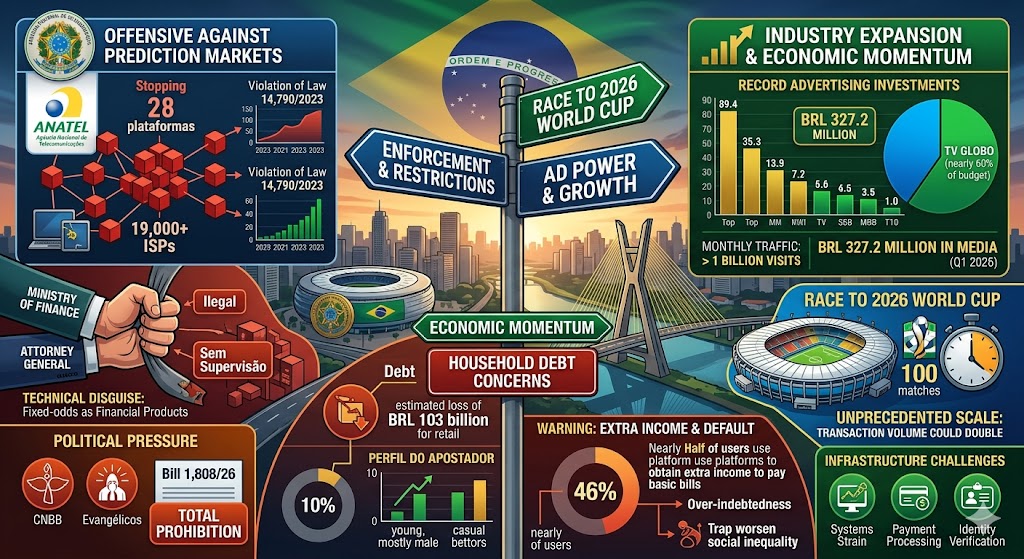
The Brazilian Federal Government, in a joint action of unprecedented scale, launched this week a rigorous operation to halt the activities of 28 platforms specialized in prediction markets.
The technical execution was assigned to the National Telecommunications Agency, Anatel, which mobilized a network of more than 19,000 internet service providers to ensure the immediate enforcement of the judicial and administrative order.
This measure is based on the direct violation of Law No. 14,790/2023, which establishes strict criteria for the operation of betting activities in national territory.
The offensive was not limited to the technical blocking of domains, but also involved strategic coordination between the Ministry of Finance, the National Consumer Secretariat, and the Attorney General’s Office of the National Treasury, aiming to suffocate the supply of modalities operating outside legality and without any form of state supervision.
Consumer Risks and Financial Disguise
The technical reasoning presented by Deputy Finance Minister Dario Durigan points out that these prediction markets operate as a form of fixed-odds betting disguised under the aesthetics of modern financial products.
However, such operations lack the economic backing and supervision required by regulatory bodies such as the National Monetary Council and the Securities and Exchange Commission of Brazil (CVM).
The illegality lies in the fact that current legislation allows exclusively betting on real sports events or certified online games, making any wager on weather conditions or private-life events involving celebrities an illegal practice.
Government concern focuses on protecting household income, since these platforms operate without safeguard mechanisms such as centralized self-exclusion, exposing citizens to compulsive behavior and abusive commercial practices disguised as profitable investment.
Political Pressure and the Religious Caucus
In the National Congress, the debate over the future of online betting gained new contours with the movement led by Congressman Pedro Uczai, PT leader in the Chamber.
The lawmaker began a round of strategic talks with the National Conference of Bishops of Brazil (CNBB) and several evangelical leaders to gather support for Bill 1,808/26, which seeks the total prohibition of virtual betting activities in the country.
This strategy of rapprochement with religious sectors seeks to create a broad front capable of pressuring the legislature in a sensitive election year, exploring the convergence of moral values and concern for social welfare.
The resistance of conservative caucuses to gambling is seen as a political asset that may fragment right-wing coalitions and accelerate severe restrictions on the iGaming sector.
Socioeconomic Impact and Retail Losses
The central justification for prohibition lies in the collateral damage that the rapid spread of betting has caused to the domestic economy.
Uczai uses alarming data from studies by the National Confederation of Commerce to illustrate how the redirection of popular income toward betting platforms resulted in an estimated loss of BRL 103 billion for Brazilian retail in 2024 alone.
The phenomenon is described as a factor of systemic indebtedness, in which capital that previously circulated in local commerce and the purchase of essential goods is now drained by betting algorithms.
This diagnosis has echoed in President Lula’s speeches, as he has publicly expressed the need for much stricter regulation to prevent the gaming market from destroying family wealth and the financial stability of the most vulnerable groups in Brazilian society.
PT National Congress Guidelines
During the 8th National Congress of the Workers’ Party, the party consolidated its stance toward the sector through what it called the “BBB Taxation”, an acronym for Banks, Bets and Billionaires.
This communication motto serves as a pillar for the 2026 re-election campaign guidelines, seeking to contrast the government’s agenda with that of the opposition and improve reception among religious and middle-class voters.
The idea is that the betting sector, due to its highly profitable nature and relevant social impact, should contribute disproportionately to the financing of social rights.
The manifesto approved by the party, although moderate in tone toward legal institutions, is categorical in placing the taxation of betting as a decisive structural reform for the future of the country’s democratic-popular project.
Selective Tax and Ban on Predatory Games
Beyond revenue collection, the approved government program defends a combative position against specific betting modalities.
The document establishes the commitment to ban games considered predatory and without a basis of skill, such as the popularly known “Fortune Tiger game,” which has been pointed out as a cause of family disruption throughout Brazil.
For activities that remain regulated, the proposal foresees the incidence of a Selective Tax with rates significantly higher than those applied to tobacco and alcohol, functioning as a fiscal mechanism to discourage consumption.
The goal is that the resources arising from this high tax burden be linked exclusively to the Unified Health System (SUS) and the Unified Social Assistance System (SUAS), aiming to mitigate mental health problems and psychological suffering associated with the uncontrolled spread of virtual gaming.
The Hegemony of Free-to-Air TV in the Sector
The betting market in Brazil has reached a stage of advertising maturity in which investment volume reflects its importance to the revenues of major media groups.
In the first quarter of 2026, the ten leading operators in the country injected BRL 327.2 million into media campaigns, with free-to-air television serving as the main exposure channel.
TV Globo alone captured nearly 60% of this budget, consolidating iGaming as one of the economic pillars of the national programming schedule.
This phenomenon generates heated debate about the financial dependence of media outlets on the betting sector, which could, in theory, influence journalistic coverage of the negative impacts of the activity and delay the approval of advertising restrictions in the National Congress.
Brand Intelligence and Return on Investment
Despite the high amounts invested, research by Tunad indicates that budget size does not necessarily guarantee leadership in public interest.
While brands such as Betano and Superbet top the spending list, cases of high creative efficiency are observed in companies such as bet365 and BetNacional, which manage to maintain consistent online search volumes with more optimized budgets.
On the other hand, new entrants or brands with less refined strategies show below-average returns, suggesting that the saturated market no longer accepts mere capital dumping without emotional or functional connection with bettors.
The transition from awareness stage to loyalty stage now requires operators to demonstrate responsibility and creativity in order to stand out in an environment where customer acquisition costs continue to rise.
Infrastructure Challenges for the 2026 World Cup
With the approach of the 2026 World Cup, the technology sector focused on iGaming in Latin America faces a warning sign regarding its support infrastructure.
In recent seminars promoted by leaders such as SOFTSWISS and SBC, specialists highlighted that this will be the largest World Cup in history, with more than one hundred matches and an extended competition period.
This unprecedented scale will place massive strain on betting systems, payment processing, and identity verification tools.
It is projected that transaction volume could double compared to usual market peaks, requiring operators to start investing now in distributed architectures and continuous monitoring systems to avoid outages that could destroy established brand reputations within minutes.
Quality as Insurance for Success
The dominant mindset in the Latin American market, often focused on reduced costs, is being challenged by the need for technical stability.
During major events, technology becomes the only factor capable of keeping the business operational or shutting it down instantly.
Experts recommend that integration quality and third-party service redundancy become the absolute strategic priority.
Player retention after the World Cup will depend entirely on the experience delivered during the tournament; platforms that present slowness or withdrawal failures during critical moments will hardly be able to retain their user base.
Therefore, preparation for 2026 is not seen merely as a technical adjustment, but as vital insurance for commercial survival in a highly competitive market.
Profile of the Brazilian Bettor
Recent Datafolha data sheds necessary light on who the betting user in Brazil really is, demystifying the idea that the market is composed mostly of professional tipsters.
The survey reveals that 10% of the adult population uses these tools, but the vast majority classify themselves as casual bettors, placing wagers rarely or only during major events.
Monthly traffic, surpassing the one-billion mark at 1.3 billion accesses, is driven by a young, predominantly male base with secondary-level education.
This profile indicates that gaming has become a form of digital entertainment integrated into everyday life, similar to social media or streaming consumption, but with the component of financial risk that distinguishes it from other media.
The Warning of Extra Income and Default
The most critical finding of the study is the objective behind betting. Nearly half of users admit they use platforms in an attempt to obtain extra income to pay basic bills, a mindset that exposes them directly to over-indebtedness.
The illusion that betting can serve as a financial solution for groups earning up to two minimum wages is pointed out by sociologists and economists as a trap that worsens social inequality.
In addition, the finding that part of bettors uses money intended for essential commitments to try their luck reinforces the urgency of public policies that treat iGaming not only from a tax perspective, but also as a matter of public health and economic sovereignty for Brazilian families.
The post The Clash of Growth, Politics, and Oversight in Brazil appeared first on Americas iGaming & Sports Betting News.









Activation forms part of the brand’s multi-platform World Cup strategy, which includes sponsorship of official broadcasts on SBT and activations across approximately 130 bars throughout Brazil
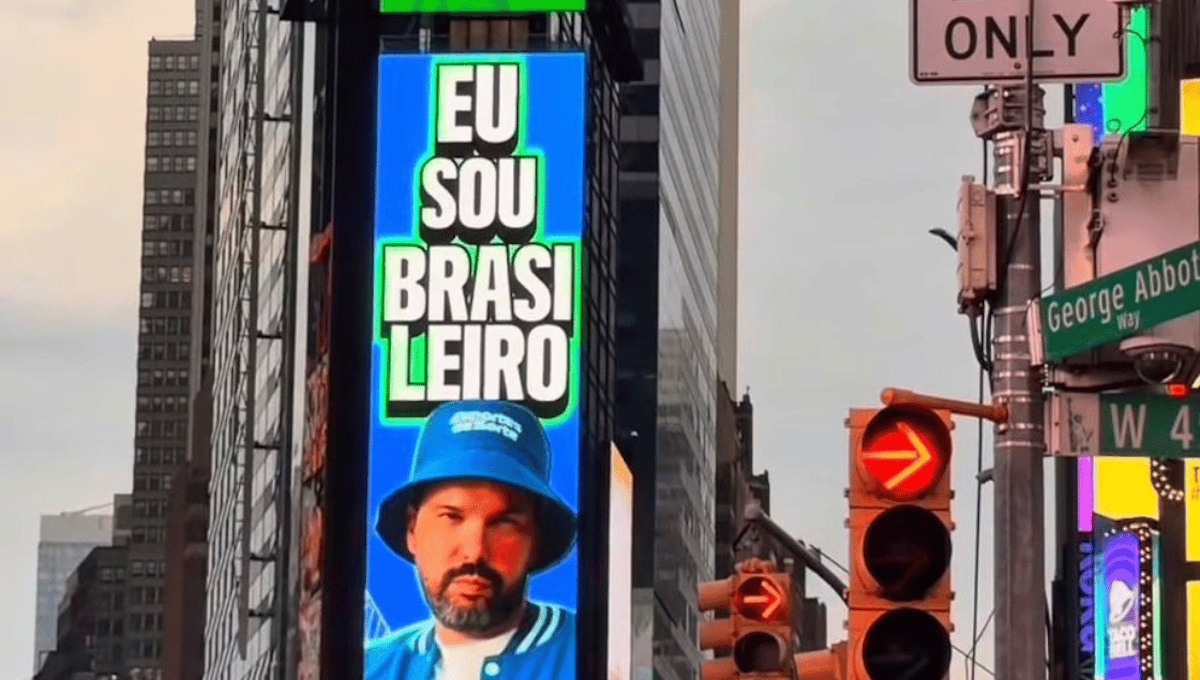
Wednesday 17th June 2026: Esportes da Sorte, Brazil’s largest fully national sports betting platform, brought the voice and energy of Brazilian football fans to the giant screens of Times Square in New York on the evenings of Saturday 13 and Sunday 14 June. Displayed in two continuous five-minute slots in the heart of Manhattan, shortly after Brazil’s opening match of the 2026 World Cup, the activation invited passers-by at one of the world’s most famous intersections to join in singing the iconic chant: “I am Brazilian, with great pride and great love”, connecting supporters directly with the host nation of the tournament.
The high-impact visual campaign featured singer Léo Santana alongside a team of brand ambassadors and influencers, including Carlinhos Maia, Bruno Formiga, Luisinho Freitas and Raul Erlich, who are providing digital coverage of the tournament directly from the United States.
The initiative placed Esportes Gaming Brasil — the group behind Esportes da Sorte, Lottu and Onabet — on one of the world’s most recognisable advertising stages during the opening weekend of the tournament. As millions of fans followed developments from the World Cup and New York celebrated the NBA championship, one of the city’s most iconic locations was illuminated in the group’s colours.
The activation forms part of a comprehensive multi-platform strategy developed by the holding company for the World Cup period, encompassing nationwide advertising campaigns, prominent presence across official broadcasts, live activations and real-time content production. The company is an official sponsor of the tournament broadcasts on SBT, with visibility across free-to-air television, the +SBT streaming platform, N Sports and digital channels.
Alongside this, the brand is leading activations across approximately 130 bars in key Brazilian cities including São Paulo, Recife, Salvador, Belo Horizonte and Fortaleza, delivering bespoke branding and integrated fan experiences in high-footfall venues. The strategy has been designed across multiple complementary touchpoints to ensure consistent visibility and strengthen connections with supporters wherever they gather to watch the action.
As Brazil’s largest 100% home-grown betting operator, Esportes da Sorte builds its brand around the passion of football fans and the moments that bring people together through a shared love of sport. More than a standalone campaign, its presence in New York was designed to create pride, connection and entertainment, bringing to life the group’s official brand positioning: “We dare you not to have fun.”
As part of its wider World Cup content ecosystem, Esportes da Sorte is also running two major national campaigns. “Cheer Like a Corinthian” explores the essence, loyalty and intensity of football fandom, while “Call-Up” combines entertainment and belief through a light-hearted and engaging narrative designed to resonate with bettors.
The post Esportes da Sorte Brings the Voice of Brazilian Fans to Times Square appeared first on Americas iGaming & Sports Betting News.
Platform pairs sportsbook simulations with a QualiBest survey on fan confidence and compares 2026 sentiment to Brazil’s 2002 campaign.
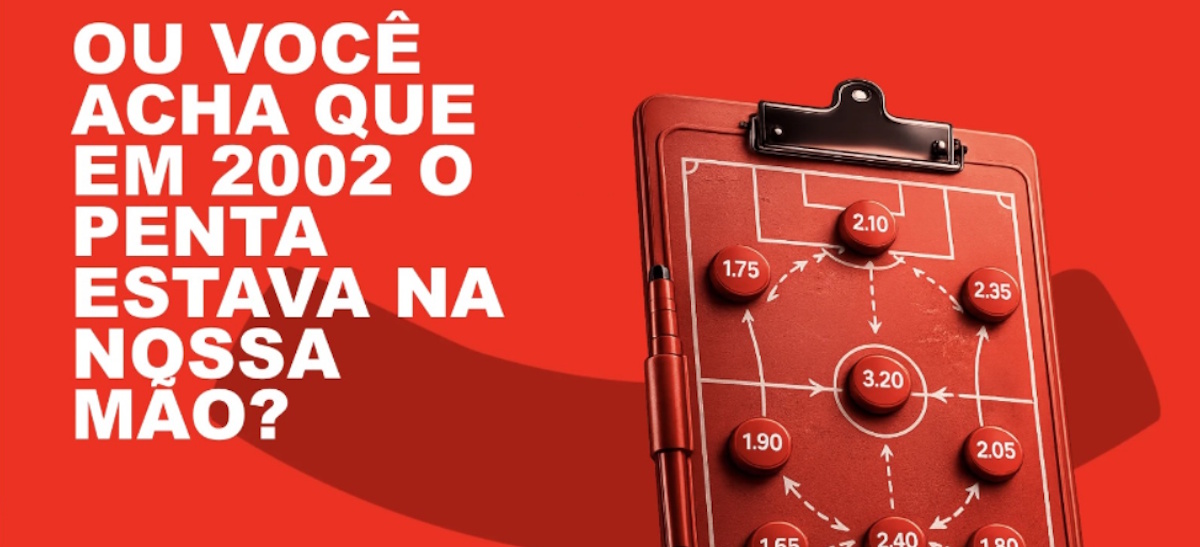
Superbet has launched “As Odds do Penta,” a data and research hub focused on Brazil’s 2026 World Cup outlook, using sportsbook-driven simulations and public opinion polling to compare the current cycle with the national team’s 2002 campaign. The initiative was announced in São Paulo in June 2026 and is hosted at termometrosuper.com.br.
According to Superbet, its sportsbook model runs predictive simulations and weighs performance metrics alongside qualitative inputs, including media coverage tone and fan engagement, to recreate historical probabilities and compare them to today’s market. “The odds in 2002 would certainly be as high as what we have now in 2026.. The scenario has several similarities: widespread distrust, a tense qualifying phase, and pressure from the press.”, said Guilherme Simantob, a statistician at Superbet.
Superbet also cited results from “Termômetro Super,” a survey commissioned from Instituto QualiBest and conducted June 4-6 with 824 internet users aged 40+ across Brazil. The company said 58% of respondents see a medium-to-high probability of a Brazil turnaround in 2026, and that 58% reported being optimistic or moderately confident based on historical parallels. The release also noted demographic splits, including higher uncertainty among women; a more negative view among Class A respondents compared to Class C; and a stronger “medium probability” view among respondents aged 61+ (44%) versus those aged 40-50 (33%).
On whether prior World Cup disappointments affect belief in a 2026 title, Superbet said 35% reported that pressure from previous defeats reduces confidence, while 22% said history shows Brazil performs strongly when expectations are low; 37% described themselves as moderately confident.
The company added that, based on its reconstruction, Brazil would have been priced at 8.50 in 2002 (which it equated to an 11% mathematical chance). For 2026, Superbet said Brazil’s title odds are around 9.50, and that the “mercado internacional” assigns the team about a 5% chance to win. Commentator Jorge Iggor, cited in the release, argued that entering without being the market favorite can reduce pressure: “Looking at the historical context and the odds themselves proves that not carrying the absolute favoritism for 2026 is a great advantage. Arriving without the weight of being the top team on the market relieves the pressure and makes the atmosphere much lighter. In 2002, the team also defied all predictions and clinical doubts about its main stars to lift the trophy.”
Superbet also highlighted what it called an experience edge in the current squad: “There is an unprecedented and favorable point for the current team. The players selected for the 2026 tournament have accumulated far more titles than the 2002 team at that time: 305 titles combined now, compared to 176 in 2002. This provides experience in big games that could be our unseen advantage.”, Simantob said. The company said the hub will update during the tournament, including additional “Termômetro” polling updates tracking changes in public confidence.
The post Superbet launches ‘As Odds do Penta’ hub tracking Brazil 2026 title odds appeared first on Americas iGaming & Sports Betting News.

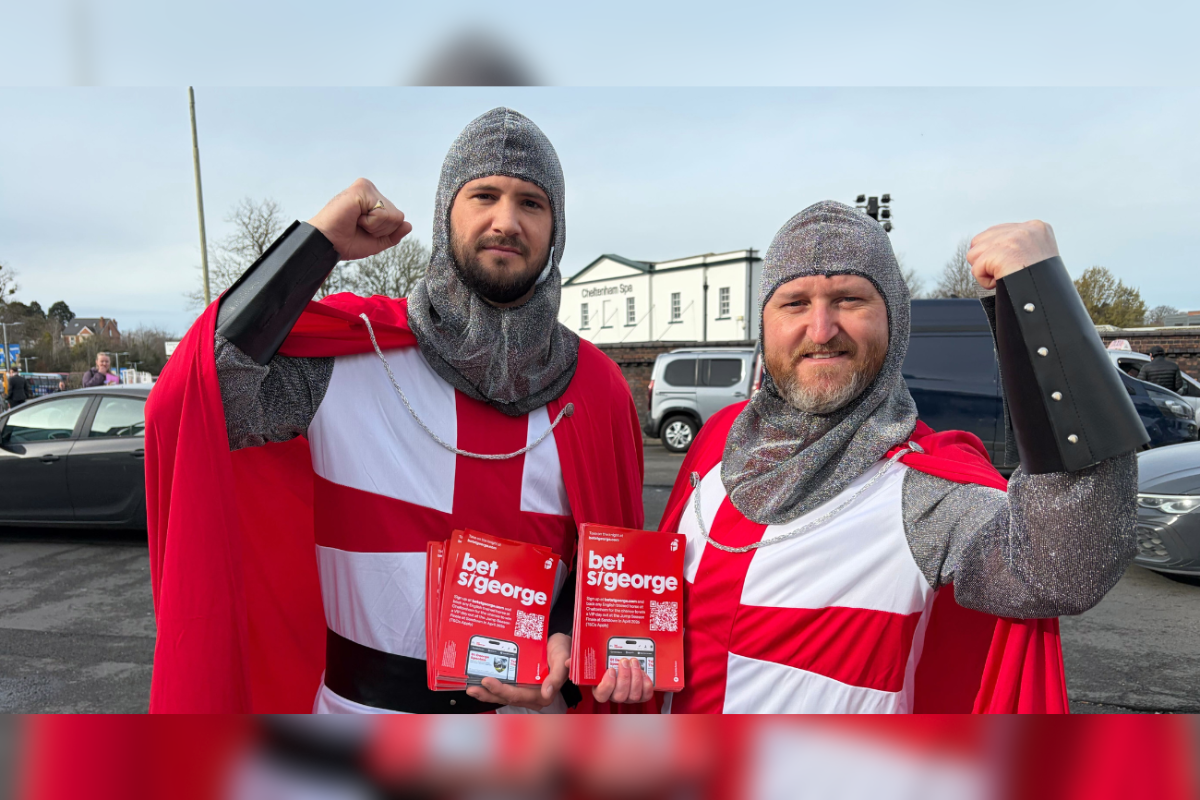
Bet St George has published new research claiming four in ten England fans expect the Three Lions to win the 2026 FIFA World Cup. The betting brand said the poll of 1,000 England sports fans was conducted between 15 and 18 May 2026, with the tournament set to start on Thursday.
In the survey, 40% of respondents said they expect England to lift the trophy in North America this summer. Optimism is highest among 25 to 34 year olds, where 67% backed England to win.
The research also points to a broader national narrative around the team. Nearly three-quarters (72%) of fans agreed that the England team brings the nation together. Separately, 26% said a World Cup win would rank among their top three most important life events, rising to 31% among men.
Regionally, Bet St George said England sports fans living in Scotland were the most confident cohort in the dataset, with 77% backing England to win and 96% agreeing the team brings the nation together. Greater London also skewed optimistic (53% backing England; 36% placing a win among their most important life events), while Yorkshire and the Humber was more cautious (31% backing England; 19% ranking a win as a top life moment).
Andre Au, Marketing Director at Bet St George, said: “England has one of the most passionate sporting audiences in the world, but for a long time, it was the only nation in the UK without a sportsbook built around its own identity.
“We created Bet St George because supporting England is different. World Cup fever hits massively once the squad is announced. For England, it is the expectation. It’s all about the previous hurt, penalty shoot-outs, the build-up, the predictions, and the debates with your mates. The whole nation feels that this tournament might finally be the one.”
The post Bet St George survey: 40% of England fans tip World Cup win appeared first on EE Gaming | Global iGaming & Tech Intelligence Hub.

-

 Bragg Gaming Group5 days ago
Massive Gaming launches Blitzcrown titles on Superbet Brazil via Bragg Hub
-
Compliance5 days ago
HIPTHER Launches HALLO: The Standard in Compliance Expertise
-
7Games5 days ago
7Games, Betão & R7 Launch FIRST.bet Sportsbook in Brazil
-
Alex Cuoci5 days ago
Wealthsimple and Kalshi Partner to Bring Prediction Markets to Canada
-
Compliance Updates5 days ago
HIPTHER Launches HALLO: The Standard in Compliance Expertise
-
Bonusetu.com4 days ago
Finland Sets Casino Gambling Risk Limits at 2% of Income, 4 Days, 2 Game Types
-
30-0 Kongeserien4 days ago
Kongebonus launches 30-0 Kongeserien Eliteserien fantasy draft game
-
Channelisation5 days ago
Swedish Gambling Authority consults tighter duty of care rules as channelisation slips