blask
When Africa gambles: seasonality patterns across five countries revealed by Blask

When Africa Gambles: Seasonality Patterns Across Five Markets Revealed by Blask , Nigeria, Tanzania, Kenya, the Democratic Republic of the Congo, and Egypt operate under diverse regulatory regimes and follow different domestic sports calendars — Egypt also observes a Friday–Saturday weekend. Yet, across these markets, gambling activity exhibits a shared rhythm: engagement climbs into Q4 and remains elevated through the year-end, with softer periods either mid-year (Nigeria, Tanzania, Kenya, DR Congo) or late winter (Egypt). Peaks broadly coincide with the European club season, while in some markets domestic leagues run in parallel.
Blask’s Seasonality feature, drawing on data from January 2016 to February 2026, allows mapping engagement by month, day, and hour, revealing nuanced patterns in each market:
Nigeria: The Long Saturday
-
Annual curve accelerates into Q4: October is the top month, followed closely by September, November, and December. June marks the low point, with a modest rebound in July before the late-summer climb.

-
Weekly cycle is weekend-led: Saturday dominates, Sunday and Friday show smaller peaks, weekdays are quieter.
-
Hourly pattern forms a broad plateau on Saturday, with elevated activity from early morning to late evening (5am–9pm Lagos time). Weekday engagement is lower, concentrating in the late afternoon and evening.
Tanzania: Saturday as a Corridor
-
Annual rhythm mirrors Nigeria: softening in June–July, rising from August into a Q4 plateau. Top months are November–December, with October close behind.

-
Weekly cycle hierarchy is clearer: Saturday is strongest, Sunday elevated but lower, Friday leads weekday peaks.
-
Saturday functions as a corridor rather than a sharp spike: activity stays high from 7am–11pm Dar es Salaam time, peaking mid-afternoon to early evening (3pm–7pm). Weekday activity tilts toward evening post-work.
Kenya: Two Clocks in One Market
-
Annual curve rises from August into Q4, with December at the peak, October and November following. Low points in June–July.

-
Weekly peaks favor the weekend: Saturday #1, Sunday #2.
-
Hourly pattern shows dual peaks: a primary late-afternoon to evening spike (3pm–9pm Nairobi time) and a secondary pre-dawn rise (3am–7am), particularly visible on weekends.
DR Congo: The Morning Market
-
January remains unusually strong alongside December, which is the top month.

-
Weekly cycle follows the familiar weekend pattern: Saturday leads, weekend days generally brighter.
-
Hourly peak occurs in the morning, roughly 5am–9am Kinshasa time, shifting an hour later in eastern regions. Weekdays maintain the morning lift, with Saturday adding extra intensity.
Egypt: Friday Leadership and After-Midnight Play
-
Annual curve climbs steadily to year-end: December tops, followed by November and October. Softest periods are February and March.

-
Weekly cycle differs: Friday peaks, Thursday and Saturday slightly behind, reflecting Egypt’s Friday–Saturday weekend.
-
Nighttime engagement is strongest in the group, concentrating after midnight (2am–5am Cairo time), consistently across all days of the week.
The Bigger Picture
-
Q4 is peak season across all five markets. Nigeria peaks earliest (October), while Tanzania, Kenya, DR Congo, and Egypt maintain high engagement through November–December. Four markets soften mid-year, Egypt peaks late winter.
-
Weekend structures explain weekly splits: Saturday for Nigeria, Tanzania, Kenya, DR Congo; Friday for Egypt.
-
Hourly patterns diverge: Nigeria and Tanzania show broad Saturday blocks, Kenya focuses on prime time with pre-dawn tails, DR Congo peaks in the morning, Egypt peaks after midnight. Cross-market scheduling without these insights risks missing most demand.
The post When Africa gambles: seasonality patterns across five countries revealed by Blask appeared first on Eastern European Gaming | Global iGaming & Tech Intelligence Hub.












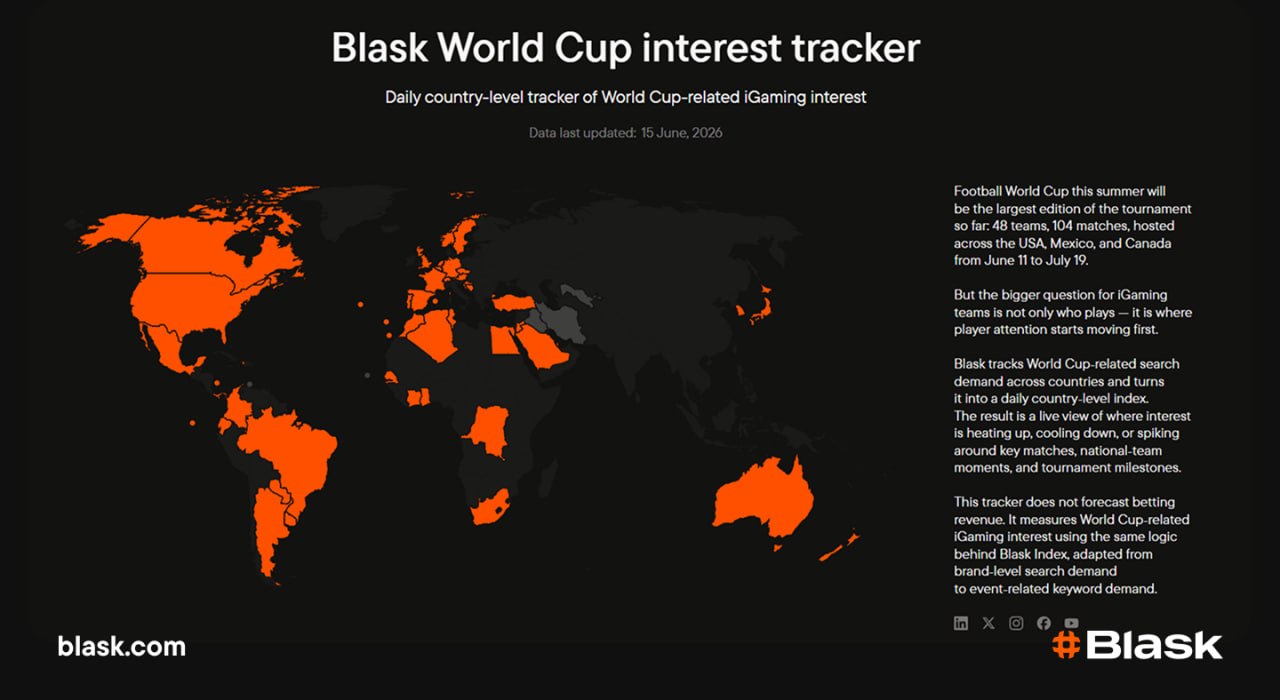
Blask has launched the Blask World Cup Index, a free interactive map showing daily interest across the majority of the 48 nations competing in the 2026 tournament. It runs for the duration of the competition.
Blask updates the map every 24 hours. Countries where interest towards the major football tournament grows over the previous day turn green. Countries where it fell turn red. Unchanged markets stay grey. Hover over any country for a quick snapshot, click through for a multi-day view, or follow the leaderboard of the fastest-rising and falling markets.
What the Blask World Cup Index measures
Blask World Cup Index draws from the Blask Index, Blask’s measure of iGaming search volume within a given market. On the landing page it tracks football related categories: how actively people in each country are searching for odds, match markets and other football-related content tied to the 2026 tournament.
Country cards show day-by-day trends; a daily leaderboard surfaces the daily World Cup Index and its change with the previous day. Visitors can track how interest in their country builds in the days before their team’s next match and how fast it collapses after an exit. The leaderboard shows which nation leads the index and how that position shifts with results. For operators and affiliates, the most actionable view is a market where interest is growing faster than the team’s performance would predict — the signal that precedes a volume spike.
After a 4-1 victory over Paraguay, the United States leads our World Cup Interest Index with 14.4 million demand points — more than three times ahead of second-placed Brazil (4.28 million), despite the Seleção’s global popularity. Germany sits third with 3.15 million following a 7-1 win over Curaçao, while England (2.53 million) and Egypt (2.22 million) round out the top five ahead of their opening group-stage matches.
To put the 2026 data in context, Blask has published two research reports drawing on iGaming activity across the 2018 and 2022 World Cups — one covering six European markets (UK, Germany, France, Spain, the Netherlands, Italy), one covering six LATAM markets.
The data shows the effect is not automatic: Germany posted positive acquisition signals at both tournaments despite group-stage exits; Peru surged +41% in 2022 without qualifying; Colombia fell 14% the same year.
Both reports include country-level APS data, cross-market patterns, and 2026 projections.
The post New Blask heatmap tracks real-time interest across World Cup 2026 nations appeared first on EE Gaming | Global iGaming & Tech Intelligence Hub.
3 Oaks Gaming
Pragmatic Play leads across Europe while RTG and 3 Oaks Gaming dominate US and Australia, new Blask data shows
Tier-1 casino lobbies are becoming less concentrated as regional challengers gain ground.
New data from Blask reveals that while Pragmatic Play remains the dominant game provider across most tier-1 European iGaming markets, regional dynamics are becoming increasingly fragmented as competitors such as Playtech, Evolution, Hacksaw Gaming, RTG and 3 Oaks Gaming rapidly expand their positions in local casino lobbies.
According to Blask’s latest analysis of tier-1 operator lobbies across Europe, North America and Australia, no single provider now holds an overwhelming market monopoly in most mature jurisdictions — with several countries showing signs of diversification and aggressive competition between suppliers.
In the United Kingdom, Pragmatic Play retained the leading position despite its market share declining year-over-year from 15.53% to 13.99%. At the same time, Reel Kingdom nearly doubled its presence, while Playtech also strengthened its position, reflecting increasing pressure on the long-time market leader.
Spain emerged as one of the most competitive European jurisdictions. While Pragmatic Play and Playtech both expanded their shares, the standout growth came from Evolution, which surged from 0.33% to 5.58% in just one year, signaling a major expansion of live casino content within the market.
Italy showed an even sharper shift toward supplier parity. Pragmatic Play and Playtech both lost substantial market share year-over-year, leaving the country without a clearly dominant provider. Evolution also accelerated its presence in the market, growing from 0.13% to 3.41%.
Germany remained one of Pragmatic Play’s strongest territories despite a decline from 17.39% to 14.40%. However, the market’s fastest-growing supplier was Hacksaw Gaming, which more than doubled its share and entered direct competition for a top-tier position.
France demonstrated one of the most balanced supplier landscapes in Europe. While Pragmatic Play overtook Play’n GO to become the leading provider in 2026, the difference between major suppliers remains minimal, suggesting that player demand in the country is spread across a wide range of content studios.
The Nordic markets also showed signs of changing player preferences. In Sweden, all top-five providers lost market share year-over-year while smaller suppliers expanded, indicating rising demand for newer studios. Denmark showed particularly strong momentum for Evolution, whose growth correlated with increasing live casino demand tracked by Blask.
Outside Europe, market structures differed significantly.
In the United States, RTG remains the dominant supplier with an 18.05% share, far ahead of competitors that struggle to exceed the 6% threshold. Meanwhile in Australia, 3 Oaks Gaming emerged as the leading provider, narrowly competing with Playson in one of the most distinct supplier ecosystems among tier-1 markets.
“Tier-1 markets are no longer moving toward monopoly dynamics,” said Vitaly Zubtsov, Head of PR at Blask. “What we see instead is fragmentation: local player preferences, live casino expansion, and new-generation studios increasingly reshape supplier hierarchies country by country.”
The report is based on Blask’s proprietary lobby-tracking technology, which continuously monitors game visibility and supplier presence across major regulated iGaming markets.
The post Pragmatic Play leads across Europe while RTG and 3 Oaks Gaming dominate US and Australia, new Blask data shows appeared first on Eastern European Gaming | Global iGaming & Tech Intelligence Hub.
The study analyzes key markets across both regions, including South Africa, Nigeria, Ghana, Brazil, Mexico, and Argentina. Using real-time data on game placement and player demand, the research provides a clear view of what content operators prioritize and what resonates most with players. The report also features insights from operators such as BetPawa and MSport, adding industry perspective to the data-driven analysis.
One key finding is that slots continue to dominate across both regions. In Africa, they account for 71% of the Top 30 games featured in casino lobbies, while in Latin America, they make up 67% of the Top 30 games analyzed — outperforming both crash and live formats.
At the same time, the data shows that what operators place in lobbies does not always match what players are actually looking for. Some of the most searched-for games are not prominently featured or are missing from lobbies altogether.
For 1spin4win, this report is part of their broader expansion strategy across Africa and Latin America. The provider began actively extending its presence in these markets in 2025, strengthening partnerships with local aggregators and refining its product strategy to better align with regional player preferences. These include mobile optimization and fast loading and smooth performance even on weak internet connections. In Africa, these efforts led to a 9.2x increase in the number of bets.
Olga Hlukhovskaya, Business Development Director at 1spin4win, “At 1spin4win, we place strong emphasis on working with data. It’s at the core of how we approach product development. We focus on understanding player preferences and making informed decisions that help us deliver experiences that truly resonate with our audience.”
Ilya Batcherikov, Blask CPO, commented, “By aggregating non-branded search data at scale, we help teams understand what players are actually looking for in each market — often before those trends become visible inside the product. This allows operators to move from reactive content strategies to proactive ones, aligning supply with real-time demand and capturing value that would otherwise be missed.”
Full insights from the research are available in the report “What’s hot in LATAM and Africa” on the Blask website.
About 1spin4win
1spin4win is an established game provider founded in May 2021 by ambitious developers with over 15 years of experience in the gambling industry. Since its inception, the company has expanded its portfolio to include over 200 classic online slots, all characterized by quality mathematics, transparent mechanics, and well-balanced gameplay — key factors that drive strong player retention. The studio aims to release an average of four new games each month in 2026 and offers effective promotional tools for casino operators to help them enhance player loyalty.
The post 1spin4win & Blask report 7 out of 10 top games in Africa are slots appeared first on Eastern European Gaming | Global iGaming & Tech Intelligence Hub.

-

 Bragg Gaming Group6 days ago
Massive Gaming launches Blitzcrown titles on Superbet Brazil via Bragg Hub
-
Compliance6 days ago
HIPTHER Launches HALLO: The Standard in Compliance Expertise
-
Alex Cuoci6 days ago
Wealthsimple and Kalshi Partner to Bring Prediction Markets to Canada
-
7Games6 days ago
7Games, Betão & R7 Launch FIRST.bet Sportsbook in Brazil
-
Compliance Updates6 days ago
HIPTHER Launches HALLO: The Standard in Compliance Expertise
-
Bonusetu.com5 days ago
Finland Sets Casino Gambling Risk Limits at 2% of Income, 4 Days, 2 Game Types
-
30-0 Kongeserien5 days ago
Kongebonus launches 30-0 Kongeserien Eliteserien fantasy draft game
-
Channelisation6 days ago
Swedish Gambling Authority consults tighter duty of care rules as channelisation slips