Latest News
20 years of HyperX: How Has the Gaming Industry Changed?

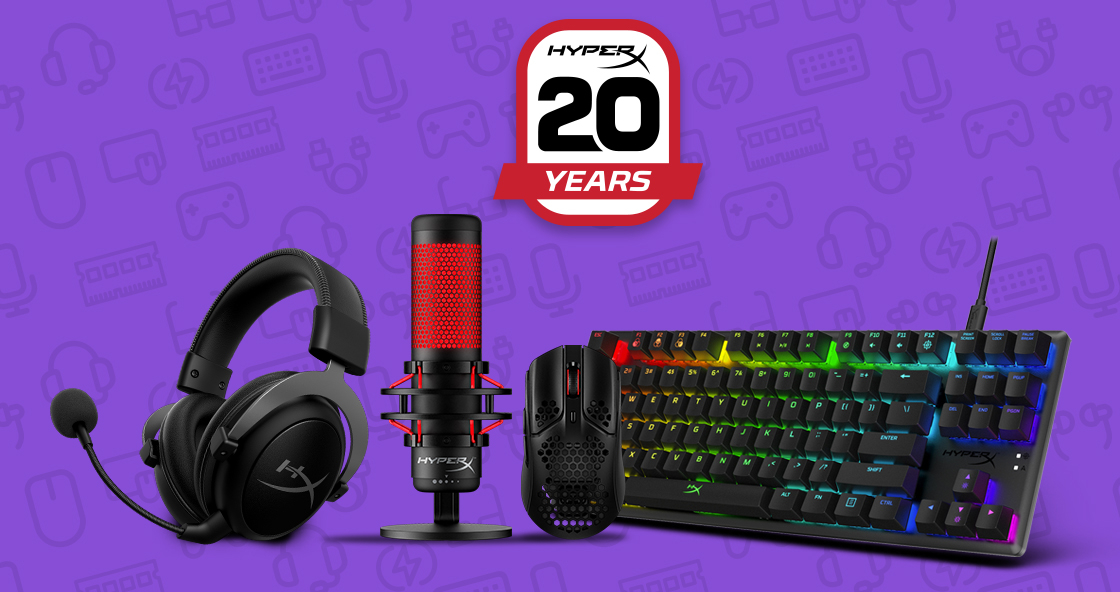
Paul Leaman, Vice President EMEA, HyperX provides some insight into just how much the gaming industry has changed in the last 20 years.
Over the last 20 years the gaming industry has changed and grown exponentially. By 2026 it is expected to be worth $321 billion. Besides this financial growth, we’ve seen huge strides in the visual aspect: video games from 8-bit graphics to almost lifelike characters and the introduction of VR. But it isn’t just the look and feel of games that has changed over the last 20 years. The technology we use to game, how we consume our games and who games, have all evolved in ways that few could have predicted in 2002. Here’s a look at some of the most fascinating developments in the gaming industry and what has led us to where we are today.
Evolving tech – the rise of wireless
Rewind 20 years and the PS2 and Xbox were still relatively new consoles to the market, having both launched within two years prior. For those who are not familiar with them, what they will probably find most surprising by today’s standards is that they came with wired controllers. Fast-forward a mere six years and we truly saw the beginning of a new wave of gaming technology – the rise of wireless. Xbox, PS3 and Nintendo Wii, all came with wireless controllers as standard and it would be the start of the modernisation of how people gamed. Wireless became the norm rather than the exception for controllers, headsets, mice, keyboards and chargers. As the technology continues to expand, more users are upgrading to wireless gaming hardware. The wireless gaming headset market alone, is expected to grow by 996.69 million USD during 2020-2024.
For a long time, wired connections led the way for enthusiast gamers. Having a more reliable, stable, physical connection would give you the least amount of lag or delay. However, significant research and development in the modern space has meant this is no longer the case. The ability to deliver to near-zero latency connectivity in wireless hardware has paved the way for its rise. Another important determining factor for gamers switching to wireless is due to aesthetics. Gamers can now create clean and tidy gaming set-ups that seamlessly fit into the design of their room.
Wireless headsets are becoming one of the most popular wireless gaming technologies. They offer freedom to gamers, with no cables to get tangled up in and the ability to move and talk freely. In today’s market most wireless gaming headsets have been designed so gamers spend less time charging and more time gaming in complete comfort with ergonomic designs. The biggest question mark has always been battery life and battery life degradation. However, this year we saw the first headset with up to 300 hours battery life and now gamers even have the option of in-ear buds, perfect for gaming on the move. Which begs the question, what will be possible next?
Gaming as a force for good
As the passion for gaming continues to grow around the world, it is no longer just seen as a hobby, but a thriving industry that is showing no signs of slowing down. Over 439 million people around the world tuned into esports events in 2020. This is a huge development from 2002 when competitive gaming was still very much in its infancy. While there is still a long way to go for gaming to be more inclusive, there have been huge strides taken in the last 20 years.
There is a long way to go to make gaming more inclusive for women and as it should be. However, over the last 20 years the industry has massively changed. There are now dedicated communities for women gamers, such as Sugar Gamers, r/GirlGamers and Women in Games International. These offer female gamers a greater voice and a safer space to make friends, share their experiences and learn more about the industry. We also have more female gaming ambassadors, that are improving women’s representation in games and communities specifically for female gamers. These play their part in facilitating a healthier environment and help pave the way to a brighter future for gaming.
Gaming is a great force for connecting different people, regardless of race, sexuality and gender. Gamers and the gaming industry is misunderstood by many, with typical stereotypes wildly outdated. In reality, the gaming community is over two billion globally and is very diverse and inclusive. For example, in the US alone, 65% of women between the ages of 10 and 65 play mobile games and research shows that 86% of UK parents game. If we think about COVID-19 and the global shutdown that ensued, gaming provided people with a way to stay connected virtually, even when they were physically isolated. Our research also showed that 50% of parents in the UK felt gaming improved their child’s mental health during lockdown and 52% felt their child coped better in lockdown because of gaming. And while we all need to stay on top of our screen time, gaming has a lot of benefits and can teach people values and skills. Multiplayer games foster teamwork and communication, gaming communities nurture belonging, and games can provide people a useful escape in troubling times. It is different for each person but ultimately, gaming has the power to be a force for good.
Online gaming
In the last 20 years, the world of online gaming has burst onto the scene and grown at a mindboggling rate. Since 2007, the online gaming market has continued to grow at a significant rate, with an annual growth rate of over 20% over the last five years. In the last 20 years, esports has gone from a vibrant niche to a central form of entertainment across the globe. Over 439 million people around the world tuned into esports events in 2020 and research from Nielsen found that 82% of global consumers played video games or watched video game content during the peak of the COVID-19 pandemic.
This meteoric rise has led to the opening of arenas such as the HyperX Esports Arena in Las Vegas. A multilevel arena designed to host every form of competitive gaming, the size and standard of the arena is one which historically was associated with traditional professional sports teams. Gaming is no longer just something people do in their spare time at home, it has place in a 30,000 square foot arena. We’re also seeing this level of growth as for many young gamers their idols and the “celebrities” they follow are no longer always in the traditional media. They’re streamers and content creators, such as Tim The Tatman or Valkyrae.
What to expect next
The transformation of the gaming industry over the last 20 years is nothing short of remarkable. The developments of huge online communities, the rise of gamers from all over the globe, from all different backgrounds, the constantly evolving technologies, and the growth of esports and online communities. Like any budding industry, it won’t stop here and it is going to be a fascinating journey. With the rise of new technologies, developing VR even further, completely immersive gaming; the possibilities are endless. And no doubt the next 20 years will be even more exciting.
Powered by WPeMatico



New title adds Fire Spins and Blitz Spins bonuses plus Standard, Super and Ultra Power Play modes at 5x, 10x and 20x stake.
Blueprint Gaming has released a new slot, Wolf Fury Fire Blitz, built around an “evolving Fire Blitz mechanic” and two bonus paths: Fire Spins and Blitz Spins.
The game uses a Fire Blitz logo above the reels as a meter. In the base game and Power Play, the supplier said every Cash and Wolf symbol contributes to the meter, with boosts able to add extra symbols and “guarantees either Fire Spins or Blitz Spins.”
Fire Spins triggers when six or more Cash symbols land in view. Each reel position spins independently to add more Cash or Wolf symbols, with new symbols resetting a three-spin counter and locking in place. Blueprint said the Wolf can land on the centre reel to collect all Cash symbols in view, then collect additional prizes that land for the remainder of the feature.
Blitz Spins activates when a Wolf symbol lands on reel three alongside Cash symbols on two adjacent reels. During the bonus, the Wolf collects every Cash symbol that lands before the reels respin, and additional Wolf symbols can lock in place, with up to three collectors active at once.
The title also includes Blueprint Gaming’s multi-level Power Play, offering Standard, Super or Ultra modes at 5x, 10x or 20x the base stake. In these modes, the company said only Cash and Wolf symbols appear on the reels.
Jo Purvis, Director of Marketing, PR and Events at Blueprint Gaming , said: “Wolf Fury Fire Blitz combines several of our most engaging mechanics into a fast-paced experience that offers players frequent feature opportunities and exciting collection gameplay. The Fire Blitz mechanic creates anticipation throughout every session, while the dual bonus structure ensures plenty of variety.
“The addition of our multi-level Power Play further enhances the experience by giving players greater control over how they engage with the game, reinforcing our commitment to delivering innovative, feature-rich content that performs across regulated markets worldwide.”
The post Blueprint Gaming releases Wolf Fury Fire Blitz slot appeared first on EE Gaming | Global iGaming & Tech Intelligence Hub.

Playson has launched 4 Chili Pots: Hold and Win, a new slot built around Hold and Win and Pots mechanics with two bonus modes and jackpots reaching 10,000x.
The game runs on a 5×3 grid and triggers a Hold and Win Bonus Game with Chili Features when red, orange or green Chili Bonus symbols land, combining with enlarged matching chilis above the reels. The chilli colour determines the feature in play: red triggers a Multi Feature that adds multipliers up to 5x; orange triggers a Mystery Feature that can award Mini, Minor or Major jackpot values or a coin value up to 75x; and green triggers a Collect Feature that gathers the value of all symbols in play, including any attached multipliers.
A golden Super Chili Bonus symbol can trigger a Super Bonus Game on an expanded 5×5 grid, with random Multi, Mystery or Collect features, including combinations. During the round, the active Super Chili Feature lands random Chili Bonus symbols until six are present, which then activates a new feature or enhances the current one.
Playson said jackpots can be triggered in both bonus modes. Filling all 15 cells in the classic bonus awards the Grand Jackpot at 3,000x, while filling all 25 cells in the Super Bonus Game awards the Super Jackpot at 10,000x. Skull-themed symbols can also appear in bonus play and transform into red, orange or green Chili Bonus symbols. The title includes two Buy Bonus levels, allowing players to trigger the Bonus Game or Super Bonus Game with one, two or three Chili Features.
Anton Ivannikov, CPO at Playson, said: “Our fiery new title showcases our continued focus on evolving proven mechanics in fresh and exciting ways. By combining two player-favourite features with layered bonus progression, dynamic Chili Features and a Super Bonus Game offering even greater rewards, we have created a title that delivers excitement throughout every stage of play.
“Complemented by its vibrant Mexican fiesta theme and engaging gameplay, we are confident 4 Chili Pots: Hold and Win will prove to be another valuable addition to our partners’ casino offerings.”
The post Playson releases 4 Chili Pots: Hold and Win with dual bonus modes appeared first on EE Gaming | Global iGaming & Tech Intelligence Hub.

Under the theme “Perspectives,” a total of 43 compliance staff members from the Merkur Group across various countries gathered from 30 June to 1 July to further develop compliance processes in a sustainable manner. Colleagues from Germany, Spain, England, Malta, Australia and the US traveled to the two-day meeting at Benkhausen Castle, the in-house training centre of the Merkur Group. The workshop set the stage with expert presentations on global and digital topics such as cybersecurity, risk management and artificial intelligence. A panel discussion featuring representatives from various international companies within the Merkur Group, as well as a digital quiz, rounded out the programme.
In keeping with its guiding principle, the workshop focused on sharing experiences, fostering global networking and providing impetus for the further development of compliance processes. Because informal exchanges are also key to close cooperation, the evening programme created a relaxed atmosphere and gave participants the opportunity to continue their conversations, make new connections, and further strengthen team spirit across company and national boundaries.
“The ideas and diverse perspectives gained during the workshop will now be incorporated into our day-to-day work and help us to continuously improve collaboration and existing processes,” said Ludwig Beckmann, Chief Compliance Officer of the Merkur Group.
The concluding feedback session also highlighted just how valuable the international exchange is. The term “collaboration” came up particularly often, a clear indication of how highly the participants value working closely together within the international compliance network.
The post Merkur Group Strengthens Global Compliance Strategy appeared first on EE Gaming | Global iGaming & Tech Intelligence Hub.

-

 Compliance Updates6 days ago
Arizona Department of Gaming Issues Cease-and-Desist Orders to Multiple Operators Linked to Underage Gambling and Illegal Activity
-
 Compliance Updates6 days ago
KONAMI GROUP’s Konami Gaming Inc. First to Submit Manufacturer License Application in Japan’s Emerging IR Market
-
Latest News7 days ago
PG Soft appoints Hugo Baungartner as General Manager LatAm
-
Canada7 days ago
Canada’s Safer Gambling Gap: Why Market Success Doesn’t Always Equal Player Safety
-
Latest News7 days ago
Booming Games launches Fish Tales: Double Catch Max Scatter
-
Latest News7 days ago
Tom Horn Gaming ships Royal Ruby FeatureStorm slot worldwide on 14 July 2026
-
Latest News7 days ago
PG Soft names Hugo Baungartner as General Manager LatAm
-
Latest News7 days ago
BC.GAME names Guillermo Ochoa brand ambassador for Mexico push