Latest News
Global Online Gambling Market Report 2022: Featuring William Hill, Flutter Entertainment, 888 Holdings, Bet365 & Others

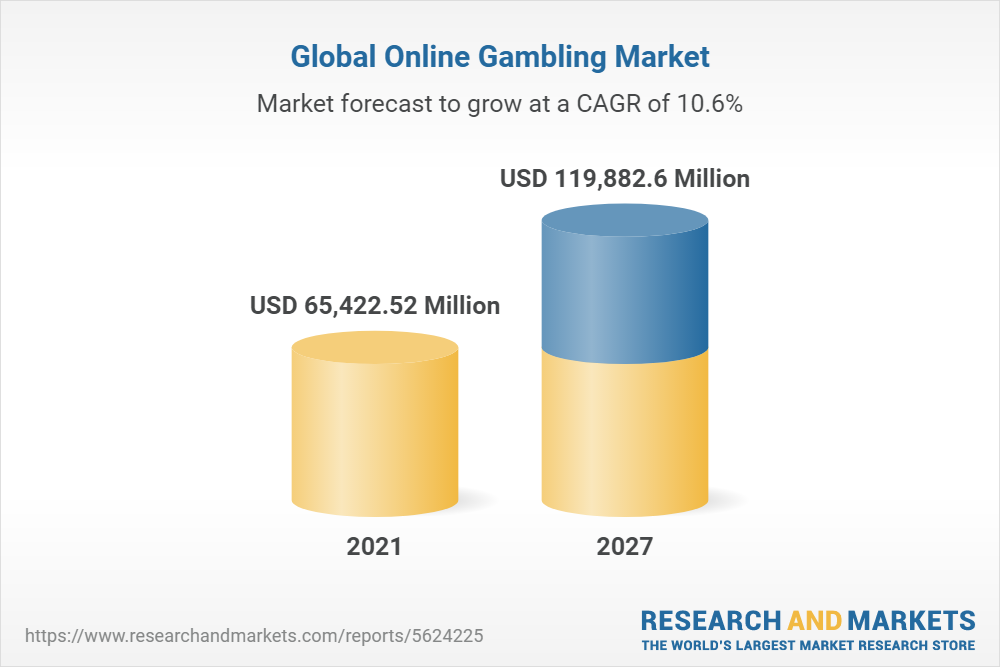
The “Global Online Gambling Market – Forecasts from 2022 to 2027” report has been added to ResearchAndMarkets‘ offering.
The global online gambling market was valued at US$65.316 billion in 2020 and is expected to grow at a CAGR of 10.11% over the forecast period to reach a total market size of US$128.154 billion in 2027.
The growing popularity of betting across different regions around the globe is significantly driving the global online gambling market. According to the American Gaming Association (AGA), around 2,800 sites were active online and offered games and activities, such as poker, lottery, and bingo, as of 2018.
The growing adoption of smartphones, coupled with rapid penetration of better internet connectivity across various regions/countries, is supporting easy access to various online gambling platforms. With companies offering freemium models to their customers, the number of people engaged in various types of online gambling is rising at a considerable rate which, in turn, is boosting the growth of the global online gambling market.
An increasing number of cost-effective mobile applications to play different online gambling games on smartphones is also contributing to the market growth of online gambling worldwide. The ease of sports betting using a portable connected device such as a smartphone, laptop, and tablet has increased the number of players in the online gambling industry.
Moreover, the proliferation of sports betting along with other online gambling ads is further attracting people to try online gambling, thus positively impacting the market growth during the forecast period. Online agencies, third-party ad servers, and networks and exchanges are used for advertising gambling websites of various companies. Online gambling service providers enter into agreements with individual customers or players to offer betting services for real money, attracting more and more gamers.
The online gambling industry has a vast range of regulatory frameworks in place, which attributes mainly to the market size, the number of participants, and the level of illegal gambling. Legislation for online gambling ranges from licensed markets that are fully open to commercial operators to explicitly prohibited and banned. Tax rates, online penetration, and other regulatory requirements vary widely across geographic regions. As legislation continues to evolve, the regulated markets have a severe impact of increasing costs and barriers to entry which includes consumer protection initiatives and rising gambling taxes. By far, the United Kingdom is the largest regulated online gambling market for many online operators. Other sizeable regulated markets include Sweden, Spain, Italy, and Australia.
However, many countries prohibit the online gambling industry, which is hampering the growth of the global online gambling market. Countries, where online gambling is illegal, include Singapore, the United Arab Emirates (UAE), North Korea, India, and Qatar. In Russia, online gambling is completely banned except for interactive gambling, which includes simulators of slot machines, card games, and casino games. Moreover, countries, where online gambling is allowed have restricted and stringent regulations, which further erodes the growth of this overall online gambling market.
Powered by WPeMatico


Malta’s Prime Minister has said his nation will veto any attempts by the EU to introduce a bloc-wide online gambling levy, threatening to place the industry at the centre of febrile European politics.
Robert Abela has told Malta’s parliament that he would use his nation’s member state veto to block the passage of the next EU budget, if a proposed gambling levy is included.
The budget, formally known as the Multiannual Financial Framework (MFF), lays out how the EU will spend its €2trn budget from 2028 to 2034.
The prospect of adding a continent-wide tax to the budget remains only a proposal, but the idea has heavyweight backing.
Vice-president of the European Parliament Victor Negrescu is spearheading these efforts, arguing that a fast-growing digital industry that generates billions in revenue should be subject to EU-level taxation.
Negrescu says that the levy could generate between €2-4bn every year.
“This industry fully benefits from the EU’s single market, digital infrastructure and crossborder access, but operates under fragmented rules, unequal taxation and insufficient enforcement,” he said.
The online gambling sector might well quibble with the specifics of these claims.
The idea that it “fully benefits” from the EU single market may have been unassailably true in the point-of-supply era, but the subsequent fragmentation of national rules that Negrescu refers to has significantly complicated that picture.
Nevertheless, backing for the levy from a senior European politician has naturally spooked the industry and its primary champion within the EU, Malta.
The levy would be so damaging to Malta’s economic interests that it is willing to use its most powerful EU instrument by executing a veto in the European Council in order to block the budget from being approved.
That would likely plunge the island nation into the centre of a political firestorm, but recent history suggests that smaller EU nations and their allies can successfully disrupt budget negotiations.
During discussions over the 2020 EU budget, Poland and Hungary successfully secured concessions after they both threatened to veto the MFF over rule-of-law requirements.
Malta will also hope to rely on support from the Friends of Cohesion, an informal alliance of 16 nations concerned with regional development, of which it is a part.
Negrescu’s pledge to pair his levy with a “clear EU directive against illegal and unlicensed platforms” is unlikely to satisfy the online gambling industry, despite growing complaints of a rampant black market from a number of quarters.
Malta strikes again
In simple terms, Malta is seeking to protect an industry which accounts for 10 percent of its gross domestic product.
The nation has shown a clear willingness to ignore the EU’s wishes in order to shield the many gaming firms that host their headquarters within its borders.
Most notably, the creation of Bill 55 has successfully protected local companies from having to repay hundreds of millions of euros in player refund settlements.
Ongoing cases before the Court of Justice of the European Union suggest that Europe’s top judges will soon rule against Bill 55, which is now Article 56A of Malta’s gambling act.
The European Commission also launched infringement proceedings against Malta over the provision
Tax troubles.
There are so far no specifics on how the levy would be calculated or what value it would be set at, but beyond Malta an additional levy would also be extremely challenging for operators in European markets already struggling with high tax burdens.
This includes the Netherlands, where a government report released this week has shown that staggered increases to taxes of 37.8 percent of gross gambling revenue (GGR) have failed to deliver any benefit to the country’s budget.
Even a relatively slight increase to this tax rate could send more operators scurrying out the market and see channelisation dive further than its current rate of 55 percent.
Nations like France, where online betting is taxed at 59.3 percent of GGR, or Portugal, with its 8 percent turnover tax on online sports betting, would also feel an impact.
Negotiations over the contents of the EU budget are set to continue for several months, with the approval process expected to be completed in late 2026 or early 2027.
Leaders in the Council of Europe have agreed to come to a preliminary deal on the MFF by October, according to a coordinated statement issued earlier this month.
Malta’s devout opposition to a possible gambling levy is just one of a range of issues under discussion, including a stark divide between nations such as Germany, which favour spending cuts, and the Friends of Cohesion, who want additional cash for agriculture and regional funding.
The post Malta Prepares For EU Budget Battle To Stave Off Gambling Levy appeared first on EE Gaming | Global iGaming & Tech Intelligence Hub.

The esports organisation’s second anime apparel collaboration will be sold exclusively via g2esports.com/shop.
G2 is launching a limited-edition G2 | One Piece capsule collection on June 25, with the drop available exclusively through the organisation’s online store at g2esports.com/shop.
The collection is inspired by One Piece’s Gear 5 Monkey D. Luffy and includes hoodies, zip-ups, t-shirts, caps, sleeves, and tote bags. According to G2, the items use a black-and-white palette and feature a minimalist embroidered logo alongside a custom G2 | One Piece Jolly Roger that combines the G2 samurai emblem with Luffy’s straw hat.
“At G2, we’re continuing to push the culture and fashion of esports beyond competition alone, and this One Piece collection is a natural extension of that,” says Sabrina Ratih, COO of G2 Esports. “We wanted to create a capsule that continues to elevate the esports fashion space – understated, premium, and stylish enough for everyday wear, while still carrying the spirit of adventure, ambition, and individuality that defines One Piece and G2 alike. Every piece is designed to bridge the gap between fandom and everyday style, and continuing our mission to redefine what esports fashion can be.”
G2 described the drop as its second anime collaboration, following a previous apparel collaboration with Solo Leveling. The company positioned the release as part of its broader effort to connect esports, anime, and streetwear.
One Piece debuted in 1999 and remains one of the largest anime franchises globally. G2 cited over 600 million manga copies sold and more than 1,160 episodes for the series.
The post G2 drops limited-edition One Piece streetwear capsule on June 25 appeared first on EE Gaming | Global iGaming & Tech Intelligence Hub.

Projects sit within UKRI’s Research Programme on Gambling and the GHR-UK Evidence Centre, backed by the statutory levy.
Ygam has been named as a partner on four projects funded through the UKRI Research Programme on Gambling, supported by the statutory levy. The charity will work with academic teams including the University of Birmingham, Bournemouth University, the University of Plymouth, Lancaster University, and Liverpool John Moores University.
The four projects sit within the Gambling Harms Research UK (GHR-UK) Evidence Centre, which coordinates 19 one-year Innovation Partnerships under the programme. UKRI has been appointed by the UK Government to oversee research commissioned through the new statutory Gambling Levy. Under the levy, 20% of annual funding will be allocated to research, equating to £22.1 million in 2025/26.
Emily Tofield, Chief Executive of Ygam, said: “We are pleased to be working in partnership with leading university partners, contributing our expertise in a key strategic area of our work. A defining strength of our approach is that it is grounded in robust insight and research, underpinning everything we do. This enables us to understand how and why harms emerge and translate that into practical, preventative education that is credible and scalable. We look forward to achieving these outcomes together and informing effective measures to prevent harms among children and young people.”
Ygam said its advisory panels — including young people, individuals with lived experience, community and faith leaders, gaming and esports representatives, and student ambassadors — will help shape the research to reflect “real-world experience and diverse community perspectives.”
The four partnerships are: INTEGRATE (University of Birmingham, Ygam, Al-Hurraya and Community Connexions), focused on intersectional gambling harm and interventions for children, young people and emerging adults; “From Evidence to Action: Safeguarding Neurodivergent Young People in Gamified Digital Environments” (Bournemouth University, Ygam, Work’n’Diversity CIC), focused on gambling-like risks in gamified digital environments; GRASP (University of Plymouth-led partnership including NatCen, NHS and third-sector organisations, and Ygam), mapping support pathways and gaps in prevention and recovery; and GRACE-Net (Lancaster University and Liverpool John Moores University with local authorities, NHS partners, third-sector organisations and Ygam), testing collaborative approaches in the North West of England and sharing learning more widely.
The post Ygam joins four UKRI-funded gambling harms research partnerships appeared first on EE Gaming | Global iGaming & Tech Intelligence Hub.

-

 Australia7 days ago
Former Star Entertainment Executives Mathias Bekier and Paula Martin Disqualified and Ordered to Pay Penalties
-
Alejandra Burato7 days ago
Record Attendance, Exciting New Releases, and a Resounding Success: This was Zitro Experience Peru
-
ArenaPlus7 days ago
DigiPlus Wins “Digital Operator of the Year” Award at 2026 Global Gaming Awards Asia-Pacific
-
Amusnet7 days ago
Weekend Reels | Week 25: Slot Drops & Trends
-
Anthony Dalla-Giacoma7 days ago
Elysium Studios Releases its Latest Slot Game “Hood and Loot”
-
Greece7 days ago
SYNOT Games Announces New Partnership with Superbet
-
Bragg Gaming Group4 days ago
Massive Gaming launches Blitzcrown titles on Superbet Brazil via Bragg Hub
-
Compliance4 days ago
HIPTHER Launches HALLO: The Standard in Compliance Expertise