Canada
DIMAYOR Names Stats Perform as Official Data Partner


Multi-Year Deal Gives Stats Perform Official Rights to Collect and Distribute Match Data to Media and Technology Partners
DIMAYOR (Colombia Official League) has agreed to a new extended partnership with Stats Perform, the sports tech leader in data and AI, as its official data provider. The new three-year deal will see Stats Perform collect and manage Opta data from the Primera División, Second Division and Domestic Cup.
Stats Perform’s Opta data will support DIMAYOR and their partners in creating unique experiences for their audiences across media, brands and sponsors. DIMAYOR ’s continued alignment with Stats Perform reinforces the professional league’s commitment to ensuring that media and technology partners covering the competitions are provided with the highest quality data to bring every match to life for fans around the world.
Detailed data will be delivered through an extensive range of Opta data feeds, with Stats Perform’s highly visual, easily customisable widgets providing data-powered solutions for use across digital and social platforms, before, during and after the action.
Opta data and statistics will power DIMYOR’s social channels, where they will help determine the week’s top performing players (for the team of the week) and inform and empower fans.
Extensive preview and post-match packs will be made for the clubs and media ahead of all Primera División matches using Opta data. These packs serve a variety of functions, including the production of data-driven match previews or to support broadcast operations and commentators.
Innovation continues to be at the forefront of every Stats Perform partnership, with the artificial intelligence (AI) and data science teams building on the company’s established advanced metrics to elevate media analysis and fan engagement, including Expected Goals (xG), Expected Assists (xA), Sequences, Playing Styles, Possession Chains and more. Using industry-leading AI and machine learning, and delivered through their global sales network, Stats Perform will continue to bring rich data insights and storytelling to enhance the way football is understood and experienced.
Stats Perform is committed to growing Columbia’s competitions in South America and globally through data, content, and distribution. This deal is yet another milestone in Stats Perform’s commitment to supporting the expansion of the sport across the globe, with the company already holding partnerships with the Premier League, CONMEBOL, LPF Argentina, La Liga, MLS, U.S. Soccer and the Eredivisie.
Alex Rice, Chief Rights Officer, Stats Perform, said: “We’re delighted to announce that we will be extending and expanding our partnership with DIMAYOR as Columbia’s Official Data Partner. We look forward to working closely with the leagues to deliver the best quality data, giving the competition control of their data rights and access to Stats Perform’s expertise and sales network.”
Fernando Jaramillo, President of DIMAYOR Colombia, said: “We can say we have the biggest data company to know the performance of all our competitions and those who are part of them. DIMAYOR has been working with Stats Perform’s Opta data for the last 4 years and thanks to the excellent results, quality of services and their vast coverage of our competitions we have been able to move forward with the clubs’ performances, create programmes such as DIMAYOR INNOVA and better understand and take advantage of the data just as other big leagues do. It is a pleasure to have this global agreement with Stats Perform.”
Powered by WPeMatico


High 5 Games, the creator of premium casino content for the land based, online and social gaming markets announced it has secured supplier approval from the Alberta Gaming, Liquor and Cannabis Commission (AGLC), extending its games beyond Play Alberta to all licensed operators in the province’s newly opened commercial iGaming market.
High 5 Games has entertained Alberta players since 2024 through Play Alberta, the province’s government operated gaming platform, where titles such as DaVinci DeluxeWays, Billionaire’s Bank, Green Machine and more have become established player favourites. With Alberta’s commercial market now open, that same proven portfolio is available to all licensed operators entering the province.
Alberta’s commercial iGaming market will be opening on July 13, 2026, making it the second Canadian province after Ontario to welcome private sector operators. Overseen by AGLC and the Alberta iGaming Corporation (AiGC), the market launched with nearly 50 registered operator brands, one of the most anticipated regulated market openings in North America this year.
The approval extends High 5 Games’ regulated North American footprint, which includes New Jersey, Michigan, Pennsylvania, Connecticut, West Virginia, Ontario, Quebec, British Columbia. Alberta players will gain access to High 5’s catalogue of player favourite titles, including DaVinci DeluxeWays, Billionaire’s Bank, Green Machine and other titles through launch partnerships with operators.
“Alberta players already know and love our games through Play Alberta, that is a head start no newcomer to this market can claim. With the open market live, every operator in the province can now offer their players the award winning High 5 titles they have been playing for years, from day one.” says Tony Singer, CEO at High 5 Games.
High 5 Games’ content is certified across New Jersey, Michigan, Pennsylvania, Connecticut, West Virginia, Ontario, British Columbia and the studio has developed more than 300 games over three decades of game making.
The post High 5 Games Expands Across Alberta’s Open iGaming Market Following AGLC Supplier Approval appeared first on Americas iGaming & Sports Betting News.


The supplier can now distribute its online casino titles beyond Play Alberta to all licensed operators in the province.
High 5 Games has secured supplier approval from the Alberta Gaming, Liquor and Cannabis Commission (AGLC), allowing the studio to supply its online casino content to all licensed operators in Alberta’s newly opened commercial iGaming market.
The company has been live in the province since 2024 via Play Alberta, the government-operated platform, where it said titles including DaVinci DeluxeWays, Billionaire’s Bank and Green Machine have become player favourites. With the commercial market now open, High 5 Games said the same portfolio can be offered across operators entering Alberta.
Alberta’s commercial iGaming market is set to open on July 13, 2026, becoming Canada’s second province after Ontario to allow private-sector operators. The market is overseen by AGLC and the Alberta iGaming Corporation (AiGC) and launched with nearly 50 registered operator brands, according to the company.
“Alberta players already know and love our games through Play Alberta, that is a head start no newcomer to this market can claim. With the open market live, every operator in the province can now offer their players the award winning High 5 titles they have been playing for years, from day one.” says Tony Singer, CEO at High 5 Games.
High 5 Games said the AGLC approval expands its regulated North American footprint, which it listed as including New Jersey, Michigan, Pennsylvania, Connecticut, West Virginia, Ontario, Quebec and British Columbia. The company said it has developed more than 300 games over three decades.
The post High 5 Games wins AGLC supplier approval ahead of Alberta iGaming launch appeared first on EE Gaming | Global iGaming & Tech Intelligence Hub.
Canada’s online gambling market is the third-largest in the world. It generated approximately CAD 13.15 billion in 2025, growing faster than virtually any other country. By the metrics the industry tends to reach for, it is a success story.
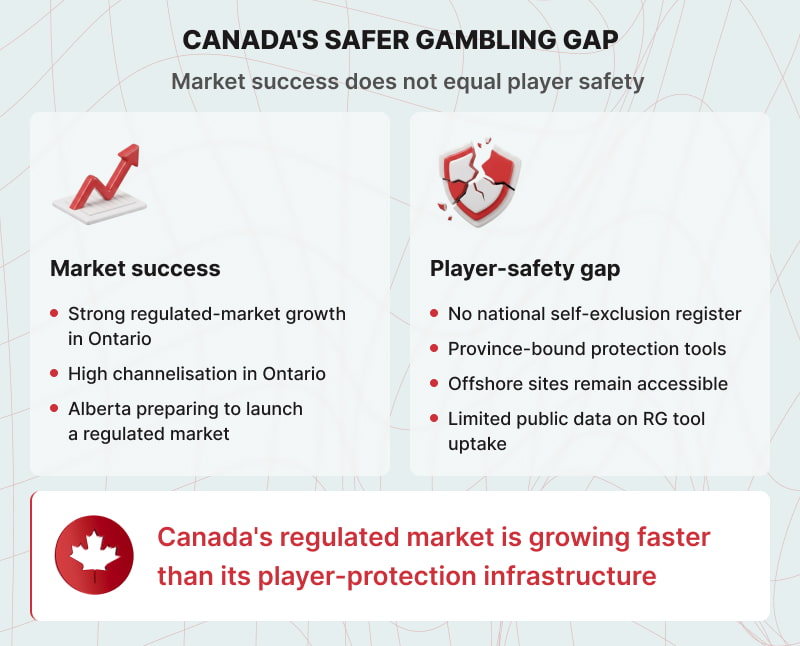
Unfortunately, where many of the metrics that matter for player protection are concerned, the story is different. Unlike several other countries, Canada has no national self-exclusion register and no national licensing framework.
While Ontario is regulated, and there is a lot of excitement around Alberta opening its regulated market this summer, the overwhelming majority of online gambling in the country still happens on unlicensed platforms.
An Ontario or Alberta player who self-excludes still can gamble through offshore sites or outside the province. Canada has no single stop button.
Key Findings
- Canada has no national self-exclusion register, no national licensing framework, and the last national survey predates the legalisation of single-event sports betting.
- Offshore leakage outside Ontario ranges from 49% to 93% by province. The offshore market grew at 40% year-on-year in 2025.
- Ontario has a 91.1% channelisation rate, but 20.2% of players also play on unregulated sites.
- Player awareness of RG tools in Ontario stands at 65.4%, according to iGO’s own Leger survey baseline. No province publishes data on actual tool uptake rates.
- A CMAJ study found gambling helpline contacts in Ontario rose 198% after market privatisation, concentrated almost entirely in men aged 15 to 44.
A Fragmented System
Canada’s gambling framework is a product of its constitution. Sections 91 and 92 of the Constitution Act distribute authority to the provinces, and Section 207 of the Criminal Code permits them to conduct and manage lottery schemes within their own borders. A 1985 federal-provincial agreement completed the transfer, leaving Ottawa without a gambling regulator and the country without national standards of any kind.
The result is ten parallel regimes, all operating at different standards. Ontario operates an open market, and Alberta is building a similar structure. Every other province runs a government monopoly: BCLC’s PlayNow, Loto-Quebec’s Espace-jeux, and the Atlantic Lottery Corporation.
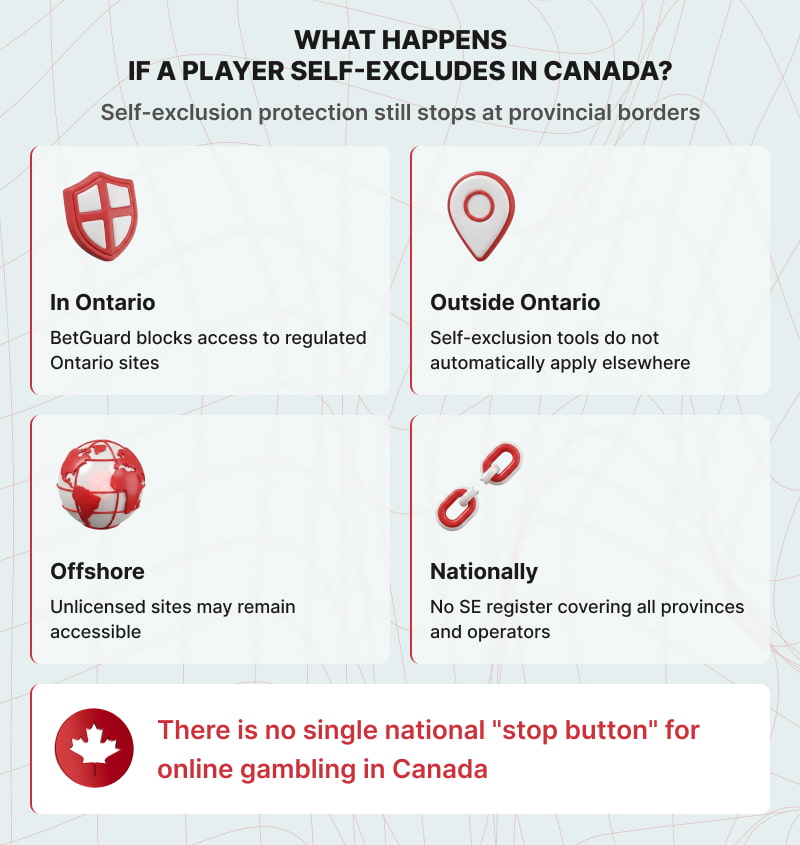
The issue is that there is no connection between these. A responsible gambling tool in one province has no power in another. A self-exclusion registered in Ontario does not block a player from gambling elsewhere.
Changes do not appear to be on the horizon, with no federal legislation on those issues currently before Parliament.
The Offshore Risks
The Blask 2025 USA and Canada iGaming Landscape Report highlights the scale of this problem. Saskatchewan carries an estimated 93% offshore leakage rate. Alberta and Manitoba sit at 88%. Quebec, where Loto-Quebec has operated since 2010, holds only around 17% of a market estimated at CAD 2.3 billion.
Even British Columbia, with years of PlayNow operations behind it, retains approximately 49-51% of its online market, according to Blask’s reports. Offshore platforms grew at 40% year-on-year in 2025, nearly double the 23% growth of domestic licensed operators.
Ontario’s Success and Limits
Ontario deserves genuine credit for its current position, and it is often hailed as an example of a strong regulatory market.
The regulated market generated CAD 82.7 billion in wagers and CAD 2.9 billion in gross gaming revenue in FY2024/25. Channelisation, measured by the share of online gamblers using regulated platforms, reached 83.7% in early 2025 and 91.1% on the most recent IPSOS survey.
However, the Ontario story is often viewed as the national story, and this is not the case. Even within the province, 20.2% of players using regulated platforms also gamble on unregulated sites.
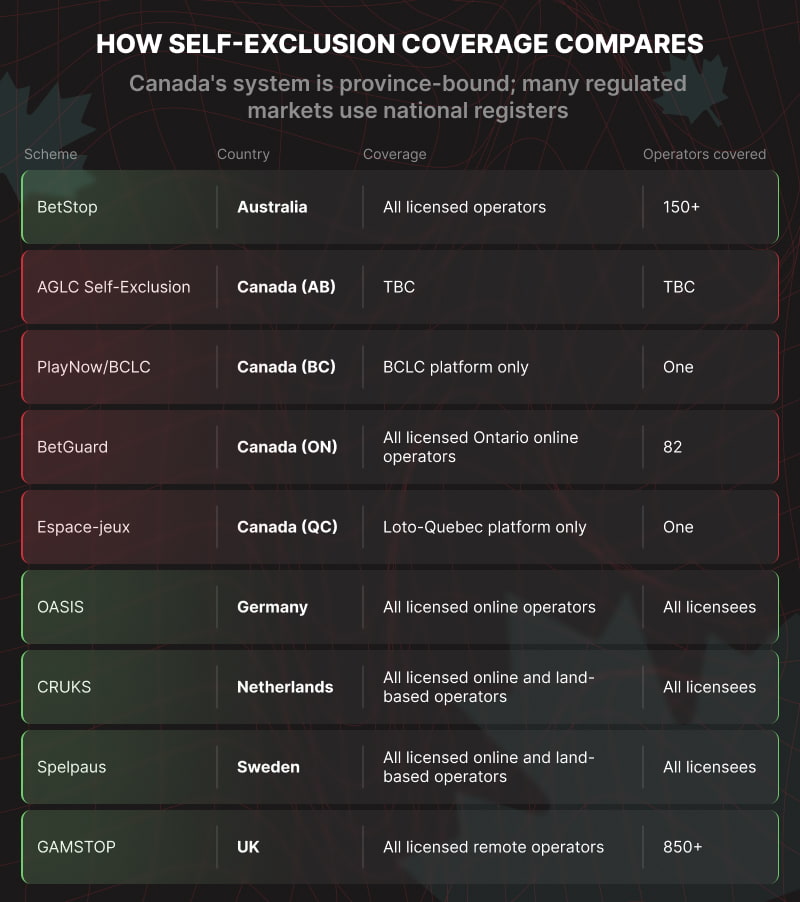
BetGuard, launched in May 2026, finally delivered the centralised self-exclusion system that the market should have had from day one, allowing a player to exclude from all regulated platforms at once.
The early take-up numbers show more than 500 people registered for BetGuard in its first two weeks. That is not a negligible start, and iGaming Ontario has stated it will measure the platform’s success by renewal rates, term lengths selected, and connections to addiction support services.
However, Ontario’s market has 1.235 million active player accounts. The gap between the scale of the regulated market and the early uptake of the tool is wide.
The deeper problem is that BetGuard is province-bound. A player who is excluded in Ontario is not blocked elsewhere.
Many other countries have solved this problem. GAMSTOP in the UK covers all licensed remote operators under a single registration. Spelpaus in Sweden does the same across online and land-based channels. BetStop in Australia covers approximately 150 licensed wagering providers with a five-minute sign-up.
Canada has no equivalent, and there is currently no route to making one.
What the Evidence Says
The academic case for nationally coordinated self-exclusion is strong. A comparative review of self-exclusion programmes across multiple jurisdictions found that the reach and enforcement of any scheme vary directly with how completely it covers the market.
A review of BCLC’s voluntary self-exclusion programme found that 97% of participants who gambled while excluded did so at venues not covered by their agreement. The exclusion worked where it applied, but not beyond that.
The tool-uptake literature is equally sobering. Studies analysing voluntary deposit-limit setting across large player populations find uptake rates in the low single digits over three-month periods. Ontario does not publish equivalent figures, but iGO’s own Leger survey in 2024 found that only 65.4% of regulated players were aware of available RG tools.
The gap between knowing a tool exists and using it is consistently wide, and no regulator publishes data on actual tool engagement rates. That absence is itself a significant accountability problem.
Where public health data does exist, it is alarming. British Columbia’s 2025/26 prevalence study found that 35% of past-year online gamblers showed moderate or high-risk behaviour.
The most striking recent evidence comes from a January 2026 CMAJ study analysing contacts with Ontario’s ConnexOntario helpline over thirteen years.
The study found that gambling-related contacts increased from a monthly rate of 13.4 per million before online gambling launched, to 17.0 after PlayOLG’s introduction, to 26.2 following the market opening in April 2022.
The increases occurred almost exclusively in adolescent boys and men aged 15 to 44, with the 15-to-24 age group estimated to have seen contacts rise by 337.8%.
A regulated market that generates record-breaking wagers and a near-200% increase in gambling-related helpline contacts simultaneously is simply demonstrating that market growth and player protection are not the same thing.
The Future
Alberta’s launch will introduce centralised self-exclusion from day one, requiring all registered operators to integrate with AGLC’s self-exclusion programme as a condition of registration.
This is a huge step in the right direction, but, like BetGuard, it will still be province-bound.
The case for a shared register is strong. Licensed operators are also competing with offshore threats. A functioning national self-exclusion infrastructure, combined with the channelisation benefits that a well-regulated market delivers, serves their commercial interests as directly as it serves players’ welfare.
If Canada is going to solve its responsible gambling issues, it needs to admit that the fragmented framework has shortcomings in customer care and stop using Ontario’s success as a stand-in for the country as a whole.
The post Canada’s Safer Gambling Gap: Why Market Success Doesn’t Always Equal Player Safety appeared first on Americas iGaming & Sports Betting News.

-

 10bet5 days ago
Ellis Park Stadium signs five-year naming rights deal with 10bet
-
central asia5 days ago
Groove confirms attendance at SBC Summit Tbilisi 2026
-
Bucharest4 days ago
Eeze opens 1,200 sqm Bucharest hub for technical teams
-
API integration4 days ago
Belatra signs cooperation deal to distribute slots via VeliGames
-
AB Trav och Galopp3 days ago
BetMakers Technology Group Selected to Distribute ATG Horse Racing Content Across Australia and New Zealand
-
affiliate marketing5 days ago
SEOBROTHERS’ Aleksandra Drigo flags higher barriers for affiliates in regulated Alberta
-
Big Bass Blast5 days ago
Pragmatic Play adds Big Bass Blast to Big Bass slot series
-
BETANO4 days ago
Play’n GO strengthens Latin American presence with Betano Colombia launch