Canada
MediaTroopers Secures Sports Betting Vendor License in Virginia


Leading digital marketing agency MediaTroopers that specializes in online gaming in regulated US jurisdictions, has completed the application process and received its Virginia Sports Betting Vendor License. With the license granted by the Virginia Lottery, MediaTroopers can now expand its operations to Virginia and provide marketing services for state-licensed sports betting operators.
MediaTroopers will use its extensive in-house mobile and digital-media expertise to introduce in Virginia the exciting new paradigm of online sports betting. It will utilize its new and existing partnerships with leading sports betting app operators in other regulated states.
Sam Segal, CEO of MediaTroopers said: “We are excited to receive this vote of confidence from the government and the people of Virginia. However, we are aware that along with this big opportunity comes a serious responsibility to promote fairness and safe, responsible gambling. With a population of around 8.5 million, which is similar in size to one of our most successful states [New Jersey], our prospects for Virginia are huge.”
MediaTroopers intends to use this time to provide its wide audience with continuous news about sports events, predictions, odds, offers and updates on the progress towards the launch in the Old Dominion State.
When asked about the company’s plans for the near future, Segal added: “The launch in Virginia is right around the corner. So, we are already working around the clock providing users of all our media channels with valuable news, information and knowledge. So, Virginias interested in sports betting can hit the ground running from day 1.”
Talking about how to overcome the differences between states, he said: “Our biggest strengths are our flexibility and agility. Aside for media capabilities, we pride ourselves in the ability to quickly expand reach to new audiences and adjust our content to new states. We are coming off the back of a successful launch in Iowa, and now preparing for the Michigan launch. We will study and prepare just as hard for Virginia and do it again.”
Although Virginia does not have any of its own major league sports franchises, neighboring NFL’s Washington Football Team and NHL’s Washington Capitals have their operational headquarters and practice facilities in the Northern part of the state. In addition to the massive following of teams from neighboring states, many local sports fans hope that the momentum brought by sports betting will help to finally bring major sports franchises to Virginia.
MediaTroopers is currently licensed and operates in New Jersey, Pennsylvania, Colorado, Indiana, Tennessee, Illinois, Michigan, Iowa, West Virginia, and Washington D.C.
On its newest license in Virginia Segal added: “This is another milestone in our expansion and growth in the US regulated market. In addition to Virginia, there are a number of other states expected to launch sports betting this year, and we are already working closely with these states to be ready as soon as they go live.”
Bills to legalize sports betting in Virginia were passed in both the House and Senate in April 2020. After accepting a few amendments by Virginia Governor Ralph Northam, the bills were enacted into law in July 2020. The first sports betting apps and websites are expected to launch in the state in January 2021.
Powered by WPeMatico

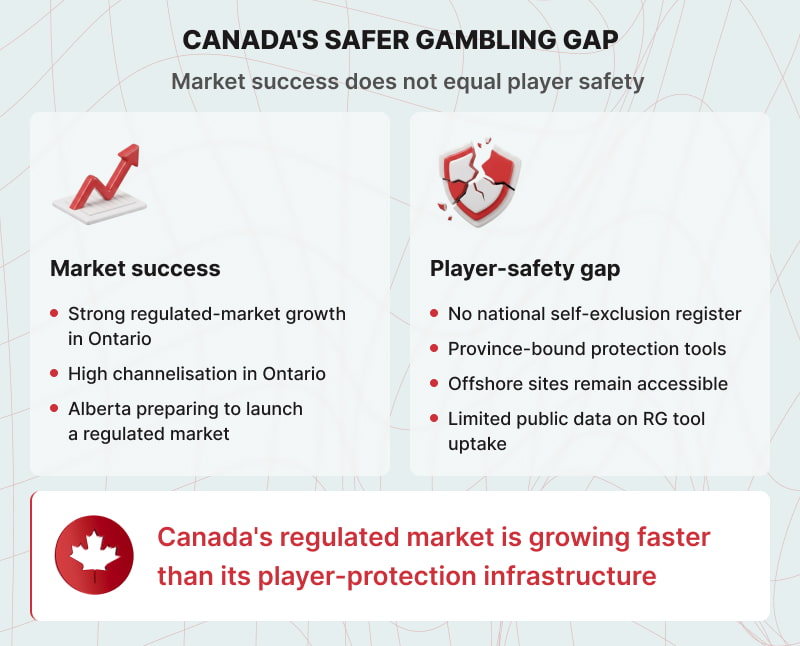
Canada’s online gambling market is the third-largest in the world. It generated approximately CAD 13.15 billion in 2025, growing faster than virtually any other country. By the metrics the industry tends to reach for, it is a success story.
Unfortunately, where many of the metrics that matter for player protection are concerned, the story is different. Unlike several other countries, Canada has no national self-exclusion register and no national licensing framework.
While Ontario is regulated, and there is a lot of excitement around Alberta opening its regulated market this summer, the overwhelming majority of online gambling in the country still happens on unlicensed platforms.
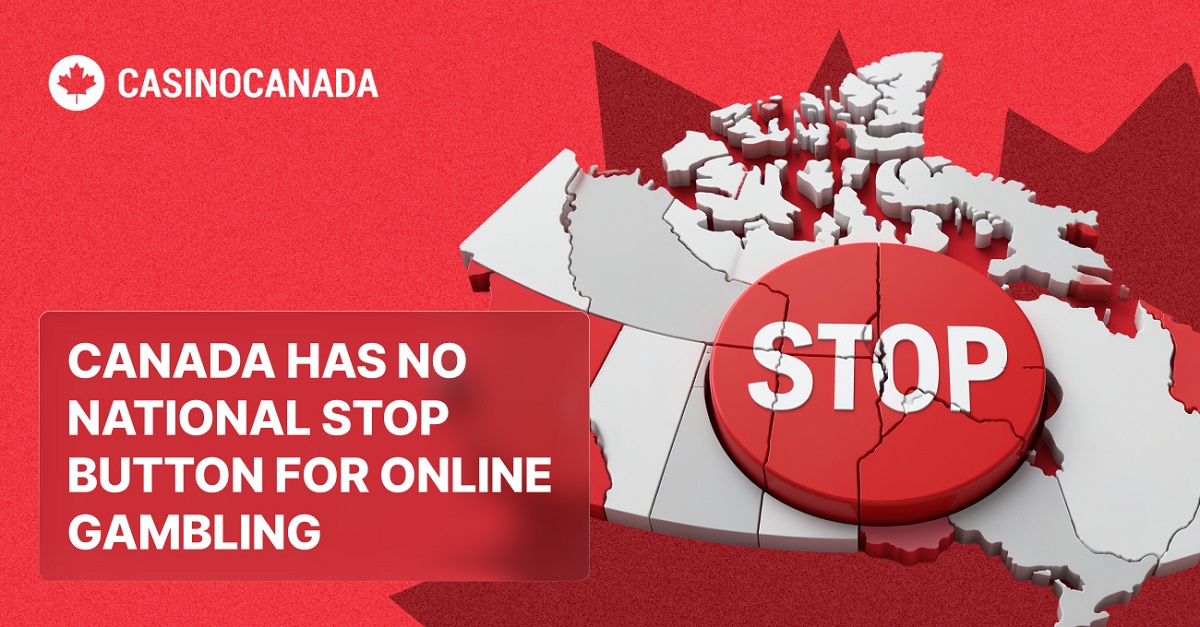
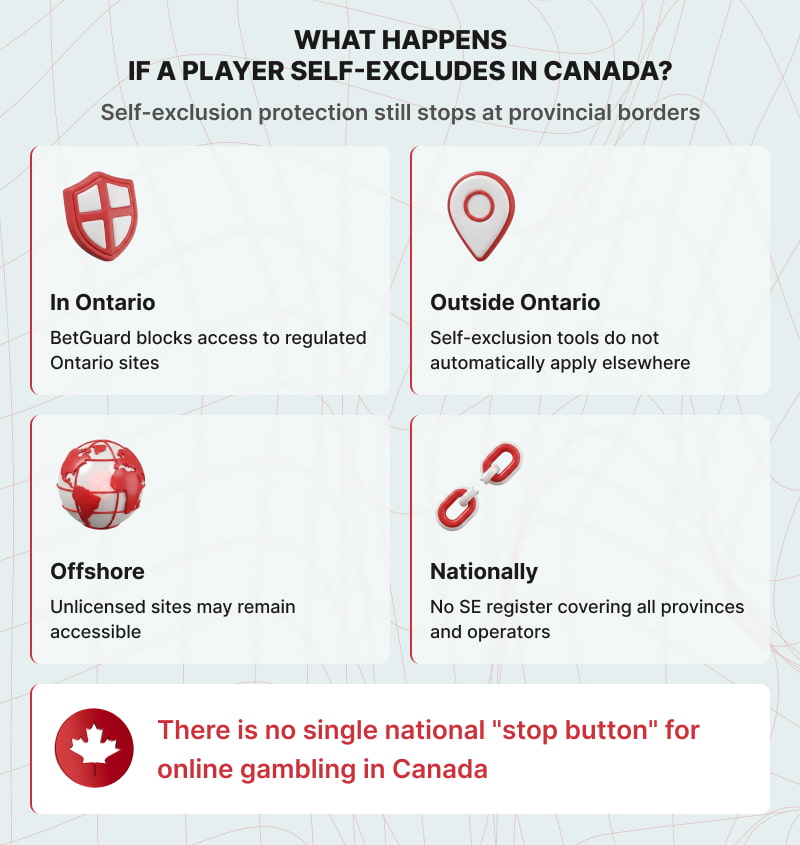
An Ontario or Alberta player who self-excludes still can gamble through offshore sites or outside the province. Canada has no single stop button.
Key Findings
- Canada has no national self-exclusion register, no national licensing framework, and the last national survey predates the legalisation of single-event sports betting.
- Offshore leakage outside Ontario ranges from 49% to 93% by province. The offshore market grew at 40% year-on-year in 2025.
- Ontario has a 91.1% channelisation rate, but 20.2% of players also play on unregulated sites.
- Player awareness of RG tools in Ontario stands at 65.4%, according to iGO’s own Leger survey baseline. No province publishes data on actual tool uptake rates.
- A CMAJ study found gambling helpline contacts in Ontario rose 198% after market privatisation, concentrated almost entirely in men aged 15 to 44.
A Fragmented System
Canada’s gambling framework is a product of its constitution. Sections 91 and 92 of the Constitution Act distribute authority to the provinces, and Section 207 of the Criminal Code permits them to conduct and manage lottery schemes within their own borders. A 1985 federal-provincial agreement completed the transfer, leaving Ottawa without a gambling regulator and the country without national standards of any kind.
The result is ten parallel regimes, all operating at different standards. Ontario operates an open market, and Alberta is building a similar structure. Every other province runs a government monopoly: BCLC’s PlayNow, Loto-Quebec’s Espace-jeux, and the Atlantic Lottery Corporation.
The issue is that there is no connection between these. A responsible gambling tool in one province has no power in another. A self-exclusion registered in Ontario does not block a player from gambling elsewhere.
Changes do not appear to be on the horizon, with no federal legislation on those issues currently before Parliament.
The Offshore Risks
The Blask 2025 USA and Canada iGaming Landscape Report highlights the scale of this problem. Saskatchewan carries an estimated 93% offshore leakage rate. Alberta and Manitoba sit at 88%. Quebec, where Loto-Quebec has operated since 2010, holds only around 17% of a market estimated at CAD 2.3 billion.
Even British Columbia, with years of PlayNow operations behind it, retains approximately 49-51% of its online market, according to Blask’s reports. Offshore platforms grew at 40% year-on-year in 2025, nearly double the 23% growth of domestic licensed operators.
Ontario’s Success and Limits
Ontario deserves genuine credit for its current position, and it is often hailed as an example of a strong regulatory market.
The regulated market generated CAD 82.7 billion in wagers and CAD 2.9 billion in gross gaming revenue in FY2024/25. Channelisation, measured by the share of online gamblers using regulated platforms, reached 83.7% in early 2025 and 91.1% on the most recent IPSOS survey.
However, the Ontario story is often viewed as the national story, and this is not the case. Even within the province, 20.2% of players using regulated platforms also gamble on unregulated sites.
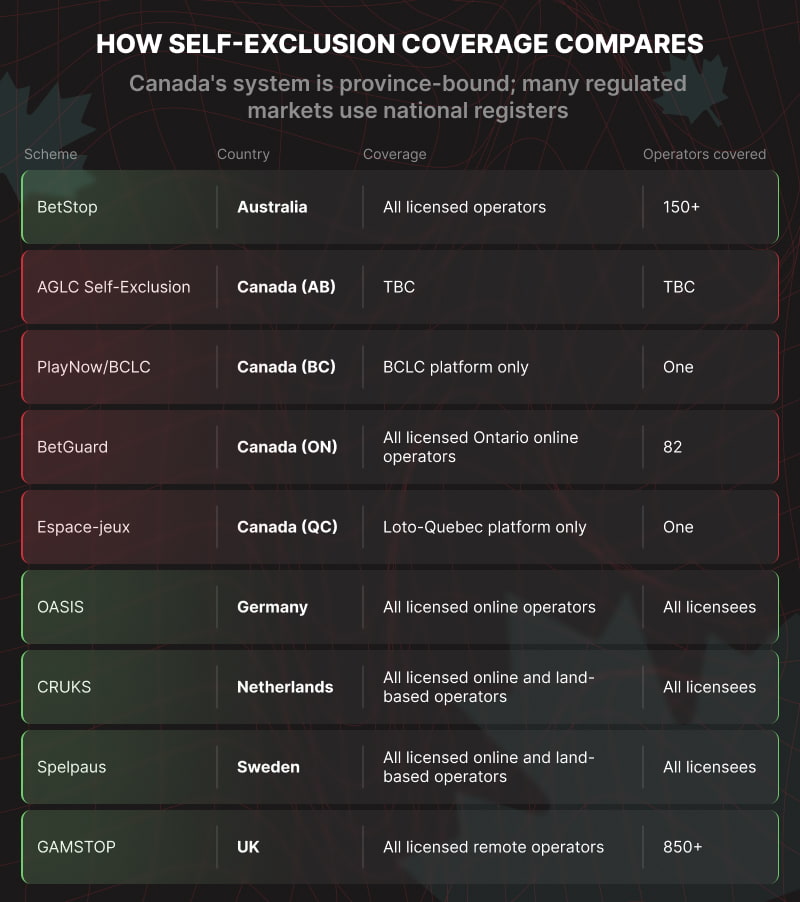
BetGuard, launched in May 2026, finally delivered the centralised self-exclusion system that the market should have had from day one, allowing a player to exclude from all regulated platforms at once.
The early take-up numbers show more than 500 people registered for BetGuard in its first two weeks. That is not a negligible start, and iGaming Ontario has stated it will measure the platform’s success by renewal rates, term lengths selected, and connections to addiction support services.
However, Ontario’s market has 1.235 million active player accounts. The gap between the scale of the regulated market and the early uptake of the tool is wide.
The deeper problem is that BetGuard is province-bound. A player who is excluded in Ontario is not blocked elsewhere.
Many other countries have solved this problem. GAMSTOP in the UK covers all licensed remote operators under a single registration. Spelpaus in Sweden does the same across online and land-based channels. BetStop in Australia covers approximately 150 licensed wagering providers with a five-minute sign-up.
Canada has no equivalent, and there is currently no route to making one.
What the Evidence Says
The academic case for nationally coordinated self-exclusion is strong. A comparative review of self-exclusion programmes across multiple jurisdictions found that the reach and enforcement of any scheme vary directly with how completely it covers the market.
A review of BCLC’s voluntary self-exclusion programme found that 97% of participants who gambled while excluded did so at venues not covered by their agreement. The exclusion worked where it applied, but not beyond that.
The tool-uptake literature is equally sobering. Studies analysing voluntary deposit-limit setting across large player populations find uptake rates in the low single digits over three-month periods. Ontario does not publish equivalent figures, but iGO’s own Leger survey in 2024 found that only 65.4% of regulated players were aware of available RG tools.
The gap between knowing a tool exists and using it is consistently wide, and no regulator publishes data on actual tool engagement rates. That absence is itself a significant accountability problem.
Where public health data does exist, it is alarming. British Columbia’s 2025/26 prevalence study found that 35% of past-year online gamblers showed moderate or high-risk behaviour.
The most striking recent evidence comes from a January 2026 CMAJ study analysing contacts with Ontario’s ConnexOntario helpline over thirteen years.
The study found that gambling-related contacts increased from a monthly rate of 13.4 per million before online gambling launched, to 17.0 after PlayOLG’s introduction, to 26.2 following the market opening in April 2022.
The increases occurred almost exclusively in adolescent boys and men aged 15 to 44, with the 15-to-24 age group estimated to have seen contacts rise by 337.8%.
A regulated market that generates record-breaking wagers and a near-200% increase in gambling-related helpline contacts simultaneously is simply demonstrating that market growth and player protection are not the same thing.
The Future
Alberta’s launch will introduce centralised self-exclusion from day one, requiring all registered operators to integrate with AGLC’s self-exclusion programme as a condition of registration.
This is a huge step in the right direction, but, like BetGuard, it will still be province-bound.
The case for a shared register is strong. Licensed operators are also competing with offshore threats. A functioning national self-exclusion infrastructure, combined with the channelisation benefits that a well-regulated market delivers, serves their commercial interests as directly as it serves players’ welfare.
If Canada is going to solve its responsible gambling issues, it needs to admit that the fragmented framework has shortcomings in customer care and stop using Ontario’s success as a stand-in for the country as a whole.
The post Canada’s Safer Gambling Gap: Why Market Success Doesn’t Always Equal Player Safety appeared first on Americas iGaming & Sports Betting News.

Supplier content is already live on BetMGM in Ontario, with Party Casino & Sports Interaction lined up ahead of Alberta’s July iGaming opening.
Gaming Corps has expanded its partnership with Entain, extending distribution of its casino content across more Entain brands and markets, with Canada positioned as a key near-term focus.
The supplier went live with Entain’s joint venture BetMGM in Ontario in December 2025, followed by a wider Entain rollout in the province in March 2026. Gaming Corps and Entain are also preparing for Alberta’s regulated iGaming market opening in July, with Gaming Corps content “ready to go live from day one with BetMGM” and Party Casino & Sports Interaction to follow.
Outside Canada, Gaming Corps said it completed a full content launch in Brazil with Sportingbet and Betboo in May, and launched 3 Pigs of Olympus exclusively across Entain’s UK-facing Ladbrokes, Coral Gala and Foxy brands in June. The company also said additional launches are being prepared for Portugal, Spain and New Zealand.
The latest phase includes football-themed titles such as Penalty Champion, Goals to Glory: Football Fever and Goals to Glory: Instant Blitz, alongside the supplier’s 3 Pigs IP. Graham Greensmith, Chief Commercial Officer at Gaming Corps, said: “For Gaming Corps, this is a huge milestone. Entain is one of the biggest names in global gaming, so to see our relationship grow in this way is a clear sign of the trust, performance and commercial value we have built together.
“What makes this particularly exciting is the scale of the opportunity. This is not a single-brand launch or a one-market rollout. Entain is continuing to take Gaming Corps content into more territories, across more of its brands, and that says a lot about where we are as a business.
“We have worked hard to build a portfolio that gives major operators real flexibility, from high-performing IP to timely, event-led content and new game formats. To see that strategy being recognised by a partner of Entain’s calibre is incredibly rewarding, and we are very excited about what comes next.”
Obdulio Bacarese, Global Gaming Director at Entain, added: “Gaming Corps has been a valuable partner over the last four years. The strength of the relationship lies in how easily the content can be activated around different commercial priorities, from supporting new market entries to adding timely releases around key calendar moments. The studio understands the need for content that is flexible, relevant and easy to position locally, and we are pleased to continue building on the partnership.”
The post Gaming Corps expands Entain deal with Ontario live and Alberta launch planned appeared first on EE Gaming | Global iGaming & Tech Intelligence Hub.
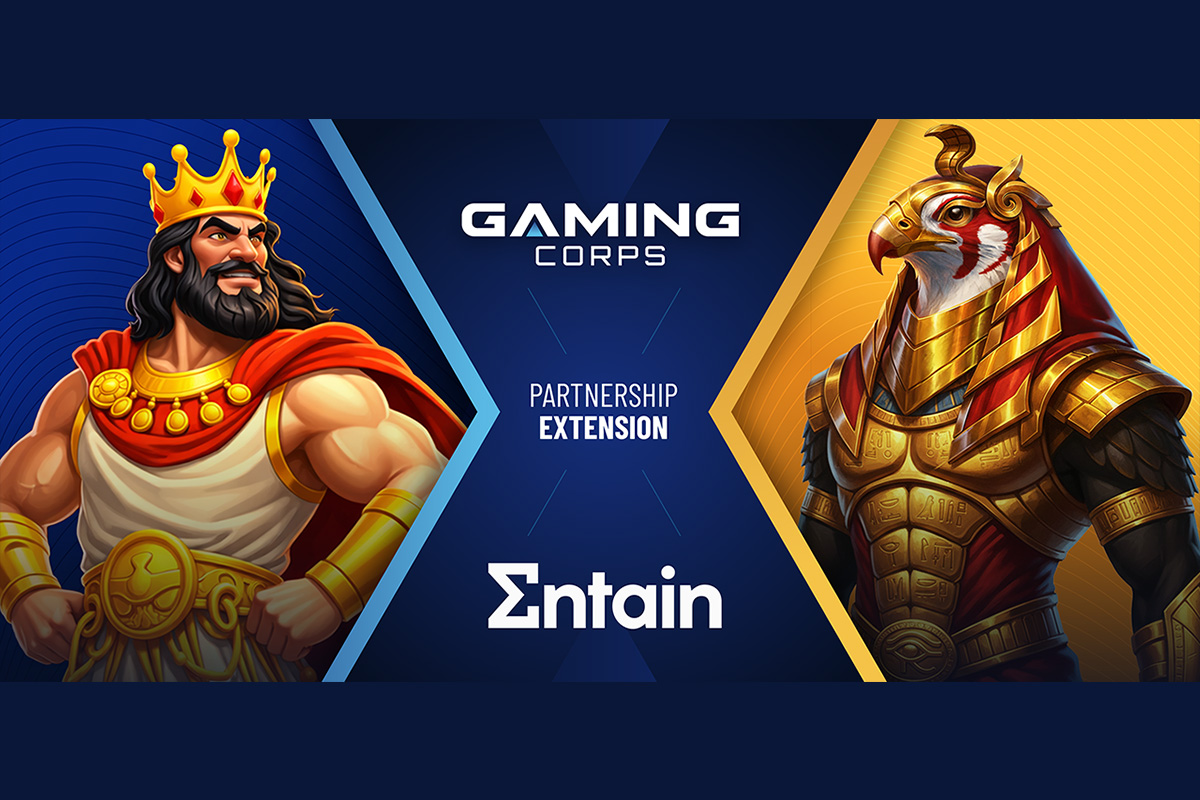
Gaming Corps, a publicly listed game development company based in Sweden, has expanded its partnership with Entain, one of the world’s largest sports betting and gaming groups, marking the latest phase of a relationship that began with the companies’ original partnership agreement in 2022 and now spans multiple Entain brands.
Canada is a major focus for the extended partnership. Gaming Corps went live with Entain’s Joint Venture, BetMGM in Ontario in December 2025, followed by a wider Entain rollout in the province in March 2026. Both are now preparing for the opening of Alberta’s regulated iGaming market in July, with the studio’s content ready to go live from day one with BetMGM and Party Casino & Sports Interaction following shortly after.
The partnership has also continued to grow internationally, with Gaming Corps completing a full content launch in Brazil with Sportingbet and Betboo in May of this year, followed by the exclusive launch of 3 Pigs of Olympus across Entain’s UK-facing Ladbrokes, Coral Gala and Foxy brands in June.
Additional market launches in Portugal, Spain and New Zealand are also being prepared.
The latest phase includes a mix of Gaming Corps’ most recognisable content, from football-themed titles such as Penalty Champion, Goals to Glory: Football Fever and Goals to Glory: Instant Blitz, to the studio’s high-performing 3 Pigs IP.
Graham Greensmith, Chief Commercial Officer at Gaming Corps, said: “For Gaming Corps, this is a huge milestone. Entain is one of the biggest names in global gaming, so to see our relationship grow in this way is a clear sign of the trust, performance and commercial value we have built together.
“What makes this particularly exciting is the scale of the opportunity. This is not a single-brand launch or a one-market rollout. Entain is continuing to take Gaming Corps content into more territories, across more of its brands, and that says a lot about where we are as a business.
“We have worked hard to build a portfolio that gives major operators real flexibility, from high-performing IP to timely, event-led content and new game formats. To see that strategy being recognised by a partner of Entain’s calibre is incredibly rewarding, and we are very excited about what comes next.”
Obdulio Bacarese, Global Gaming Director at Entain, added: “Gaming Corps has been a valuable partner over the last four years. The strength of the relationship lies in how easily the content can be activated around different commercial priorities, from supporting new market entries to adding timely releases around key calendar moments. The studio understands the need for content that is flexible, relevant and easy to position locally, and we are pleased to continue building on the partnership.”
The post Gaming Corps expands Entain partnership with major Canadian rollout appeared first on Americas iGaming & Sports Betting News.

-

 Affiliate Industry6 days ago
Hub Affiliations Triumphs at the iGB Affiliate Awards 2026: Winner of Programme/Network Campaign of the Year
-
Austria7 days ago
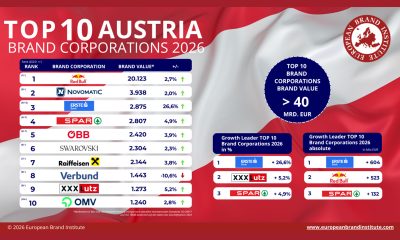
Austrian Brand Value Study: NOVOMATIC Defends Top Ranking
-
Latest News6 days ago
N1 Partners at iGB L!VE 2026: Bringing Together Affiliates, Art and Innovation
-
Africa7 days ago
PopOK Gaming sponsors Botswana’s TT Cup Challenge horse racing event
-
Betsson CEO Pontus Lindwall7 days ago
Gaming in the Nordics launch event sets annual Copenhagen conference from 2027
-
Amusnet7 days ago
Amusnet Releases its Latest Video Slot “Golden Snake”
-
Azerbaijani Parliament7 days ago
Azerbaijan to Impose Tougher Penalties for Illegal Online Gambling
-
Amusnet7 days ago
Weekend Reels | Week 27: Slot Drops & Trends