Canada
Return of Sports Brings a Resurgence of Online Betting

As the legal infrastructure becomes more friendly towards sports betting, specifically in the online space, many companies in the gambling industry are beginning to offer more sports betting options. According to a report by the Associated Press, companies like DraftKings are making serious strides in developing easy to use systems available to the public through partnerships with sports leagues. Now, as the restrictions of social distancing are slowly being scaled back in numerous states, new numbers on gambling and sports betting are being reported. For example, a report by the Chicago Sun-Times indicates that New Jersey gamblers set a nationwide record for the most money bet on sports in a single month, spending almost USD 668 Million in August on events including resurgent baseball, basketball and hockey seasons that had been interrupted by the outbreak. FansUnite Entertainment Inc. (OTC: FUNFF) (CSE: FANS), DraftKings Inc. (NASDAQ: DKNG), International Game Technology PLC (NYSE: IGT), Boyd Gaming Corporation (NYSE: BYD), Penn National Gaming, Inc. (NASDAQ: PENN)
New Jersey has been the first state to make sports betting legal back in 2018. In total, sports betting is legal in some form in 24 states, according to date provided by ESPN. Of course, sports betting legalization in the United States is a complex issue. Nevertheless, despite the legal challenges, interest in the industry is high. According to a report by MarketWatch, many have invested money into a new exchange-traded fund that tracks the sports betting and online gambling industries. This represents a “remarkable vote of confidence for a fund that’s only a few days old,” said Dave Nadig, a longtime industry veteran now at ETF Database. “I am a fan of this fund. If you believe online sports betting is the next big thing, this fund will capture everything from back-office infrastructure to front-facing retail plays.”
FansUnite Entertainment Inc. (OTC: FUNFF) (CSE: FANS) announced earlier last week that,
“McBookie Ltd (“McBookie”) has continued its impressive performance since becoming part of FansUnite.
The Scottish based operator increased its overall year-over-year (“YOY”) turnover for the months of July and August by 108% – from $3M CAD to $6.3M CAD, with 78% of the turnover growth led by the return of sport.
The increase resulted in a YOY increase in Gross Gaming Revenue over the same period of 412%, resulting in gross gaming revenue of $371K for July and August 2020 and a gross margin of $161K. During the same period last year the platform generated $72K in gross gaming revenue resulting in a gross margin loss of $66K.
With the strong results over the last two months, McBookie is preparing to continue the positive trend with the return of the English Premier League and the other major European leagues in the coming weeks.
‘We are very pleased that McBookie has been able to continue its strong 2020 performance despite the slowdown in sports betting from the global pandemic,’ said Scott Burton, CEO of FansUnite. ‘The figures for the past 60 days have been exceptional and continue to validate our belief in this leading B2C betting brand and the management team behind it. For the duration of 2020, major European leagues are set to begin again and present a great opportunity for McBookie to capture the attention of new and existing customers. We will work directly with McBookie in ensuring their presence in the U.K. expands and they are in a position to service this growing user base of bettors.’
‘The team at FansUnite has worked very hard to improve all aspects of our business since joining FansUnite and it is great to see that replicated in the numbers,’ said Paul Petrie, founder and Director of McBookie. ‘With just one month to wait until the whole of Scottish football is back, having the resources and expertise of FansUnite helps puts us in an excellent position to continue building on our recent success.’
While the return of sport has provided an uptick in betting volume, casino turnover during the two-month period was strong as well with $3.1M wagered. McBookie will be looking to build on these numbers with the recent launch of a Live Casino product earlier this month.
‘After launching a successful Virtual Sports betting offering in March, we decided to expand our platform with the addition of a Live Casino,’ continued Paul Petrie. ‘It represents another betting alternative for our loyal customers and helps us diversify our revenue stream.’”
For our latest “Buzz on the Street” Show featuring FansUnite Entertainment Inc. recent corporate news, please head over to: https://www.youtube.com/watch?v=SkSk3GQD6GI
DraftKings Inc. (NASDAQ: DKNG) announced yesterday a multi-year agreement with ESPN to become a co-exclusive sportsbook link-out provider and exclusive daily fantasy sports provider of the media giant. Links across ESPN digital platforms will connect fans to DraftKings’ products and services. “ESPN helped revolutionize the 24/7 sports news cycle and continues to be the go-to source for many fans today on the latest and largest sports stories,” said Jason Robins, Co-Founder, Chairman and Chief Executive Officer, DraftKings. “We look forward to this collaboration to exclusively showcase DraftKings’ daily fantasy content and offerings while also advancing further visibility and mainstream adoption of our regulated sports betting products.” Under the agreement, DraftKings will now be able to integrate its products and offerings across ESPN’s digital platforms. DraftKings will also power existing and future ESPN studio shows with dedicated segments for promotion, beginning with daily fantasy sports.
International Game Technology PLC (NYSE: IGT) announced last month that it has expanded its PlaySports offering for the U.S. sports betting market with the formation of its own full-service Trading Team based in Las Vegas, Nev. The diverse and talented team adds another dimension of service to the most widely deployed B2B sports betting solution in the U.S. market and further cements IGT’s market leadership. “IGT’s in-house, U.S.-based Trading Team enhances the appeal of the entire PlaySports offering and enables us to deliver an ‘all-indone’ solution for operators seeking a single sports betting service provider,” said Enrico Drago, IGT PlayDigital Senior Vice President. “IGT PlaySports’ pure B2B focus, the Trading Team’s in-depth knowledge of regional and local betting preferences and trends, and the Company’s favorable regulatory standings in tribal and state-governed jurisdictions across the U.S. continue to create opportunities for our customers and drive our nationwide sports betting leadership.”
Boyd Gaming Corporation (NYSE: BYD) and FanDuel Group just announced the debut of the FanDuel Par-A-Dice Sportsbook in the state of Illinois. Sports bettors across the state of Illinois now have access to FanDuel’s industry-leading online and mobile sports-betting platform, with wagering options available in professional football, basketball, baseball, hockey and more. Additionally, FanDuel will operate a retail sportsbook located at Boyd Gaming’s Par-A-Dice Casino in East Peoria, Illinois, pending regulatory approval. Keith Smith, President and Chief Executive Officer of Boyd Gaming, said: “Given the tremendous success of our existing FanDuel Sportsbooks, we are confident that the FanDuel Par-A-Dice Sportsbook will quickly become Illinois sports bettors’ mobile app of choice. We are excited for the opportunity to offer both mobile and retail sports betting in one of the most populous states in the country, as we continue to expand our strategic partnership with FanDuel Group.”
Penn National Gaming, Inc. (NASDAQ: PENN) announced on July 1st, that it had entered into a partnership with Sportradar, the global provider of sports data and content, to use official National Football League (“NFL”) data on the Company’s sports betting platforms. As part of the partnership, Penn National has the ability to offer a wide array of live, in-game wagering options on NFL games at its retail sports betting locations and on its Barstool Sportsbook app, which is expected to launch in the third quarter of 2020. “We are thrilled to be partnering with Sportradar for NFL data in advance of the upcoming football season,” said Jon Kaplowitz, Senior Vice President of Penn National’s interactive gaming division. “Delivering official NFL data to our growing, loyal audience, including over 66 million Barstool fans and our 20 million casino customers, will provide tremendous wagering opportunities where we operate sports books across the country.”
SOURCE FinancialBuzz.com
Powered by WPeMatico

High 5 Games, the creator of premium casino content for the land based, online and social gaming markets announced it has secured supplier approval from the Alberta Gaming, Liquor and Cannabis Commission (AGLC), extending its games beyond Play Alberta to all licensed operators in the province’s newly opened commercial iGaming market.
High 5 Games has entertained Alberta players since 2024 through Play Alberta, the province’s government operated gaming platform, where titles such as DaVinci DeluxeWays, Billionaire’s Bank, Green Machine and more have become established player favourites. With Alberta’s commercial market now open, that same proven portfolio is available to all licensed operators entering the province.
Alberta’s commercial iGaming market will be opening on July 13, 2026, making it the second Canadian province after Ontario to welcome private sector operators. Overseen by AGLC and the Alberta iGaming Corporation (AiGC), the market launched with nearly 50 registered operator brands, one of the most anticipated regulated market openings in North America this year.
The approval extends High 5 Games’ regulated North American footprint, which includes New Jersey, Michigan, Pennsylvania, Connecticut, West Virginia, Ontario, Quebec, British Columbia. Alberta players will gain access to High 5’s catalogue of player favourite titles, including DaVinci DeluxeWays, Billionaire’s Bank, Green Machine and other titles through launch partnerships with operators.
“Alberta players already know and love our games through Play Alberta, that is a head start no newcomer to this market can claim. With the open market live, every operator in the province can now offer their players the award winning High 5 titles they have been playing for years, from day one.” says Tony Singer, CEO at High 5 Games.
High 5 Games’ content is certified across New Jersey, Michigan, Pennsylvania, Connecticut, West Virginia, Ontario, British Columbia and the studio has developed more than 300 games over three decades of game making.
The post High 5 Games Expands Across Alberta’s Open iGaming Market Following AGLC Supplier Approval appeared first on Americas iGaming & Sports Betting News.


The supplier can now distribute its online casino titles beyond Play Alberta to all licensed operators in the province.
High 5 Games has secured supplier approval from the Alberta Gaming, Liquor and Cannabis Commission (AGLC), allowing the studio to supply its online casino content to all licensed operators in Alberta’s newly opened commercial iGaming market.
The company has been live in the province since 2024 via Play Alberta, the government-operated platform, where it said titles including DaVinci DeluxeWays, Billionaire’s Bank and Green Machine have become player favourites. With the commercial market now open, High 5 Games said the same portfolio can be offered across operators entering Alberta.
Alberta’s commercial iGaming market is set to open on July 13, 2026, becoming Canada’s second province after Ontario to allow private-sector operators. The market is overseen by AGLC and the Alberta iGaming Corporation (AiGC) and launched with nearly 50 registered operator brands, according to the company.
“Alberta players already know and love our games through Play Alberta, that is a head start no newcomer to this market can claim. With the open market live, every operator in the province can now offer their players the award winning High 5 titles they have been playing for years, from day one.” says Tony Singer, CEO at High 5 Games.
High 5 Games said the AGLC approval expands its regulated North American footprint, which it listed as including New Jersey, Michigan, Pennsylvania, Connecticut, West Virginia, Ontario, Quebec and British Columbia. The company said it has developed more than 300 games over three decades.
The post High 5 Games wins AGLC supplier approval ahead of Alberta iGaming launch appeared first on EE Gaming | Global iGaming & Tech Intelligence Hub.
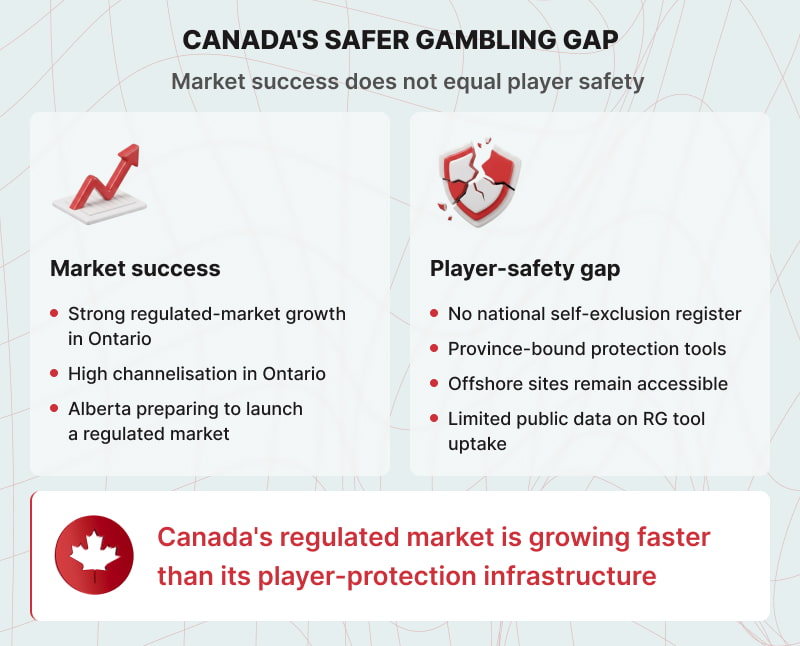
Canada’s online gambling market is the third-largest in the world. It generated approximately CAD 13.15 billion in 2025, growing faster than virtually any other country. By the metrics the industry tends to reach for, it is a success story.
Unfortunately, where many of the metrics that matter for player protection are concerned, the story is different. Unlike several other countries, Canada has no national self-exclusion register and no national licensing framework.
While Ontario is regulated, and there is a lot of excitement around Alberta opening its regulated market this summer, the overwhelming majority of online gambling in the country still happens on unlicensed platforms.
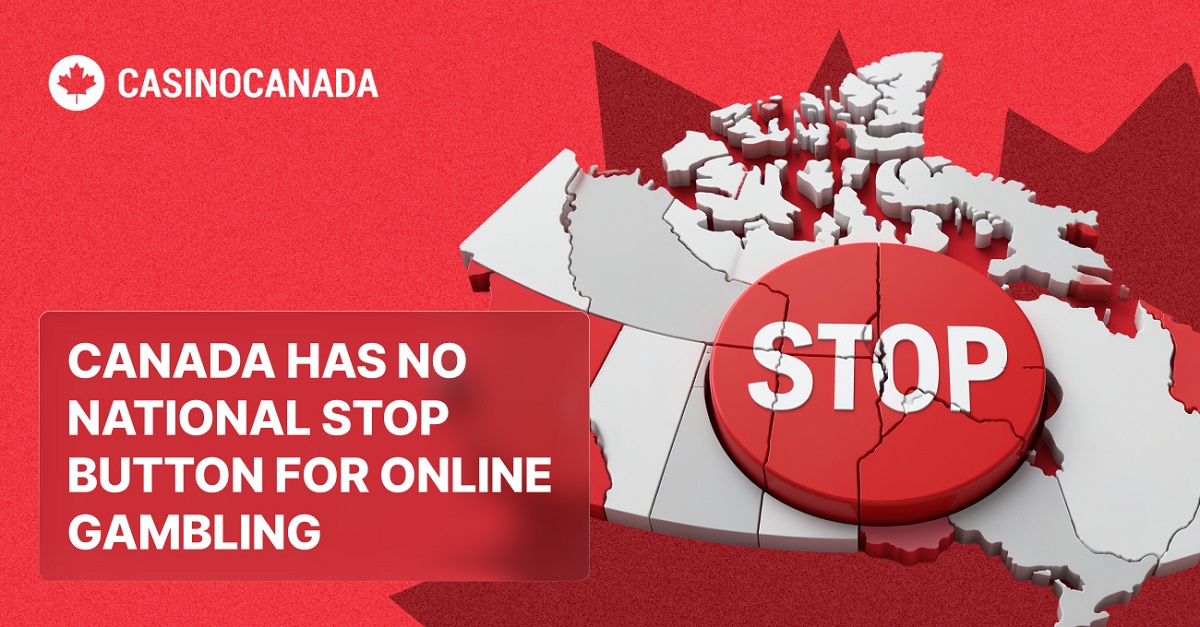
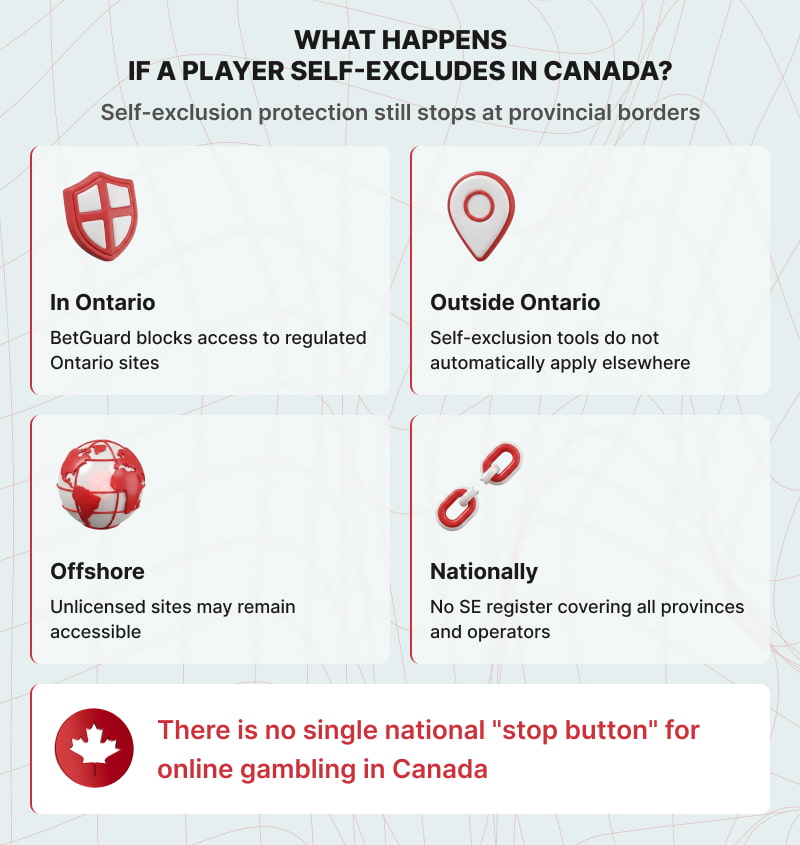
An Ontario or Alberta player who self-excludes still can gamble through offshore sites or outside the province. Canada has no single stop button.
Key Findings
- Canada has no national self-exclusion register, no national licensing framework, and the last national survey predates the legalisation of single-event sports betting.
- Offshore leakage outside Ontario ranges from 49% to 93% by province. The offshore market grew at 40% year-on-year in 2025.
- Ontario has a 91.1% channelisation rate, but 20.2% of players also play on unregulated sites.
- Player awareness of RG tools in Ontario stands at 65.4%, according to iGO’s own Leger survey baseline. No province publishes data on actual tool uptake rates.
- A CMAJ study found gambling helpline contacts in Ontario rose 198% after market privatisation, concentrated almost entirely in men aged 15 to 44.
A Fragmented System
Canada’s gambling framework is a product of its constitution. Sections 91 and 92 of the Constitution Act distribute authority to the provinces, and Section 207 of the Criminal Code permits them to conduct and manage lottery schemes within their own borders. A 1985 federal-provincial agreement completed the transfer, leaving Ottawa without a gambling regulator and the country without national standards of any kind.
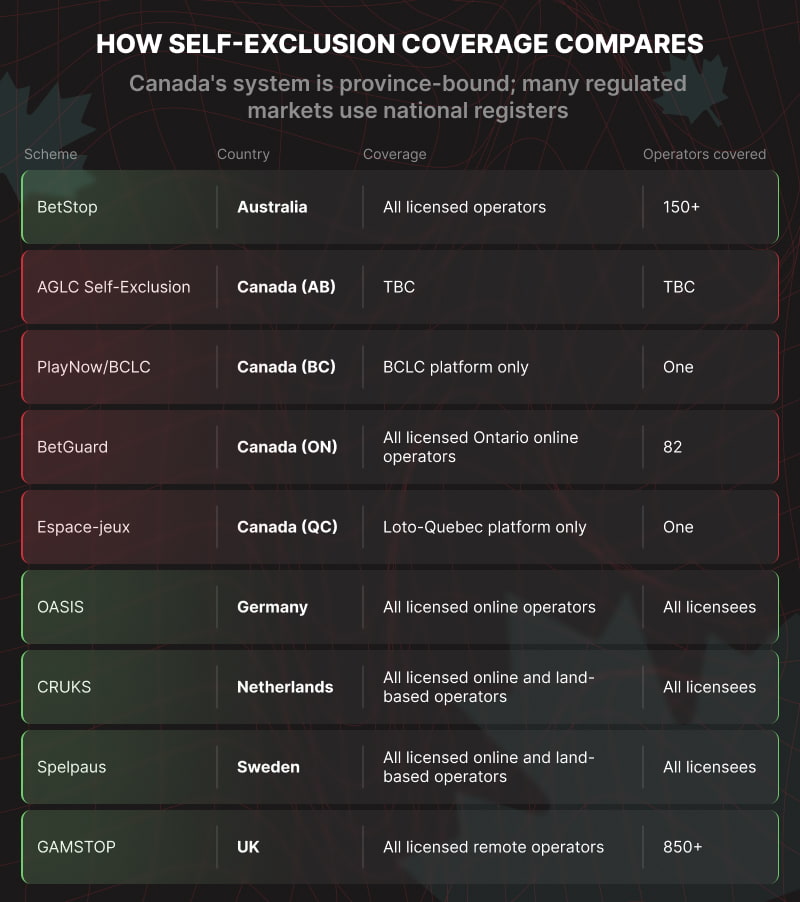
The result is ten parallel regimes, all operating at different standards. Ontario operates an open market, and Alberta is building a similar structure. Every other province runs a government monopoly: BCLC’s PlayNow, Loto-Quebec’s Espace-jeux, and the Atlantic Lottery Corporation.
The issue is that there is no connection between these. A responsible gambling tool in one province has no power in another. A self-exclusion registered in Ontario does not block a player from gambling elsewhere.
Changes do not appear to be on the horizon, with no federal legislation on those issues currently before Parliament.
The Offshore Risks
The Blask 2025 USA and Canada iGaming Landscape Report highlights the scale of this problem. Saskatchewan carries an estimated 93% offshore leakage rate. Alberta and Manitoba sit at 88%. Quebec, where Loto-Quebec has operated since 2010, holds only around 17% of a market estimated at CAD 2.3 billion.
Even British Columbia, with years of PlayNow operations behind it, retains approximately 49-51% of its online market, according to Blask’s reports. Offshore platforms grew at 40% year-on-year in 2025, nearly double the 23% growth of domestic licensed operators.
Ontario’s Success and Limits
Ontario deserves genuine credit for its current position, and it is often hailed as an example of a strong regulatory market.
The regulated market generated CAD 82.7 billion in wagers and CAD 2.9 billion in gross gaming revenue in FY2024/25. Channelisation, measured by the share of online gamblers using regulated platforms, reached 83.7% in early 2025 and 91.1% on the most recent IPSOS survey.
However, the Ontario story is often viewed as the national story, and this is not the case. Even within the province, 20.2% of players using regulated platforms also gamble on unregulated sites.
BetGuard, launched in May 2026, finally delivered the centralised self-exclusion system that the market should have had from day one, allowing a player to exclude from all regulated platforms at once.
The early take-up numbers show more than 500 people registered for BetGuard in its first two weeks. That is not a negligible start, and iGaming Ontario has stated it will measure the platform’s success by renewal rates, term lengths selected, and connections to addiction support services.
However, Ontario’s market has 1.235 million active player accounts. The gap between the scale of the regulated market and the early uptake of the tool is wide.
The deeper problem is that BetGuard is province-bound. A player who is excluded in Ontario is not blocked elsewhere.
Many other countries have solved this problem. GAMSTOP in the UK covers all licensed remote operators under a single registration. Spelpaus in Sweden does the same across online and land-based channels. BetStop in Australia covers approximately 150 licensed wagering providers with a five-minute sign-up.
Canada has no equivalent, and there is currently no route to making one.
What the Evidence Says
The academic case for nationally coordinated self-exclusion is strong. A comparative review of self-exclusion programmes across multiple jurisdictions found that the reach and enforcement of any scheme vary directly with how completely it covers the market.
A review of BCLC’s voluntary self-exclusion programme found that 97% of participants who gambled while excluded did so at venues not covered by their agreement. The exclusion worked where it applied, but not beyond that.
The tool-uptake literature is equally sobering. Studies analysing voluntary deposit-limit setting across large player populations find uptake rates in the low single digits over three-month periods. Ontario does not publish equivalent figures, but iGO’s own Leger survey in 2024 found that only 65.4% of regulated players were aware of available RG tools.
The gap between knowing a tool exists and using it is consistently wide, and no regulator publishes data on actual tool engagement rates. That absence is itself a significant accountability problem.
Where public health data does exist, it is alarming. British Columbia’s 2025/26 prevalence study found that 35% of past-year online gamblers showed moderate or high-risk behaviour.
The most striking recent evidence comes from a January 2026 CMAJ study analysing contacts with Ontario’s ConnexOntario helpline over thirteen years.
The study found that gambling-related contacts increased from a monthly rate of 13.4 per million before online gambling launched, to 17.0 after PlayOLG’s introduction, to 26.2 following the market opening in April 2022.
The increases occurred almost exclusively in adolescent boys and men aged 15 to 44, with the 15-to-24 age group estimated to have seen contacts rise by 337.8%.
A regulated market that generates record-breaking wagers and a near-200% increase in gambling-related helpline contacts simultaneously is simply demonstrating that market growth and player protection are not the same thing.
The Future
Alberta’s launch will introduce centralised self-exclusion from day one, requiring all registered operators to integrate with AGLC’s self-exclusion programme as a condition of registration.
This is a huge step in the right direction, but, like BetGuard, it will still be province-bound.
The case for a shared register is strong. Licensed operators are also competing with offshore threats. A functioning national self-exclusion infrastructure, combined with the channelisation benefits that a well-regulated market delivers, serves their commercial interests as directly as it serves players’ welfare.
If Canada is going to solve its responsible gambling issues, it needs to admit that the fragmented framework has shortcomings in customer care and stop using Ontario’s success as a stand-in for the country as a whole.
The post Canada’s Safer Gambling Gap: Why Market Success Doesn’t Always Equal Player Safety appeared first on Americas iGaming & Sports Betting News.

-

 10bet7 days ago
Ellis Park Stadium signs five-year naming rights deal with 10bet
-
Bucharest6 days ago
Eeze opens 1,200 sqm Bucharest hub for technical teams
-
central asia7 days ago
Groove confirms attendance at SBC Summit Tbilisi 2026
-
AB Trav och Galopp4 days ago
BetMakers Technology Group Selected to Distribute ATG Horse Racing Content Across Australia and New Zealand
-
API integration5 days ago
Belatra signs cooperation deal to distribute slots via VeliGames
-
BETANO6 days ago
Play’n GO strengthens Latin American presence with Betano Colombia launch
-
affiliate marketing6 days ago
SEOBROTHERS’ Aleksandra Drigo flags higher barriers for affiliates in regulated Alberta
-
Aino Lahti5 days ago
Kasinohai Audit: Most Slots Could Be Affected by Finland’s Draft Gambling Rules