Compliance Updates
Cyprus Betting Authority Deploys 150 Secret Agents to Conduct Raids on Betting Agencies

The Cyprus NBA is significantly ramping up its regulatory oversight for 2026. Raids on betting agencies are being carried out by “undercover” agents as part of stepped-up checks by the NBA to ensure compliance with the law.
The NBA has procured inspection services from the private sector, deploying 150 undercover agents who pose as customers and enter betting premises unannounced.
While on site, the agents monitor staff conduct, check whether illegal bets are being placed and verify that minors are not present.
Alongside these surprise visits, NBA officers also carry out on-site inspections and monitor betting websites used by hundreds of players, while inspections are also conducted to identify potential money-laundering activity.
The issues related to the violations of rules were raised during a meeting of the House Finance Committee, where an NBA representative said the Authority imposed fines totalling €46,000 last year.
Of that amount, €26,000 related to breaches linked to the lack of required licences, with the remainder stemming from the presence of minors on premises and other violations of the legislation.
At the same time, data submitted to parliament showed that bets worth €1.3 billion were placed last year, with players receiving €1.17bn in winnings.
Against that backdrop, and following an increase in the betting tax, state revenue from betting rose to €6 million, up from €3.2m a year earlier.
During the discussion, it was also noted that a draft bill has been pending at the Ministry of Finance for around a year.
The bill provides for new products and services, as well as enhanced safeguards for responsible gaming and the protection of minors.
A representative of the ministry clarified that there are no plans to introduce online casino games.
Expected revenue from betting activity is projected at €71.85m this year, an increase of 28.03 per cent, or €15.73m, compared with 2025.
Revenue is forecast to rise further to €75.27m in 2027 and €78.59m in 2028.
Breaking down the figures, betting tax is expected to generate €53m, licence fees €8.2m and betting activity contributions €10m.
Class A and Class B licence holders pay tax at a rate of 10 per cent on net betting earnings, with Class A covering land-based betting and Class B online betting.
In addition, €32m relates to betting tax on Opap’s Cyprus’ gross profits under the new contract, while licences for Class A and B operators, authorised representatives and premises are expected to bring in €2.8m.
A further €5m concerns Opap’s Cyprus’ licence fee and €0.4m its supervision contribution, also under the revised agreement.
The post Cyprus Betting Authority Deploys 150 Secret Agents to Conduct Raids on Betting Agencies appeared first on Eastern European Gaming | Global iGaming & Tech Intelligence Hub.









Massive Gaming (MVG), an international iGaming content supplier based in Australia, has obtained a B2B Gaming License from the Malta Gaming Authority (MGA), representing a significant achievement in the firm’s growth into regulated global markets.
The MGA license allows Massive Gaming to provide its gaming content and solutions to operators licensed under Malta‘s regulatory framework, enhancing the company’s capacity to partner with associates throughout Europe and other regulated regions.
To facilitate its regulatory growth, Massive Gaming set up MVG Malta, a specialized entity formed during the licensing process, which aids the company’s larger strategy to enhance its presence within the European iGaming landscape.
Massive Gaming expands its gaming lineup through three studios: Slot Mart, Whale House, and Blitzcrown. Each provides a variety of gaming experiences, including classic slot games, content from regulated markets, and new non-traditional gaming formats like crash-style games.
George Cho, Director at Massive Gaming, said: “Securing the MGA B2B license represents an important milestone for Massive Gaming as we continue to expand our presence in regulated markets. This achievement strengthens our ability to collaborate with operators and partners worldwide, and we look forward to building new partnerships as we grow our global distribution network.”
The Malta Gaming Authority is well-known as one of the most esteemed regulatory agencies in the worldwide iGaming sector, offering a strong foundation for compliance, transparency, and player safety.
Having obtained the MGA B2B license, Massive Gaming seeks to enhance its collaborations with operators and platforms looking for premium gaming content in regulated markets.
The post Massive Gaming Gains MGA B2B Approval to Accelerate Global iGaming Alliances appeared first on Eastern European Gaming | Global iGaming & Tech Intelligence Hub.
The Alberta Gaming, Liquor and Cannabis (AGLC) board has approved Bede Gaming as suitable to hold a conditional one-year iGaming Goods or Services Supplier licence, ahead of Alberta’s regulated gambling market opening later this year.
As one of the first international platform providers to gain regulatory approval, Bede Gaming is now positioned to offer its platform and services to operators targeting Alberta, unlocking new commercial opportunities as the province launches its regulated iGaming ecosystem.
Fully SOC 2 certified, Bede Gaming provides operators with a streamlined entry into the market. Its comprehensive in-house product suite, combined with over 150 third-party integrations, equips businesses with the tools to scale efficiently and sustainably while navigating a newly regulated environment.
Having opened registrations in January 2026, Alberta’s iGaming market is expected to follow a growth trajectory similar to Ontario’s regulated sector, making it an attractive destination for international operators. Bede is proud to be among the first licensed providers preparing for the province’s official market launch.
Colin Cole-Johnson, CEO of Bede Gaming, commented:
“Bede is thrilled to receive conditional regulatory approval to operate in Alberta, putting us in a strong position to support operators as they expand into the province.
“We have a long-standing commitment to the Canadian iGaming market, and this marks an exciting new chapter. Being one of the first applicants recognised by the regulator allows us to offer a truly localised service, and our SOC 2 certification ensures partners can launch quickly and confidently.”
The post Bede Gaming cleared for Alberta market entry appeared first on Eastern European Gaming | Global iGaming & Tech Intelligence Hub.

The Alberta Gaming, Liquor and Cannabis (AGLC) board has declared Bede Gaming suitable to hold a conditional one-year iGaming Goods or Services Supplier licence when the province opens its regulated gambling market later in the year.
As one of the first international platform providers to be granted approval from the regulator, Bede is now ready to offer its services to operators targeting Alberta when the newly-regulated province officially goes live, creating a range of commercial possibilities for the company moving forward.
Fully SOC 2 certified, the established software provider is well-equipped to help partners secure a quick and hassle-free entry into Alberta, and its suite of in-house products and 150+ third-party integrations provides the perfect toolset for businesses to scale both efficiently and sustainably.
Having begun accepting registrations in January 2026, Alberta is expected to see growth on par with the regulated Ontario iGaming market over the longer term, making it an enticing destination for international operators looking to expand their global outreach; and Bede is honoured to be among the first licensed providers in the run-up to the province officially opening for business.
Colin Cole-Johnson, Chief Executive Officer at Bede Gaming, said: “Bede is delighted to receive conditional regulatory approval to work in Alberta, putting us in a great position to support operators with their upcoming expansions in the province.
“We have a longstanding investment in the Canadian iGaming industry, and I’m eager for the exciting opportunities ahead in this new market. As one of the first applicants to be formally recognised by the regulator, Bede offers a truly localised service to its partners, and the fact that we’re SOC 2 certified will allow them to hit the ground running as soon as they’re ready to launch.”
The post Bede Gaming cleared for Alberta market entry appeared first on Americas iGaming & Sports Betting News.

-

 Games Global7 days ago
Games Global and Stormcraft Studios dive into aquatic adventure with Mermaid’s Millions Cashingo™
-
Edvardas Sadovskis CPO at ICONIC217 days ago
Patrick’s Lucky Fortune by ICONIC21 Rolls Out to Power Operator Growth and Seasonal Offers
-
Alex Fonseca CEO Superbet Brazil7 days ago
Fluminense and Superbet Renew Their Partnership
-
Africa6 days ago
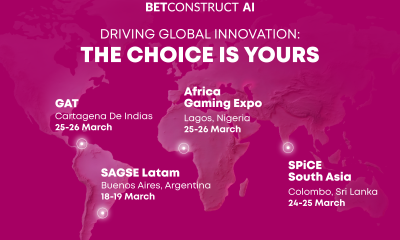
BetConstruct AI to Drive Global Innovation and Strategic Growth AcrossKey Markets in LatAm, Asia, and Africa
-
Centurion Winner Grand Chance™5 days ago
New from Inspired: Luck It Up™ and Centurion Winner Grand Chance™ available online & on mobile
-
Blazin' Bonus5 days ago
Booming Games releases Blazin’ Bonus
-
Asia6 days ago
Mumbai to Host the Prestigious Global Esports Games (GEG) World Finals from March 19–22
-
Cristiano Blanco CEO of SpinCore Group5 days ago
SpinCore Group Enters Finnish Market via Finnplay Partnership