Compliance Updates
KSA: Spring 2025 Monitoring Report Shows Positive Effect of Responsible Gaming Policy


The measures introduced in October to protect players have had a positive effect: players are losing fewer large amounts and the percentage of extreme losses has fallen sharply. This is evident from the latest monitoring report from the Netherlands Gambling Authority (KSA). The figures also show that the majority of Dutch players still play with legal providers. However, the amount of money circulating in the illegal market has increased.
The gross gaming result (GSR, stakes minus prizes paid out) for the whole of 2024 is 1.47 billion euros. This is a growth of 6% compared to 2023, when the GSR amounted to 1.39 billion. In the second half of 2024, the GSR was 10% lower than in the first half of the year. This could be due on the one hand to a peak during the European Football Championship in June, but also to the introduction of new rules to better protect players, which also include a deposit limit.
Young adults
Young adults (18 to 23 years old) receive extra attention in the monitoring report, because they are a vulnerable target group. Together, they lost 11% of the BSR in the second half of 2024, while they make up 9% of the adult population. They do spend less money on average; they lose an average of €48 per month, compared to €148 for 24+ players. It is striking that young adults gamble relatively more on sports events than older age groups; of the money they spend, 29% goes to sports betting, while for other players this is 22%.
Number of players and accounts
In the last six months, an average of 1.19 million accounts were played per month. This is a slight increase compared to half a year earlier, when there were 1.1 million. In the last quarter, the number of new accounts increased; this could be due to the new measures for safe gaming. A player can have multiple accounts, so the number of accounts is not equal to the number of people gambling. An estimated 788 thousand players were active with legal providers in the last six months, 5.4% of the adult population. Six months earlier, this was 5.5%, so the number of players is stable.
Loss
The average player aged 24 and over lost €148 per month on gambling in the second half of 2024. That is lower than the first six months, when it was €160. Although players have been playing with more accounts since the introduction of the responsible gaming policy, the average loss is lower than before the introduction. The number of accounts with extreme losses has also fallen sharply. Before October 2024, 4% of accounts lost more than €1000 per month, after October that is only 1.2%. Before October 1, 2024, 73% of the BSR came from players with losses of more than 1000 euros. After the introduction of the rules, this percentage has dropped to 23%. This means that providers generate less income from player accounts with large losses.
Canalization
The monitoring report shows that the channelling in terms of players and the channelling in terms of money differ greatly. Of all people who gamble online, the vast majority (91%) do so with legal providers. On the illegal market, significantly more money is spent: of the total amount that Dutch people spend on gambling, 50% is spent with illegal parties.
Problem gamblers
There are no hard figures on the total number of people with a gambling addiction in the Netherlands. There are figures on the number of people who are being treated for a gambling addiction. In 2023, 2456 people were treated. At the time of publication of this report, there was no update of that figure. The total number of players who have excluded themselves from risky gambling with a Gokstop with a registration in the Cruks register was 87,345 people in January 2025. Half of them are under 32 years of age. Of the total number of Cruks registrations, 16% are young adults.
Source: kansspelautoriteit.nl
The post KSA: Spring 2025 Monitoring Report Shows Positive Effect of Responsible Gaming Policy appeared first on European Gaming Industry News.










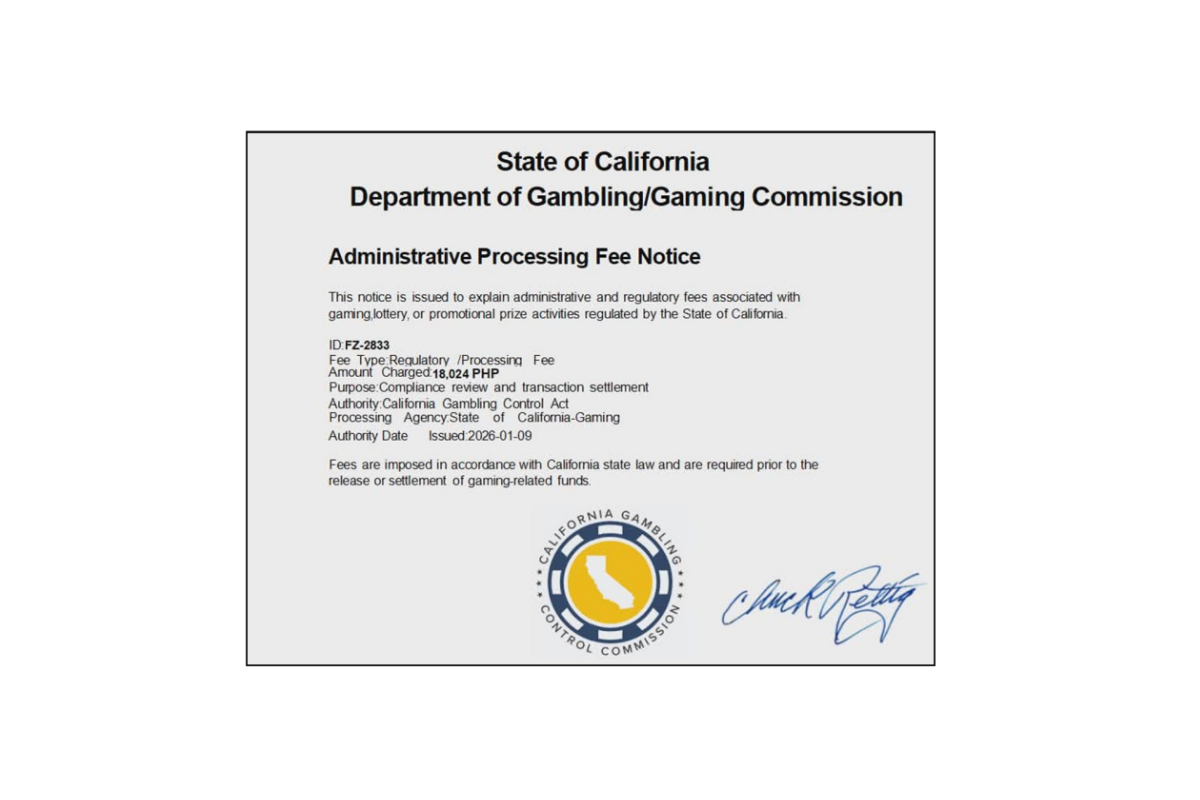
The California Gambling Control Commission (Commission) has received information that an illegal gambling operation called California Scratch Card is using the Commission’s name and logo to claim that winners must pay them an “Administrative Processing Fee” imposed by the Commission before they can collect their winnings. Examples are attached to this notice. It appears this illegal gambling operation is primarily operating on Facebook, and may be operating on other social media platforms.
Based on the information the Commission has received, this illegal gambling operation appears to be based in the Philippines and is targeting citizens of the Philippines.
The Commission does not issue, nor has it ever issued, licenses to California Scratch Card or any other similar illegal gambling operations. The Commission does not require “Administrative Processing Fees” or other such fees that these illegal gambling operations claim. The Commission is currently pursuing all available options to address this matter.
Illegal gambling operations such as these are often fronts for scams and thefts, as they can keep a player’s deposited funds, refuse to pay out winnings, or demand payment from the winner before releasing the winnings, and then not release the winnings at all.
The post ADVISORY: ILLEGAL GAMBLING OPERATION USING FORGED COMMISSION CREDENTIALS appeared first on Americas iGaming & Sports Betting News.
Austria
EU Court Ruling on Online Gambling Liability: Players Can Sue Foreign Operators’ Directors Under Their Home Country Law (Case C-77/24 Wunner)


Published: 15 January 2026
Jurisdiction: Court of Justice of the European Union (CJEU)
Case: C-77/24 (Wunner)
A major ruling from the Court of Justice of the European Union (CJEU) is reshaping the legal landscape for cross-border online gambling in the EU. In Case C-77/24 (Wunner), the Court clarified that a player can, as a general rule, rely on the law of their country of residence when bringing a legal claim to establish tort/delict liability against the directors of a foreign gambling provider that did not hold the required local licence.
In plain terms: If an operator offers online gambling in a country without being licensed there, the player’s losses may legally be treated as “damage” occurring in the player’s home country—making it easier for the player to sue under the rules and protections of that local market.
This decision is likely to have significant implications not only for gambling operators, but also for directors, C-level executives, compliance leaders, and corporate legal teams, especially those managing cross-border growth strategies, grey-market exposure, or “EU passporting assumptions” that do not apply to gambling.
What Happened in Case C-77/24 (Wunner)?
The case centers around an Austrian resident who participated in online gambling offered by a Maltese provider called Titanium Brace Marketing Limited (“Titanium”), which was reportedly available across the European market.
Titanium held a gambling licence in Malta, but did not hold a licence in Austria.
The Austrian player filed legal proceedings in Austria against two directors of Titanium to recover losses incurred through online gambling activity, arguing that:
-
the gambling contract was null and void, and
-
under Austrian law, the directors were personally and jointly and severally liable because the company offered illegal games of chance in Austria without the required local authorisation.
However, the directors disputed the jurisdiction and the applicable law, claiming that:
-
the event that gave rise to the damage occurred in Malta
-
the damage occurred in Malta
-
therefore Austrian courts should not have jurisdiction
-
and Maltese law—not Austrian law—should apply
This created a critical conflict-of-laws problem that many cross-border online gambling disputes face: where did the “damage” actually occur in an online gambling transaction?
The Key Legal Question: Where Does the Player’s “Damage” Occur?
The CJEU examined the issue under the Rome II Regulation (Regulation (EC) No 864/2007), which sets the rules on which country’s law applies to non-contractual obligations (tort/delict) in cross-border situations.
Under Rome II, the general rule is:
the law applicable to a non-contractual obligation is the law of the country in which the damage occurs.
This rule applies:
-
regardless of where the event giving rise to the damage occurred, and
-
regardless of where indirect consequences occur.
This distinction matters enormously in online gambling, where the operator, bank accounts, infrastructure, licensing and corporate entity may sit in one jurisdiction, while the player plays from another.
CJEU Decision: The Damage Occurs Where the Player Resides
The Court ruled that in the context of a player seeking damages for gambling losses incurred via an online operator that lacked a licence in the player’s country, the damage sustained by the player is deemed to have occurred in the Member State where the player is habitually resident.
In this case:
 Player residence: Austria Operator jurisdiction: Malta Damage is deemed to occur: Austria
Therefore, Austrian law would apply as the default rule, because it is the law of the country where the damage occurred.
This is a powerful statement for cross-border enforcement because it significantly strengthens the position of the player in local legal proceedings.
Why This Is Bigger Than One Operator vs One Player
Operators and B2B suppliers often debate where online gambling “takes place”:
-
Where the website is hosted?
-
Where the operator is incorporated?
-
Where the payment processor is located?
-
Where the player clicks the spin button?
The Court recognized the reality of online gambling: it is not easily tied to one physical location.
Instead, the Court anchored the legal “place of damage” in the most relevant point of impact: where the player participates and is protected by local law.
This is not just a technical detail. It changes the legal risk profile for operators pursuing cross-border traffic without local authorisation.
Directors Can Be Targeted Personally Under Tort/Delict Claims
One of the most important elements in this decision is that the lawsuit was not only against the company (which was in liquidation), but also against the directors.
The Court clarified that Rome II applies to an action seeking to establish tortious liability aimed at directors for the infringement of a national prohibition on offering games of chance without a licence.
Crucially, the Court stated that this type of claim is not excluded under the category of “non-contractual obligations arising out of the law of companies.”
That matters because:
-
directors may be pursued for external obligations under national law
-
liability cannot automatically be pushed behind the corporate shield
-
liquidation status doesn’t necessarily end the route to recovery
-
plaintiffs may try to recover from individuals when the company can’t pay
For executive leadership, this decision amplifies the importance of cross-border compliance controls and licensing certainty before market entry.
What is Rome II Regulation and Why Does It Matter for iGaming?
The Rome II Regulation governs which national law applies when a tort/delict crosses borders inside the EU.
In iGaming, tort/delict claims can arise in scenarios such as:
-
offering gambling without a licence in a player’s country
-
breach of national consumer protections
-
misleading marketing practices
-
aggressive bonus or VIP retention practices
-
AML/KYC failures causing financial harm
-
payment disputes framed as “damage”
This ruling confirms that when the player’s alleged damage manifests in their home country, their home law may apply even if the operator is licensed elsewhere.
For operators, that’s a fundamental shift in predictability: you can be licensed and compliant in Jurisdiction A, but still face litigation under Jurisdiction B if you are not authorised there.
What About the Bank Transfer to Malta? Does That Change Anything?
In the case background, the player funded their account by transferring money from an Austrian bank account to a Maltese bank account connected to the operator, structured as a real account for the client.
This detail is important because many operators might assume that:
“Since the money went to Malta, the financial harm happened in Malta.”
But the Court’s logic places the relevant harm in Austria because:
-
the player participated from Austria
-
the Austrian prohibition existed to protect Austrian interests
-
the alleged wrongdoing was the availability of unlicensed gambling to the Austrian public
-
the loss actually “manifested itself” where the player played
This is a regulatory confirmation that payment routing does not automatically determine where damage occurs.
The “Manifestly Closer Connection” Exception: Is There a Way Out?
Rome II does allow a court to apply another law if the situation is manifestly more closely connected with another country.
This is not an automatic escape route, but it provides legal flexibility when circumstances clearly point away from the default rule.
However, for many online gambling cases, “habitual residence of the player” will likely remain the dominant factor, because:
-
online gambling is consumed at home
-
national gambling prohibitions are designed to protect local public policy
-
consumer harm and addiction protections are domestic priorities
What This Means for Online Gambling Operators
For licensed operators, this ruling reinforces a simple message:
Having a licence somewhere in the EU does not mean you are safe everywhere in the EU.
Online gambling remains a regulated activity at national level. The court’s approach supports local enforcement actions, local consumer claims, and local standards for liability.
Key operator implications:
-
Greater exposure to player claims in their home countries
-
Increased likelihood of multi-jurisdiction legal disputes
-
Stronger incentives for local licensing compliance
-
Higher risk in “cross-border availability” strategies
-
Potential personal liability pressure on management/directors
What This Means for Directors and Executive Teams
Directors and senior leaders should treat this ruling as a board-level issue, not just a legal memo.
Because once claims start targeting individuals:
-
risk becomes personal
-
reputational impact rises
-
insurers and D&O coverage becomes critical
-
governance and compliance documentation matters more
-
market-entry decisions need formal defensibility
If an operator “knows or should know” a jurisdiction requires local licensing and still targets players, it can become harder to argue that leadership lacked responsibility.
What This Means for Compliance and Legal Teams
This ruling increases pressure on compliance departments to strengthen controls around:
-
geo-blocking enforcement and logging
-
affiliate and marketing restrictions
-
local licensing checks for incoming traffic
-
responsible gaming enforcement tied to jurisdiction
-
internal “grey market” classification and decision logs
-
audits showing intent to prevent unlicensed access
It also encourages compliance leaders to align more closely with the business side.
Because in many organizations, unlicensed market exposure doesn’t come from direct intent—it comes from:
-
affiliate channels
-
SEO traffic
-
paid ads leakage
-
influencer content
-
“international” brand messaging
-
insufficient enforcement of region-based access restrictions
What This Means for Casinos and Land-Based Brands Expanding Online
For land-based casino groups moving into digital, this decision is a warning against the “soft launch across Europe” approach.
Many casino brands assume cross-border digital rollout is comparable to hospitality marketing. It isn’t.
If a casino group launches online and traffic arrives from unlicensed jurisdictions, the legal risk may follow the player back home—even if the operational core sits in a licensed hub.
Potential Industry Impact: A Stronger Local Enforcement Future
This judgment fits into a broader trend across Europe:
-
member states defending national gambling restrictions
-
regulators pressuring operators on compliance and marketing
-
increased litigation from players seeking loss recovery
-
courts being less tolerant of grey market monetization
-
stronger accountability mechanisms for leadership
In practice, it could accelerate:
-
more local lawsuits by players
-
more action against executives when companies dissolve or liquidate
-
more demand for proof of compliance intent and enforcement
-
more re-evaluation of licensing strategy in “borderline” markets
Strategic Takeaways for iGaming Operators
If you manage a regulated brand, this ruling supports three high-level strategic priorities:
1) Local licensing is the only stable long-term route
Short-term grey exposure may now bring long-term legal cost.
2) Geo-compliance must be demonstrable
It’s no longer enough to “have a tool.”
You need logs, enforcement, and proof of execution.
3) Executive governance matters
If leadership risk becomes personal, the organization must show that compliance decisions were not casual.
Final Thoughts: A Defining Ruling for Cross-Border Online Gambling Risk
The CJEU decision in Case C-77/24 (Wunner) gives players a major advantage in cross-border online gambling disputes: the ability, in general, to rely on the law of their country of residence when bringing tort/delict claims against the directors of a foreign provider that lacked the required licence.
This is not a symbolic ruling. It is a practical legal framework that:
-
strengthens local consumer protection
-
reinforces national licensing regimes
-
increases compliance pressure
-
and raises personal accountability risks for leadership
For operators with ambitions across Europe, the message is clear:
Cross-border growth must be built on compliance-first foundations, not geographic ambiguity.
FAQ: Quick Answers for Operators and Industry Leaders
Can players sue under their home country law?
As a general rule under Rome II, yes—if the damage is deemed to occur in their country of habitual residence.
Does a Maltese licence protect an operator across the EU?
No. Gambling is regulated nationally, and this ruling reinforces that reality.
Can directors be personally targeted?
Yes—especially where claims are framed as external tort/delict obligations, not just internal company law matters.
Can courts apply another country’s law instead?
Only where the case is manifestly more closely connected with another country, based on all circumstances.
The post EU Court Ruling on Online Gambling Liability: Players Can Sue Foreign Operators’ Directors Under Their Home Country Law (Case C-77/24 Wunner) appeared first on Eastern European Gaming | Global iGaming & Tech Intelligence Hub.
Compliance Updates
Global Gaming Solutions welcomes the Isle of Man Government’s commitment to the iGaming sector

Global Gaming Solutions has welcomed a statement from the Isle of Man Government reaffirming its commitment to the iGaming sector. It comes after a year that tested confidence across parts of the industry.
The Isle of Man Government highlighted its strong iGaming history in a statement released today by the Department for Enterprise. The Island’s reputation comes from robust regulation, political and economic stability, and close working between Government, regulators and industry. The statement reaffirmed that iGaming remains a core and enduring part of the Isle of Man’s economy, now and into the future.
The Chief Minister said the Government has strengthened its understanding of risk in response to a more complex global environment. He added that additional resources and frameworks are now in place to respond to emerging threats. The statement confirmed that ICE 2026 in Barcelona is the starting point for a coordinated programme of engagement. Digital Isle of Man and other agencies will continue to make the case for the Island as a secure and trusted home for well-regulated iGaming.
Responding to the announcement, Global Gaming Solutions said the statement provides important reassurance for existing licence holders and prospective businesses operating in the sector.
Mark O’Neill, Managing Director of Global Gaming Solutions, said:
“The Isle of Man Government’s reaffirmation of its commitment to the iGaming sector provides important clarity and reassurance for existing licence holders and the wider global industry. The Island’s long-standing focus on robust regulation, awareness and mitigation of emerging risks and constructive engagement with industry continues to underpin its reputation as a trusted and well-governed jurisdiction.”
Global Gaming Solutions added that clear, public affirmation of Government support plays a valuable role in maintaining confidence during periods of change, particularly for jurisdictions with a strong international reputation for regulatory quality and cooperation.
The Isle of Man Government stated that it will continue to work closely with industry. The aim is to support sustainable growth, meet international standards, and secure the sector’s long-term success. The Government will carry out further outreach and information sharing over the coming year to ensure regulatory expectations and emerging risks are clearly understood.
The post Global Gaming Solutions welcomes the Isle of Man Government’s commitment to the iGaming sector appeared first on Eastern European Gaming | Global iGaming & Tech Intelligence Hub.

-

 Carl Gatt Baldacchino Head of Account Management SlotMatrix7 days ago
SlotMatrix revives classic slot action with Crazy 777 U.S launch
-
Adam Pentecost Chief Revenue Officer at Gaming Corps7 days ago
Gaming Corps partners with BetMGM for exclusive Ontario launch
-
BGaming7 days ago
Land Diamond-Encrusted Prizes in BGaming’s Jewel Boom Super Drop
-
Compliance Updates6 days ago
Romanian B2B Licence Granted to iGP, Boosting Its Regulated Operations in Europe
-
Africa7 days ago
Soccabet goes live with QTech Games retail solution in Ghana
-
Compliance Updates6 days ago
Global Gaming Solutions welcomes the Isle of Man Government’s commitment to the iGaming sector
-
Latest News3 days ago
SKIP THE QUEUE WITH THE MIDNITE SHUTTLE: MIDNITE TEAMS UP WITH SNOOKER LEGEND TO OFFER FANS A FREE SHUTTLE SERVICE FROM ALLY PALLY STATION
-
BETER6 days ago
BETER enters sixth US state with North Carolina approval