Latest News
The boom of virtual gaming tournaments


The global gaming industry is undergoing rapid change and is seeing significant growth year on year. It is currently worth around £116 billion, and it is expected to grow by a Compound Annual Growth Rate percentage of 12.9% between now and the year 2027.
There are a number of key factors that are driving this, including the availability and advancement of technology. Both the hardware and software of games consoles, computers and gaming accessories are improving greatly in terms of efficiency, innovation and usability.
Increased access to internet services with decent connection and speed has also influenced this, as well as the relatively new development of influencer marketing through streaming platforms. Of course, it is also undeniable that recent global events have meant that people have had to spend more time at home social distancing and have found themselves playing more games. Gaming has provided entertainment and social engagement to people who may have been too busy to play regularly before. There are game types to suit everybody, from action and adventure games to strategy and puzzle games. All gaming sectors have seen an increase of gameplay during this period and one in particular is the casino industry. In the last several months, many people have signed up to one of many casino sites to play their favourite games like blackjack and poker. The increase of players has been forced by the closure of land-based casinos meaning people had to move online to access casino games. And it was not just normal casino games that had to take place online, many large gambling events like the World Series of Poker tournament also had to move online due to the recent pandemic. Many events and competitions were already taking place virtually, however this year has seen more events than ever make the transition online, is this phenomenon going to stay?
Virtual Competitions
There has also been a boom in virtual gaming tournaments, or esports tournaments, during this time. The number of tournaments has skyrocketed in comparison to previous years, so too has the audience numbers on streaming sites such as Twitch and YouTube. As conventional tournaments across the sports and entertainment industries have faced cancellations or postponements, virtual competitions have acted as their replacements.
There are three main types of esports that are run as virtual gaming competitions. One is first person shooters (FPSs), these can be player v player or team games, with popular examples including Call of Duty, Doom and Counter-Strike. There are also fighter gaming competitions, such as those held for Super Smash Bros or Street Fighter. However, some of the most anticipated tournaments are those in the Multiplayer online battle arena (MOBA) category, with League of Legends and DOTA 2 being the big names in this area.
Many players participate in these events due to their financial incentives. Large corporations sponsoring these events draw in professional players with the promise of huge cash prizes. Pros train for these events all year round, gaming to them is a career choice as they fund their passion through prize winning and sponsorship deals scored through their streaming channels. DOTA 2 is by far one of the biggest tournaments in terms of the amount of prize money it gives out. Since the game was released in 2013, there have been 54 tournaments and the average prize has been a hefty sum of $111,111 US dollars. This year’s prize money hase totalled $6 million.
Replacing Sporting Events
Virtual gaming tournaments this year have acted as a good replacement for some of the major sporting events.
After F1 was forced to postpone earlier this year, Torque Esports’ All-Star Esport Battle took over in March. Racers from a variety of motorsports joined in on the action, including the legendary Max Verstappen. Verstappen found victory at the Redline’s Real Racers Never Quit competition series when he won the first qualifier, however the final saw Rudy Van Buren take home the top prize after he dropped out. Van Buren actually holds the title of ‘World’s Fastest Gamer’ in 2017.
There was also the virtual Formula One Grand Prix which attracted both pro gamers and champion F1 stars. This was the second time the event ran and this year it was based on Albert Park circuit in Melbourne. Competitors included Ben Stokes, an England cricketer, and racing driver Alex Albon. The trophy was won by two time Grand Prix winner Charles Leclerc.
Another high-profile esports tournament was the Fortnite World Cup. In the summer of 2019, the Fortnite finals were streamed across Twitch, Youtube, Twitter, Facebook and within the game itself. Weekly online tournaments started in April, with players from each region competing to qualify for the finals and be in for a chance of winning a cut of the $1,000,000 prize pool. The overall winner was 16 year old Kyle “Bugha” Giersdorf, who lifted the trophy at Arthur Ashe Stadium in New York. This year however, Epic Games have had to put a stop to the World Cup this year due to the cross-region nature of the event. They instead moved all over competitions exclusively online this year, including the Fortnite Champion Series and the Fortnite Cash Cups.
Virtual Gaming Industry is Growing
At the rate that the virtual gaming industry is growing, in the future we may see the same kind of media coverage and attention for these tournaments as we do some of the major traditional sports competitions. Huge audiences already enjoy watching these events via live streams, and many also place bets too. As stadium events around the world continue to be cancelled and postponed, virtual gaming tournaments are continuing to become a more mainstream form of entertainment for fans of competitive sports.
Powered by WPeMatico


The UAE Lottery has partnered with SmartLife Foundation to support outdoor workers during the UAE summer, backing the Cool Bus Shelter initiative in Abu Dhabi on July 20, 2026.
The programme aligns with the UAE’s Midday Break rules, which require outdoor work to stop between 12:30 PM and 3:00 PM during peak heat. As part of the initiative, air-conditioned buses were stationed near labour sites to provide workers a place to rest before returning outdoors.
Volunteers from The UAE Lottery and SmartLife Foundation provided cold towels, cold water and drinks, according to the organisations. Workers also received portable rechargeable neck fans intended to provide additional cooling after the break.
Suzan Kazzi, Associate Director – Corporate Social Responsibility at Momentum- The UAE Lottery, said: “Outdoor workers are the backbone of our cities’ urban development, and initiatives like the Cool Bus Shelter ensure they receive the care and recognition they deserve during the most challenging months of the year. This is our small way of saying thank you and reminding them that their wellbeing truly matters”.
Abhijeet Oak, Vice President at SmartLife Foundation, added: “At SmartLife Foundation, we believe that protecting the wellbeing of outdoor workforce is a shared responsibility. Through the Cool Bus Shelter initiative, we are proud to collaborate with organizations such as The UAE Lottery and other community partners to create moments of comfort, appreciation and human connection that leave a lasting impact”.
The post The UAE Lottery backs Cool Bus Shelter initiative for outdoor workers appeared first on EE Gaming | Global iGaming & Tech Intelligence Hub.
Bally’s Intralot
Intralot Ireland Limited Signs Seven Year Contract Extension with Premier Lotteries Ireland

Bally’s Intralot announced that its subsidiary Intralot Ireland Limited has signed a seven year contract extension, through November 2034, with Premier Lotteries Ireland (PLI). The agreement supports PLI’s continued operation of the Irish National Lottery through the remainder of its license period and reinforces Bally’s Intralot’s role as a trusted technology and services partner.
Under the terms of the agreement, Bally’s Intralot will modernise PLI’s technology ecosystem by deploying its next-generation LotosX Omni solution and PlayerX Player Account Management platform. The solution will provide a modern, cloud-based technology foundation supporting lottery operations across retail and digital channels, while incorporating advanced retailer management, instant games management, device management and content management capabilities. The agreement also includes comprehensive support and maintenance services, along with cloud operations and cybersecurity services for the first year, designed to ensure the long-term reliability, security and performance of PLI’s technology environment.
Through this partnership, Bally’s Intralot will support PLI in delivering a future-ready operating environment designed to enhance operational efficiency, accelerate innovation and strengthen player engagement. The modernisation will provide a secure, scalable and resilient platform that enables PLI to continue evolving its offerings while improving time-to-market implementation of new initiatives, along with maintaining the highest standards of reliability and service to players and retailers across Ireland.
“We are pleased to extend our partnership with Bally’s Intralot, a relationship built on trust, commitment to excellence, and shared ambition since 2014. As we look to the future, this agreement provides a strong platform for continued innovation and growth, ensuring we can deliver a modern, secure, and world-class National Lottery that places responsible play at its heart while continuing to benefit communities across Ireland,” said Cian Murphy, CEO of PLI.
Robeson Reeves, CEO of the Bally’s Intralot Group, said: “We are proud to extend our long-standing partnership with Premier Lotteries Ireland for a further seven years. This agreement reflects the strength of our technology and the trust we have built with PLI over more than a decade of collaboration. We look forward to continuing to support the National Lottery of Ireland and to delivering innovative, responsible gaming experiences to players across the country.”
The post Intralot Ireland Limited Signs Seven Year Contract Extension with Premier Lotteries Ireland appeared first on EE Gaming | Global iGaming & Tech Intelligence Hub.
Artificial Intelligence
Kambi Delivers Record-breaking World Cup with More Than 100 Million Bets as Bet Builders and Player Props Take Centre Stage
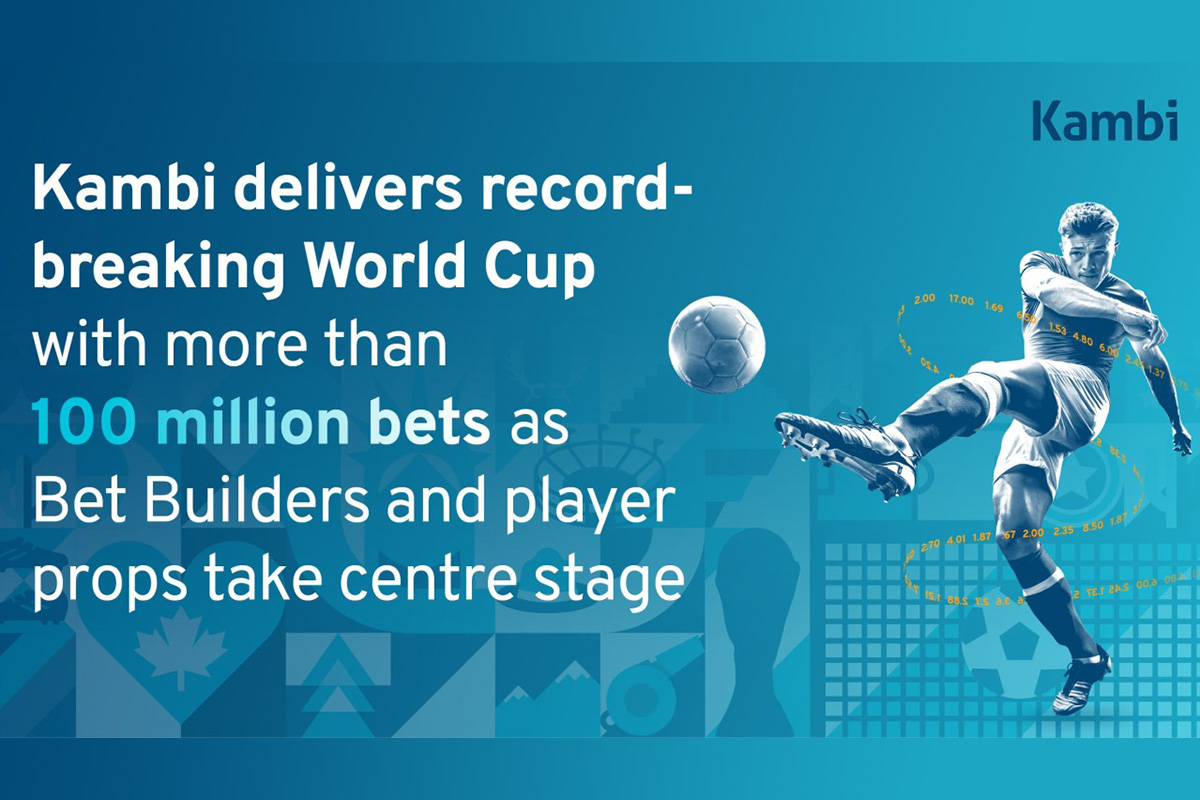
Kambi, the home of premium sports betting solutions, and its global network of Turnkey Sportsbook partners have exceeded 100 million bets placed during the ongoing FIFA World Cup, with data showing the continued evolution of player betting preferences towards higher-margin products.
Data from Kambi’s global partner network shows the continued growth of player props and Bet Builder, reducing the dependency on traditional core markets to drive engagement and margin performance. This is illustrated by last week’s semi finals which had more than 700,000 unique combinations placed on each game.
The expanded tournament has delivered on the increased turnover potential that was anticipated, yet Kambi has also exceeded average turnover per match and seen an increase in average stake compared to 2022. Kambi’s geographically diversified partner network has driven betting volume across a wider range of markets and time zones, while diversifying risk and liabilities across its broad global partner base.
Key World Cup 2026 betting trends (versus 2022) across Kambi’s Turnkey Sportsbook include:
• Pre-match Bet Builder turnover up 3.6x
• Average pre-match Bet Builder selection size now 3.5 compared to 2.9
• Player shots on target is the top pre-match Bet Builder offer by turnover, generating 2x the turnover of match winner market
• Share of pre-match turnover from bets other than match winner up from 57% to 63%
• Live Bet Builder turnover up 10x
• Player shots on target is the most popular live bet, accounting for 15% of live turnover
Together, these trends underline the transition to more complex, higher-margin recreational play, helping Kambi sustain a strong tournament margin despite a competition in which the top four seeds reached the semi-finals and leading strikers frequently scored.
This shift has been facilitated by Kambi’s AI trading system, with the tournament becoming the first World Cup where bet offers across both pre-match and live were fully compiled and traded by Kambi’s proprietary algorithmic capability. This has supported greater efficiency and scalability while enabling a broader, deeper betting offer.
Combining advanced AI-driven technology with the vast data generated by its global network has enabled Kambi to deliver a wide range of product improvements, from expanded player props markets and increased Bet Builder combinability to reduced suspension times, lower live delays and enhanced uptime.
Werner Becher, CEO of Kambi, said: “Surpassing 100 million bets before the final demonstrates both the scale of our network and the progress we are making in sportsbook innovation. This is the first World Cup fully traded by our AI-powered capabilities and we’ve seen the impact in stronger product performance, greater engagement with player props and Bet Builder, and a betting mix that continues to evolve beyond traditional markets. At a tournament where results have not always been favourable for some bookmakers, these advances have enabled us to continue performing strongly and delivering for partners.”
Kambi will publish its Q2 2026 Report on 22 July, when it will share further insights from the World Cup and provide additional detail on the performance of its sportsbook products during the tournament.
The 100 million bet milestone applies to Kambi’s Turnkey Sportsbook only and does not include the millions of bets driven by Kambi’s Odds Feed+ product.
The post Kambi Delivers Record-breaking World Cup with More Than 100 Million Bets as Bet Builders and Player Props Take Centre Stage appeared first on EE Gaming | Global iGaming & Tech Intelligence Hub.

-

 ESPN Networks3 days ago
THE 57th ANNUAL WORLD SERIES OF POKER® CONCLUDES AN EXTRAORDINARY SUMMER OF GLOBAL ENGAGEMENT AND ELITE COMPETITION
-
Latest News6 days ago
EveryMatrix’s Fantasma Games launches three-reel slot Bonus Bullets
-
Latest News4 days ago
Booming Games launches Tasty Bonanza Max Scatter slot
-
Latest News5 days ago
SCCG Management Launches Dedicated SCCG Brazil Division with Local Partner Thomas Carvalhaes
-
Latest News6 days ago
Blokotech adds Wicked Games slots in new content deal
-
Canada5 days ago
ThrillTech secures AGCO supplier licence for Ontario launch
-
Latest News5 days ago
Esportes Gaming Brasil takes two ClienteSA Awards 2026 wins; exec named Personality of the Year
-
Canada4 days ago
Peter & Sons launches full game portfolio in Alberta