Latest News
SKS365 Signs Online Casino Deal With WMG


The agreement with the acclaimed Italian provider further enriches the Planetwin365 gaming portfolio
SKS365, owner of the Planetwin365 brand joins with well-known italian provider WMG to continue its fast growth in the online casino vertical. With twenty-year experience in the gaming sector, WMG was one of the first providers in Italy to have introduced the Casino retail offer in the online channel. Thanks to this agreement, the first 5 games of WMG’s online catalogue, including the famous Fowl Play Gold, are already available for Planetwin365 online customers.
Manuele Mazzucato from WMG Gaming declared “The partnership with SKS365 was our primary goal throughout 2020. Collaborating with such an important operator in the Italian and European scene is a source of pride for our group and gives us a further incentive for growth and commitment. In addition to the famous FOWL PLAY GOLD slot, our range of games also includes some of the best seller titles on the Italian market (AWP & VLT) such as HAUNTED HOUSE and 4 FOWLPLAY, which will surely capture the interest of the most demanding Planetwin365 players “.
“We are very proud to welcome WMG, one of the best known and most appreciated providers in Italy” – said Troy Cox, Chief Commercial Officer of SKS365. “The introduction of WMG titles allows us to further expand our gaming offering, by intercepting a cluster of customers more closely tied to the physical slot offer. It is no coincidence that the WGM titles have already established themselves as top performers both in terms of popularity and revenue just few days after their launch on our gaming platform”.
Powered by WPeMatico



Here are this weeks latest slots releases compiled by Eastern European Gaming
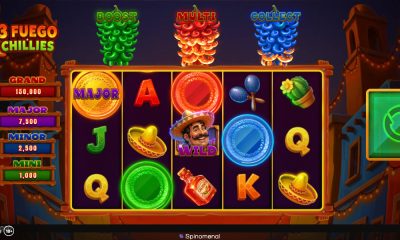
Spinomenal has released 3 Fuego Chillies, a new 5×3 video slot themed around a Mexican street fiesta. The game ships with a feature-led Bonus Game and a top prize billed as a Grand Jackpot of x3,000 the total bet.

CT Interactive has released its latest slot game, 40 Mega Star. As the night sky comes alive with countless shimmering lights, only a select few stars have the power to capture attention and become true Mega Stars.

TaDa Gaming has expanded its popular Unlimited Fortune mechanic with the launch of Joker Coins Unlimited Fortune. Combining Lock & Respin, progressive bonus expansion, jackpots, multipliers and the signature Unlimited Fortune feature, this compact three-reel release delivers layered gameplay and win potential of up to 5000x.

Blueprint Gaming is releasing an upgraded version of Super Graphics Upside Down exclusively on Lottomart, giving Lottomart’s UK players early access to the title. Originally launched in 2021, Super Graphics Upside Down is being re-released with a new bonus wheel feature and an increased max win potential, rising from 250X to 3000X, according to the companies.

ICONIC21 has released Wild Gold Mine 2, a high-volatility sequel to its Wild Gold Mine slot. The game is played across 243 ways and launches with multiple RTP configurations, with a stated top prize of 10,000x.

Games Global has launched Rumble Kong CASHINGO , a new jungle-themed online slot developed with exclusive studio partner Alchemy Gaming. The title went live on 23rd July 2026. Rumble Kong CASHINGO is a 5×5, 3,125 ways-to-win game built around an expanding CASHINGO collection grid.

Swintt has released a new slot from its Elysium Studios label, titled Odyssey Hold & Win. The supplier said the game is built around a Hold & Win collection mechanic and features a stated maximum win of 3,317x. Odyssey Hold & Win runs on a 4×4 grid that can expand to 4×8 when Athena appears, according to the company.

ELA Games has released a new slot, Age of Cleopatra, adding another ancient-Egypt theme title to its portfolio. The studio positions the game as a medium-volatility release and says it is available to demo now. Age of Cleopatra runs on a 5×3 reel set-up with 25 paylines.

Endorphina has launched Zalatar, a new myths-and-legends themed online slot, expanding its recent run of fantasy-leaning releases. The supplier said Zalatar is a 5-reel, 3-row game with 25 fixed paylines, 96.03% RTP and high volatility.

The post Weekend Reels | Week 30: Slot Drops & Trends appeared first on EE Gaming | Global iGaming & Tech Intelligence Hub.
Slotsoo is proud to announce the winners of the Slotsoo Awards 2026, recognising the online casinos and game providers that have delivered the best player experiences over the past year. Now firmly established as an annual celebration of excellence, the awards continue to recognise the companies setting new standards for quality and innovation across the iGaming industry.
Spotlighting the Best Game Providers of 2026
Following last year’s successful debut, the Slotsoo Game Provider Awards returned for a second year to recognise the studios pushing online slots forward through original ideas, engaging gameplay, and consistently high-quality releases. This year’s winners are:
- The Machine MVP – Pragmatic Play
- Bonus Buyer – Eurasian Gaming
- Volatility Virtuoso – 1spin4win
- Jackpot Jumbo – Platipus Gaming
- Symphony Spinner – Peter & Sons
- Reel Renegade – TaDa Gaming
- Promising Prodigy – EXCO Game Studio
Pragmatic Play retained the prestigious Machine MVP award for a second consecutive year, while every other category crowned a new winner, highlighting the emergence of fresh talent and new ideas among game providers.
Casino Awards Return for a Fourth Year
Since their debut in 2023, the Slotsoo Casino Awards have celebrated the operators raising the standard for online casino experiences. This year’s winners continue that tradition, earning recognition for excellence across bonuses, withdrawals, gamification, and overall quality. The seven winners for 2026 are:
- The Gambling GOAT – Lunar Spins
- The Bonus Buff – Go4Casino
- The Loyalty Lord – Valhalla Wins
- The Withdrawal Wizard – Taste Vegas
- The Gamification Guru – Lucky Fuel
- The Payout Professor – Stupid Casino
- The Noisy Newcomer – Kudos Bet
While the Game Provider Awards saw several first-time winners, the Casino Awards reflected the continued strength of a few established operators. C24 Partners enjoyed a particularly successful year, with four awards going to brands from its portfolio, including the main trophy The Gambling GOAT.
Recognition That Goes Beyond Popularity
Unlike many industry awards, the Slotsoo Awards are not decided by public voting. Winners are selected by the Slotsoo team after evaluating casino operators and game providers throughout the year. Each nominee is assessed on factors such as player value and innovation.
This approach ensures that both established industry leaders and ambitious newcomers have an equal opportunity to be recognised. Whether it’s a casino redefining loyalty rewards or a game studio introducing fresh mechanics, the awards highlight companies that genuinely move the industry forward.
Other News from Slotsoo.com This Summer
The Slotsoo Awards weren’t the only milestone for the company this summer. In June, the team attended the HIPTHER Baltics & Nordics Gaming Conference in Tallinn, connecting with industry professionals, exploring the latest developments in iGaming, and returning home with plenty of inspiration.
July marked the publication of Slotsoo’s first book, The Casino Player’s ABC, written by Markus Björk, Head of Content. This tongue-in-cheek ABC book for adults takes a humorous look at the ups and downs in slot gaming. Markus Björk comments:
“The awards and the book may seem like very different projects, but they share the same goal. Both are about celebrating what makes this industry unique and helping players navigate it with a sense of humour.”
With another successful awards season, the publication of their first book, and an active presence at industry events, 2026 has been one of Slotsoo’s busiest and most exciting years to date.
The post Slotsoo Awards 2026 Celebrate the Best Casinos and Game Providers appeared first on EE Gaming | Global iGaming & Tech Intelligence Hub.

BETBY, the Tier 1 sportsbook supplier, has continued its strong start to 2026, delivering solid year-on-year growth across its business during the first half of the year. Building on the positive Q1 results reported in April, the supplier’s performance was supported by continued market expansion, product innovation, and strong activity across its operator partnerships.
During the first half of 2026, BETBY’s sportsbook Gross Gaming Revenue (GGR) increased by 42.7% compared to H1 2025. The number of active players across the provider’s partner network grew by 47%, while the total number of bets placed rose by 21.2%, reflecting sustained growth across both new and existing operator partnerships.
The period also saw BETBY further expand its product ecosystem through several key launches and developments. Among them was BETBY Predictions, the industry’s first fixed-odds prediction markets feed, opening a new betting vertical for operators. The supplier also introduced Stories, an engagement feature built around a familiar, interactive content format and delivered directly within the sportsbook experience.
The FIFA World Cup provided an additional boost during the last three weeks of June, generating high levels of betting activity across BETBY’s partner network and demonstrating the scalability and reliability of its sportsbook during the world’s largest sporting event.
BETBY’s proprietary esports feed, Betby Games, also delivered continued growth during H1 2026, recording a 28% year-on-year increase in Gross Gaming Revenue. Active players grew by 46%, while the number of bets placed rose by 14.8%. These figures reinforce Betby Games’ importance within BETBY’s broader product portfolio.
Leonid Pertsovskiy, Chief Executive Officer at BETBY, said: “After a strong first quarter, we are pleased to see that the positive trend continued throughout the first half of the year. These results reflect the strength of our long-term strategy, combining continued market expansion with a clear focus on product innovation and helping our partners grow.
“The launch of products such as BETBY Predictions and features like Stories, alongside the continued evolution of Betby Games, demonstrate our commitment to delivering solutions and technology that create measurable value for operators. We are proud of what we have achieved so far this year and remain focused on continuing this progress throughout H2.”
The post BETBY Builds on a Strong Start to 2026 with Solid H1 Sportsbook Growth appeared first on EE Gaming | Global iGaming & Tech Intelligence Hub.

-

 Alberta6 days ago
Greentube strengthens Canadian presence with Alberta debut as market opens
-
Compliance Updates6 days ago
The MGA Publishes Notice on Websites Impersonating Licensed Operators
-
Alberta6 days ago
Greentube goes live in Alberta as province opens regulated iGaming
-
hold and respin6 days ago
Spinomenal releases new slot 3 Fuego Chillies
-
Brazil5 days ago
Hunch cites 78% matchday retention for Super World Cup free-to-play suite
-
Anne Marie Caulfield4 days ago
Irish Gambling Regulator Threatens Prediction Market with High Court Action
-
Brazil5 days ago
Hunch reports 78% matchday retention for Brazil World Cup free-to-play push
-
Canada5 days ago
Tonybet player in Canada claims $20,000 CAD golden World Cup card prize