API integration
Belatra signs cooperation deal to distribute slots via VeliGames


Belatra has signed a cooperation agreement with VeliGames to distribute its online slots to operators across Latin America, Africa and Asia. The deal was announced Tuesday 7th July 2026.
VeliGames is a game aggregation platform by VeliTech. The companies said the platform is designed for operators in Latin America, Africa and Asia, with architecture optimised for unstable internet connections and low-cost devices.
Under the expanded agreement, VeliGames will gain access to Belatra’s portfolio through a single API integration, giving operators access to Belatra’s slots via the aggregator.
Misha Voinich, Head of Business Development at Belatra said: “Our integration with VeliGames through a single API opens a direct route for our slots to reach operators in Latin America, Africa and Asia. Our mathematical architecture and character-based IP are focused on long-term player retention, and VeliGames’ technology ensures stable operation of content in these markets regardless of the quality of communication.”
Revaz Janelidze, Operations Lead at VeliGames, added: “Belatra’s award-winning portfolio and proven mechanics are just the kind of dependable content our operator partners are looking for across multiple regions. Bringing the games into our ecosystem through a single API makes it simple to deliver, even on lower spec devices and slower connections.”
The post Belatra signs cooperation deal to distribute slots via VeliGames appeared first on EE Gaming | Global iGaming & Tech Intelligence Hub.












API integration
Reliability in Motion: Why Modern Digital Businesses are Abandoning the Single-Vendor Model
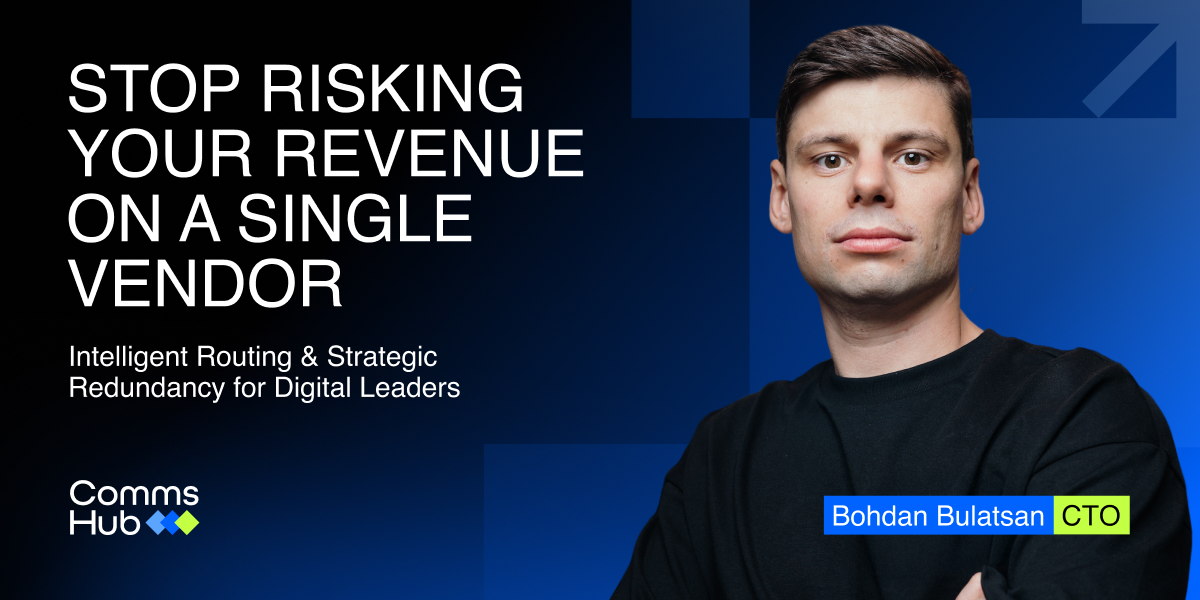
In the fast-paced environment of digital businesses, communication isn’t just a utility – it’s the heartbeat of the business. Whether it’s a high-stakes trade confirmation or a time-sensitive user’s notification, a lost message is often a direct precursor to lost revenue. Today, we sat down with Bohdan Bulatsan, CTO at CommsHub to discuss why the industry is shifting away from traditional messaging setups toward a more resilient, “strategic redundancy” approach. We explore how CommsHub is redefining delivery standards through intelligent routing and financial transparency.
In the high-stakes world of digital businesses, we often talk about “guaranteed delivery,” but the reality of infrastructure is that things break. From a technical leadership perspective, why is the “Single Vendor” model becoming a terminal risk for modern enterprises?
That’s right. No technical system is infallible. Downtime and glitches are inherent to infrastructure; the real differentiator is how you manage those failures to protect the business. Relying on a single vendor creates a “Single Point of Failure.” If that one provider goes down, your entire operation grinds to a halt.
At CommsHub, we address this by implementing a sophisticated provider cascading system. This architecture ensures that if one path is blocked, the traffic finds another. By eliminating the reliance on a single provider, we transform communication from a financial gamble on uptime into a stable, predictable business process.
CommsHub moves the conversation from “sending messages” to “strategic redundancy.” Can you walk us through the logic of your automated routing – how does the platform decide which path a message takes in milliseconds to ensure the highest delivery rate?
Our cascading logic functions as an intelligent safety net. When our system detects a failure signal from a provider, it triggers a reaction in milliseconds. The mechanism immediately consults a predefined routing roadmap and reroutes the message through the next optimal path in the chain.
Crucially, we allow clients to configure response wait times in both static and dynamic modes. This is a game-changer for businesses where speed is as vital as the delivery itself. Ultimately, our system is built for flexibility; we don’t just send messages – we architect a logic that supports virtually any messaging scenario a business requires.
Integration speed is often a bottleneck; you’ve managed to cut the industry standard from 45 days down to just 10. How does this technical agility impact a brand’s ability to scale into new, unpredictable international markets?
In the modern economy, standing still is the same as moving backward. Our clients are constantly expanding into new geographic territories and they need a partner that moves at their speed. By shrinking integration time to around 10 days, we allow businesses to respond to market opportunities almost instantly.
Our priority is the continuous onboarding of validated providers. This doesn’t just give our clients access to new GEOs; it gives them the power of choice within their existing markets, ensuring they always have the most competitive and reliable options available.
We’ve seen that “lost messages” translate directly to “lost revenue.” How does CommsHub’s unified dashboard bridge the gap between technical delivery logs and the financial transparency that C-level executives need?
Data is only useful if it’s actionable. C-level executives need to see the “why” behind the spend. The CommsHub analytics module is divided into two pillars: Performance and Finance.
The Performance section allows teams to monitor delivery rates and message statuses by country in real-time. Meanwhile, the Financial section provides total visibility into spending, broken down by provider and region. This bridge between technical performance and cost-efficiency allows Finance and Marketing departments to make data-driven decisions rather than educated guesses.
Looking at the mission of CommsHub – to make communication “simple, clear and predictable” what is the one technical myth about bulk messaging you want to debunk for businesses currently struggling with delivery stability?
The most dangerous myth is the belief that finding one “perfect” or “premium” provider is enough. The reality is that no provider – regardless of their size – is immune to regional outages, regulatory shifts or sudden performance drops.
If you want stability, stop looking for the perfect provider and start building a resilient strategy. True reliability comes from intelligent routing, multi-vendor redundancy and the ability to adapt to changing conditions in real-time. That is the mission we fulfill at CommsHub.
As we’ve discussed, the transition from a single-vendor dependency to a diversified, intelligent routing system is no longer a luxury – it is a necessity for survival in high-growth sectors. CommsHub continues to lead this charge, proving that when technical agility meets financial transparency, businesses can scale without the fear of silence. For those looking to turn their communication infrastructure into a competitive advantage, the path forward is clear: prioritize resilience over the illusion of a “perfect” single source.
The post Reliability in Motion: Why Modern Digital Businesses are Abandoning the Single-Vendor Model appeared first on Eastern European Gaming | Global iGaming & Tech Intelligence Hub.

ZingBrain AI Drives Hondubet Growth with Real-Time Personalisation
ZingBrain AI is reshaping the iGaming landscape by delivering measurable performance gains for Hondubet through advanced real-time personalization technology.
By replacing its manually curated casino lobby with a fully automated, API-driven solution, Hondubet has unlocked a new level of player engagement and operational efficiency. The AI-powered system dynamically adapts content to individual player behaviors, ensuring that each user encounters games tailored to their unique preferences.
Significant Performance Gains Across Player Segments
Data from a controlled A/B test comparing the legacy manual lobby with the new personalized system highlights substantial improvements:
- A 25% increase in Gross Gaming Revenue (GGR) and turnover among newly registered players
- A 10% rise in total bets placed by returning users
- A 25% boost in the number of unique games explored across the player base
These results underscore the effectiveness of AI-driven personalization in enhancing both user engagement and revenue generation.
From Manual Management to Intelligent Automation
Previously, Hondubet relied heavily on manual processes to manage its casino lobby, requiring constant updates and resource-intensive oversight. According to Julian Pareja Garcia of Hondubet, the shift to ZingBrain AI has been transformative.
The automated system continuously learns from player interactions, refining game recommendations and lobby sections without human intervention. This allows the operator’s team to focus on strategic initiatives rather than routine maintenance.
Smarter Player Experiences Through AI Innovation
Oleg Smolerov emphasized the collaborative approach between the two companies, highlighting a shared commitment to innovation and product excellence.
Rather than static content placement, the AI engine ensures that every element of the lobby evolves in response to real-time data. This creates a more intuitive and engaging user experience, where players are presented with content that feels both relevant and natural.
Aligning Commercial Goals with User Experience
Beyond engagement metrics, the integration also supports Hondubet’s commercial strategy. Through ZingBrain AI’s Game Promotion tool, priority titles can be strategically surfaced within personalized sections.
Crucially, the system evaluates performance continuously. Games that fail to resonate with players are automatically deprioritized and replaced with more relevant options. This ensures a balance between promotional objectives and player satisfaction, maximizing both retention and monetization.
A New Standard for iGaming Personalisation
The success of this integration signals a broader shift within the iGaming industry toward intelligent automation and data-driven experiences. By leveraging AI to personalize every touchpoint, operators like Hondubet are setting new benchmarks for engagement, efficiency, and revenue growth.
As competition intensifies, solutions like ZingBrain AI are poised to become essential tools for operators seeking to deliver meaningful, high-performing user experiences at scale.
The post ZingBrain AI Boosts Hondubet Engagement appeared first on Eastern European Gaming | Global iGaming & Tech Intelligence Hub.

Editor’s Take
Why this matters: The crash game vertical is currently one of the most crowded in iGaming. For aggregators like Hub88, the challenge isn’t just adding more games, but adding different games. Solidicon’s debut of a “racing crash” mechanic with Quackinator offers operators a fresh twist on the standard “multiplier curve” format, potentially engaging a demographic looking for more visual excitement than the typical line-graph interface.
Hub88, the fast-growing aggregation platform, has announced a new content partnership with Solidicon, a Swedish game studio recognized for its visually distinct and artistic approach to casino game design.
This integration brings Solidicon’s full suite of titles onto Hub88’s seamless API, making them immediately available to a global network of operators.
A New Spin on Crash Games The headline addition to the platform is Quackinator, a title marketed as the “world’s first racing crash game.” As the crash genre continues to dominate player preferences in emerging markets, Solidicon is attempting to evolve the format by blending high-speed racing mechanics with the traditional risk-reward crash structure.
Alongside Quackinator, the deal includes other high-performing titles such as Navigator and Supershoot Crash, all of which are designed by Solidicon’s team—a group self-described as “a collective of nerds and dreamers” founded in 2006.
Management Commentary The partnership focuses on delivering “novel” experiences to players who are increasingly fatigued by standard slot mechanics.
Jess Inglott, Head of Supplier Relations at Hub88, emphasized the visual quality of the new additions:
“Solidicon’s games bring a bold, unforgettable touch to the casino experience. Adding their titles to our platform allows operators to offer visually striking, memorable content that stands out in a crowded market.”
For Solidicon, the deal represents a significant distribution upgrade. Robert Ackerman, CEO of Solidicon, noted:
“Partnering with Hub88 provides a practical way to broaden distribution of our games and simplify access for operators. Their platform is well regarded for its stability and ease of use, which makes this partnership a strong fit for us.”
The post Hub88 Strengthens Aggregation Platform with Solidicon’s Artistic Game Portfolio appeared first on Gaming and Gambling Industry Newsroom.

-

 Arizona Department of Gaming7 days ago
Arizona Department of Gaming Concludes Legislative Session with Approved Agency Continuation and Enhanced Spending Authority for Problem Gambling
-
 Amusnet6 days ago
Connecting Business and Diplomacy: Amusnet Supports BBLF’s Annual Meeting of the Diplomatic Corps
-
Arizona7 days ago
Arizona extends Gaming Department for six years; problem gambling budget rises 20%
-
AGCO5 days ago
AGCO Fines Great Canadian Entertainment $120,000 for Using Unauthorised Gaming System Software at Four Casinos
-
Affiliate Industry4 days ago
Hub Affiliations Triumphs at the iGB Affiliate Awards 2026: Winner of Programme/Network Campaign of the Year
-
certification6 days ago
PopOK Gaming secures certification for Portugal iGaming market
-
Latest News4 days ago
N1 Partners at iGB L!VE 2026: Bringing Together Affiliates, Art and Innovation
-
Latest News5 days ago
LEON announces LEON.bet Masters, a new CS2 tournament in Portugal