Latest News
How 2 Bolton Based Businesses are Tackling Addiction in the Aftermath of Lockdown


Two Bolton based businesses, Acquiesce and WHYSUP, recorded a podcast discussing addiction, and how they are tackling it following the coronavirus lockdown.
Acquiesce is a private rehabilitation centre, offering luxury accommodation and an urban recovery model that integrates recovery into everyday life. Tina, the senior practitioner at Acquiesce, oversees each individual’s entire journey.
WHYSUP was founded by Mark and Liam. They work to deliver presentations, workshops and keynotes to schools and businesses across the UK to educate and raise awareness of mental health and addiction.
Mark’s Story
Mark begins by explaining his battle with a gambling addiction that started with a bet when he was just sixteen. By 21 he realised he needed help and attended Gamblers Anonymous meetings.
“I remember going to a GA meeting, looking around and thinking ‘Well I’ve not lost my house, not lost my wife, not lost my family. I’m not as bad as these so I don’t need help.”
By 25 he had a girlfriend and a professional job. Everyone around him thought he had left his old life behind and was on the road to recovery. Unfortunately, this wasn’t the case.
At 29, he was kidnapped and held hostage by a group with machetes who were demanding ransom from his mother. Luckily, the police tracked his phone and rescued him.
Mark finally hit rock bottom when his family turned their backs on him. Without his family, he felt that suicide was the only way out of his mess but knew the impact this would have on everyone around him, including his children.
With help from his mum, Mark went to rehab in Birmingham. He took part in the fourteen week programme but stayed there for another five and a half months.
In rehab, Mark wrote down all of his debts. He initially thought he owed a total of £100,000 but now says it was closer to £306,000.
“It’s like I’m talking about a different person now when I look back. Thankfully that’s where it turned around for me. Rehab saved my life.”
Liam’s Story
Around the age of 13, Liam started to experiment with alcohol and drugs like many teenagers at the time.
“There was no prevention or awareness, no knowledge of addiction. My decisions were based on ‘Am I going to get caught?’”
“By 15 I was taking Class A drugs several times a week. I thought drinking and drugs were a normal part of life. I also thought I was good at it because I could do it and still do what I was supposed to be doing.”
Liam got his GCSEs, enjoyed Thai boxing, got his A levels and had a long term girlfriend, all whilst taking drugs.
“I was living a double life. No one knew. From the outside I was seen as popular and successful, the things that you don’t associate with addiction. That’s why I never thought I had a problem.”
He also started struggling with his mental health, dealing with feelings of shame, guilt and paranoia. Liam finally acknowledged his problem after crashing four cars in one week and his family started to ask questions.
“From the minute rehab was mentioned I booked myself in. I pretty much destroyed everyone I loved because I had to tell them what had been going on. When I came out, I went back to normal life, the life where I’d taken drugs for 19 years.”
Following rehab, Liam continued to take drugs after he relapsed at a funeral. His wife became frustrated with the chaos and arranged for him to stay with Mark.
“It wasn’t easy but I was given a safe place. I was able to build a recovery in the real world, which is very important because you can’t just live in a bubble.”
Mark encouraged Liam to make weekly plans, give up his cash card and attend the gym in the same way that he did when he was in recovery at the halfway house.
“I didn’t need to change my location, I needed to change my mindset. People, places, routine, structure- I had to relearn it all to get where I am today. This is why we got in touch with Acquiesce. It integrates the real world into your recovery.
Acquiesce
Acquiesce provides a discreet, highly supported and safe environment within the community to recover in. Without being hidden from the real world, the urban recovery model allows individuals to gain all the tools and experience necessary whilst maintaining a carefully monitored level of responsibility over their own recovery.
This makes the transitional period from treatment a much smoother process, resulting in a more sustainable recovery journey.
WHYSUP
Mark and Liam started WHYSUP after discussing how their addictions started and the mental challenges they had faced. They wondered if anything would have changed had they been given a talk in school.
Three years later, their service is well established and works in three different sectors; education, business and sport.
They have spoken to over 30,000 people nationwide. Over the last 18 months, people with some form of experience have joined the team. Initially their key focus was addiction but they now focus more on mental health and wellbeing.
Support During Lockdown
The team were managing the number of calls well, especially once they hired a professional who helped with more severe cases. Unfortunately, when lockdown started, calls quadrupled and they could no longer meet the demand.
“We underestimated how many and how severely people were declining. They were threatening suicide and we had to drop off flowers at funerals of people who would likely still be here if it wasn’t for lockdown.”
Acquiesce also had an increase in calls, with people experiencing anxiety and fear from a loss of jobs and uncertainty about the future. Tina explained that the number of individuals at high risk from drinking has doubled according to Public Health England.
“We found that some clients have relapsed after being clean for many years and have had to come back into treatment.” Tina added.
When defining addiction from a professional point of view, Tina says they look at withdrawals, tolerance, loss of control, broken promises and consequences, but that in reality it’s a much wider perspective.
“I define addiction as a compulsive behaviour that is impossible to stop without professional help and support. As much as you try to convince yourself you can do it alone, I know from experience that you just can’t.” Added Mark
Liam’s definition of addiction has changed over time. He said, “Two and a half years ago, I’d have talked about drugs. For me now it’s more than a substance or behaviour, it centres around thinking and feeling.”
Tina explained that the Acquiesce programme is very much about positivity, positive self talk, self esteem, gaining confidence.
“When clients come in, their addiction has robbed their self esteem and we work to get it back.”
If you or a loved one are struggling with addiction or mental health issues, please book a callback with Acquiesce at acquiesce.org.uk/contact or 01204 771940, or get in touch with WHYSUP at whysup.co.uk/contact
To listen to the whole podcast, please visit acquiesce.org.uk/how-2-bolton-based-businesses-are-tackling-addiction-in-the-aftermath-of-lockdown/
Powered by WPeMatico



Booming Games says it is marking two years in South Africa and is setting a target to be “recognised as the market’s leading games provider in the next 1-2 years,” according to a company statement dated 14 July 2026.
The Malta-based supplier entered the market in July 2024 and says it has since grown from a single partner relationship to working with “a host of tier one operators across Africa.” The company also claims its local team has doubled in size, with further hiring planned in the coming months, and noted shortlistings at the SiGMA Africa Awards and iGA Summit Awards earlier this year.
In South Africa, Booming Games said it has more than 145 titles “tested, approved and live” in Mpumalanga, Western Cape and Eastern Cape. The company also pointed to a partnership announced last month with World Sports Betting (WSB), under which a selection of its titles will be integrated into WSB’s platform.
Solomon Godwin, Head of Africa at Booming Games, said: “Close partnerships with operators is central to our ability to innovate and deliver at speed. These collaborations allow us to establish a comprehensive feedback loop that informs future games. Put simply, we listen to our punters through our partners.”
Looking ahead, Booming Games said it plans to expand into “every remaining province” and increase investment in local presence and operator partnerships, including targeting new aggregator platforms entering the market. The supplier also said it will expand its release pipeline with localised titles and is developing new games across crash and instant categories, alongside updates to existing games.
Max Niehusen, Founder of Booming Games, said: “South Africa already drives the largest proportion of our revenues in Africa, and as we celebrate two successful years here, we are well placed to build out our offering even further over the years ahead.”
The post Booming Games marks two years in South Africa, targets top supplier spot appeared first on EE Gaming | Global iGaming & Tech Intelligence Hub.

Tonybet has awarded a €7,000 prize to a player in Kilcock, Ireland, after the customer found the campaign’s silver card in the operator’s World Cup Card Collection promotion. The update was announced Tuesday 14th July 2026.
The World Cup Card Collection includes 51 cards: 48 digital cards representing each participating World Cup nation, plus three unique cards—gold, silver and bronze—tied to prize payouts. Tonybet said the bronze card was available during the group stage and was previously found by a customer in Canada.
According to the operator, the silver card was available during the knockout rounds through the quarter-finals. The gold card is now in play for the semi-finals, third-place play-off and final.
Tonybet Head of Product Kiryl Liudvikevich said: “Our Tonybet World Cup Card Collection Bronze prize went during the group stage; now Silver has gone too!
“A massive congratulations to our lucky winner in Kilcock, County Kildare. Silver was always the knockout-round card, available once the World Cup reached the stage where a single result ends a team’s tournament. It has found its winner just as the field thins to the last handful of nations.
“Now we’re down to the final four, that’s where the competition really hots up, leaving just the golden card still hidden somewhere for our lucky winner to find. Best of luck to all of our players as this amazing World Cup reaches its conclusion this week.”
Tonybet said its World Cup Card Collection runs until 31 July. With the bronze and silver cards already claimed, the remaining campaign prize depends on when the gold card is found before the promotion ends.
The post Tonybet awards €7,000 silver prize in World Cup Card Collection campaign appeared first on EE Gaming | Global iGaming & Tech Intelligence Hub.
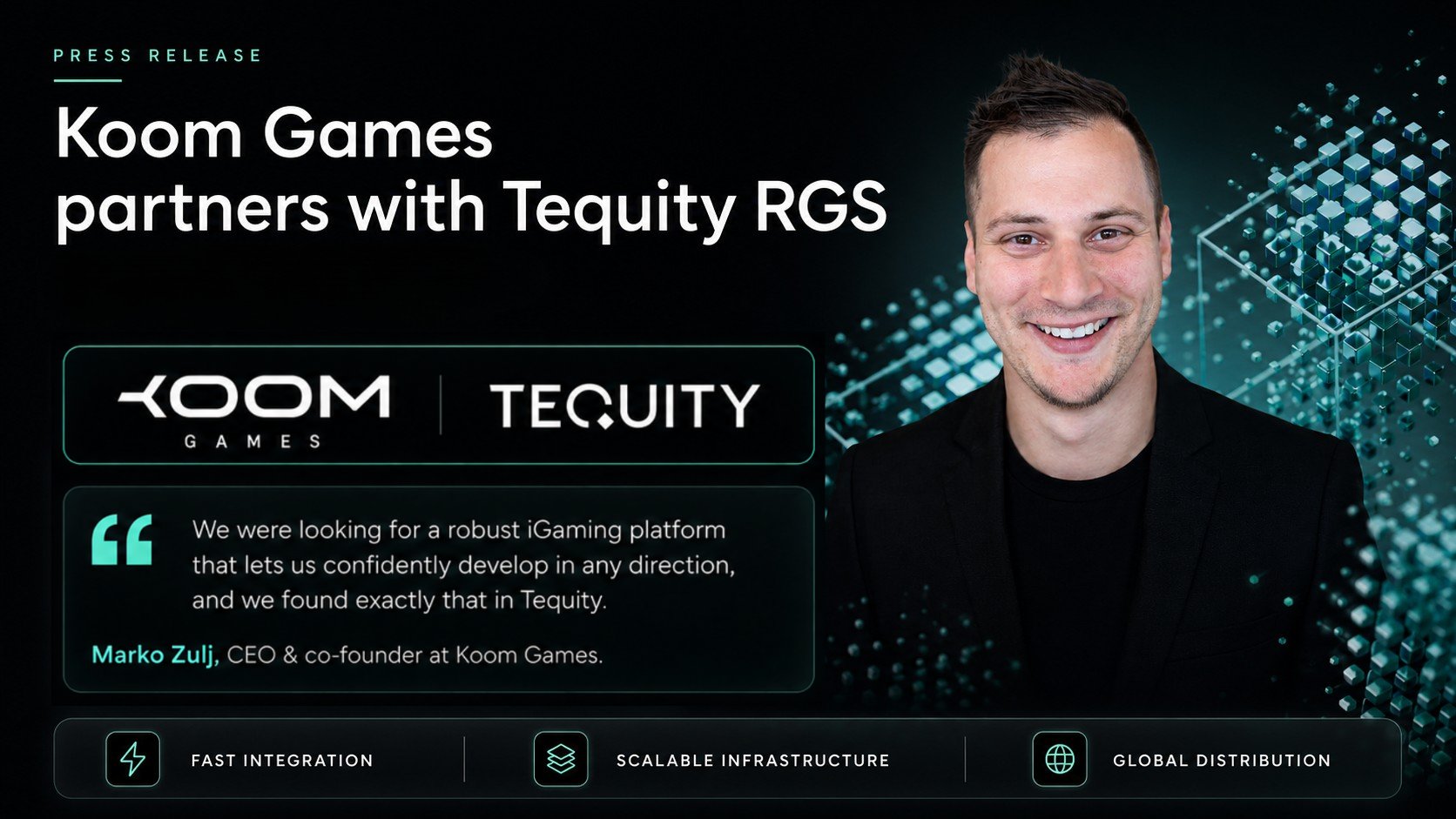
Tequity has agreed a Remote Gaming Server (RGS) deal with slot studio Koom Games, with the partnership announced on 14 July 2026. Koom Games will use Tequity’s licensed modular RGS to develop and roll out new titles for distribution to operators worldwide.
Under the agreement, Koom Games will use Tequity’s infrastructure to handle game delivery while keeping control of its creative and development roadmap. The studio said its approach is to build content closer to mobile and social gaming than traditional casino titles.
Tequity said it currently supports 31 RGS clients and manages more than 130 integrations across regulated markets. The company positioned the Koom Games deal as part of a wider run of commercial agreements with providers and operators.
Tanja Bergman, VP of Partnerships at Tequity, said: “Koom Games is a studio that is looming to enter the global market by making a big splash. The team’s dedication to creating content that is genuinely fresh is highly impressive. We are thrilled to offer the stable, high-performance environment needed to transform this creative vision into a market-leading reality.”
Marko Zulj, CEO & co-founder at Koom Games, said: “Whenever operators and aggregators ask us what category our games fit into, we actually struggle to give a traditional answer. Instead, we tell them, ‘you’ll need to try them, because you haven’t played this before’.
“Our games come with completely new mechanics, fresh math, and features built for social engagement. To scale such a vision and remain agile, we needed more than a reliable RGS — we were looking for a robust iGaming platform that lets us confidently develop in any direction, and we found exactly that in Tequity.”
The post Tequity signs Koom Games to its RGS platform appeared first on EE Gaming | Global iGaming & Tech Intelligence Hub.

-

 Compliance Updates7 days ago
Kasinohai Audit: Most Slots Could Be Affected by Finland’s Draft Gambling Rules
-
Latest News6 days ago
BetMakers Technology Group Selected to Distribute ATG Horse Racing Content Across Australia and New Zealand
-
Latest News7 days ago
Belatra signs cooperation deal to distribute slots via VeliGames
-
Compliance Updates7 days ago
Pernambuco court revokes Spribe’s interim relief in Aviator trademark dispute
-
Compliance Updates6 days ago
ACMA Warns MMA Fighter Jamie Mullarkey for Breaches of Online Gambling Laws
-
 Compliance Updates4 days ago
Arizona Department of Gaming Issues Cease-and-Desist Orders to Multiple Operators Linked to Underage Gambling and Illegal Activity
-
Latest News6 days ago
DEGEN Studios unleashes the Plague City chase
-
Latest News5 days ago
PG Soft appoints Hugo Baungartner as General Manager LatAm