Latest News
Prague Gaming & TECH Summit 2023: Charting the growth of Esports in CEE

Ahead of our sold-out Prague Gaming & TECH Summit 2023 next week, we sat down with some of the brightest minds in Europe to talk all things Esports and its potential for the CEE region.
In one of our most insightful interviews this year, we brought together Peter Rippel Szabo (PRS), Associate at Bird & Bird, Amir Mirazee (AM), Managing Director and COO at Bayes Esports, as well as Dimitris Panageas (DP), Group General Counsel at Kaizen Gaming to get the latest on Esports’ growth.
Covering everything from Ukraine, localised regulation, market demographics, state licensing and taking on traditional sportsbook spend, this one’s not to be missed!
To kick things off, let’s talk about the demand for Esports in CEE – how much does the region stand out in terms of growth potential vs the likes of Scandinavia and Western Europe?
AM: It’s a unique environment and of course being Bayes, we can gauge that from a good standpoint with over 100 betting clients globally and 200 in our extended network. On the CEE side, our major partners are GG.bet, DATA.BET and BETER, and we’re seeing considerable volume. This is particularly the case for Counter Strike – and players love new titles.
The one issue we have right now is the changing political dynamics. While Ukraine and Russia used to offer great Esports teams, as well as serving an anchor for satellite nations around them (Poland, Baltics etc), this equilibrium has of course been shifted, and it now needs to settle at a new one. This is especially the case for Ukraine, which really was the epicentre in the CEE region for Esports. Added to that is Russia of course now being shut out of the market, with operations now needing to be re-established to find a new hub to anchor the vertical’s development. In my view – the Czech Republic will likely be a key component.
PRS: From my base in Hungary, I can certainly say that across CEE organised tournaments are very strong – with growth proving very organic, and indeed, spontaneous. There’s not yet big money in most of the tournaments’ prize pools, but they are certainly crammed with amateur players who are very ‘plugged-in’ online and have a real passion for Esports. This goes for both the relevant products and enjoyment of that entertainment. Also, it is worth mentioning that in Hungary more established clubs with strong foundations across various sports have engaged with Esports (e.g. through establishing dedicated esports departments and training players professionally). Universities and other non-profit organisations have also started to study thoroughly the various physical, psychological and other aspects of Esports.
From a legal perspective what is needed for growth is a clear regulatory environment (dealing with the status of esports, i.e. whether it is a ‘normal’ sport, whether it has a special status, or something in between, as well as covering issues like requirements for tournament organisation, player safeguarding and integrity). This would also help alleviate some aspects negatively perceived by the general public (like lack of exercise, addiction or abuse). Of course, talking about Scandinavia and Western Europe – the one variable in comparison with CEE is consumer spend and the resulting market size which will likely never reach the same level in the East.
DP: For myself, and indeed given our extensive experience at Kaizen, I would say the demand is there to see. It’s not a new way of betting, but rather a new type of possible future verticals, and a set of betting markets to enjoy. As it’s still in the emerging stage, I would say it’s not yet considered a fully established ‘traditional’ vertical like sportsbook, lottery, live casino and others.
Looking at demographics, they are without a doubt smaller than more established verticals, which we need to distil into sub-segments to better understand on a micro level. Factoring in how fast the CEE market is changing, especially with the likes of Hungary (which was until recently a state monopoly), I would definitely say that we have every potential for Esports to really take off in the next 5-10 years.
On a macro level, the major growth blocker that needs to be overcome is that of regulation. Esports needs to be properly and specifically regulated as both a sport and from a betting perspective – this is essential in order to enable it to become a fully established vertical in its own right. So, in summary, it’s emerging fast and gaining traction, but still a long way to go.
What do you see as the key driver for demand for Esports betting in CEE? From a regulatory perspective, do you see CEE jurisdictions as being more open to Esports betting?
AM: Agreeing with Peter in his first answer, I would certainly say it’s a unique generation in CEE and that’s certainly why Esports has grown so much here. Online gaming, and indeed video gaming, has created the generation we’re seeing now, as well providing them with a connection to the rest of Europe and the wider world. Without a doubt, we can say that the ‘internet generation’ in their 20s and 30s have very much been shaped by that culture, whether that’s Call of Duty, memes, and everything else. On the regulation front, again, I agree also – it needs to be regulated as a sport. Germany, for example, does not even acknowledge Esports as a sport, which as a consequence, means it can’t even be bet on yet. That needs to change.
PRS: It’s a complex question but with plenty of potential in CEE. Gambling, betting and generally games of chance have similar basic legal concepts when it comes to regulation across Europe (national regulatory frameworks may differ of course), therefore, CEE jurisdictions can be as open to Esports betting as other countries. I think the key driver is simply how much Esports will gain in popularity in the future, for the more popular certain Esports titles will be the more will the demand be for Esports betting. Also, I think if Esports would be recognised explicitly as a sport and/or it would be a regulated activity in a CEE jurisdiction, then I believe it would likely facilitate the demand for Esports betting in that jurisdiction.
DP: Indeed. The key factor that you need to drive demand (let’s say from a sample set of the 10 major CEE countries), is that they do not yet specifically regulate Esports. Hungary, as Peter has mentioned, is becoming part of that change, so we’re seeing the opportunity for it to become a conducive environment for development. In my view, the regulatory framework for most of CEE is still vague; and as long as it’s principally viewed as a betting market rather than a sporting discipline in its own right, it will stay as that.
Taking the wider perspective, any law and/or regulation will take a minimum of 6-12 months to be adopted and following that – you’ll then need extensive marketing and commercial communication expenses to then push Esports into the mainstream. Without a doubt, however, looking at CEE demographics, the unique composition of their audiences holds plenty of potential. What makes it special is that while it is niche as a sport/product, it’s not the same as niche traditional sports, such as handball in Germany.
Rather, you have a fast-growing product that can easily enter the mainstream as it transcends borders and can offer penetration principally via social media, where it is already very popular. I am sure that with the proper marketing and investment, Esports will create a snowball effect that will allow it to become a mainstream vertical by itself soon enough.
When it comes to being a complementary product to traditional sportsbook spend, how is Esports fitting into the mix and is it cannibalising from traditional sportsbook?
PRS: I’d say that Esports and traditional sportsbook can, and do, complement each other, especially if popular traditional sports (like football or basketball) are played via video games (FIFA or NBA2K) in organised Esports competitions which traditional sports fans can easily perceive and understand.
So, even if audiences are of course very different, you’ll see crossovers when it comes to interests. Using Hungary as an example, the state-owned betting & lottery operator (Szerencsejáték Zrt.) launched betting on esports competitions in 2020 due to the lack of traditional live sports events resulting from the Covid-19 pandemic. It has quickly become one of its most popular betting offerings.
An interesting point too is the ability to convert players to new verticals, and as a result, increase engagement and incremental spend. For example, you’ll have a millennial customer use football as a platform for introduction, and then while waiting for the match to play out for 90 minutes (or indeed after the final whistle), he / she will then give Efootball or another Esports activity a try – which is a great way of introducing the product.
AM: From my perspective, if we’re talking about FIFA and other Esports, these worked superbly well during COVID as a substitute product for those looking to replicate the missing sporting schedule, with nothing happening aside from (as I recall), the Belarusian Premier League. With the likes of League of Legends and Counter Strike, you have a very different demographic / audience – and you’ll find them in different places rather than traditional sportsbook.
As a result, I believe you need to look at providing something different to attract players. Take a look at Bet365’s Esports offering for example, it works surprisingly well for a UX that has evidently been derived from traditional sports. However, there’s much more room for improvement in the coming years. It’s easy to see the use-case for this, looking at all sports betting viewership right now, everything’s declining aside from Esports, so it’s an opportunity to be capitalised on.
We’re also seeing demographics change rapidly, while Esports was previously only for the 20-25 age group, it’s now becoming much older, so you’re closing that monetisation gap. If you want to capture the interest of this fast-growing demographic, you need to reformat the UX to cater to that. So yes, without a doubt, Esports is now becoming a product that can drive traffic in its own right through new audiences, without cannibalising spend from traditional sportsbook.
DP: For me, it depends on the definition of where cannibalisation starts from. When new products are introduced, they certainly drive interest and add to engagement, but in theory that will also bring a decline in engagement for traditional alternatives as overall sportsbook spend is going to be finite.
The positive that Esports brings however, is that it can complement well, given it has a very different schedule to traditional sportsbook. Tournaments taking place across the globe (for example in Asia) are during the evening , meaning it’s during the day in Europe – enabling Esports to boost sportsbook spend both before and the day after evening football matches such as the Champions League mid-week.
Taking the longer view, there is a greater risk of cannibalisation if we see more European Esports tournaments taking place during the evening (at the same time as major football matches), which will likely happen in the next 5-10 years. This will create a tipping point where it becomes more popular to bet on than evening football matches.
Looking at the delayed Euro 2020 held last year, can operators use the standout success of Efootball during the tournament as a reason to engage more players during the weekend’s sport fixtures?
DP: I believe Esports will always hold plenty of potential as a complementary product during major events such as the Euros, where we see heightened betting activity and greater overall spend. However, the challenge is always going to be taking this into the mainstream and having it considered as a regular fixture week in, week out. In my view, it is very possible that this could translate well into a complementary product that fills the gaps between sporting fixtures, especially for those who like to be pre-match and not in play. Given a football match lasts 90 minutes, you have plenty of space to fill over the 90 minutes after pre-match bets are placed. If you can identify and incentivise that opportunity, then I believe there is huge potential in the long term.
AM: Also, as we’ve covered already – the audience you have for Efootball- is completely different to Counter Strike, League of Legends and the like, so in effect we’re only talking about 50% of the potential Esports audience.
Let’s take Europe as a market to speak on a macro level and place Efootball in isolation. Regulation for a start is going to be key, making sure that product is available and acceptable. That’s something in particular we’d need to see in Germany with the Bundesliga, as Esports is not yet regulated to be a betting market. Looking further west towards the UK, there’s far less of an overlap, due to player preferences and composition of audience. However, if we return to the CEE, then yes, without a doubt I see plenty of potential here for operators to really test this out as it’s something the new generation of players are very receptive to.
PRS: To add to that, I would certainly say in many ways we’re looking at an area of spend (and indeed audience) that are traditionalists when it comes to football. However, if we look at the new generation and their social circles and familiarity with the online environment, they are shaped by a very different world than what older generations had for football growing up as a primary source of entertainment.
So, without a doubt, we’ll see a very different trend towards the Esports landscape over the next decade. Whether that’s for Esports as a complementary product or one in its own right, I believe it will be inevitable that it becomes an area of engagement with traditional sports fixture in the decade to come. This is especially the case if Esports will be regulated clearly, as well as Esports tournaments being organised regularly, enabling online gaming operators to follow that lead and invest in technology and commercial communication dedicated to Esports.
Last but not least, looking at the big picture – what’s your take on how Esports is going to develop in CEE over the next five years, how much more do you see it gaining popularity?
DP: I believe it is going to develop, and it will no doubt gain traction. But in my view, it won’t take off immediately. The next few years will likely see Esports continue as a complementary product that will enable operators to diversify and upgrade their offerings. The new generation coming online will power this, and with an extensive spectrum of events around the globe, and the 24-7 betting that it brings, it can scale fast.
However, for that to happen, we also need to see more investment in the vertical for it to become more established. For a start, we need more advanced trading models that can enable operators to offer a much broader spectrum of Esports betting markets to attract more players. We’re already seeing that happen in real-time, and even in the last three years, there’s been a real surge in terms of managed trading services for Esports and the provision of data. As we’re seeing truly specialised companies for this provision begin to corner the market, growth will inevitably become even more exponential, with a ‘hockey stick’ style adoption curve.
AM: I agree. There’s plenty of potential. We can certainly say that outside of the present conflict taking place between Russia and Ukraine, there’s a stable trend towards growth, aside from the recent Parimatch / Ukraine news this week. I’m confident it’s only going to keep growing for all the reasons we’ve covered above.
All of this is fuelled by the unique audiences of the region, and indeed their demand for entertainment. If we compare the potential of Western vs. Eastern Europe, then without a doubt, I believe that CEE is the most likely to emerge as the continent’s major player. Given our position on the market as one of the world’s leading Esports providers, I believe that Esports is exactly what you make of it – and if you take a proactive view and approach, the market share is there for the taking.
PRS: I concur with Amir and Dimitris, I believe it’s only going to grow – all the foundations are there in CEE to make that happen; demographics, interest, increasing awareness of relevant brand values and an established understanding of the mechanics. In the short-term, I don’t believe we’ll see major displacement of the most popular traditional sports or radical shifts in market trends. Longer term, we’ll to see much greater adoption that will no doubt scale over as exponential growth really begins to emerge.
Powered by WPeMatico


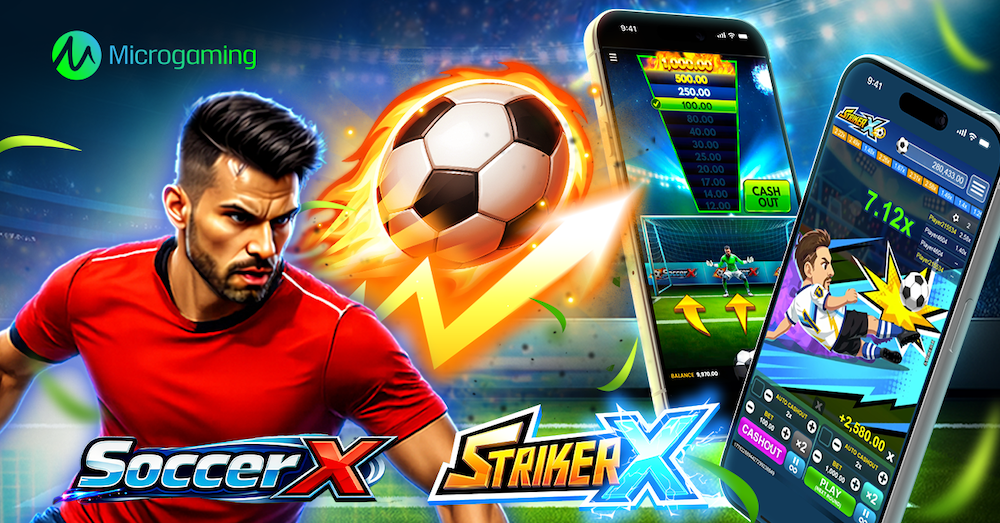
Crash and instant win formats target fast onboarding, mobile play and low-friction mechanics, with RTP and max win figures disclosed for SoccerX.
Microgaming has launched two football-themed games, StrikerX and SoccerX, positioning them as “gateway” titles designed to support player acquisition for operators.
The supplier said the releases are built around quick-result gameplay and low-friction entry, with mechanics intended to be easy to pick up. StrikerX is a Crash game, while SoccerX is an Instant Win title, with both designed for fast loading and mobile performance, according to the company.
SoccerX is built around a penalty shootout format where players pick a shot and attempt to beat the keeper while progressing up a prize ladder. Microgaming said the ladder can be cashed out at any point or pushed further. The company lists the game’s RTP at 96.00% and a top win potential of up to 12,500x, and says players can choose their own volatility.
StrikerX allows players to place up to two bets in a single round, using different strategies at the same time, while “dynamic game events” increase the multiplier as play progresses, according to Microgaming. Its Ultimate Shot feature triggers at 100x and introduces bonus multipliers ranging from x1 to x100, with win potential of up to 10,000x.
A Microgaming spokesperson said: “Acquisition is not just about visibility, it is about removing friction. With SoccerX and StrikerX, the aim was to create games that are quick to load, quick to understand and easy to get into, which makes them very effective at opening the door to a wider portfolio. Football gives both titles an immediate hook, but the bigger value is in having formats that can bring in new audiences and still give them a reason to stay.”
The post Microgaming launches football games StrikerX and SoccerX aimed at acquisition appeared first on EE Gaming | Global iGaming & Tech Intelligence Hub.

The 2026 Gaming in Germany Conference will take place on Tuesday, November 10, 2026, at the DoubleTree Hilton Ku’damm in Berlin. The organisers have also announced the first confirmed speakers for the annual regulated iGaming-focused event.
Conference topics will include the ongoing evaluation of the 2021 State Gambling Treaty (GlüStv 2021), the “current & future permissibility of new products” including prediction betting, sweepstakes and eSports betting, and the future of remaining gambling monopolies in Germany and Austria. The programme also flags market re-regulation in Austria and “strategies for countering offshore offerings and to #ReclaimTheMarket for licensed operators.”
Confirmed speakers listed by the organiser include a senior GGL representative, Dr. Damir Boehm (CEO, Tipwin), Dr. Christian Piska (Professor, Faculty of Law, University of Vienna), Dr. Joerg Hofmann (Senior Partner, Melchers Law Firm), Vasiliki Panousi (Regulatory Affairs Senior Manager, Kaizen), Josh Hodgson (COO, H2 Gambling Capital), and Mohamed Messaoudi (Director, Digital Vault Product, Trust & Sign, Docaposte), among others.
Gaming in Germany founder Willem van Oort said: “I am extremely pleased with this year’s speaker lineup. We are undeniably bringing an impressive amount of expertise to the stage – including, of course, a significant amount of business and regulatory experience. Since we will be discussing, among other things, the outcome of the evaluation of the GlüStv 2021 – something that is highly relevant to the entire sector – I am very glad about the amount of thought leadership that we have managed to bring together so far.”
The organiser said registration is open and issued a call for additional speakers, specifically seeking expertise on business topics including media and marketing, affiliation, compliance and operations.
The post Gaming in Germany Conference sets Nov 10, 2026 date in Berlin, names first speakers appeared first on EE Gaming | Global iGaming & Tech Intelligence Hub.

Company plans to roll out SOCCERBET with LALIGA archive footage on its own platform in Italian retail after the World Cup.
Highlight Games Limited said its proprietary platform has passed Italy’s ADM collaudo process, the technical certification required for gaming platforms. The company announced the approval on 14 July 2026 from London.
Following the conclusion of the World Cup, Highlight said it will launch its Spanish SOCCERBET product featuring archive LALIGA footage on its own platform across Italian retail channels. The company added that operators will transfer to Highlight’s platform over the months that follow.
The supplier said the certification allows it to deliver its content via its own “zero-cost streaming technology” in Italy and gives it control over its product roadmap in what it called its most important market.
Steven Holmes, CEO, Highlight Games said: ‘This is a huge moment for Highlight as we bring our video-based technology stack to the Italian market and join a select few who are able to offer an officially ADM certified platform. Italy is where SOCCERBET has proven itself time and again and passing the ADM collaudo means we can now deliver that content on our own platform, with our zero-cost streaming solution, exactly as it was designed to be experienced.
‘Owning the technology end to end means we control our own roadmap, resulting in faster launches, smoother integrations for our operator partners and a richer experience for players. Our products consistently perform at the top of the market wherever they are live, and with our platform now officially certified in Italy, we have everything in place to build on that momentum.’
The post Highlight Games’ platform clears Italy’s ADM collaudo certification appeared first on EE Gaming | Global iGaming & Tech Intelligence Hub.

-

 Latest News7 days ago
Eeze opens 1,200 sqm Bucharest hub for technical teams
-
Latest News7 days ago
Play’n GO strengthens Latin American presence with Betano Colombia launch
-
Latest News6 days ago
BetMakers Technology Group Selected to Distribute ATG Horse Racing Content Across Australia and New Zealand
-
Latest News7 days ago
Belatra signs cooperation deal to distribute slots via VeliGames
-
Compliance Updates7 days ago
Kasinohai Audit: Most Slots Could Be Affected by Finland’s Draft Gambling Rules
-
Compliance Updates7 days ago
Pernambuco court revokes Spribe’s interim relief in Aviator trademark dispute
-
Latest News7 days ago
R. Franco Digital releases fighting game-themed slot Spin Fighters
-
Compliance Updates6 days ago
ACMA Warns MMA Fighter Jamie Mullarkey for Breaches of Online Gambling Laws