Latest News
New Survey Shows Impact of Gambling Advertising on Customers

The UK Gambling Commission (UKGC) has published its latest survey which reveals the impact of gambling advertising on customers. The survey included data from 6258 respondents.
Of the 4,566 respondents who had gambled in the past 12 months, 34% said that a post or media had prompted them to spend money on a gambling activity in that period.
Free bets or money to spend with a gambling company was the most likely to prompt a customer to engage in gambling, with 22% of gamblers reporting doing so.
Advertising on social media and TV had each prompted 15% of gamblers to gamble in the last 12 months. Direct marketing, sports sponsorships and newspaper advertising prompted 9%, 8% and 7%, respectively.
The Gambling Commission also asked those who had reported seeing gambling ads how, if at all, those ads had changed their gambling habits.
Of those respondents who had reported seeing traditional advertising from gambling companies – such as television or print ads – 52.8% said that the advertising had not changed the amount that they gambled.
Meanwhile, 13.0% said such ads prompted them to start gambling for the first time, while 16.3% said these traditional ads prompted them to increase the amount that they gamble.
A further 14.7% were prompted to restart gambling after taking a break from the activity because of these ads. Meanwhile, 10.1% said the ads prompted them to change what they gambled on or try a new form of gambling.
Free bets or money to spend with a gambling company was shown to be the most effective new customer acquisition method, as 25.9% of those who had gambled in the last 12 months and seen posts or advertising said that free bets prompted them to start gambling for the first time.
Free bets also led to 18.6% of viewers restarting gambling after taking a break.
Of the advertising methods examined, the Gambling Commission said free bets had the lowest rate of responses saying they had not changed the amount that respondents gambled, at just 35.2%.
Direct marketing via email, text message or push notification appeared to be more effective with existing or lapsed customers, however. It was cited by most respondents as prompting them to increase the amount they gambled, at 21.8%. It was also the method that prompted most people to restart gambling after taking a break, at 19.6%.
The figures also showed that 85% of those surveyed reported having seen any gambling advertising or sponsorship. In total, 83% reported having seen advertising and 78% having seen sponsorship.
These figures are down on 2019’s survey which showed 87% of people had seen advertisements or sponsorships, with 86% seeing advertisements and 82% sponsorships.
Television advertising was the most widely seen format for gambling advertising, with 76% of respondents reporting seeing this.
Gambling sponsorships on TV, radio or podcasts were the next most common format for people to see, at 67%. Other common places to see gambling advertising or sponsorships were on sports merchandise (60%), in sports venues (59%) and online outside social media (56%).
The least common reported place to see a gambling advertisement was via direct marketing, either by email, text message or push notification, which 37% of respondents reported seeing.
The data showed that young people are more likely to see gambling advertising online, with 77% of people aged 18 to 24 saying they had seen gambling ads online, compared to 55% of those 65 and over.
Of those surveyed, most (68%) said they use social media but don’t follow gambling operators or companies. Meanwhile, 17% said they do not use social media or streaming platforms, and 16% said they do follow or watch gambling companies.
Powered by WPeMatico


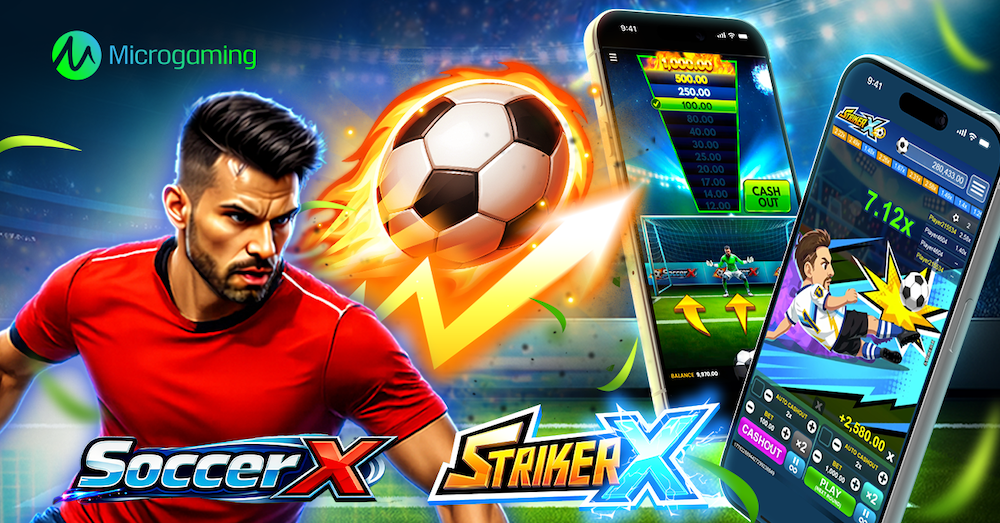
Crash and instant win formats target fast onboarding, mobile play and low-friction mechanics, with RTP and max win figures disclosed for SoccerX.
Microgaming has launched two football-themed games, StrikerX and SoccerX, positioning them as “gateway” titles designed to support player acquisition for operators.
The supplier said the releases are built around quick-result gameplay and low-friction entry, with mechanics intended to be easy to pick up. StrikerX is a Crash game, while SoccerX is an Instant Win title, with both designed for fast loading and mobile performance, according to the company.
SoccerX is built around a penalty shootout format where players pick a shot and attempt to beat the keeper while progressing up a prize ladder. Microgaming said the ladder can be cashed out at any point or pushed further. The company lists the game’s RTP at 96.00% and a top win potential of up to 12,500x, and says players can choose their own volatility.
StrikerX allows players to place up to two bets in a single round, using different strategies at the same time, while “dynamic game events” increase the multiplier as play progresses, according to Microgaming. Its Ultimate Shot feature triggers at 100x and introduces bonus multipliers ranging from x1 to x100, with win potential of up to 10,000x.
A Microgaming spokesperson said: “Acquisition is not just about visibility, it is about removing friction. With SoccerX and StrikerX, the aim was to create games that are quick to load, quick to understand and easy to get into, which makes them very effective at opening the door to a wider portfolio. Football gives both titles an immediate hook, but the bigger value is in having formats that can bring in new audiences and still give them a reason to stay.”
The post Microgaming launches football games StrikerX and SoccerX aimed at acquisition appeared first on EE Gaming | Global iGaming & Tech Intelligence Hub.

The 2026 Gaming in Germany Conference will take place on Tuesday, November 10, 2026, at the DoubleTree Hilton Ku’damm in Berlin. The organisers have also announced the first confirmed speakers for the annual regulated iGaming-focused event.
Conference topics will include the ongoing evaluation of the 2021 State Gambling Treaty (GlüStv 2021), the “current & future permissibility of new products” including prediction betting, sweepstakes and eSports betting, and the future of remaining gambling monopolies in Germany and Austria. The programme also flags market re-regulation in Austria and “strategies for countering offshore offerings and to #ReclaimTheMarket for licensed operators.”
Confirmed speakers listed by the organiser include a senior GGL representative, Dr. Damir Boehm (CEO, Tipwin), Dr. Christian Piska (Professor, Faculty of Law, University of Vienna), Dr. Joerg Hofmann (Senior Partner, Melchers Law Firm), Vasiliki Panousi (Regulatory Affairs Senior Manager, Kaizen), Josh Hodgson (COO, H2 Gambling Capital), and Mohamed Messaoudi (Director, Digital Vault Product, Trust & Sign, Docaposte), among others.
Gaming in Germany founder Willem van Oort said: “I am extremely pleased with this year’s speaker lineup. We are undeniably bringing an impressive amount of expertise to the stage – including, of course, a significant amount of business and regulatory experience. Since we will be discussing, among other things, the outcome of the evaluation of the GlüStv 2021 – something that is highly relevant to the entire sector – I am very glad about the amount of thought leadership that we have managed to bring together so far.”
The organiser said registration is open and issued a call for additional speakers, specifically seeking expertise on business topics including media and marketing, affiliation, compliance and operations.
The post Gaming in Germany Conference sets Nov 10, 2026 date in Berlin, names first speakers appeared first on EE Gaming | Global iGaming & Tech Intelligence Hub.

Company plans to roll out SOCCERBET with LALIGA archive footage on its own platform in Italian retail after the World Cup.
Highlight Games Limited said its proprietary platform has passed Italy’s ADM collaudo process, the technical certification required for gaming platforms. The company announced the approval on 14 July 2026 from London.
Following the conclusion of the World Cup, Highlight said it will launch its Spanish SOCCERBET product featuring archive LALIGA footage on its own platform across Italian retail channels. The company added that operators will transfer to Highlight’s platform over the months that follow.
The supplier said the certification allows it to deliver its content via its own “zero-cost streaming technology” in Italy and gives it control over its product roadmap in what it called its most important market.
Steven Holmes, CEO, Highlight Games said: ‘This is a huge moment for Highlight as we bring our video-based technology stack to the Italian market and join a select few who are able to offer an officially ADM certified platform. Italy is where SOCCERBET has proven itself time and again and passing the ADM collaudo means we can now deliver that content on our own platform, with our zero-cost streaming solution, exactly as it was designed to be experienced.
‘Owning the technology end to end means we control our own roadmap, resulting in faster launches, smoother integrations for our operator partners and a richer experience for players. Our products consistently perform at the top of the market wherever they are live, and with our platform now officially certified in Italy, we have everything in place to build on that momentum.’
The post Highlight Games’ platform clears Italy’s ADM collaudo certification appeared first on EE Gaming | Global iGaming & Tech Intelligence Hub.

-

 Latest News7 days ago
Eeze opens 1,200 sqm Bucharest hub for technical teams
-
Latest News7 days ago
Play’n GO strengthens Latin American presence with Betano Colombia launch
-
Latest News6 days ago
BetMakers Technology Group Selected to Distribute ATG Horse Racing Content Across Australia and New Zealand
-
Compliance Updates7 days ago
Kasinohai Audit: Most Slots Could Be Affected by Finland’s Draft Gambling Rules
-
Latest News7 days ago
Belatra signs cooperation deal to distribute slots via VeliGames
-
Compliance Updates7 days ago
Pernambuco court revokes Spribe’s interim relief in Aviator trademark dispute
-
Latest News7 days ago
R. Franco Digital releases fighting game-themed slot Spin Fighters
-
Compliance Updates6 days ago
ACMA Warns MMA Fighter Jamie Mullarkey for Breaches of Online Gambling Laws