Latest News
The Right RTP for the German 5.3% Turnover-taxation?

So, you may have seen a poll I have published recently with the title: “If/when Germany introduces the 5.3% turnover tax, what RTP rate is best suited considering both game-play and effective tax-paid?” If you haven’t seen it, here is the poll again for reference:
https://www.linkedin.com/feed/update/urn:li:activity:6790660730564825088/
There are a few ways of looking at this, but I think the key take-away is that the industry this poll represents is fairly evenly split between above 90% RTP and below 90% RTP.
The tax explained
First, to ensure we are on the same page, a quick explanation of the tax proposed:
Currently a 5.3% tax on turnover has been proposed and a draft-legislation does exist. I won’t go into the politics and the thinking behind this, but rather try to analyze the numbers.
A 5.3% tax on every bet being placed on an online slot means an operator can not offer an RTP over 94.7%. At 94.7% RTP, the operator would break even exactly on a bet-level, but obviously would lose money as marketing, employees and general operation have to be financed somehow. Considering financial overhead in any operation, that means the maximum RTP a casino is technically able to offer while avoiding bankruptcy is probably around 93% or more likely at 92%. This is the top ceiling and at the same time too high to be profitable.
Now, there is a bit of uncertainty and I’m also not entirely sure if the number to calculate against is 5.3% or rather 5.033%. The tax is 5.3% on turnover, meaning a 1 EUR bet causes a tax of 5.3 cents, which totals to 1.053 EUR. The tax-portion of 1.053 EUR is less than 5.3%. 100*5.3/(100+5.3) = 5.033 resp. 5.033%. I do calculations here in this document based on 5.3%.
How to balance RTP and profitability
We’ve established above that 93% or 92% is the top ceiling, but where is the bottom?
The table below shows how a Slots-operator will be taxed, calculated into the GGR-equivalent %-age number and cross-referenced with RTP. For reference, many other jurisdictions in Europe offer a GGR-based tax-rate of around 20%. As you can see from the table below, the 5.3% tax-rate on turnover wouldn’t be so bad, if players would accept 80% RTP. At 80% RTP, the GGR-equivalent tax-rate is 26.50% and thus a competitive tax-rate.
The coloring I have done here may be slightly biased, especially in terms of RTP so please take with a grain of salt. But if you roughly accept that the red-area you want to avoid on the RTP and on the GGR-% side, then you end up with an RTP-bandwidth between 84% and 91% to play with.
Further, and again granted you accept the coloring, an operator obviously wants to find an RTP in the green and a GGR-% in the green. Here we arrive at 88% and 89% RTP.
Now, a lot has been written that players will not accept such low RTP’s as say 84%. There are counter-arguments made that in land-based slots the RTP is exactly at that level and actually 88% is on the higher-end in land-based casinos.
On the other hand, for many market-participants the number “9” is a psychological blocker. Players, Affiliates and a couple of Slots-Studios I speak to feel very anxious offering product below 90% as this number still feels somewhat close to the industry-average of 94 to 97%. 89% sounds very different than 90%, although it is “just” 1% in RTP dropped.
Sportsbook vs. Casinos
It will be interesting to watch if Sportsbook or Sports-led brands will choose a differing RTP-rate than Pure-Play Casinos. A Sportsbook can more easily stay on a higher RTP and just pause all short-term expenses (bonus, marketing, etc.) and focus on cross-sell. A pure-play Casino will have to look a lot more closely on bottom-line and in my opinion will have a hard time offering e.g. 90% RTP-Slots as the GGR-equivalent tax-rate is 53%.
Game-Mechanics?
Will there be new Game-Mechanics invented to combat this problem? Looking at the table above again, the second column states how many spins a player on average can make until 1 EUR is spent depending on the RTP-Level. At 95% RTP this is 20 spins. Now, if a Game-Mechanic can be invented that provides a low mathematical RTP while at the same time provides a similar amount of real spins, then this could be a solution to the problem.
Conclusion & in my opinion
The above explanation is in no way complete – there are actually interesting studies which analyze how much an RTP is “felt” by the player and there is probably very good data the land-based industry has to offer.
But, to move away from being neutral, here’s what I personally think: The reality will be that everyone will push the RTP down and experiment with the lowest acceptable RTP as this maximizes their income. As such, come 1st of July, we’ll see a lot of RTP’s experimented with. Imagine you are a pure-play casino and you can provide a Game-Mechanic that feels good to the player and has a nice session length, while staying at or below 40% GGR-equivalent-tax. I believe things start to fall apart financially for an operator at 40% tax-rate. If you own your own media-assets and have good deals with your suppliers and run a tight operation then a 40% tax is possible to do really well in Germany. That means, the average-RTP across the portfolio will have to be around 87–88%. I think you can mix in 91% games into the portfolio just so that is part of the portfolio too, but the majority of revenue of the white-market in Germany will in my opinion come from Slots around 88% RTP. And since some games will be mixed in at 90/91% you can expected some slots to be mixed in at 84/85% rate as well.
Update 07/05/2021:
I didn’t mention in this article two other potential solutions. One is directly taxing the customer on the bet and the other is directly taxing the customer on a win (paying the tax-authorities on a bet-level, but collecting funds/tax from players on a win) like currently most sportsbetting companies do in Germany. These solutions also lower the effective-RTP-rate to the customer (just charged at a differing touch-point).
The main issue with those solutions is that an operator ends up with an equivalent-GGR taxation of around 57% which isn’t sustainable. Here are some calculations of these alternative solutions: DE 5.3% Taxation Calculations
Powered by WPeMatico


Supplier secures AGLC registration and extends its Canadian footprint beyond Ontario, where it has been live since 2022.
Greentube has gone live in Alberta on the day the province opened as a newly regulated iGaming market, marking the supplier’s first launch in the jurisdiction.
The NOVOMATIC Digital Gaming and Entertainment division said it completed regulatory and technical due diligence and secured registration with the Alberta Gaming, Liquor and Cannabis (AGLC) commission to operate in the province. Alberta becomes only the second Canadian province to regulate iGaming after Ontario, with the new framework replacing the monopoly previously held by Play Alberta.
The Alberta launch builds on Greentube’s existing Canadian footprint. The company has been live in Ontario since 2022 and described the Alberta debut as part of its wider North American expansion strategy.
Greentube said Alberta players will initially have access to a curated set of titles including Piggy Prizes Wand of Riches 2, Rumble Riches Haulin’ Gold and Firecracker Frenzy Money Toad, as well as Silver Lux Big Win Spinner, Starlight Jackpots Captain’s Catch and Charming Lady’s Boom.
David Bolas, Commercial Director at Greentube, said: “Going live in Alberta on the day the market opens is an important step for Greentube and reflects the strong momentum we are seeing in Canada.
“We welcome the opportunity a new jurisdiction offers and look forward to working with locally licensed operators to introduce our established offering to players in Alberta. With a balanced line-up of new releases and proven performers, we are well placed to offer a compelling experience in the province and support our long-term ambitions in the region.”
The post Greentube goes live in Alberta as province opens regulated iGaming appeared first on EE Gaming | Global iGaming & Tech Intelligence Hub.
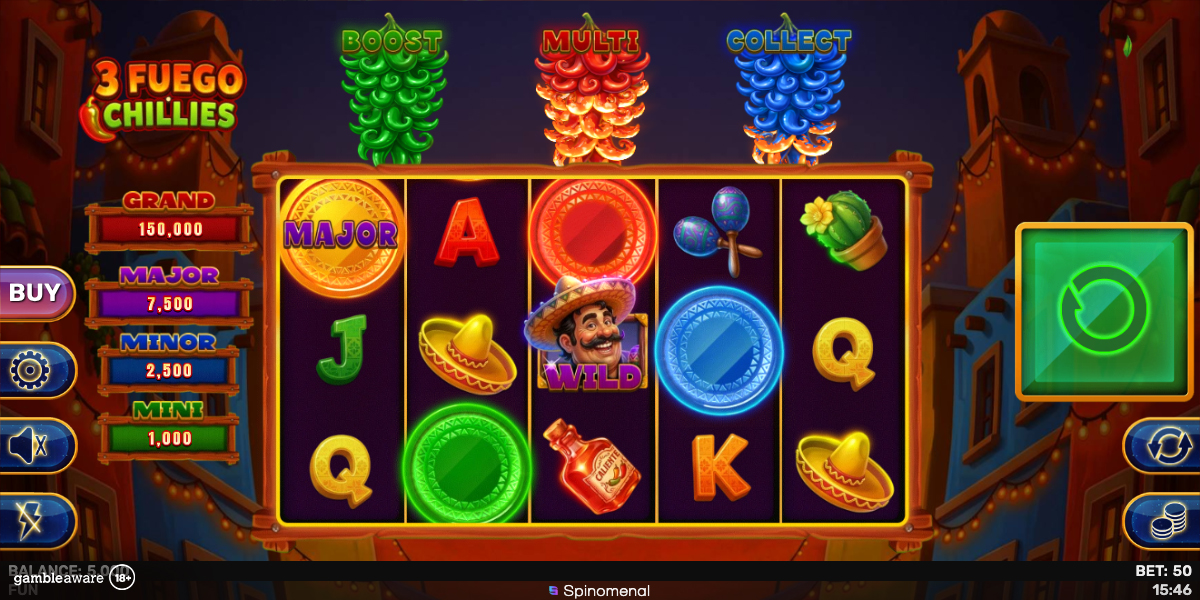
Spinomenal has released 3 Fuego Chillies, a new 5×3 video slot themed around a Mexican street fiesta. The game ships with a feature-led Bonus Game and a top prize billed as a Grand Jackpot of x3,000 the total bet.
The Wild is a mariachi in a sombrero and substitutes for all symbols except the Bonus, BOOST, COLLECT, MULTI and Jackpot symbols. Spinomenal said five Wilds on a payline return x10 the bet, with four paying x2 and three paying x0.5, while three- and four-Wild combinations only pay when followed by a Bonus or Special Bonus symbol.
Six or more Bonus and Special Bonus symbols trigger the Bonus Game. Triggering symbols lock in place and the feature starts with three bonus spins; only Bonus and Special Bonus symbols can land, carrying prizes from x1 to x10 the total bet, and each new symbol resets the spin counter back to three.
During the feature, BOOST assigns a random value (x2, x3, x4, x5, x7 or x10) and adds it to every symbol on the reels, while MULTI applies a x2, x3 or x5 multiplier to all symbols before taking a value based on the chosen multiplier. COLLECT then totals the values of all Bonus symbols into a single prize, and a MYSTERY symbol can transform into a BOOST, MULTI, COLLECT or Jackpot symbol.
Jackpot symbols during the feature pay Mini (x20), Minor (x50) or Major (x150), while filling all 15 cells awards the Grand Jackpot of x3,000 the total bet. Spinomenal also said a Bonus Blast Feature can trigger at random in the base game to spread extra symbols toward the Bonus Game, and the title includes a Buy Feature for instant entry. Spinomenal CO-CEO, Omer Henya commented: “3 Fuego Chillies brings the fun of the fiesta straight to the reels. The three chilli features keep the Bonus Game sizzling and the x3,000 Grand Jackpot gives players plenty to celebrate. We think this one will go down a treat with slot fans everywhere.”
The post Spinomenal releases new slot 3 Fuego Chillies appeared first on EE Gaming | Global iGaming & Tech Intelligence Hub.
Andy Phillips Chief Business Development Officer at Sporting Risk
Sporting Risk launches SureSub player prop markets via Sportradar odds feed

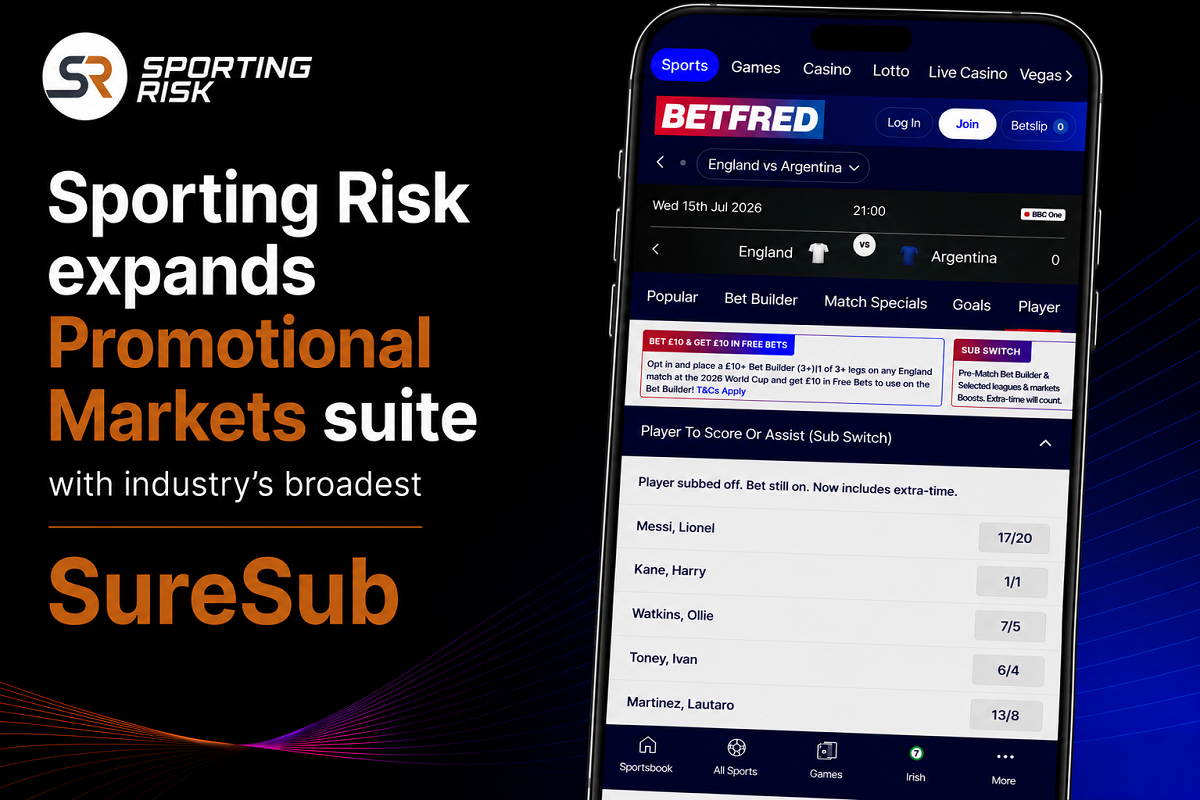
The new Promotional Markets add substitution-enabled player props designed to transfer bets to replacement players during a match.
Sporting Risk has expanded its Promotional Markets suite with a new set of SureSub player prop markets, distributed via the Sportradar Unified Odds Feed.
The company said SureSub is designed to extend eligible player prop bets beyond substitutions by automatically transferring selections to the replacement player. Sporting Risk added that operators can customise the feature, including its branding and name, to fit their sportsbook UX.
Sporting Risk positioned the release as part of its wider Promotional Markets portfolio, which it said includes products such as 2Up and other enhanced settlement mechanics aimed at helping operators differentiate without relying on bonuses, free bets or price-led promotions.
Andy Phillips, Chief Business Development Officer at Sporting Risk, said: “Operators are constantly looking for new ways to stand out in increasingly competitive markets. Promotional Markets do exactly that. They give operators a differentiated betting experience that keeps customers engaged throughout the match, without relying on bonuses or free bet campaigns. SureSub is a natural addition to that portfolio. It’s a mechanic customers already understand, but we’ve expanded it across a much broader range of player prop markets. Combined with our distribution through Sportradar, operators can now roll out SureSub at a scale that simply hasn’t been possible before.”
Sporting Risk said the product can be delivered directly or through the Sportradar Unified Odds Feed, with deployment designed to work across existing sportsbook infrastructure and scale across multiple competitions and leagues.
The post Sporting Risk launches SureSub player prop markets via Sportradar odds feed appeared first on EE Gaming | Global iGaming & Tech Intelligence Hub.

-

 Canada7 days ago
DraftKings Set to Launch its Online Sportsbook and Casino in Alberta
-
Canada7 days ago
Altenar Joins Alberta’s New Regulated iGaming Market
-
ESPN Networks3 days ago
THE 57th ANNUAL WORLD SERIES OF POKER® CONCLUDES AN EXTRAORDINARY SUMMER OF GLOBAL ENGAGEMENT AND ELITE COMPETITION
-
Latest News6 days ago
EveryMatrix’s Fantasma Games launches three-reel slot Bonus Bullets
-
Latest News4 days ago
Booming Games launches Tasty Bonanza Max Scatter slot
-
Latest News5 days ago
SCCG Management Launches Dedicated SCCG Brazil Division with Local Partner Thomas Carvalhaes
-
Latest News6 days ago
Blokotech adds Wicked Games slots in new content deal
-
Latest News7 days ago
Altenar Joins Alberta’s New Regulated iGaming Market