Latest News
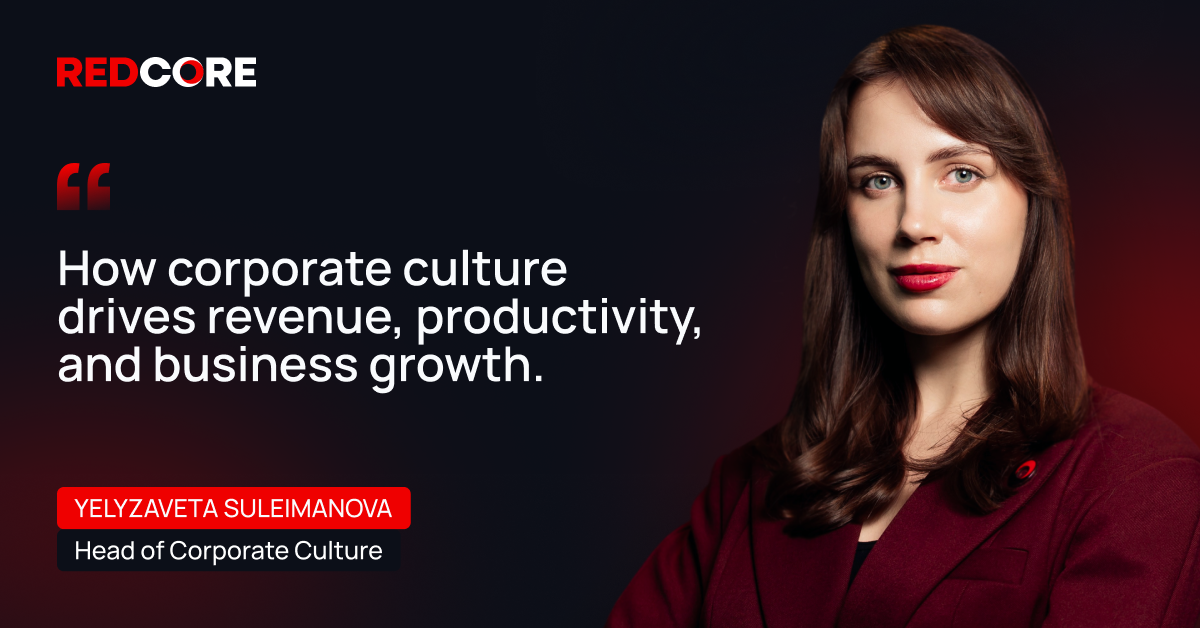
5 Questions to Test If Your Corporate Culture Really Works

Competitive salary, benefits package, access to learning, and comfortable work environment are no longer real advantages. Today, they are simply the bare minimum people expect from any modern company.
To become a market leader, you need a strong team. And top specialists are no longer satisfied with just having their basic needs covered. They want more. That is when businesses begin asking themselves important questions: How do we retain and motivate such specialists? How do we truly engage them in the company’s life? How do we unite team? And most importantly, how do we create an environment where people do not just complete tasks, but genuinely want to build something bigger?
At this point, corporate culture stops being just a conversation about values and engagement. Today, it directly impacts how much revenue your business generates, how productive your specialists are, and how effectively your managers make decisions.
I want to share five questions that can help you understand whether your corporate culture is truly working, or whether it is simply something people mention during meetings. Using the RedCore business group as an example, I will show how strong internal processes influence business results and what companies lose when those systems are not built properly.
Do your specialists understand where the company is going?
The “we’ll figure it out along the way” approach simply does not work anymore. Without a clear direction, businesses risk scattering their own potential. At RedCore, it is extremely important for specialists to be proactive, motivated, engaged, and confident enough to offer bold and unconventional ideas.
But this only becomes possible when teams clearly understand where the business group is heading. And a huge part of that responsibility lies within internal communications.
At the same time, simply “informing employees” is not enough. At RedCore, we built a strong internal media environment based on dialogue rather than monologue.
Over the past year alone, we published around 4,000 pieces of content across more than 25 targeted internal digital channels organized by location, services, and business units. This allows us to communicate with every specialist no matter where they are located.
Business updates are shared through multiple formats including our CEO’s blog with insights into strategy and decisions, regular leadership updates, town halls, Q&A sessions, as well as our video and podcast format – the “CoreCast”.
We also created an interactive business model inside group’s internal platform RedCore Team called “RedCore Town”, where all of our brands are represented visually. It helps unite teams online, demonstrates the scale of the business group, and helps specialists navigate changes more confidently while reducing uncertainty. The gamified format also makes the experience more engaging and enjoyable.
When specialists understand where the company is going, why decisions are being made, and what is happening across teams, it directly impacts engagement, motivation, trust, and ultimately business success.
Do specialists have real influence over processes?
Let’s be honest. Almost every company claims that specialists can influence processes. But in reality, those opportunities are often blocked by bureaucracy, skepticism, or unspoken barriers.
And behind this lies one of the most expensive mistakes businesses make. The moment a person feels that their opinion changes nothing, they stop offering ideas. And at that point, the company loses much more than engagement. It loses improvements, solutions, and growth that could have come directly from within the team.
RedCore became a large business group precisely because we encouraged initiative and actively supported it. For example, our B2B solutions appeared when team members came to us and said: “Here is what the market is missing. Here are the numbers. Here is the scaling potential.” And instead of shutting the idea down, our response was: “What do you need to make this happen?” Today, more than six brands within RedCore are market leaders in their industries and continue strengthening the entire business group.
Transparency became one of our core principles and it works exceptionally well for us. One example is our Core Idea project, where employees can submit initiatives and suggestions. We receive over 50 ideas every month, and many of them are implemented and influence real processes.
Here is our key point. When ideas are not ignored but transformed into action, employees stop seeing themselves as simple executors and begin acting as active participants in the system. And that creates a completely different level of responsibility, engagement, and decision-making quality.
Do you recognize your specialists’ contributions?
Imagine you have already built communication based on dialogue. Specialists understand where the business is going. They influence processes and deliver strong results.
But is their contribution visible? Does your company have a true culture of recognition, or does everything stop at formal performance reviews?
Making people’s contributions visible is not just about creating a “good atmosphere.” It has a direct impact on team motivation.
At RedCore, we integrated recognition into a unified system. We created an environment where recognition is normal rather than exceptional. Thanking colleagues, highlighting contributions, and making achievements visible are all part of our culture.
To make the process feel authentic and engaging, we integrated it into our gamified platform RedCore Team. Specialists can thank each other, receive “awards”, and see their contribution reflected within the overall system. According to our latest data, our team members have already sent more than 95,000 recognition achievements to colleagues and received over 4,500 “awards” from managers.
This clearly shows that the culture of recognition truly works. It not only increases engagement, but also directly influences responsibility and the quality of results.
People naturally strengthen what becomes visible.
Does your culture exist beyond screens?
Communication creates understanding. But it does not automatically create real interaction. And interaction is what determines how effectively the system works.
When teams and specialists lack shared context and meaningful connections, decisions slow down, synchronization becomes harder, and ideas fail to reach implementation. And this goes far beyond work itself.
Today, when team members may live in completely different parts of the world, offline formats become incredibly important. They help build stronger relationships, create trust faster, and develop real synergy between people.
At RedCore, we implement a systematic event strategy that includes monthly activities in every location, more than 20 major events, and over 100 office initiatives every year. We also make sure remote specialists can participate by covering logistics and accommodation expenses when needed. We pay special attention to cultural context as well. Teams celebrate national holidays together, helping both local and relocated specialists feel connected and adapt more comfortably to a new environment. As a result, our attendance rates exceed 80%, while employee satisfaction consistently remains above 90%.
We also actively invest in wellbeing initiatives including mental health webinars, sports activities, participation in international marathons, and programs involving psychologists. All of this helps maintain balance between performance and wellbeing, which ultimately strengthens the effectiveness of the entire system.
Would your corporate culture continue working without your constant involvement?
If the answer is no, then it is not truly a system yet. A strong culture should not require constant manual control. Eventually, it begins operating through people themselves. There is a well-known idea: “If everything falls apart without you, then you are not leading effectively.” The same principle applies to culture.
Of course, at the beginning, culture must be intentionally built. You define shared values, create the environment, and establish the mechanisms. But the real question comes later: does the culture continue growing without direct involvement from leadership?
At RedCore, our specialists actively develop self-driven communities. Today, we already have more than 18 communities based on shared interests including sports, books, gaming, travel, investing, and much more.
And they have long gone beyond simple group chats. For example, our sports community independently launches challenges and initiatives ranging from regular training sessions to marathon participation. As a business, we support these formats and help scale them further.
This is an important moment. When employees stop waiting for initiatives from above and begin creating the environment where they personally want to grow and belong, culture stops being just a process and becomes a living system. And that is exactly when culture begins scaling naturally while directly strengthening the business itself.
Ultimately, corporate culture is not a declaration of values, a communication strategy, or a set of isolated initiatives. It is a complete system that shapes how people make decisions, how they interact with one another, and how the business functions overall. And that directly impacts efficiency, growth speed, and financial results.
So after answering these questions honestly, what conclusion did you reach?
Is your culture truly working for the business? Or are you still manually managing processes instead of building a system?
At RedCore, we are always looking for people who share our vision and want to grow alongside us while discovering new opportunities within a strong and dynamic environment.
Want to become part of the team?
Submit your CV via the link below.
The post 5 Questions to Test If Your Corporate Culture Really Works appeared first on Eastern European Gaming | Global iGaming & Tech Intelligence Hub.









Booming Games says it is marking two years in South Africa and is setting a target to be “recognised as the market’s leading games provider in the next 1-2 years,” according to a company statement dated 14 July 2026.
The Malta-based supplier entered the market in July 2024 and says it has since grown from a single partner relationship to working with “a host of tier one operators across Africa.” The company also claims its local team has doubled in size, with further hiring planned in the coming months, and noted shortlistings at the SiGMA Africa Awards and iGA Summit Awards earlier this year.
In South Africa, Booming Games said it has more than 145 titles “tested, approved and live” in Mpumalanga, Western Cape and Eastern Cape. The company also pointed to a partnership announced last month with World Sports Betting (WSB), under which a selection of its titles will be integrated into WSB’s platform.
Solomon Godwin, Head of Africa at Booming Games, said: “Close partnerships with operators is central to our ability to innovate and deliver at speed. These collaborations allow us to establish a comprehensive feedback loop that informs future games. Put simply, we listen to our punters through our partners.”
Looking ahead, Booming Games said it plans to expand into “every remaining province” and increase investment in local presence and operator partnerships, including targeting new aggregator platforms entering the market. The supplier also said it will expand its release pipeline with localised titles and is developing new games across crash and instant categories, alongside updates to existing games.
Max Niehusen, Founder of Booming Games, said: “South Africa already drives the largest proportion of our revenues in Africa, and as we celebrate two successful years here, we are well placed to build out our offering even further over the years ahead.”
The post Booming Games marks two years in South Africa, targets top supplier spot appeared first on EE Gaming | Global iGaming & Tech Intelligence Hub.

Tonybet has awarded a €7,000 prize to a player in Kilcock, Ireland, after the customer found the campaign’s silver card in the operator’s World Cup Card Collection promotion. The update was announced Tuesday 14th July 2026.
The World Cup Card Collection includes 51 cards: 48 digital cards representing each participating World Cup nation, plus three unique cards—gold, silver and bronze—tied to prize payouts. Tonybet said the bronze card was available during the group stage and was previously found by a customer in Canada.
According to the operator, the silver card was available during the knockout rounds through the quarter-finals. The gold card is now in play for the semi-finals, third-place play-off and final.
Tonybet Head of Product Kiryl Liudvikevich said: “Our Tonybet World Cup Card Collection Bronze prize went during the group stage; now Silver has gone too!
“A massive congratulations to our lucky winner in Kilcock, County Kildare. Silver was always the knockout-round card, available once the World Cup reached the stage where a single result ends a team’s tournament. It has found its winner just as the field thins to the last handful of nations.
“Now we’re down to the final four, that’s where the competition really hots up, leaving just the golden card still hidden somewhere for our lucky winner to find. Best of luck to all of our players as this amazing World Cup reaches its conclusion this week.”
Tonybet said its World Cup Card Collection runs until 31 July. With the bronze and silver cards already claimed, the remaining campaign prize depends on when the gold card is found before the promotion ends.
The post Tonybet awards €7,000 silver prize in World Cup Card Collection campaign appeared first on EE Gaming | Global iGaming & Tech Intelligence Hub.
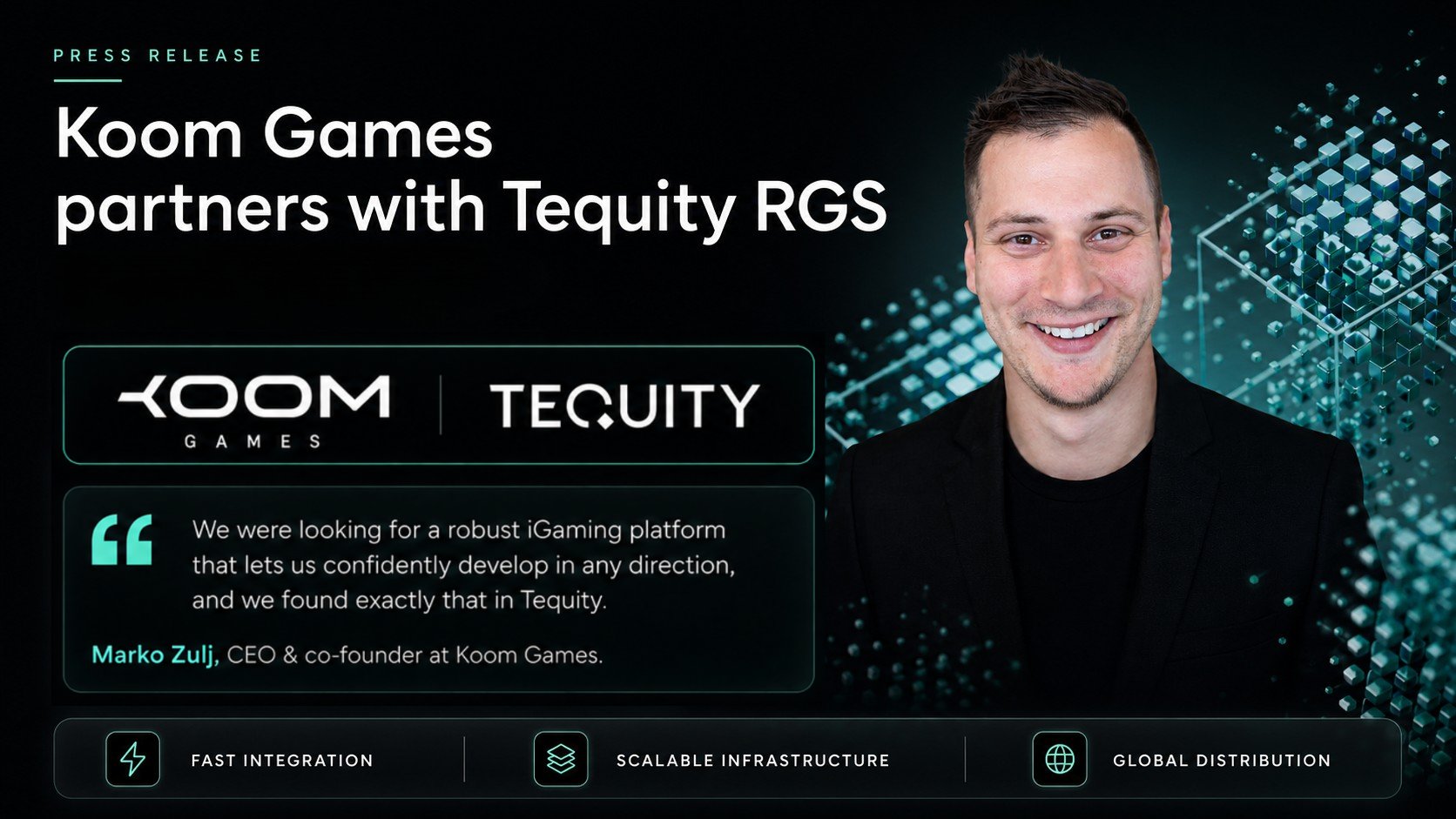
Tequity has agreed a Remote Gaming Server (RGS) deal with slot studio Koom Games, with the partnership announced on 14 July 2026. Koom Games will use Tequity’s licensed modular RGS to develop and roll out new titles for distribution to operators worldwide.
Under the agreement, Koom Games will use Tequity’s infrastructure to handle game delivery while keeping control of its creative and development roadmap. The studio said its approach is to build content closer to mobile and social gaming than traditional casino titles.
Tequity said it currently supports 31 RGS clients and manages more than 130 integrations across regulated markets. The company positioned the Koom Games deal as part of a wider run of commercial agreements with providers and operators.
Tanja Bergman, VP of Partnerships at Tequity, said: “Koom Games is a studio that is looming to enter the global market by making a big splash. The team’s dedication to creating content that is genuinely fresh is highly impressive. We are thrilled to offer the stable, high-performance environment needed to transform this creative vision into a market-leading reality.”
Marko Zulj, CEO & co-founder at Koom Games, said: “Whenever operators and aggregators ask us what category our games fit into, we actually struggle to give a traditional answer. Instead, we tell them, ‘you’ll need to try them, because you haven’t played this before’.
“Our games come with completely new mechanics, fresh math, and features built for social engagement. To scale such a vision and remain agile, we needed more than a reliable RGS — we were looking for a robust iGaming platform that lets us confidently develop in any direction, and we found exactly that in Tequity.”
The post Tequity signs Koom Games to its RGS platform appeared first on EE Gaming | Global iGaming & Tech Intelligence Hub.

-

 Compliance Updates7 days ago
Kasinohai Audit: Most Slots Could Be Affected by Finland’s Draft Gambling Rules
-
Latest News6 days ago
BetMakers Technology Group Selected to Distribute ATG Horse Racing Content Across Australia and New Zealand
-
Latest News7 days ago
Belatra signs cooperation deal to distribute slots via VeliGames
-
Compliance Updates7 days ago
Pernambuco court revokes Spribe’s interim relief in Aviator trademark dispute
-
Compliance Updates6 days ago
ACMA Warns MMA Fighter Jamie Mullarkey for Breaches of Online Gambling Laws
-
 Compliance Updates4 days ago
Arizona Department of Gaming Issues Cease-and-Desist Orders to Multiple Operators Linked to Underage Gambling and Illegal Activity
-
Canada6 days ago
Gaming Corps expands Entain partnership with major Canadian rollout
-
Latest News6 days ago
DEGEN Studios unleashes the Plague City chase